- Hitech City, Hyderabad
- Office Hours: 10:30 am - 7:30 pm
Home > Common GST Compliance Mistakes That Trigger Tax Notices in 2026
Preparing for the Next Phase of Transfer Pricing Compliance
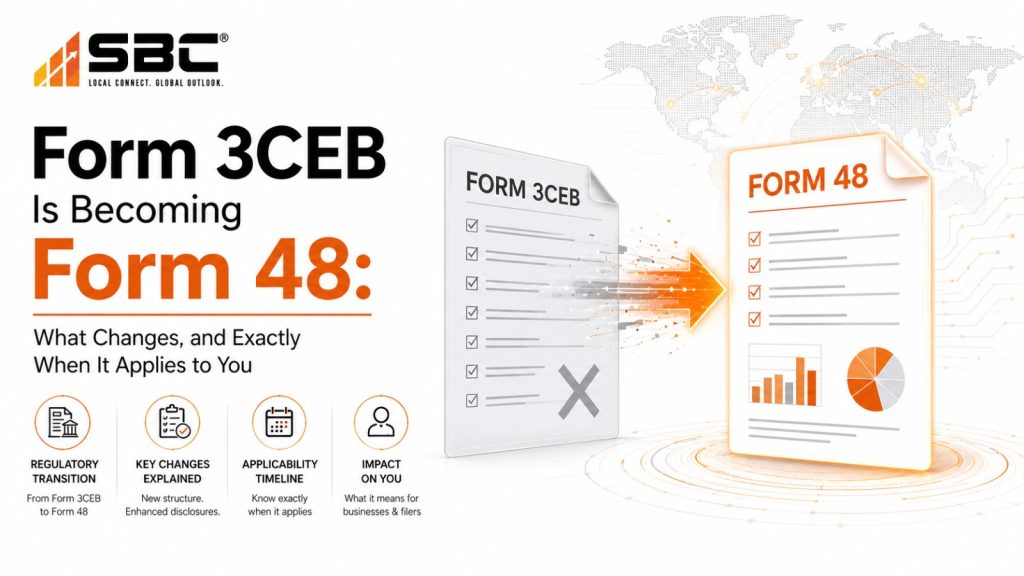
The introduction of the Income-tax Act, 2025 marks a significant development in India’s transfer pricing framework. Among the notable changes is the replacement of Form 3CEB with Form 48, introducing a more comprehensive reporting framework for transfer pricing compliance. This is especially relevant for businesses relying on Transfer Pricing Services in India to stay compliant through the transition.
While this change may appear to be a simple replacement of forms, it has far-reaching implications for businesses undertaking international transactions and specified domestic transactions. Form 48 requires taxpayers to provide more detailed information supporting their transfer pricing positions, making it essential for businesses to strengthen their documentation and compliance processes well in advance.
The transition also provides taxpayers with an opportunity to review their existing transfer pricing documentation and ensure they are prepared for the enhanced reporting requirements under the new law.
One of the most common questions among taxpayers is whether Form 48 is applicable for the current financial year.
The answer is straightforward.
| Financial Year | Applicable Form | Governing Law |
|---|---|---|
| FY 2025–26 | Form 3CEB | Section 92E of the Income-tax Act, 1961 |
| FY 2026–27 onwards | Form 48 | Section 172 of the Income-tax Act, 2025 read with Rule 85 of the Income-tax Rules, 2026 |
Accordingly, taxpayers filing their accountant report for FY 2025–26 will continue to furnish Form 3CEB. Form 48 is effectively applicable from FY 2026–27. Although businesses have one transition year before Form 48 becomes applicable, they should utilise this period to assess their transfer pricing documentation and reporting processes, as the new form requires significantly more detailed disclosures than its predecessor.
Why Was Form 48 Introduced?
The introduction of Form 48 is aimed at strengthening the quality and consistency of transfer pricing reporting.
While Form 3CEB primarily required the Chartered Accountant to certify the particulars of international transactions and specified domestic transactions, Form 48 adopts a more structured reporting approach by requiring taxpayers to disclose additional information supporting the arm’s length nature of such transactions.
The objective is to:
The transition therefore reflects the Government’s objective of making transfer pricing reporting more transparent, consistent and evidence-based.
The Income Tax Department has published an official Guidance Note on Form No. 48 detailing the reporting requirements directly.
Form 48 – A More Comprehensive Reporting Framework
The most significant change under Form 48 is not merely the reporting format but the extent of information that taxpayers will be required to maintain and disclose.
Unlike Form 3CEB, Form 48 places greater emphasis on the economic analysis supporting transfer pricing positions. Consequently, taxpayers should ensure that robust transfer pricing documentation is available before the reporting process begins.
Some of the additional information expected to be reported under Form 48 includes:
Accordingly, businesses can no longer treat benchmarking as a year-end exercise. The benchmarking study should be completed upfront so that the arm’s length margin and supporting analyses are readily available while preparing Form 48.
Documentation Readiness – Why Businesses Should Start Preparing Now
Although Form 48 is applicable from FY 2026–27, businesses should begin preparing during the current financial year to avoid last-minute compliance challenges.
To ensure a smooth transition, businesses should maintain the following documentation:
Preparing these documents in advance will help businesses respond efficiently to the enhanced disclosure requirements under Form 48.
How SBC Can Support Your Transition
The transition from Form 3CEB to Form 48 is more than a change in the reporting format—it requires businesses to revisit their transfer pricing documentation and ensure that all supporting analyses are available before the reporting process commences.
As a dedicated Transfer Pricing Consultant for businesses navigating this transition, SBC brings the following support:
At SBC, our Transfer Pricing professionals assist businesses in preparing for Form 48 by providing:
Our objective is to help businesses transition smoothly to the new reporting framework while ensuring that their transfer pricing documentation remains technically robust and audit-ready. For the complete regulatory breakdown — documentation requirements, benchmarking methods, and audit support — see our full guide: Transfer Pricing Services in India. Businesses managing GST and income tax compliance alongside transfer pricing can find related guidance through SBC’s GST Advisory Services.
For the complete regulatory breakdown — documentation requirements, benchmarking methods, and audit support — see our full guide: Transfer Pricing Services in India.
Key Takeaways
Conclusion
The transition from Form 3CEB to Form 48 represents an important step in the evolution of India’s transfer pricing compliance framework. While Form 3CEB remains applicable for FY 2025–26, businesses should utilise this transition year to strengthen their transfer pricing documentation, complete benchmarking analyses, and establish robust internal processes to meet the enhanced reporting requirements under Form 48.
Early preparation will not only facilitate seamless compliance but also help businesses minimise reporting risks and confidently address future transfer pricing assessments. Businesses managing GST and income tax compliance alongside transfer pricing can find related guidance through SBC’s GST Advisory Services. With the right planning and technical support, organisations can transform this regulatory change into an opportunity to strengthen their overall transfer pricing governance.
Q: Does e-invoicing apply to B2C (business-to-consumer) sales?
A: No, the core e-invoicing mandate applies to B2B supplies and exports. B2C invoices follow separate rules, including dynamic QR code requirements for certain businesses, but not IRN generation.
Q: What happens if my turnover drops below INR 5 crore next year?
A: The obligation doesn’t switch off. Once your aggregate turnover has crossed INR 5 crore in any year since 2017-18, e-invoicing remains mandatory going forward, regardless of later fluctuations.
Q: Which Invoice Registration Portal (IRP) should I use?
A: Several government-authorised IRPs are available, including NIC’s portal and other authorised providers. Most businesses use whichever IRP their accounting software or ERP integrates with directly.
Q: Is a 6-digit HSN code mandatory for e-invoices?
A: Businesses above INR 5 crore turnover are required to use a minimum 6-digit HSN code at the item level; businesses at or below that threshold can use 4-digit codes.
Q: Does this affect my GST return filing directly?
A: Yes, indirectly a missing or invalid IRN can create inconsistencies between your e-invoice data and your GSTR-1 filing, which is exactly the kind of mismatch GSTN’s automated systems are now built to catch quickly.
Q: What if I’m not sure whether I’ve crossed the threshold in a past year?
A: This is worth a proper reconciliation rather than a guess, aggregate turnover has to be checked across every GSTIN under your PAN, across every year since 2017-18, which is easy to get wrong without a documented review.
Verify your email address below to download the PDF