
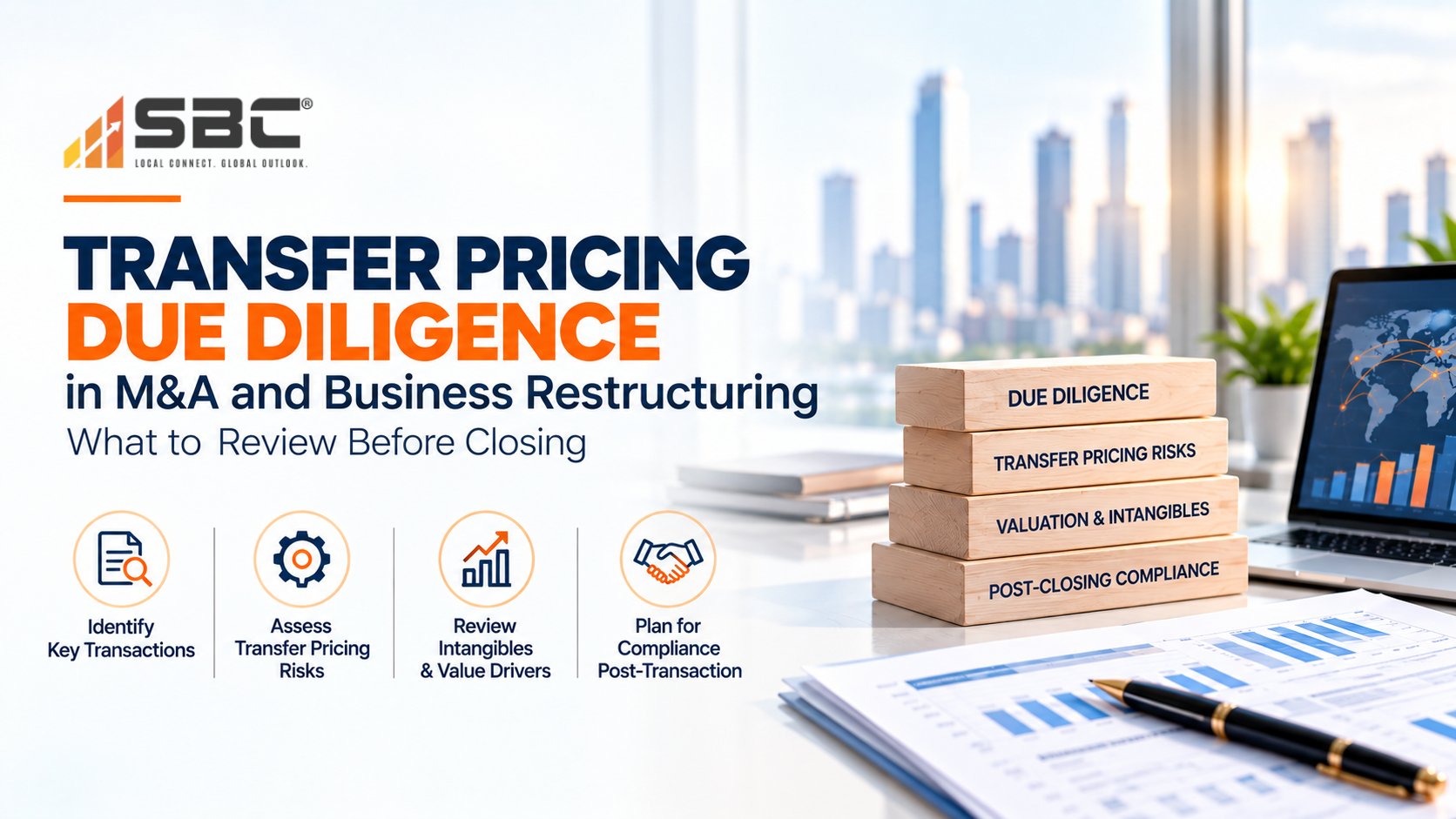
Transfer Pricing Due Diligence in M&A and Business Restructuring: What to Review Before Closing
M&A teams usually focus on purchase price, tax exposures, contracts and operational integration. Transfer pricing can sit quietly inside all four. The transaction may change ownership of IP, decision-making rights, supply chains, financing, distribution arrangements or functions. Those changes can alter the transfer pricing analysis even if nobody intended to “change transfer pricing”.
The important principle is that a restructuring should be analysed as a business event, not only as a change in legal ownership. Where functions, assets or risks move between associated enterprises, the tax consequences should be considered before the new model is implemented.
For the broader service scope, see SBC’s Transfer Pricing Services in India and use the article below for the specific issue covered here.
Where Transfer Pricing Appears in Diligence
Identify the Transactions That Will Change After Closing
Build a before-and-after transaction map. Examples include a distribution company becoming a contract manufacturer, a regional hub taking over procurement, an Indian company becoming an IP owner, or a captive centre taking on product-development responsibilities.
Each change should be evaluated against the functions, assets and risks of the entities before and after the transaction.
SBC’s business restructuring and exit charge article discusses why a restructuring can raise an exit-charge question when something of value moves between associated enterprises.
The key is to identify whether a profit-earning activity, asset or intangible right has actually moved and what an independent party would have required in the same position.
Due Diligence Questions Around Intangibles
Review trademarks, patents, software, know-how, customer relationships, domain names, proprietary processes and other rights.
Determine who owns them legally and who performs the economically significant functions associated with developing and exploiting them. The legal owner should not automatically be treated as the only party that creates or contributes to intangible value.
The OECD’s transfer pricing guidance on intangibles is useful for structuring this analysis, especially where a transaction transfers rights to use or exploit an intangible rather than the underlying legal title.
Open Transfer Pricing Positions Are a Deal Issue
A pending transfer pricing dispute can affect the buyer’s risk assessment, tax reserves, indemnities and post-closing integration.
The diligence team should ask:
- What tax years remain open?
- What transfer pricing positions are under examination?
- Are there recurring related-party transactions?
- Could a historical adjustment affect later years?
Where there is a litigation history, read the pleadings and orders, not just the summary in the diligence report.
The exact issue matters. A case involving comparable selection creates a different future risk from a case involving business characterisation or the deductibility of an intra-group charge.
Post-Closing Integration: The Forgotten Step
Once the deal closes, the new operating model needs a new transfer pricing governance process.
Update:
- Intercompany agreements
- Transaction mapping
- Functional analysis
- Pricing policies
- Accounting codes
- Reporting processes
If the group keeps old agreements for convenience, the documentation can start describing a business that no longer exists.
A Practical Transaction Checklist
| Area | Key Review |
|---|---|
| Transaction mapping | Identify related-party transactions and compare the pre- and post-closing transaction flows. |
| Functions, assets and risks | Assess how the functions, assets and risks of each entity will change after the transaction. |
| Intangibles | Review IP, brands, technology, customer relationships and other intangible rights. |
| Historical compliance | Review transfer pricing studies, filings, notices, adjustments, appeals and open disputes. |
| Agreements | Compare intercompany agreements with invoices, payment terms, service delivery and actual conduct. |
| Post-closing model | Design the transfer pricing policy, agreements and documentation for the new operating model. |
How SBC Fits into a Restructuring-Led Transfer Pricing Project
SBC’s Transfer Pricing service scope includes business restructuring, policy setting, documentation, valuation, complex intercompany transactions and dispute support.
The combination is relevant because M&A changes rarely arrive as one isolated tax question; they usually affect several parts of the transfer pricing model at once.
Practical Implementation Notes
Historical Compliance Is Only Half of the Review
A buyer should distinguish between whether the target filed the required documents and whether the underlying transfer pricing position is economically robust.
A compliant filing can still contain an outdated FAR analysis or a weak benchmarking set.
Review the Ownership of Intangibles
Business restructurings often involve IP, brands, technology, customer relationships or local marketing investments.
The diligence team should identify who owns the legal rights, who performs DEMPE-related functions and how the post-deal model will allocate returns.
Where relevant, the FAR analysis should be refreshed to reflect the actual operating model.
Model the First Day After Closing
A useful diligence exercise produces a post-closing transaction map, not just a historical risk list.
It should show the entities, flows, agreements, functions and pricing approach that will operate once the deal is implemented.
Check for Trapped Compliance Issues
Look for:
- Open notices
- Unresolved adjustments
- Unfiled reports
- Inconsistent transaction values
- Agreements that were never updated after earlier restructurings
These items can create work immediately after closing even if they were not visible in the headline tax position.
Coordinate Tax with Finance and Legal
Transfer pricing diligence is strongest when the tax analysis is integrated with the purchase agreement, financial model and operating-plan work.
That coordination helps management price known exposures and design the post-deal structure before implementation.
Further Practical Considerations
Review the Target’s Transaction Architecture
Build a diagram showing Indian entities, overseas related parties, flows of goods and services, financing, IP and shared costs.
This makes it easier to see where the acquisition or restructuring changes the existing transfer pricing model.
Review Agreements Against Invoices and Conduct
A signed agreement is useful evidence, but it should be tested against actual invoices, payment terms, service delivery and decision-making.
Gaps between paper and conduct can become post-closing remediation items.
Quantify the Exposure
Where possible, quantify the value of open adjustments, recurring transactions, disputed amounts, documentation gaps and potential restructuring costs.
Quantification helps management distinguish high-value issues from low-value housekeeping points.
Plan the First Compliance Cycle
The post-closing plan should identify who will own the transaction register, agreements, benchmarking, documentation and statutory filings.
The best time to assign those owners is before the new operating model begins.
Use the Diligence Report as an Operating-Model Document
The final report should not be a list of historic tax problems.
It should explain:
- What needs to change after closing
- Which agreements should be updated
- What benchmarking needs to be performed
- What evidence should be collected
Final Implementation Considerations
An M&A diligence timetable should place transfer pricing review before the operating model is finalised.
Early review allows tax to influence contract design and transaction sequencing rather than simply documenting a structure that has already been chosen.
Where a restructuring transfers functions, assets or risks, the team should document the commercial rationale as well as the tax analysis. Business evidence can be important in explaining why the group changed its model and what independent parties might have considered.
Post-closing agreements should be ready early. A common implementation failure is to approve the new structure but leave the intercompany contracts, pricing policy and transaction master data unchanged for several months.
Management should also assign a post-deal owner. Someone needs to monitor whether the business is operating as described in the transfer pricing analysis and escalate material deviations to tax.
What Finance Teams Should Review Before Closing
- Map related-party transactions and agreements for the entities entering the deal.
- Review historical TP studies, audit correspondence, adjustments and open disputes.
- Compare contractual functions and risks with actual conduct.
- Identify IP, financing, shared services and restructuring-related pricing issues.
- Assess whether any transfer of functions, assets or risks requires separate economic analysis.
- Design the post-closing TP policy, agreements and documentation before implementation.
Why Is Transfer Pricing Relevant in an M&A Transaction?
An acquisition or restructuring can change functions, assets, risks, intercompany flows and the tax position of the Indian entities.
Transfer pricing therefore needs to be considered alongside the wider commercial, financial, legal and tax diligence process.
Does Every Restructuring Create an Exit Charge?
It can, depending on the functions, assets, risks, rights and economic value transferred. The facts need to be analysed under the applicable transfer pricing framework.
A restructuring should therefore be reviewed based on what has actually changed between the associated enterprises rather than simply on the change in legal ownership.
Should Transfer Pricing Be Reviewed Before Closing?
Transfer pricing due diligence is most useful when it is performed before the transaction structure is locked.
A buyer or group reorganising its Indian operations should understand not only historical compliance, but also what functions, assets and risks will move after closing.
A restructuring can change the economic profile of an Indian entity even when the legal entity itself remains the same.
Start with the transaction map. Identify the Indian entities, their related-party flows, intercompany agreements, IP arrangements, financing, shared services and cost allocations.
Then compare the contractual structure with actual operations. The biggest issues often arise where the two no longer match—for example, an entity continues to be described as a routine service provider after it has taken on strategic decision-making or valuable local functions.
Next, review historical controversy and open exposures. Look at pending notices, adjustments, appeals, MAP or APA positions, secondary adjustments, penalties and unresolved documentation gaps.
These items can affect valuation, tax provisioning and the practical timetable for closing.
Finally, model the post-transaction transfer pricing position before signing.
The goal is not simply to document the structure after the fact. It is to test whether the proposed operating model can be supported by agreements, benchmarking and actual conduct from the first day after closing.
Frequently Asked Questions
Why should transfer pricing be part of M&A due diligence?
Because an acquisition or restructuring can change functions, assets, risks, intercompany flows and the tax position of the Indian entities.
What documents should a buyer request?
Transfer pricing studies, benchmarking files, intercompany agreements, filings, notices, assessment orders, appeals, APA/MAP material and relevant financial schedules are common starting points.
Can restructuring create an exit-charge issue?
It can, depending on the functions, assets, risks, rights and economic value transferred. The facts need to be analysed under the applicable transfer pricing framework.
Should the post-deal benchmarking be prepared before closing?
Where the operating model is sufficiently defined, preparing the analysis before implementation can help align agreements, pricing and actual conduct from the start.
How does transfer pricing affect purchase price or valuation?
Open adjustments, uncertain positions and future restructuring costs can affect tax provisions and transaction economics, so they may be relevant to financial due diligence.
Where can I read more about restructuring and transfer pricing?
SBC’s restructuring-focused transfer pricing content can be linked from this article, alongside the main Transfer Pricing Services in India page.
Conclusion
Transfer pricing due diligence is most useful when it is performed before the transaction structure is locked.
A buyer or group reorganising its Indian operations should understand not only historical compliance, but also what functions, assets and risks will move after closing. A restructuring can change the economic profile of an Indian entity even when the legal entity itself remains the same.
Start with the transaction map, review the historical transfer pricing position, test agreements against actual conduct, identify changes in functions, assets and risks, and model the post-transaction transfer pricing position before implementation.
For the wider commercial and compliance picture, SBC’s Transfer Pricing Services in India brings the individual issue back into the broader transfer pricing workflow—compliance, documentation, benchmarking, advisory, controversy support and transaction-specific analysis.
Talk to SBC: If the issue discussed in this article is part of a wider Indian transfer pricing position, use the Transfer Pricing Services in India page as the main practice reference.