
CategoriesSBC

Virtual CFO Services in India — Complete Guide to Outsourced Financial Leadership

India Union Budget 2026-27

Home > Virtual CFO Services in India — Complete Guide to Outsourced Financial Leadership

vcfo-services

Quick Answer: A Virtual CFO is an experienced financial leader who provides CFO-level strategy, reporting, and oversight to a business on a part-time, retainer, or project basis — without the cost of a full-time hire. This typically covers financial planning, MIS reporting, fundraising support, cash flow management, and compliance oversight for startups, SMEs, and growth-stage companies in India. SBC provides this as an ongoing, embedded function rather than a one-off consulting engagement.

Every founder eventually hits the same wall: the business has outgrown a bookkeeper, but it isn’t quite ready — financially or budget-wise — for a full-time CFO on the Financial and payroll. That gap has widened considerably in the last few years. Startups are raising rounds faster and needing investor-grade reporting earlier, SMEs are dealing with tighter working capital cycles and more demanding lenders, and even established businesses are realising that a part-time finance function run on spreadsheets doesn’t scale once revenue crosses a certain threshold. This is exactly the gap Virtual CFO Services in India were built to fill — senior financial leadership, delivered flexibly, without the fixed overhead of a full executive hire.

SBC works with founders and finance teams across India and globally, including Hyderabad, Mumbai, Pune, and Dubai, who are at exactly this inflection point: too big for informal bookkeeping, not yet ready to commit to a full-time CFO salary. This guide walks through what a Virtual CFO actually does, how engagements are typically structured, which businesses benefit most, and where our virtual CFO consultant services can plug directly into your existing team. Think of this as the landscape view — the specifics of your situation are best worked out in an actual conversation with our team.

  • What Is a Virtual CFO?
  • Why Businesses in India Are Choosing Virtual CFO Services
  • What a Virtual CFO Actually Does
  • Services Covered
  • Virtual CFO Engagement Models
  • Outsourced CFO Services India
  • Financial Planning & Analysis Services India
  • Fundraising & Investor Reporting Advisory Services
  • Virtual CFO Services for Startups
  • Industries We Serve
  • Virtual CFO Services in Hyderabad, India
  • Virtual CFO Consultant India
  • Why Choose SBC
  • Our Engagement Process

What Is a Virtual CFO?

Strip away the title and a Virtual CFO is really just this: someone who thinks about your business’s money the way a full-time finance executive would, without sitting in your office five days a week.

That means real financial strategy — not just closing the books each month, but reading what the numbers are telling you about runway, margins, and risk, and acting on it before it becomes a problem. A bookkeeper records what happened. An accountant makes sure it’s compliant. A Virtual CFO does both of those jobs justice and then goes a step further — forecasting what’s coming, flagging where cash is getting tight, and making sure the story your numbers tell is one investors, lenders, and your own leadership team can actually trust.

The “virtual” part is about the delivery model, not depth of involvement. Engagements typically run a few days a month to a few days a week, scaled to what the business actually needs at its current stage — which is precisely why it works for companies that have outgrown basic bookkeeping but aren’t yet at the size (or budget) where a full-time CFO makes sense.

Why Businesses in India Are Choosing Virtual CFO Services

The shift toward Virtual CFO services isn’t a fad — it’s a fairly direct response to how business conditions have changed:

  • Fundraising has gotten more numbers-driven. Investors expect clean MIS reporting, defensible unit economics, and a credible financial narrative well before a term sheet is on the table — not something to figure out during due diligence.
  • The cost math genuinely favours it. A full-time CFO in India carries a significant fixed salary commitment; a Virtual CFO delivers senior-level input at a fraction of that cost, scaled to actual need.
  • Compliance has gotten heavier, not lighter. Between GST, FEMA, PF, ESI, PT, ROC filings, income tax, and (for many businesses now) cross-border transactions, the finance function needs someone who can hold the compliance calendar and the strategic picture at the same time.
  • Growth exposes gaps fast. A finance process that worked fine at 2 crore in revenue often breaks down completely at 20 crore — and by the time that’s obvious, the damage (a missed forecast, a cash crunch, a messy board update) has usually already happened.

For most businesses, the real trigger isn’t a single crisis — it’s the slow realisation that financial decisions are being made on gut feel rather than reliable numbers, and that gap only gets more expensive to close the longer it’s left alone.

What a Virtual CFO Actually Does

This is where a lot of confusion creeps in, because “Virtual CFO” gets used loosely. In practice, the role typically covers four connected layers:

  • Financial reporting and MIS — monthly/quarterly management reports that actually get read and used, not just filed away.
  • Cash flow and working capital management — staying ahead of cash crunches rather than reacting to them.
  • Budgeting, forecasting, and scenario planning — building a forward-looking financial model, not just a backward-looking report.
  • Board and investor reporting — translating the numbers into a narrative your board or investors can act on.
  • Compliance reporting- roports and filings of the compliance requirements under the different laws prevailing in India

The common thread across all four is that a Virtual CFO is forward-looking by design. Where a traditional accounting function tells you what already happened, this role exists to help you see what’s coming and make decisions early enough for it to matter.

Services Covered

Virtual CFO needs look different depending on where a business is in its growth journey:

Business Stage Core Focus Typical Services
Early-Stage / Pre-Seed to Seed
Financial hygiene, fundraising readiness
Basic MIS setup, investor reporting templates, burn-rate tracking
Growth-Stage
Scaling operations, tighter forecasting
Budgeting, working capital management, board reporting, systems/ERP oversight
Pre-IPO / Mature SME
Governance, audit-readiness, complex reporting
Full MIS suite, compliance oversight, M&A and valuation coordination, investor relations support

The right scope of engagement follows the business, not a fixed template — a seed-stage startup and a pre-IPO company need very different things from the same underlying function.


Virtual CFO Engagement Models

Just as a benchmarking method needs to fit the transaction, a Virtual CFO engagement needs to fit how your business actually operates:

Model Best Suited For
Project-Based
A specific deliverable — fundraising readiness, a financial model rebuild, due diligence prep
Part-Time Retainer
Ongoing monthly reporting and advisory without daily involvement — the most common model for growth-stage companies
Full Outsourced Finance Function
Businesses that want the entire finance operation — bookkeeping, reporting, compliance, strategy — run externally, end to end

Most clients start with a part-time retainer and adjust scope as the business grows — which is really the point of the model: it flexes with you, rather than locking you into a fixed headcount decision.

Outsourced CFO Services in India

Day-to-day, Outsourced CFO Services India cover the operational backbone of the finance function — the work that has to happen reliably every month, regardless of whatever else is going on:

  • Monthly book closure oversight and accuracy checks
  • MIS report preparation and review
  • Vendor payments and accounts receivable/payable management
  • Coordination with your existing accounting or bookkeeping team, rather than replacing it

This is often the entry point for businesses new to the model — get the operational layer running cleanly first, then layer in the more strategic pieces as trust and scope build.

Financial Planning & Analysis Services in India

Once the operational reporting is solid, the real value of Financial Planning & Analysis Services India shows up in the forward-looking work:

  • Annual and rolling budgets, built to reflect how the business actually spends, not a generic template
  • Rolling cash flow forecasts, updated as assumptions change
  • Unit economics tracking — CAC, LTV, contribution margin, whatever the metrics that actually drive your specific business model are
  • Burn-rate monitoring for funded businesses managing runway against milestones

Good FP&A work is less about producing more reports and more about producing the right few numbers that leadership actually checks before making a decision.

Fundraising & Investor Reporting Advisory Services

Raising a round changes what “good financial reporting” means almost overnight. Our Fundraising & Investor Reporting Advisory Services are built around exactly that shift:

  • Due diligence readiness — making sure the data room holds up before an investor’s team starts asking questions
  • Investor-grade MIS and board decks that tell a consistent, defensible story quarter over quarter
  • Coordination with valuation and M&A specialists where a raise involves more complex structuring
  • Post-raise investor reporting cadence, so the relationship doesn’t go quiet the moment the round closes

A surprising number of fundraising delays trace back to financial reporting that wasn’t investor-ready rather than the business fundamentals themselves — this is the piece designed to remove that risk.

Virtual CFO Services for Startups

Startups have a distinct set of needs from established SMEs, and Virtual CFO Services for Startups are shaped around the realities of that stage specifically:

  • Setting up financial hygiene and reporting systems from scratch, often for founders with no in-house finance background
  • Building the first real financial model — one that can survive investor scrutiny, not just an internal spreadsheet
  • Cap table awareness and coordination with legal counsel around fundraising documentation
  • Early compliance groundwork (GST registration, ROC filings, statutory basics) so it’s never playing catch-up later

For a founder juggling product, hiring, and fundraising simultaneously, this function is frequently the difference between a smooth raise and a scramble two weeks before a term sheet.

Industries We Serve

Financial priorities shift meaningfully by sector:

  • Technology & SaaS — recurring revenue metrics, unit economics, and investor reporting cadence
  • Pharmaceuticals & Manufacturing — working capital cycles, inventory financing, and cost structure analysis
  • Real Estate & Infrastructure — project-based cash flow modelling and lender reporting
  • Financial Services — regulatory reporting alongside standard MIS and board reporting needs

A SaaS business obsessing over churn and CAC payback needs a very different monthly report than a manufacturer managing raw material financing — the underlying discipline is the same, but what gets tracked and reported changes completely.

Virtual CFO Services Hyderabad

Our Virtual CFO practice is based in Hyderabad, with dedicated teams also working from our Mumbai and Pune offices and close coordination with our Dubai team for businesses managing India-UAE finances. Whether your business is headquartered in Hyderabad or works with our surrounding regional teams, the reporting cadence and depth of involvement stay consistent — the only thing that changes is how often we’re in the room versus on a call. You can find office details on our contact page.

Virtual CFO Consultant India

Pulling all of the above together, here’s what engaging a Virtual CFO Consultant India businesses can rely on for the long term actually looks like end to end:

  • Monthly MIS reporting and financial close oversight
  • Budgeting, forecasting, and rolling cash flow management
  • Board and investor reporting support
  • Fundraising readiness and due diligence coordination
  • Compliance oversight in coordination with your tax and secretarial functions
  • Ongoing financial strategy input as the business scales

Whether you need someone to own the entire finance function or simply provide senior oversight over an existing internal team, this is the starting point for that conversation.

Why Choose SBC

Financial leadership advice is only as good as the experience behind it:

  • Our Virtual CFO practice is led by the Founder & CEO, alongside a team carrying Big Four consulting backgrounds
  • Direct experience supporting fundraising rounds, not just monthly reporting — we understand what investors actually scrutinise
  • Real UAE presence via our Dubai office, useful for businesses managing cross-border finances alongside domestic operations
  • 250+ professionals across our India, UAE, UK and US offices, so the engagement can scale in scope without switching providers

We’d rather demonstrate this through specific engagement examples relevant to your stage and sector than through generic claims — happy to walk you through that in a conversation.

Our Engagement Process

  1. Initial Assessment — understanding your current financial reporting, team structure, and immediate priorities
  2. Gap Review — identifying where reporting, compliance, or forecasting is falling short of what the business now needs
  3. Scope & Model Selection agreeing the right engagement model (project, retainer, or full outsourced function)
  4. Systems & Reporting Setup — building or refining MIS, budgeting, and forecasting frameworks
  5. Ongoing Advisory — regular reporting cadence, board/investor support, and strategic input as the business evolves
  6. Scale-Up Support — adjusting scope as fundraising, growth, or compliance needs change
  7. Compliance — ensuring timely filings and adherence to statutory requirements under applicable laws, minimizing regulatory risk

If your monthly reporting still feels more like bookkeeping than financial strategy, or a fundraising conversation is coming up faster than your reporting is ready for, that’s usually the moment to talk to us. Get in touch with our Virtual CFO team for a practical assessment of where your finance function stands today.

Virtual CFO Services in India work best as an ongoing relationship, not a one-time fix — the value compounds as your reporting, forecasting, and compliance all mature together over successive quarters. Whether you’re a founder preparing for your next round, an SME finance head trying to get ahead of cash flow instead of reacting to it, or a growth-stage business that has simply outgrown its current setup, our team is a solid place to start that conversation.

×

Verify Email

Verify your email address below to download the PDF

Please wait while we verify your email.

CONTACT US

Name
=

RELATED POSTS

CategoriesSBC Transfer Pricing

Transfer Pricing Services in India — Complete Regulatory & Advisory Guide

India Union Budget 2026-27

Home > Transfer Pricing Services in India — Complete Regulatory & Advisory Guide

Transfer Pricing Services in India

Quick Answer: Transfer pricing refers to the rules and pricing methods that govern transactions between related entities across borders, ensuring they reflect market value under the arm’s length principle. This includes compliance, documentation, benchmarking, and dispute resolution for businesses in India with cross-border or specified domestic related-party transactions. SBC helps companies stay compliant while managing tax risk across jurisdictions.

India’s tax landscape has never moved faster, and demand for reliable Transfer Pricing Services in India has grown right alongside it. Between tightening CBDT scrutiny, the global rollout of BEPS Action 13, and the early tremors of OECD Pillar Two reshaping how multinational profits get taxed, cross-border business in India today runs on a very different rulebook than it did even five years ago. Add to that the growing volume of India-UAE trade, the rise of GCCs (Global Capability Centres) setting up shop across Hyderabad, Pune, and Mumbai, and an income tax department that has made related-party transactions one of its top audit priorities — and it’s clear why transfer pricing has quietly become one of the highest-stakes compliance areas for any business with group entities, subsidiaries, or cross-border dealings.

This is exactly the terrain SBC operates in every day. As a multidisciplinary tax, financial, and business consulting firm with teams across Hyderabad India, Mumbai, Pune, and Dubai, we work with startups, SMEs, and multinational groups to get their transfer pricing right — not just compliant on paper, but genuinely defensible if the tax department comes asking. This guide walks through what transfer pricing means in the Indian context, how the regulatory framework actually works, which transactions and methods apply, and where our transfer pricing consultant services in India can step in to keep your business audit-ready. Consider it a map of the terrain — for the turn-by-turn navigation, that’s what a conversation with our team is for.

Jump to a section:

  • What Is Transfer Pricing?
  • Why It Matters for Businesses in India
  • Legal & Regulatory Framework
  • Transactions Covered
  • Transfer Pricing Methods
  • Transfer Pricing Documentation Services
  • Transfer Pricing Compliance Services in India
  • Cross Border Transaction Advisory Services
  • Industries We Serve
  • Where We Operate
  • Transfer Pricing Audit Support & Dispute Resolution
  • Our Transfer Pricing Consultant Services
  • Why Choose SBC
  • Our Engagement Process

What Is Transfer Pricing?

Strip away the jargon and transfer pricing is really about one question: when two related companies do business with each other, is the price fair?

If your Indian subsidiary sells software services to its US parent, or your Dubai entity buys raw materials from its Hyderabad group company, tax authorities want to see that the price charged mirrors what two unrelated companies would have agreed to in the open market. That benchmark is called the arm’s length principle, and it sits at the heart of every transfer pricing rule in India and globally.

Why does it matter so much? Because related companies could, in theory, shift profits to whichever country taxes them the least — simply by adjusting internal prices. Transfer pricing regulations exist to stop exactly that, and India’s tax department enforces them with real intensity.

Why Transfer Pricing Matters for Businesses in India

India has one of the more aggressive transfer pricing enforcement regimes globally, and the numbers back that up — TP audits routinely result in some of the highest tax adjustment values across all assessment categories. A handful of reasons this matters right now, not just in theory:

  • Penalty exposure is real. Non-compliance or inadequate documentation can trigger penalties on top of the tax adjustment itself. 
  • Global rules are converging. BEPS Action 13’s three-tiered documentation approach (Master File, Local File, Country-by-Country Report) means Indian entities of multinational groups now face reporting obligations that stretch well beyond national borders.
  • OECD Pillar Two is changing the math. As global minimum tax rules take effect, how profits are allocated between related entities is under more scrutiny than ever.
  • Cross-border activity is accelerating. More Indian companies are setting up UAE entities, and more global groups are routing operations through India — every one of those relationships needs a defensible pricing policy.

For a business owner or CFO, the practical takeaway is simple: transfer pricing isn’t a once-a-year filing exercise. It’s an ongoing risk area that needs a proactive strategy, not a reactive scramble each assessment year.

There’s also a strategic upside worth mentioning, and it’s one businesses often overlook. Getting transfer pricing right isn’t just about avoiding penalties — a well-documented, defensible pricing policy gives your finance team genuine clarity on intra-group profitability, makes due diligence far smoother during fundraising or M&A, and removes a recurring source of uncertainty from your annual tax position. Businesses that treat transfer pricing as a strategic function, not just a compliance line item, tend to spend a lot less time firefighting during assessment season.

Legal & Regulatory Framework

Transfer pricing in India is governed primarily under the Income Tax Act, with detailed procedural requirements laid out in the Income Tax Rules — most notably Rule 10D, which prescribes the documentation every taxpayer must maintain to support their related-party pricing.

A few structural elements worth understanding:

  • CBDT’s risk-based selection approach means not every taxpayer with related-party transactions gets picked for scrutiny — cases are selected based on risk parameters, transaction value, and industry patterns. That said, “lower risk of selection” is not the same as “no obligation to document.”
  • Accountant’s certification (Form 3CEB) is mandatory for taxpayers with specified international or domestic related-party transactions above prescribed thresholds, and needs to be filed alongside the income tax return.
  • Safe Harbour Rules offer certain categories of taxpayers a simplified compliance route, provided their margins fall within prescribed thresholds — worth exploring if your transaction profile qualifies.

This framework is deliberately layered — practical experience navigating CBDT’s approach, not just the bare text of the law, is what separates a compliant filing from a genuinely defensible one.

It’s also worth understanding how assessments actually unfold in practice. Once a case is selected for scrutiny, the Assessing Officer typically refers the transfer pricing aspects to a Transfer Pricing Officer (TPO), who examines whether the transaction pricing and the supporting benchmarking study hold up. This is precisely where documentation quality decides outcomes — a benchmarking study built on weak comparables or an outdated functional analysis rarely survives that level of examination, no matter how well-intentioned the original filing was. The regulatory framework isn’t just something to comply with once a year; it’s the lens every future assessment will be viewed through, which is why getting the underlying documentation right the first time saves considerable time and cost later.

Transactions Covered

Indian transfer pricing regulations apply to two broad categories of transactions:

Category Examples Applies To
International Transactions
Sale/purchase of goods, provision of services, royalty/licensing, cost allocation, intra-group financing, guarantees
Any transaction between an Indian entity and its associated enterprise located outside India
Specified Domestic Transactions (SDTs)
Transactions between domestic related parties where one enjoys profit-linked tax deductions or exemptions
Domestic group companies above prescribed transaction-value thresholds

Both categories require arm’s length pricing, contemporaneous documentation, and (where applicable) Form 3CEB certification.

Transfer Pricing Methods

The Income Tax Act prescribes specific methods to determine whether a related-party transaction meets the arm’s length standard. The right method depends on transaction type, data availability, and functional profile:

Method Best Suited For
CUP (Comparable Uncontrolled Price)
Transactions with a direct comparable market price — commodities, standardised services
RPM (Resale Price Method)
Distribution and resale transactions with minimal value addition
CPM (Cost Plus Method)
Manufacturing or service transactions where cost-based markup is the norm
PSM (Profit Split Method)
Highly integrated transactions where both parties contribute unique value (e.g., joint IP development)
TNMM (Transactional Net Margin Method)
The most widely used method in India — applicable where reliable comparables at the net margin level exist

Choosing the right method — and defending that choice with a solid benchmarking study — is often where transfer pricing cases are won or lost at the assessment stage.

Transfer Pricing Documentation Services

Good documentation isn’t paperwork for its own sake — it’s your primary line of defence if the tax department ever asks questions. Our transfer pricing documentation services in India are built around the three-tiered BEPS framework:

  • Master File — group-wide information on the multinational’s business, intangibles, financing arrangements, and financial/tax positions.
  • Local File — entity-specific documentation covering the Indian entity’s related-party transactions, functional analysis, and benchmarking support.
  • Country-by-Country Report (CbCR) — applicable to large multinational groups above the prescribed consolidated revenue threshold, detailing revenue, profit, tax paid, and economic activity by jurisdiction.
  • Form 3CEB Filing — the accountant’s certificate that must accompany the income tax return for entities with reportable transactions.

We build documentation that’s ready before the deadline pressure hits — not assembled retroactively once a notice arrives.

One distinction that trips up a lot of businesses: documentation isn’t just about having the right files in a folder. The Master File and Local File need to genuinely reflect how the business operates — its functional profile, the risks each entity actually bears, and the assets it genuinely owns — not a generic template repeated across group entities. Tax authorities are increasingly good at spotting documentation that reads like a copy-paste exercise versus documentation that reflects real operational substance. That distinction alone is often the difference between a filing that holds up under scrutiny and one that doesn’t.

Transfer Pricing Compliance Services in India

Transfer pricing compliance in India runs on a fairly unforgiving calendar — documentation needs to be contemporaneous, not prepared after the fact, and certification deadlines are strict. Our Transfer Pricing Compliance Services India cover:

  • Ongoing compliance calendar tracking, aligned to your specific filing obligations
  • Contemporaneous documentation maintenance (not year-end reconstruction)
  • Form 3CEB accountant’s certification
  • Coordination with your existing finance and audit teams so compliance doesn’t sit in a silo

If you want the full picture of upcoming statutory deadlines across tax, secretarial, and compliance obligations, our Compliance Calendar is a useful companion resource alongside this guide.

Cross Border Transaction Advisory Services

With Indian businesses expanding into the UAE, and global groups routing structures through India, our Cross Border Transaction Advisory Services have become one of the most requested parts of our transfer pricing practice. This typically covers:

  • Structuring India-UAE transactions to be both commercially sound and defensible under both jurisdictions’ rules
  • Advising on intra-group financing, royalty, and management fee arrangements across borders
  • Coordinating transfer pricing positions with broader international tax planning

This work sits close to our International Tax Advisory Services India offering, and the two are frequently handled by the same team for clients with genuinely global structures — since a transfer pricing position rarely stands alone from the wider international tax strategy behind it. For businesses expanding beyond a single jurisdiction, treating transfer pricing and International Tax Advisory Services India as one coordinated exercise, rather than two separate workstreams, tends to produce a far more defensible outcome.

Industries We Serve

Transfer pricing risk doesn’t look the same across sectors. We work across:

  • Technology — IP licensing, R&D cost-sharing, and GCC/captive service structures
  • Pharmaceuticals — contract manufacturing arrangements, royalty structures, and R&D cost allocation
  • Manufacturing — intra-group supply chains, toll manufacturing, and comparable pricing benchmarks
  • Infrastructure & Real Estate — project financing structures and related-party service arrangements
  • Financial Services — intra-group financing, guarantees, and treasury function pricing

Each of these carries its own benchmarking challenges, and our approach adjusts accordingly rather than applying a one-size template. A GCC providing back-office services to its US or European parent, for instance, faces an entirely different set of benchmarking questions than a pharmaceutical company licensing IP to a group manufacturing entity — and treating them the same way is usually where documentation starts to fall apart under scrutiny.

Where We Operate

Our transfer pricing practice is anchored in Hyderabad, with dedicated teams also working out of our Mumbai and Pune offices, and close coordination with our Dubai team for India-UAE structuring. Wherever your business is headquartered, our surrounding regional teams are positioned to support both the advisory and compliance side of your transfer pricing needs. You can find office details on our contact page.

Transfer Pricing Audit Support & Dispute Resolution

Even the most carefully prepared documentation can invite scrutiny — and when it does, how you respond matters as much as the documentation itself. Our transfer pricing audit support covers the full dispute lifecycle:

  • TPO (Transfer Pricing Officer) proceedings — representation and response drafting during the assessment
  • Dispute Resolution Panel (DRP) — objection filing and representation where the TPO’s adjustment is contested
  • Appeals — support through CIT(A) and Tribunal stages where required
  • Advance Pricing Agreements (APA) — negotiating upfront certainty on pricing methodology for future years
  • Mutual Agreement Procedure (MAP) — resolving double-taxation disputes through India’s treaty network
  • Safe Harbour applications — where eligible, a faster route to certainty for specific transaction categories

Having represented clients across each of these stages, our approach is built on knowing not just the law, but how a given assessment officer or panel is likely to read a specific fact pattern.

Timing matters more than most businesses realise here. An APA, for example, can take a couple of years to negotiate but delivers multi-year certainty once concluded — which makes it a very different tool from a MAP filing, which resolves an existing dispute rather than preventing a future one. Part of our role is helping clients pick the right mechanism for their situation rather than defaulting to litigation as the first response every time a TPO adjustment lands.

Our Transfer Pricing Consultant Services

Businesses looking for a Transfer Pricing Consultant India teams can rely on for both routine compliance and complex disputes usually need more than a one-off filing service — they need a partner who understands their group structure end to end. Here’s the full scope of how our transfer pricing consultants in India support businesses:

  • Transfer pricing benchmarking studies using reliable, defensible comparable sets
  • Master File, Local File, and CbCR documentation
  • Form 3CEB certification and filing
  • Cross-border and domestic related-party transaction structuring
  • APA filing and MAP representation
  • TPO audit response and DRP/appeal representation
  • Ongoing transfer pricing risk assessment as your business and group structure evolves

Whether you need a one-time benchmarking study or an ongoing transfer pricing advisor embedded alongside your finance team, this is where that conversation starts.

              Speak to a Transfer Pricing Consultant  →  steadfastconsultants.in/contact-us


Why Choose SBC

Transfer pricing advice is only as good as the people behind it, and that’s where we’d rather let substance do the talking:

  • Our transfer pricing practice is led by the Founder & CEO, along with a team carrying Big Four consulting backgrounds
  • A genuine litigation track record — not just documentation support, but representation through TPO, DRP, and appellate stages
  • Real UAE presence via our Dubai office, not a referral partnership, for businesses navigating India-UAE structures
  • 250+ professionals across our India, UAE, and US offices, giving clients a bench that scales with their needs

We’d rather be judged on outcomes than adjectives — happy to walk you through specific engagement examples relevant to your industry.

Our Engagement Process

  1. Initial Assessment — understanding your group structure, related-party transactions, and current documentation status
  2. Risk & Gap Review — identifying exposure areas and documentation gaps against Rule 10D requirements
  3. Benchmarking & Documentation — building or updating Master File, Local File, and benchmarking studies
  4. Compliance Filing — Form 3CEB certification and return filing support
  5. Ongoing Advisory — ongoing monitoring as transactions, group structure, or regulations change
  6. Audit & Dispute Support — representation if and when TPO scrutiny arises

If any part of your related-party transactions — international or domestic — hasn’t been reviewed in the last year, that’s usually the first sign it’s worth a conversation. Get in touch with our transfer pricing team for a practical assessment of where you stand.

Transfer pricing in India isn’t a box-ticking exercise — it’s a genuinely high-stakes compliance area that rewards businesses who treat it proactively rather than reactively. From documentation and benchmarking to audit representation and cross-border structuring, transfer pricing services in India work best as an ongoing relationship, not a once-a-year filing. If you’re building out a group structure, expanding into the UAE, or simply haven’t had your existing documentation reviewed recently, our team is a good place to start that conversation.

×

Verify Email

Verify your email address below to download the PDF

Please wait while we verify your email.

CONTACT US

Name
=

RELATED POSTS

CategoriesGST SBC

Common GST Compliance Mistakes That Trigger Tax Notices in 2026

India Union Budget 2026-27

Home > Common GST Compliance Mistakes That Trigger Tax Notices in 2026

Common GST Compliance Mistakes That Trigger Tax Notices in 2026 (And How the AI-Matching System Catches Them)

GST compliance in India no longer depends on whether a tax officer happens to review your filings. The GSTN portal now crossmatches your GSTR-1, GSTR-3B and GSTR-2B data against e-invoices, banking records and income tax filings in real time. A mistake that might have gone unnoticed for months a few years ago can now trigger a system-generated notice within days, requiring no human intervention. For businesses operating across multiple states or scaling quickly enough that manual reconciliation can’t keep pace, this shift changes what “staying compliant” actually means.

The good news is that most of the mistakes behind these notices are entirely avoidable once you know what to look for. In this guide, we’ll walk through the most common GST compliance errors we see businesses make, explain exactly how the automated matching system catches each one, and show you which notice type each mistake typically leads to so you can fix the gap before it becomes a compliance problem.

Why GST Mistakes Get Caught Faster Than Ever in 2026?

The GST system has moved from periodic manual scrutiny to continuous automated validation. Every return you file is checked against multiple data sources simultaneously: your outward supplies in GSTR-1 against the tax paid in GSTR-3B, your Input Tax Credit claims against your suppliers’ GSTR-2B filings, your e-invoice IRN data against your reported turnover, and increasingly, your GST records against your income tax and banking data.

In practice, this means the GSTN portal doesn’t need an officer to decide to investigate you. The moment a discrepancy crosses a threshold, the system flags it and can issue a notice automatically. This is exactly why understanding the mistakes below and fixing them at the source matters more in 2026 than it ever has before.

Nine (9) Common GST Compliance Mistakes That Trigger Notices

  1. GSTR-1 vs. GSTR-3B mismatches: Reporting different sales figures in your outward supply return (GSTR-1) than the tax you actually pay in GSTR-3B is one of the fastest ways to trigger scrutiny. This often happens innocently, a sales return recorded in your books one month but reflected in GSTR-1 the next but the system doesn’t distinguish intent from timing gaps.

Why it gets caught: the GSTN portal reconciles these two returns automatically every cycle.

Where it leads: this is the classic trigger for an ASMT-10 scrutiny notice, which requires a reply within approximately 15 to 30 days.

  1. Claiming ITC without reconciling GSTR-2B: Many businesses still claim Input Tax Credit based on their own purchase register rather than what appears in GSTR-2B. Following the introduction of the Invoice Management System (IMS) during the year 2024-2025, the acceptance, rejection or pending status of invoices and Credit Notes must be actively managed to streamline and generate your valid GSTR-2B. If your supplier delays uploading an invoice or enters your GSTIN incorrectly, that credit simply won’t reflect on your side, regardless of whether you genuinely paid the tax.

Why it gets caught: ITC claims are validated against supplier-side filings, not your internal records.

Where it leads: an automated demand for credit reversal, often with 18–24% interest depending on how the discrepancy is classified.

  1. Incorrect or outdated HSN/SAC codes: Since the GST 2.0 rate restructuring took effect from September 2025, most goods and services now fall under a simplified three-rate structure of 5%, 18%, or 40%. Businesses still using pre-restructuring codes or rates risk under- or over-charging tax without realizing it.

Why it gets caught: the system performs sectoral rate benchmarking using HSN-level data.

Where it leads: a demand notice for the tax shortfall plus interest, and in repeated cases, closer scrutiny of your entire invoicing pattern.

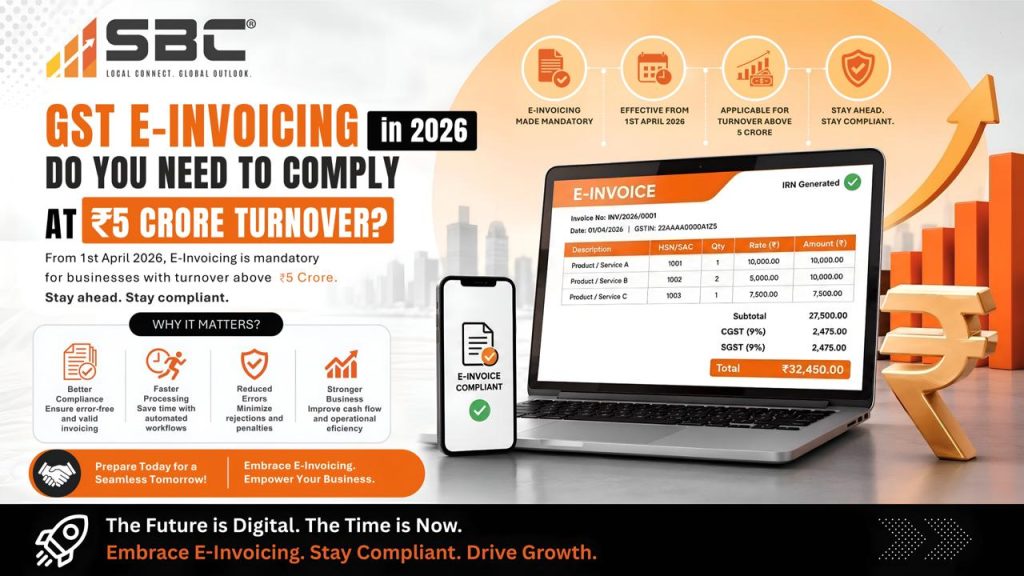
  1. Missing the e-invoicing threshold: E-invoicing thresholds have been progressively lowered, pulling many more MSMEs into the mandatory net than in previous years. Businesses that assume e-invoicing is only for large corporates often continue issuing traditional invoices without realizing they’ve crossed the applicable turnover limit.

Why it gets caught: non-compliant invoices are structurally rejected by buyers’ ITC systems, which surfaces the gap quickly.

Where it leads: invoices deemed invalid for credit purposes, plus compliance queries about the oversight itself.

  1. Delayed GST registration: Some businesses underestimate how quickly they cross the mandatory registration threshold, particularly when interstate supplies are involved. Assuming only local turnover counts is a common and costly miscalculation.

Why it gets caught: The GSTN now cross-references turnover data with income tax and banking records. Furthermore, with the deployment of the upgraded Aggregate Annual Turnover (AATO) functionality from 1st July 2026, the portal automatically updates AATO as subsequent returns are filed post-amendment window, making delayed registration and turnover mismatches highly visible.

Where it leads: retroactive tax liability and interest calculated from the date registration was due, not the date it was obtained.

  1. Ignoring Reverse Charge Mechanism (RCM) obligations: Certain transactions require the recipient, not the supplier, to pay GST directly. Businesses frequently overlook RCM liability on specific categories of purchases, assuming the supplier has already accounted for it.

Why it gets caught: unpaid RCM liability shows up as a gap between expected and reported tax payments.

Where it leads: interest on the unpaid amount and, in some cases, a formal notice questioning the omission.

  1. Inconsistent details across GST, Income Tax, and banking records: Turnover, address, or bank account details that don’t match across different government portals are a red flag the system is specifically designed to catch.

Why it gets caught: automated cross-referencing between GST, income tax, and banking data is now standard practice, not an exception.

Where it leads: in serious cases, this can be treated as suppression of turnover under Section 122 of the CGST Act, a much more serious position than a simple clerical error.

  1. Rushing or skipping annual return (GSTR-9) reconciliation: The annual return is often treated as a formality rather than a genuine reconciliation exercise. Discrepancies that were manageable at the monthly level can compound into a larger, harder-to-explain gap by year-end.

Why it gets caught: GSTR-9 data is checked against the full year’s monthly filings in aggregate, surfacing patterns that individual months might not reveal.

Where it leads: a notice questioning the full-year figures, which is typically more complex to resolve than a single-month discrepancy.

  1. Ignoring a notice or missing the reply deadline: Even businesses that make relatively minor mistakes can turn them into serious problems simply by not responding on time. GST notices come with strict windows often 7 to 30 days and missing one can trigger GSTIN suspension or a best-judgment assessment where the officer decides your liability without your input.

Why it gets caught: this isn’t a detection issue but an escalation one, the system automatically enforces deadlines. For a full breakdown of notice types, reply to forms, and timelines, see our complete guide to responding to a GST notice.

The 2026 Rule Changes Businesses Often Overlook

A few regulatory shifts from the past year deserve particular attention, since they change what “compliant” looks like:

  • GST 2.0 rate restructuring (effective September 2025): the shift to a simplified 5%/18%/40% slab structure means HSN/SAC accuracy matters more than ever, codes and rates that were correct before the restructuring may no longer be.
  • The three-year filing hard stops: if a return remains unfiled for more than 36 months, the GST portal permanently blocks it. This removes the option of “catching up later” that many businesses previously relied on.
  • Lower e-invoicing thresholds: turnover limits for mandatory e-invoicing have continued to drop, bringing a much wider band of MSMEs into scope, often without those businesses realizing the threshold has changed.

A Simple Monthly Checklist to Stay Ahead of GST Notices

  • Reconcile GSTR-2B before finalizing any ITC claim for the period
  • Cross-check GSTR-1 against GSTR-3B every single filing cycle, not just at year-end
  • Verify HSN/SAC codes and rates against the latest GST Council notifications
  • Confirm whether e-invoicing thresholds apply to you each financial year, not just once
  • Keep PAN, address, and turnover details consistent across the GST portal, income tax records, and banking details
  • Treat every notice as urgent — even a minor one — and respond well within the deadline

Why These Are Rarely Cases of Fraud — And Why That Still Matters

Most of the mistakes above don’t originate from an intent to evade tax. They come from disconnected systems, delayed reconciliation or simply not knowing a rule changed. We worked with a mid-sized manufacturing client who had been flagged for a GSTR-1/3B mismatch stretching back two quarters. On review, the gap traced entirely to a timing difference in how sales returns were being booked, not any attempt to understate liability. Because the discrepancy was caught and explained proactively, with clear reconciliation records, the matter was resolved without escalating into a formal demand.

That distinction—a genuine process gap versus a deliberate misstatement—matters enormously in determining how a case unfolds if it reaches the notice stage. However, the preferable position is to avoid having to make that argument in the first place.

When to Bring in a GST Advisory Team

Businesses with multi-state operations, high transaction volumes, cross-border supply chains, or a history of recurring notices tend to benefit most from a structured compliance review rather than reactive, notice-by-notice firefighting. A periodic health check such as  reconciling returns, verifying ITC eligibility,and confirming HSN and threshold accuracy is almost always less costly than responding to a notice after the fact.

Our GST Advisory and Corporate Compliance teams at Steadfast Business Consulting regularly help businesses build exactly this kind of proactive compliance framework.

Frequently Asked Questions

  • What is the most common reason for a GST notice in India? Mismatches between GSTR-1 and GSTR-3B are among the most frequent triggers, since the GSTN portal reconciles these two returns automatically every filing cycle.
  • Can a small mismatch in GSTR-1 and GSTR-3B lead to a notice? Yes. Even minor timing differences, such as a sales return booked in a different month than it’s reported, can trigger an automated scrutiny notice under the current matching system.
  • What happens if I claim ITC not reflected in GSTR-2B? The credit is likely to be disallowed, and you may face a demand for reversal along with interest, since GSTR-2B is the primary document the system uses to validate eligible ITC.
  • Is e-invoicing mandatory for all businesses in 2026? Not for all businesses, but the applicable turnover threshold has been lowered progressively, so many mid-sized businesses that were previously exempt may now be required to comply.
  • What is the GST three-year filing block introduced in 2026? As of January 2026, any GST return left unfiled for more than 36 months is permanently blocked on the portal, removing the option to file it later.
  • How can I avoid GST notices proactively? Regular reconciliation of GSTR-1, GSTR-3B, and GSTR-2B, accurate HSN/SAC classification, and consistent records across GST, income tax, and banking data are the most effective ways to reduce notice risk.

Key Takeaways: Avoiding GST Notices in 2026

Most GST notices don’t originate from fraud — they come from mismatches, missed thresholds, and reconciliation gaps that the GSTN’s automated system now catches almost immediately. Understanding which mistakes matter most, and fixing them at the source, is far more effective than responding to notices as they arrive.

If your business would benefit from a proactive GST compliance review, our advisory team at Steadfast Business Consulting can help you identify and close these gaps before they turn into a notice.

×

Verify Email

Verify your email address below to download the PDF

Please wait while we verify your email.

CONTACT US

Name
=

RELATED POSTS

CategoriesGST SBC

How to Respond to a GST Notice in India (2026 Guide): Section 74A, Timelines & Reply Format

India Union Budget 2026-27

Home > How to Respond to a GST Notice in India (2026 Guide): Section 74A, Timelines & Reply Format

How to Respond to a GST Notice in India (2026 Guide): Section 74A, Timelines & Reply Format

GST compliance in India has quietly become a data-matching exercise rather than a paperwork one. Between GSTR-1, GSTR-3B, e-way bill records and ICEGATE export data, the GSTN / GST Portal systems now flag mismatches automatically, often before a human officer even looks at the file. For startups and SMEs juggling multiple compliance deadlines, and for larger businesses operating across states or borders, this means a GST notice can land even when nothing was intentionally wrong like a mismatched invoice, a delayed return, or an input tax credit claim that doesn’t quite reconcile is often enough to trigger one.

This is exactly why knowing how to respond to a GST notice has become a core business skill, rather than just a task for the tax team. In this guide, we’ll walk through the different types of GST notices you might receive, the newly consolidated Section 74A framework that now governs all notices from FY 2024-25 onward, the exact reply process on the GST portal, and the mistakes that turn a routine query into a prolonged dispute. By the end, you’ll know exactly what to do the moment a notice lands in your GST portal inbox.

What Is a GST Notice and Why You Received One

A GST notice is a formal communication from the GST Authorities asking a registered taxpayer to explain a discrepancy, provide additional documents or respond to an allegation of non-compliance. It is not, by itself, a finding of guilt it’s the authorities way of giving you a chance to clarify your position before any penalty or demand is finalized.

Notices are typically triggered by:

  • Return mismatches: differences between GSTR-1, GSTR-3B and e-way bill data
  • Input Tax Credit (ITC) discrepancies: claiming more credit than supporting invoices justify
  • Late or non-filing of periodic returns
  • Export data mismatches: shipping bill details not reflected in GSTR-1
  • Registration-related issues: incomplete documentation or address verification during registration or amendment

Understanding why you received a notice is the first step to responding correctly, because each trigger maps to a different notice type and each notice type has its own form, deadline and reply format.

Types of GST Notices and Their Reply Forms

Different notices are issued under different provisions of the CGST Act, and each requires a specific reply form within a specific window. Here’s a quick-reference table:

Notice Received Reason Reply Form Typical Time Limit
REG-03
Additional documents needed during registration
REG-04
7 working days
REG-17
Show cause before registration cancellation
REG-18
7 working days
ASMT-10
Scrutiny discrepancy in returns
ASMT-11
As specified in notice (usually 15 – 30 days)
DRC-01 / DRC-01A
Show cause Notice/ pre-show-cause intimation
DRC-06
As specified in notice
Section 46 reminder
Non-filing of returns
File pending returns
15 days

Getting the reply form right matters as much as getting the content right, a well-drafted response filed on the wrong form can be treated as no response at all.

The Big 2026 Change: Section 74A Explained

If there’s one development every business owner should understand this year, it’s this: notices under the old Sections 73 and 74 can no longer be issued for FY 2024-25 and beyond. Both provisions have been consolidated into a single new provision, Section 74A, which now governs all GST demand notices going forward regardless of whether fraud is alleged or not.

Previously, Section 73 covered genuine short-payment or ITC errors (lower penalty exposure, up to 10%), while Section 74 covered cases involving fraud or wilful misstatement (penalty exposure up to 100%). Under Section 74A, both scenarios are addressed within the same section, but the facts of the case still determine which penalty band applies. This distinction matters enormously a notice alleging fraudulent intent without solid evidence can sometimes be successfully argued down to the lower penalty category, which is why correctly reading the allegation, not just the form, is critical.

The other meaningful change: the window to pay the demanded tax and interest at the reduced penalty rate has been extended from 30 days to 60 days, giving businesses more breathing room to settle straightforward cases before they escalate.

Section 73 vs Section 74 vs Section 74A at a glance:

  • Section 73 (pre-FY 2024-25): tax unpaid, short-paid, erroneously refunded, or ITC wrongly availed/utilised for reasons other than fraud, wilful misstatement, or suppression
  • Section 74 (pre-FY 2024-25): short-payment or wrong ITC availment is by reason of fraud, wilful misstatement, or suppression of facts to evade tax
  • Section 74A (FY 2024-25 onward): single provision, penalty band depends on facts, not the section number.

In practice, we’ve seen businesses receive a notice framed as a serious allegation when the underlying facts were closer to a genuine clerical mismatch. One SME client in the FMCG sector, for instance, received a notice alleging wilful ITC misstatement based purely on a timing gap between two return periods. On review, the discrepancy was traced to a genuine reconciliation lag rather than any intent to misstate, and the matter was resolved without escalation once the correct evidentiary position was presented. Getting an experienced GST advisor to assess which category truly applies before drafting any reply is often the single most consequential decision in the entire process.

Step-by-Step: How to Reply to a GST Notice on the Portal

Once you know what type of notice you’ve received, the actual filing process is fairly consistent:

  1. Log in to the GST portal and go to Services User Services View Notices and Orders.
  2. Download the original notice in PDF to confirm the exact section, form, and deadline.
  3. Identify the correct reply form based on the notice type (see the table above).
  4. Draft your reply point by point i.e., address every allegation raised; an unaddressed point can be treated as accepted.
  5. Attach all supporting documents you reference invoices, reconciliation statements, ledgers, or bank records.
  6. Submit using your Digital Signature Certificate (DSC) or Electronic Verification Code (EVC).
  7. Save the acknowledgement reference number — this is your proof of timely filing and should be retained indefinitely.

For notices from enforcement wings such as DGGI or the Anti-Evasion unit, a physical reply to the issuing office may be required in addition to the portal submission, always check the specific instructions on the notice itself.

Need a starting point? Our GST Advisory team can share a ready-reference reply format aligned to your specific notice type — get in touch and we’ll help you structure it correctly the first time.

What to Include in a Strong GST Notice Reply

The difference between a reply that closes a matter and one that invites a follow-up to notice usually comes down to a few habits:

  • Be factual, not emotional. Be factual and detailed. Explain the product or service in question, discuss the relevant Chapter Notes, and quote judicial precedents or HSN references.
  • Address every point raised. Go through the notice line by line; silence on any point can be read as agreement.
  • Attach everything you reference. An incomplete reply is often treated as no reply. Use Calculation Tables for valuation, tax calculations or GSTR-1 vs GSTR-3B / ITC mismatches, summarize discrepancies in a clear table within the reply
  • Use Annexures. Keep the main response uncluttered by placing case laws, HSN schedules, or wide ITC tables in structured annexures
  • Avoid voluntary admissions. Don’t concede liability in your language unless you’ve independently verified the claim and intend to settle.
  • Maintain a reply log. Track every notice, response date, acknowledgement number and outcome, this record becomes invaluable during future assessments or audits.

Common Mistakes Businesses Make When Responding:

Even well-intentioned businesses tend to repeat the same errors:

  • Ignoring smaller notices, assuming they’ll be overlooked, they rarely are.
  • Filing a generic or partial reply instead of addressing each specific allegation.
  • Using the wrong reply form, which can invalidate an otherwise sound response.
  • Treating a Show Cause Notice casually, without recognizing it as a formal legal document with real consequences.
  • Not seeking expert review on Section 74A notices before replying, especially where fraud is alleged but the underlying facts suggest a genuine error.

What Happens If You Miss the Deadline or Ignore the Notice

Non-response doesn’t make a notice go away, it escalates it. Repeated non-compliance or failure to respond to intimations and Notices can lead to:

  • Best-judgment assessment for non-filers under Section 62 or unregistered persons under Section 63, which start with a non-obstante clause overriding Sections 73, 74, and 74A
  • Suspension or cancellation of GST registration
  • Blocking of e-way bill generation, disrupting the ability to move goods
  • Recovery proceedings under Section 79, including attachment of bank accounts
  • Prosecution under Section 132 in cases of wilful evasion

If a deadline is missed for a genuine reason, an application for restoration of proceedings or Adjournment request may be possible for certain notice types but this depends on the officer’s discretion and requires a well-documented justification, making early professional input valuable even after a deadline has slipped.

When You Need Professional Help

Some notices are straightforward enough to handle internally, a simple clarification query during registration, for instance. But once a notice involves a demand under Section 74A or a significant financial exposure, the framing of your reply can materially change the outcome. This is where an experienced GST advisory team adds real value, assessing whether the allegation is legally sound, identifying whether a case has been miscategorized, and ensuring the reply is built on a defensible factual and legal position rather than just procedural compliance.

At Steadfast Business Consulting, our GST Advisory and Legal Services teams regularly assist businesses in reviewing notices, assessing exposure, and drafting responses that hold up to scrutiny particularly where the newer Section 74A provisions are involved.

Key Takeaways: Responding to a GST Notice the Right Way 

A GST notice is manageable when you know what you’re looking at. Identify the notice type correctly, respond within the stipulated timeline, use the right reply form, and keep your response factual and well-documented. The introduction of Section 74A has changed how demand notices are framed and understanding where your case truly falls — a genuine error or a more serious allegation — can significantly affect the outcome.

If your business has received a GST notice, or you’d simply like a compliance health check before one arrives, our GST Advisory team at Steadfast Business Consulting is available to review your position and guide your response.

Frequently Asked Questions

  • What is the time limit to reply to a GST notice? It depends on the notice type. Registration-related notices (REG-03, REG-17) typically require a reply within 7 working days, while scrutiny and demand notices (ASMT-10, DRC-01) usually specify 15–30 days. Always check the exact deadline stated on your notice.
  • What happens if I don’t reply to a GST show cause notice? The authorities can proceed to pass an order based on the allegations in the notice, which may include a tax demand, penalty, registration cancellation, or recovery action, all without your side of the case being considered.
  • What is the difference between Section 73, Section 74 and Section 74A? Section 73 and Section 74 were separate provisions for non-fraud and fraud cases respectively, applicable up to FY 2023-24. From FY 2024-25 onward, both have been merged into Section 74A, with the applicable penalty still depending on whether fraud or wilful misstatement is established.
  • Can I reply to a GST notice after the deadline? In some cases, a delayed reply or a restoration or Adjournment application may be accepted if there’s a valid reason, but this is at the officer’s discretion and is far less reliable than relying on time.
  • Which form is used to reply to a GST demand notice? Demand notices issued under DRC-01 or DRC-01A are typically replied to using Form DRC-06 on the GST portal.
  • Is a notice invalid if it wasn’t served through the GST portal? Not necessarily, the CGST Act recognizes several valid modes of service, including hand delivery, registered post, and in limited cases, public notice methods. The portal is simply the most common and convenient channel.
×

Verify Email

Verify your email address below to download the PDF

Please wait while we verify your email.

CONTACT US

Name
=

RELATED POSTS

CategoriesSBC Transfer Pricing

The Complete Guide to Compliance, Documentation, Benchmarking, Advisory and Risk Management (2026) – Part 1

India Union Budget 2026-27

What Is Transfer Pricing in India? A Complete Guide for Businesses in 2026

Transfer Pricing in India: The Complete Guide to Compliance, Documentation, Benchmarking, Advisory and Risk Management (2026) – Part 1

The above highlights capture the broad policy/tax direction and key changes. Our detailed Budget 2026 tax alert, covering section-wise amendments, industry impact, and compliance action points, will follow shortly.

×

Verify Email

Verify your email address below to download the PDF

Please wait while we verify your email.

 In an increasingly interconnected global economy, Transfer Pricing in India has become one of the most significant areas of international taxation, influencing how multinational enterprises allocate profits, manage cross-border operations, and comply with evolving tax regulations.

Whether an organisation operates through overseas subsidiaries, regional headquarters, shared service centres, manufacturing facilities, or research and development hubs, Transfer Pricing directly affects its tax position, financial reporting, and regulatory exposure across multiple jurisdictions.

Unlike many areas of taxation that are primarily compliance-driven, Transfer Pricing in India sits at the intersection of taxation, economics, finance, legal structuring, and business strategy. Every intercompany transaction—whether involving tangible goods, management services, intellectual property, financial arrangements, or business restructuring—requires businesses to demonstrate that the commercial terms and pricing reflect what independent enterprises would have agreed under comparable circumstances.

Consequently, Transfer Pricing is no longer viewed merely as a year-end compliance exercise; rather, it has become an integral component of corporate governance, enterprise risk management, and global tax strategy.

The regulatory landscape governing Transfer Pricing has also undergone a fundamental transformation over the past decade. Tax administrations worldwide have significantly enhanced their audit capabilities through the implementation of the OECD’s Base Erosion and Profit Shifting (BEPS) Project, increased exchange of information between jurisdictions, Country-by-Country Reporting (CbCR), and sophisticated data analytics.

As a result, multinational enterprises are expected to maintain robust Transfer Pricing Documentation Services India, implement commercially defensible pricing policies, and proactively identify areas of potential exposure through comprehensive Transfer Pricing Risk Assessment Services in India.

India has emerged as one of the world’s most mature and dynamic Transfer Pricing jurisdictions. The Indian tax authorities actively scrutinise cross-border related-party transactions across industries such as software development, information technology-enabled services (ITES), manufacturing, pharmaceuticals, automotive, financial services, digital businesses, engineering, and consumer products.

Given the increasing complexity of global business models, businesses are expected to maintain contemporaneous documentation, undertake reliable benchmarking studies, and establish pricing frameworks that comply with both domestic legislation and internationally accepted principles.

This comprehensive guide has been prepared to provide business leaders, finance professionals, tax managers, multinational enterprises, and growing businesses with a practical understanding of Transfer Pricing in India.

Rather than offering a generic overview, this guide explains the commercial rationale behind Transfer Pricing, the regulatory expectations of tax authorities, and the practical considerations involved in designing, implementing, documenting, and defending intercompany pricing arrangements.

Throughout this guide, we also discuss how specialised Transfer Pricing Compliance Services in India, International Tax and Transfer Pricing Advisory, and Intercompany Pricing Advisory Services in India enable businesses to navigate increasingly complex regulatory environments while supporting sustainable global growth.

Why Transfer Pricing Has Become a Strategic Business Priority

The role of Transfer Pricing has changed dramatically over the past two decades. Historically, many organisations viewed Transfer Pricing primarily as an annual tax compliance requirement, undertaken towards the end of the financial year to satisfy statutory documentation obligations.

Today, however, Transfer Pricing has evolved into a strategic business discipline that influences supply chain design, operating models, intellectual property ownership, financing arrangements, investment decisions, and global expansion strategies.

Modern multinational enterprises rarely operate through a single legal entity. Instead, they establish specialised group companies across different jurisdictions to perform distinct commercial functions.

One entity may undertake research and development, another may manufacture products, another may own valuable intellectual property, while others perform distribution, marketing, procurement, financing, or shared service activities.

Each of these entities contributes differently to the overall value chain and therefore expects an appropriate allocation of profits through a well-designed Transfer Pricing framework.

As global tax authorities increasingly focus on ensuring that profits are aligned with genuine economic activity, Transfer Pricing has become central to discussions on value creation and economic substance.

Businesses can no longer rely solely on contractual arrangements to justify intercompany pricing. Instead, tax authorities evaluate who performs economically significant functions, who controls strategic risks, who develops and exploits valuable intangible assets, and where key business decisions are actually made.

For multinational enterprises, this means that Transfer Pricing decisions influence far more than tax computations. They affect customs valuation, indirect taxation, financial reporting, group profitability, treasury operations, investment planning, and merger and acquisition strategies.

Accordingly, businesses increasingly invest in Transfer Pricing Policy Design Services in India to establish consistent global pricing frameworks that align commercial objectives with regulatory expectations.

From a governance perspective, proactive Transfer Pricing in India management also enhances investor confidence. Financial stakeholders, regulatory authorities, and statutory auditors increasingly expect businesses to maintain transparent intercompany pricing supported by comprehensive documentation, robust economic analyses, and clearly defined intercompany agreements.

Consequently, organisations that integrate Transfer Pricing into their broader governance framework are generally better positioned to manage tax risks while supporting long-term business growth.

The Evolution of Transfer Pricing: From Compliance to Strategic Value Creation

The concept of Transfer Pricing is not new. However, its significance has expanded considerably with the rapid growth of globalisation, digital business models, cross-border investments, and intangible asset-driven industries.

Historically, Transfer Pricing legislation focused primarily on preventing multinational enterprises from shifting profits between high-tax and low-tax jurisdictions through artificial pricing of goods.

Manufacturing businesses represented the primary focus of early Transfer Pricing regulations, with tax authorities examining import and export pricing between related entities.

Over time, however, business models evolved. Intellectual property, software platforms, data analytics, cloud computing, digital advertising, artificial intelligence, and shared service centres began generating substantially greater enterprise value than physical assets.

As a result, Transfer Pricing analyses became increasingly complex, extending beyond tangible goods to encompass management services, royalty arrangements, financial transactions, business restructuring, cost contribution arrangements, and the exploitation of valuable intangible assets.

The publication of the OECD Transfer Pricing Guidelines established a globally accepted framework for determining arm’s length pricing. Subsequently, the OECD’s Base Erosion and Profit Shifting (BEPS) initiative fundamentally reshaped the international Transfer Pricing landscape by introducing concepts such as value creation, economic substance, DEMPE functions, enhanced documentation standards, Master File, Local File, and Country-by-Country Reporting.

Today, Transfer Pricing continues to evolve in response to emerging technologies, global tax transparency initiatives, and international tax reforms, including the OECD’s Two-Pillar Solution. Businesses operating across multiple jurisdictions must therefore ensure that their Global Transfer Pricing Advisory Services extend beyond annual documentation to include ongoing policy reviews, operational alignment, and continuous monitoring of evolving regulatory expectations.

What Is Transfer Pricing?

At its core, Transfer Pricing refers to the pricing of transactions undertaken between Associated Enterprises (AEs) forming part of the same multinational enterprise group.

These transactions may involve the sale or purchase of goods, provision or receipt of services, licensing of intellectual property, financial arrangements, business restructuring, cost contribution agreements, guarantees, or any other commercial dealings between related entities.

Unlike transactions negotiated between independent enterprises, intercompany transactions are influenced by common ownership or control.

Consequently, governments require multinational enterprises to establish Transfer Pricing that reflects market conditions and prevents the artificial allocation of profits among jurisdictions.

The internationally accepted standard governing Transfer Pricing is the Arm’s Length Principle, under which prices charged between Associated Enterprises should be consistent with prices that independent enterprises would have agreed under comparable circumstances.

From a commercial perspective, Transfer Pricing is much more than a pricing mechanism. It determines how profits are allocated across jurisdictions, how businesses manage tax risks, and how multinational groups demonstrate compliance with domestic legislation and international tax standards.

Accordingly, organisations increasingly seek support from experienced Transfer Pricing Documentation Consultants in India and specialist advisory teams to establish pricing policies that withstand scrutiny during tax audits and dispute-resolution proceedings.

Transfer Pricing Specialist’s Perspective

One of the most common misconceptions is that Transfer Pricing begins with benchmarking. In reality, benchmarking is only one component of a much broader framework.

Successful Transfer Pricing begins with understanding the commercial objectives of the business, analysing the global value chain, identifying economically significant functions, evaluating risk allocation, and designing an intercompany pricing policy that reflects operational reality.

Businesses that adopt this approach are generally better positioned to defend their pricing during audits than those that focus solely on year-end benchmarking.

What’s Next?

While this guide provides a comprehensive overview of Transfer Pricing, several topics deserve a more detailed discussion.

In our upcoming articles, we will explore practical aspects of Transfer Pricing such as benchmarking methodologies, FAR analysis, management fees, royalty arrangements, financial transactions, APA and MAP mechanisms, Transfer Pricing documentation, litigation strategies, and recent judicial developments.

Stay connected as we continue to share practical insights to help businesses navigate the evolving Transfer Pricing landscape.

CONTACT US

Name
=

RELATED POSTS

CategoriesSBC

India Union Budget 2026-27

India Union Budget 2026-27

Home > India Union Budget 2026-27

SBC-India-Union-Budget-2026-Highlights.pdf (1024 x 576 px)
Key Proposals

A. Budget anchored on Viksit Bharat with 3 Kartavya:

(i) Accelerate & sustain growth
(ii) Build aspirations & capacity
(iii) Ensure inclusive access across regions and communities

Focus on structural reforms, resilient finance, AI-led governance, and global integration.

B. Direct Tax, Transfer Pricing & Indirect Tax – Snippet:

Structural Reset of India’s Tax System

Transition to the Income-tax Act, 2025 from 1 April 2026 marks a shift from fragmented amendments to a modern, rule-based tax framework.

From Compliance Burden to Business Enablement

Strong focus on simplicity, certainty, digitisation and reduction of litigation for compliant taxpayers.

Global Competitiveness at the Core

Tax policy aligned with India’s ambition to attract long-term capital, global services, manufacturing, data centres and cross-border trade.

Technology-Led Tax Administration

Automation, rule-driven approvals, data integration and trust-based systems replace manual, discretionary processes.

Transfer Pricing as a Growth Enabler

Predictable margins, automated safe harbours, faster APAs and IFSC incentives reposition India as a stable base for global operations.

Indirect Tax as a Trade & Manufacturing Catalyst

Tariff rationalisation, export facilitation, duty relief for strategic sectors and digitised customs to improve supply-chain efficiency.

Shift from Enforcement to Partnership

The framework signals a move from dispute-driven taxation to certainty-driven compliance.

Unified Message

India is building a simple, predictable and globally integrated tax ecosystem to support scale, speed and sustainable growth.

India is shifting from incremental reform to structural transformation using technology, scale, and global integration to build a resilient, inclusive, and competitive economy.

Key Proposals


C. Individual Income-tax:

There are no changes in the income tax rates and slabs under both the regimes.

Individual Persons Resident Outside India (PROIs) may invest in equity instruments of listed Indian companies under the Portfolio Investment Scheme (PIS), with the individual limit increased from 5% to 10% and the overall PROI limit enhanced from 10% to 24%.

Indian resident buyers of immovable property shall not be required to obtain TAN for TDS while purchase from Non-Resident.

Immunity from prosecution for non-disclosure of non-immovable foreign assets valued below INR20 lakh, with retrospective effect from 01 October 2024, providing relief to taxpayers who may have inadvertently missed reporting such assets.

Securities Transaction Tax (STT) has been increased on derivatives, with the rate on futures raised from 0.02% to 0.05%, and the STT on options both on premium and on exercise enhanced to 0.15% from the earlier rates of 0.10% and 0.125%, respectively.

A special six-month window has been introduced allowing two categories of taxpayers to regularise their disclosures:

Particulars Category A Category B
Coverage
Undisclosed income or assets
Foreign income disclosed and tax paid, but foreign assets not declared
Maximum value eligible
Up to ₹1 crore
Up to ₹5 crore
Tax payable
30% of FMV of asset or 30% of undisclosed income
Not applicable
Additional levy
30% of tax (in lieu of penalty)
Not applicable
Fee
Not applicable
₹1,00,000
Immunity
Immunity from prosecution
Immunity from penalty and prosecution
Compliance window
Special 6-month window

Other key proposals as enumerated below are summarised in the following pages

I. Transfer Pricing
II. Direct tax
III. Indirect tax

I. Transfer Pricing Proposals

S. No. Topic bucket Key proposal (what changes) Applicability SBC Comments
Safe Harbour and APA
1
Safe Harbour 2.0 – IT Services
• All Software Dev + ITES + KPO + Contract R&D (software) proposed to be clubbed into one category “Information Technology Services”
• Single Safe Harbour margin of 15.5%
• Threshold ₹300 cr increased to ₹2,000 cr
• Automated rule-driven approval; option to continue 5 years
Effective date will flow from Bill/Rules when notified
• Game-changer for GCCs/IT captives.
• Larger coverage shall lead to lower friction along with longer certainty window
2
Fast-track Unilateral APA
• Unilateral APA to be fast- tracked
• Endeavour for closure in 2 years, extendable by 6 months on request
To be evaluated once notified
Faster certainty than typical APA cycle
3
APA consequence management – Associated Enterprise (AE) returns
• Where income gets modified due to APA, AE (not just APA signatory) may file return / modified return within 3 months from end of month of APA (for years covered)
• For APA entered on/after 1 April 2026
From 1 April 2026 and applies to Tax Year (TY) 2026-27 onwards
Avoids group-level mismatches and unlocks refunds/true-ups across entities
4
Safe Harbour – Data centre related-party pricing + broader global cloud push
Safe harbour 15% on cost for resident entity providing data centre services to a related foreign company providing cloud services globally
From 1 April 2026
Predictable pricing for digital infra / cloud structures
5
Exemption framework for foreign company using India data centres (cross- border model enabling TP certainty)
Foreign company exemption for income arising in India by procuring data centre services from “specified data centre” (Indian owned/operated under approved scheme India users routed via Indian reseller) till 31 Mar 2047 Section 11 read with Schedule IV – ITA 2025
From 1 April 2026 (TY 2026-27 onwards)
• Helps position India as global cloud hub.
• Additionally, Complements TP safe harbour for related-party data centre services
6
Transfer Pricing audit report default – penalty converted to fee
• Penalty for non-furnishing TP report proposed to be converted into fee (reducing litigation for technical defaults).
• Section 447 of ITA 2025 penalty relates to report under section 172 (TP accountant report)
From 1 April 2026; applies for TY 2026- 27 onwards
• Technical defaults become fee- based and thereby lower litigation, higher automation readiness – Up to 1 month – ₹ 50k or ₹ 1lakh otherwise.
7
Specified domestic transactions
• Proposal to exclude transactions with newly established SEZ units from the scope of SDT.
From 1 April 2026; applies for TY 2026- 27 onwards
• No deduction will be allowed for transactions connected with newly established SEZ units for the income enhanced after ALP computation.
Other Administrative Proposals
1
Safe Harbour – bonded component warehousing (non-resident margin)
• Safe harbour for non- residents for component warehousing in bonded warehouse at 2% of invoice value
As proposed
• Predictable low- margin model for electronics supply chains
2
Section 92CA(3A) – 60 days for TPO order clarified
• Courts differed on limitation and many TP assessments were quashed. It is clarified that the date of limitation u/s 153 / 153B is INCLUDED while computing the 60 days.
• This reflects legislative intent and overrides court rulings
ITA 1961: From 1 June 2007
ITA 2025: From 1 April 2026
• Removes technical challenges to TP orders before appellate authorities.
• Protects assessments from being quashed on limitation grounds
3
Section 144C(4) & 144C(13) – Final order timelines
• Conflicting judicial views on whether 144C process must fit within overall 153/153B limits, despite explicit carve- outs
• Clarified that 153 / 153B govern only the draft order stage, while 144C(4) / (13) timelines override 153/153B for finalisation
ITA 1961: From 1 Apr 2009 (s.153) and 1 Oct 2009 (s.153B)
ITA 2025: From 1 April 2026
Restores certainty in DRP timelines; prevents annulment of TP assessments due to misinterpretation and split judgement in the case of Shelf Drilling by the Honourable SC.

II. Direct Tax Proposals

S. No. Topic Key proposal (explained) Applicability SBC Comments
Incentives and Exemptions (Tax Holidays)
1
Tax exemption for foreign cloud & data centre players
• Income earned by a foreign company from procuring data centre services from an Indian “specified data centre” will be exempt.
• The data centre must be owned & operated by an Indian company under a notified scheme.
• Where services are used by Indian customers, billing must be routed through an Indian reseller.
• The exemption is available up to the tax year ending 31 March 2047. Section 11 read with Schedule IV – ITA 2025
From 1 April 2026
• This creates a new India-hub structure for global cloud players.
• Group billing, transfer pricing, reseller arrangements and data localisation contracts must be re-designed to qualify.
2
Five-year global income exemption for non-resident experts
• A non-resident individual who has not been resident in India in the preceding five years and who renders services in India under a notified Central Government scheme will get exemption on all foreign source income for five consecutive years.
• Only income sourced outside India is covered. Section 11 read with Schedule IV – ITA 2025
From 1 April 2026
• Enables cost- effective deployment of global experts.
• Employers must track residency history and ensure scheme approval documentation.
3
Electronics toll- manufacturing exemption
• Income of a foreign company providing capital goods, equipment or tooling to an Indian contract manufacturer located in a customs bonded warehouse for producing electronic goods
• To be exempt up to tax year 2030-31 s.11 read with Schedule IV – ITA 2025
From 1 April 2026
• Supports PLI and EMS models.
• Structures must ensure bonded status, ownership of tooling, and arm’s length pricing.
4
Critical mineral exploration deduction expanded
• The list of minerals eligible for deferred deduction of prospecting and exploration expenditure is expanded.
• The deduction can be claimed once commercial production begins. Section 51 read with Schedule XII – ITA 2025
From 1 April 2026
Mining companies can plan early- stage investments with future tax shelter
5
MAT exemption for specified non-resident businesses
• Certain non-resident presumptive businesses such as cruise ship operators and technology service providers for electronics manufacturing are excluded from MAT. Section 206 – ITA 2025
From 1 April 2026
Eliminates MAT cash-flow cost for foreign infrastructure operators.
TDS and TCS
1
No TDS on interest to co- operative banks
• Interest paid to co-operative banks, including co- operative land mortgage banks, other than interest on securities, will not be subject to TDS – Section 393(4) – ITA 2025
From 1 April 2026
Aligns with existing ITA 1961 position and removes disputes for borrowers.
2
Correction in property sale TDS note
• A wrong reference in the note to the TDS table for property transactions is corrected to avoid misinterpretation. Section 393(1) – ITA 2025
From 1 April 2026
Prevents erroneous TDS deductions in real estate transactions.
3
TCS rate rationalisation
• Uniform 2% TCS for scrap, minerals and liquor
• TCS for Tendu leaves reduced from 5% to 2%. Section 394(1) – ITA 2025
From 1 April 2026
Reduces working capital blockage for traders and manufacturers.
4
Removal of Ambiguity in TDS Rates Applicable to Manpower Supply
• It is proposed to specifically include supply of manpower within the definition of “work”, so that TDS provisions applicable to contract work will apply.
• Clarified to be charged @ 1 or 2%
From 1 April 2026
Ambiguity of classification for supply of manpower (contract work) v/s Professional/ technical services removed.
5
TCS reduced on LRS and Overseas Tour package
• LRS remittances for education or medical treatment above ₹10 lakh: TCS rate reduced from 5% to 2%.
• Overseas tour programme packages: TCS rate reduced to 2%, and the threshold is removed, making TCS applicable at 2% irrespective of the amount. Section 394 of ITA 2025
From 1 April 2026
These changes reduce the cash- flow burden on individuals by significantly lowering upfront
6
Electronic Filing and Issuance of Certificate for Lower / Nil TDS
It is proposed to allow electronic filing and electronic issuance of certificates for lower or nil deduction of TDS/TCS u/s 395 of ITA 2025, instead of the existing physical process before the Assessing Officer
From 1 April 2026
The amendment aims to reduce compliance burden, especially for small taxpayers
7
Centralised Filing of No-TDS Declaration with Depository
Investors earning dividend, interest on securities, or mutual fund income will be allowed to submit a single no- TDS declaration to the depository, instead of filing separate declarations with each payer.
From 1 April 2027
Payers will now report such declarations quarterly instead of monthly, reducing compliance burden. The facility will apply only to listed securities or units held in demat form.
8
No TDS on Interest on compensation amount awarded
Awarded by Motor Accidents Claims Tribunal to an individual
Section 393 of the ITA 2025
From 1 April 2026
Relief to the individual and to alleviate the hardship caused due to Accident
9
Quoting of PAN instead of TAN for sale of immovable property by NRIs
A resident individual / HUF is not required to obtain a TAN for deducting TDS on consideration paid under section 393(2) Section 397(1)(c) of ITA 2025
From 1 October 2026
Reduces compliance burden for the resident individual and HUF
IFSC and Investments income
1
Tax rate for IFSC post tax holiday period
Eligible business income of units in IFSC will now be taxed at 15% instead of the 22% or 30% rate applicable to income earned after the tax holiday period
TY 2026-27
Further incentivises the IFSC.
2
Extension of tax holiday for IFSC Units
• It is proposed to increase the period of deduction to 20 consecutive years out of 25 years for units in IFSC and 20 consecutive years for OBUs
From 1 April 2026 onwards
Govt states that the same is to increase the competitiveness of IFSC.
3
No deduction of interest against dividend income
• Taxpayers were allowed a deduction for interest expenditure up to 20% of dividend income while computing income under the head ‘Income from other sources’.
• Such deduction shall not be allowed
From 1 April 2026 onwards
Passive income discouraged from claim of expenses and to be offered on gross basis.
4
Buy back tax
• Consideration received on buy-back of shares chargeable to tax under the head ‘capital gains’ i.e., the same shall not be treated as dividend income.
• Additional income tax on capital gains shall be payable by ‘promoter’ shareholders @22% (for domestic corporate shareholders) and @ 30% (for others)
From 1 April 2026 onwards
This move brings parity between buybacks and other modes of profit distribution such as dividends, while also strengthening tax neutrality and anti- avoidance safeguards. Treaty benefit for additional tax levied on promoter’s buy- back entitlement to be perused in detail
5
Sovereign Gold Bonds (SGBs)
• Capital gains exemption on redemption of SGBs restricted to original subscribers holding till redemption
From 1 April 2026 onwards
To be held continuously until redemption on maturity for exemption
Litigation and Dispute Resolution
1
Jurisdictional AO clarification for reassessment
• It is clarified that reassessment proceedings will not fail merely because the notice is not issued by the “jurisdictional” AO, resolving conflicting court views (Reassessment provisions u/s 148 and 148A of ITA 1961 & corresponding provisions in ITA 2025).
ITA 1961: Retrospective from 1 April 2021 ITA 2025: From 1 April 2026
Substantially reduces writ litigation against reopening notices. However, impact on cases pronounced to be rechecked pending adjudication before Honourable Supreme Court.
2
DIN procedural defects neutralised
• Courts quashed notices/orders lacking DIN.
• The law now clarifies if assessment order are referenced by such number in any manner, then such orders shall be valid
ITA 1961: Retrospective from 1 October 2019 ITA 2025: From 1 April 2026
Pending DIN- based challenges may not survive; Focus may shift to merits.
3
Single order for assessment & penalty
• Assessment and penalty will be passed in one consolidated order to avoid parallel proceedings
ITA 1961: From 1 March 2026 ITA 2025: From 1 April 2027
Reduces procedural litigation and shortens dispute lifecycle.
4
No interest on penalty during first appeal
• Interest will not accrue on penalty while the first appeal is pending (ITA 2025)
ITA 1961: From 1 March 2026 ITA 2025: From 1 April 2027
Removes compounding financial pressure during litigation.
5
Pre-deposit reduced to 10%
• Mandatory pre-deposit for filing appeal reduced from 20% to 10% of core tax demand (ITA 2025)
From 1 April 2026
Makes appellate remedy financially accessible, especially for MSMEs.
6
Updated return allowed after reassessment notice
• Taxpayer may file an updated return even after reassessment is initiated, with additional 10% tax (ITA 2025). Section 263
ITA 1961: From 1 March 2026 ITA 2025: From 1 April 2026
Encourages early settlement and reduces prolonged litigation.
7
Immunity extended to misreporting cases
• Immunity from penalty and prosecution extended to misreporting, subject to additional tax equal to 100% of tax . Section 440 of ITA 2025
From 1 March 2026 for AY 2026-27 or any earlier AY’s
Allows settlement even in aggressive tax positions.
8
Decriminalisation of minor offences
• Non-production of books and TDS paid in kind decriminalised; graded prosecutions introduced (ITA 2025).
ITA 1961: From 1 March 2026 ITA 2025: From 1 April 2027
Reduces prosecution exposure and compliance risk.
9
Small foreign asset immunity scheme
• One-time 6-month scheme for disclosure of foreign assets (≤ ₹20 lakh non- immovable) with immunity from prosecution (Black Money Act).
6-month window (to be notified)
Strategic clean-up window for NRIs, students, tech professionals.
10
Time Limit for Completion of Block Assessment
• The time limit for completion is extended to 18 months from the initiation of the search/requisition, aligning group search cases under a uniform timeline.
From 1 April 2026
Ensuring uniformity in time limits for group searches and creating a more coordinated approach to investigations and assessments.
11
Rationalization of Block Period for Other Persons
• Restricted block period for “other persons” (third parties) involved in a search or requisition. Rule limits the block period to only the relevant tax year(s) where the undisclosed income pertains.
From 1 April 2026
This change rationalizes the assessment period for third parties, ensuring a more proportionate and targeted approach.
12
Unexplained Cash and Credits rate rationalised
• Tax rate is reduced from 60% to 30%. Further, a penalty of 10% is omitted.
• However, such an offence will continue to be subject to a penalty of 200% applicable for misreporting of income.
TY 2026-27 onwards
Immunity from penalty can be by making a payment of 120% of the tax payable on such income.
Others – Return filing, Computation of income and procedural issues
1
Time Limit for Filing Revised Return
• Extends the time limit for filing a revised return from 9 months to 12 months from the end of the relevant tax year, or before the completion of assessment, whichever is earlier.
• Additionally, a fee will be applicable for revised returns filed after 9 months. Section 263(5)
From 1 April 2026
This extension provides taxpayers with more flexibility to file revised returns, but the imposition of a fee after 9 months introduces a costly incentive to file revisions promptly, encouraging timely compliance while offering some leeway.
2
Relaxation in Filing Updated Return in case of reduction of losses
• Allows taxpayers to file an updated return even if a loss continues. Additionally, it permits the reduction of loss in cases where the updated return reduces the amount of loss claimed in the original timely filed return.
• This relaxation addresses hardship by allowing voluntary correction of excessive loss claims. Section 263(6)
From 1 April 2026
This amendment offers a significant relief for taxpayers by enabling them to correct excessive loss claims and file updated returns even when a loss is still involved, providing a more flexible and fair approach to loss adjustments.
3
Rationalization of Minimum Alternate Tax (MAT) Provisions
• MAT will be treated as a final tax under the old tax regime, with no further MAT credit allowed.
• The MAT rate is reduced from 15% to 14% of book profit for domestic companies under the old tax regime.
• MAT credit set-off will only be allowed in the new tax regime for domestic companies, limited to 25% of the tax liability.
From 1 April 2026
This amendment simplifies the MAT framework, reducing the burden of MAT credits and incentivizing the shift to the new tax regime, while offering a reduced MAT rate for smoother compliance.
4
Allowing the Filing of Updated Return After Issuance of Notice of Reassessment
• The proposed amendments allow taxpayers to file an updated return even after the issuance of a notice of reassessment under Section 280.
• Additionally, the additional income-tax payable for filing such updated returns will include a 10% extra charge, but the income on which this tax is paid will not be subject to penalty under Section 439. Section 280
From 1st April 2026 for Tax Year 2026-27 and subsequent years.
This change facilitates voluntary compliance and reduces litigation by allowing updated returns during reassessment proceedings, while the additional 10% tax helps ensure proper compliance without penalizing taxpayers for such corrections.
5
Exemption on Interest Income under the Motor Vehicles Act, 1988
• Exemption on income in the nature of interest awarded under the Motor Vehicles Act, 1988.
• This exemption applies to interest received by an individual or their legal heir as compensation for death, permanent disability, or bodily injury under the Act. Section 11
From 1 April 2026.
This exemption provides much- needed relief to victims of motor vehicle accidents and their families.
6
Rationalizing the Due Date for Employee Contribution Deduction
• Changes the due date for claiming deductions on employee contributions made by the employer.
• Due date for claiming such contributions will be aligned with the due date for filing the income tax return under Section 263(1). Section 29
From 1 April 2026
This amendment offers the employers with more flexibility in meeting compliance requirements without losing out on deductions.
7
Allowing Deduction to Non-Life Insurance Business When TDS Not Deducted Earlier is Paid Later
• Allows non-life insurance businesses to claim deductions for amounts previously disallowed under Section 35(b)(i) and 35(b)(ii) due to TDS not being deducted or paid on time.
• when the TDS is subsequently deducted and paid. Section 35
From 1 April 2026
This amendment brings fairness and clarity to the tax treatment of non- life insurance businesses by allowing them to claim deductions for TDS expenses once the overdue TDS is settled
8
Exemption of Income on Compulsory Acquisition of Land under the RFCTLARR Act
• Aligns the Income-tax Act with the RFCTLARR Act, 2013. It provides an exemption on income arising from the compulsory acquisition of land under the RFCTLARR Act. Section 11
From 1 April 2026
Ensures consistent treatment of compensation for land acquisition, aligning the Income-tax Act with the RFCTLARR Act.
9
Exemption for Disability Pension to Armed Forces Personnel
• Provides exemption for disability pension only to armed forces personnel who are invalided out of service due to a bodily disability attributable to or aggravated by their military service.
• The exemption will also extend to paramilitary personnel.
From 1 April 2026
Limiting it to those invalided out of service due to service-related disabilities, while extending the benefit to paramilitary personnel as well.
10
Rationalizing Due Dates for Filing of Income Tax Return
• Rationalize the due dates for filing income tax returns for different classes of taxpayers.
• For non-audited business cases and trusts, the due date is extended from 31st July to 31st August to provide more time for preparation and compliance.
• For individuals filing ITR-1 & ITR-2, the due date remains 31st July. Section 263
ITA 1961 From 1 March 2026 ITA 2025 From 1 April 2026
This change provides more flexibility for taxpayers engaged in non-audited businesses or trusts, simplifying their compliance process and reducing grievances, while maintaining the filing deadlines for most other individuals and businesses.

III. Indirect Tax Proposals – GST

S. No. Topic bucket Key proposal (what changes) Applicability SBC Comments
1
Post-sale discounts are now simplified
1. The amendment to Section 15(3)(b) OF CGST Act 2017 eliminates the need for a pre-existing agreement or invoice-specific linking for post-sale discounts.
2. To exclude the discount from taxable value, the only requirements are: Ø The supplier issues a Credit Note Ø The recipient reverses the proportionate Input Tax Credit (ITC)
3. Consequential alignment of Section 34 of CGST Act 2017 with revised Section 15(3)(b) is proposed under the Finance Bill, 2026.
To be Notified.
This taxpayer-friendly move acknowledges commercial reality, where post-sale discounts like year- end or performance- based incentives are often granted without a pre-existing contract. By deleting the ambiguous requirement of invoice-specific linkage, it significantly reduces litigation and disputes over volume- based and aggregate discounts.
2
Provisional Refund now applies to Refunds under Inverted Duty Structure
• Extension of Provisional Refunds 54(6): Currently, grant of 90% of the refund claim on a provisional basis is primarily available for zero-rated supplies (exports). This benefit is now being extended to refunds arising from an Inverted Duty Structure.
• Removal of Minimum Threshold for Exports 54(14): Generally, restricted refund claims less than ₹1,000 now removed specifically for cases where goods are exported out of India with payment of tax (IGST)
To be Notified.
• Businesses with accumulated credit due to inverted duty will get faster access to cash flow (90% of their claim) while the final verification is pending
• Exporters paying IGST can now claim refunds for any amount, even if it is below ₹1,000, ensuring no tax sticks to exported goods.
3
GSTAT as Interim National Appellate Authority
Section 101A(1A) empowers the Government to authorise an existing authority or tribunal (such as GSTAT) to hear appeals on conflicting advance rulings.
From 1 April 2026
The amendment addresses the non- functioning of the NAA, reducing uncertainty for taxpayers.
4
Place of Supply of intermediary services
Section 13(8)(b) of the IGST Act has been omitted, removing the special place-of-supply rule for intermediary services. The place of supply will now be determined under Section 13(2), i.e., based on the location of the service recipient.
To be Notified.
This aligns intermediary services with general GST rules, reduces disputes, and enables export benefits for services provided to foreign clients.

Indirect Tax Proposals – Customs

S. No. Topic bucket Key proposal (what changes) Applicability SBC Comments
1
Custom Duty Exemptions
• BCD exemption on components for the manufacture of civilian, training and other aircrafts.
• Facilitation of sales by in SEZ to the DTA at export turnover. / parts required eligible manufacturing units concessional rates of duty.
• Increase in limit for duty-free imports of specified inputs used for processing seafood products for export, from the current 1% to 3% of the FOB value of the previou
As notified in detail
These measures signal a strong pro- manufacturing and export-oriented approach by reducing input costs and easing market access across key sectors.
2
Ease of Doing Business with New Export Opportunities
• Approvals required for cargo clearance through a single & interconnected digital window. • Customs Integrated System (CIS) to be rolled out in 2 years as a single, integrated and scalable platform . Complete removal of current value cap of 710 lakh per consignment on courier exports. • Fish catch by an Indian fishing vessel in Exclusive Economic Zone (EEZ) or on the High Seas to be made free of duty.
As notified in detail
These measures significantly improve ease of trade by reducing clearance bottlenecks, lowering logistics and compliance costs, and enabling faster market access— particularly benefiting exporters, courier-based trade, and the marine sector through greater operational efficiency and competitiveness.
3
Healthcare Relief & Personal Import Duty Rationalisation
• Reduction of tariff rate on all dutiable goods imported for personal use from 20% to 10%.
• Basic customs duty on 17 drugs or medicines to be exempted to provide relief to patients, particularly those suffering from cancer.
• Addition of 7 more rare diseases for the purposes of exempting import duties on personal imports of drugs, medicines and Food For Special Medical Purposes (SMP) used in their treatment.
Refer detailed alert to be released shortly
These measures significantly reduce the cost of essential medicines and personal imports, improving affordability and access to life-saving treatments while reflecting a strong policy focus on patient welfare and social impact.
4
Strategic Duty Relief for Energy Transition & Resource Security
• Extension of the basic customs duty exemption given to capital goods used for manufacturing Lithium- Ion Cells for batteries and battery energy storage systems
• Extension of the basic customs duty exemption on imports of goods required for Nuclear Power Projects till the year 2035
• Basic customs duty exemption to the import of capital goods required for processing of critical minerals in India
• Exclusion of the entire value of biogas while calculating the Central Excise duty payable on biogas blended CNC
Refer detailed alert to be released shortly
These measures reinforce long-term policy commitment to energy transition and strategic self- reliance by lowering project costs for lithium-ion batteries, nuclear power, critical minerals processing, and green fuels, thereby improving investment viability and accelerating sustainable infrastructure development.

The above highlights capture the broad policy/tax direction and key changes. Our detailed Budget 2026 tax alert, covering section-wise amendments, industry impact, and compliance action points, will follow shortly.

×

Verify Email

Verify your email address below to download the PDF

Please wait while we verify your email.

CONTACT US

Name
=

RELATED POSTS

CategoriesSBC

Transfer Pricing (TP) Compliance Developments in Mauritius – Finance Act 2025

Transfer Pricing (TP) Compliance Developments in Mauritius - Finance Act 2025

Home > Transfer Pricing (TP) Compliance Developments in Mauritius – Finance Act 2025

Transfer Pricing (TP) Compliance Developments in Mauritius - Finance Act 2025

The Finance Act 2025 marks a major shift in Mauritius’s tax and transfer pricing (TP) landscape. Section 75 of the Income Tax Act, which has long required related-party transactions to meet the arm’s length principle, will now be reinforced with mandatory TP documentation effective 8 August 2025. This aligns Mauritius with OECD BEPS standards, requiring companies to maintain detailed records of intercompany dealings. Multinational enterprises, Global Business Companies, and local groups must prepare Local and Master Files, ensure fair pricing, and demonstrate real economic substance.

The Act also introduces the Qualified Domestic Minimum Top-Up Tax (QDMTT), a Fair Share Contribution for high-income individuals, a 10% Alternative Minimum Tax for certain industries, and VAT on digital services from January 2026. These changes highlight Mauritius’s commitment to transparency, global tax alignment, and stricter compliance. Businesses should act now to strengthen governance, mitigate risks, and prepare robust documentation. Click below to download

CategoriesSBC

360° Fixed Asset Management

360° Fixed Asset Management

Home > 360° Fixed Asset Management

360° Fixed Asset Management

Comprehensive Enterprise Solutions with SBC – FixTag

From initial procurement to final disposal, including physical verification, precise tagging, reconciliation, capitalization, and robust compliance reporting— SBC + FixTag ensures your organization remains audit- ready and operates with maximum cost-efficiency.

360° Fixed Asset Management

Capitalization: Ensuring assets are correctly capitalized on books.

Asset Tagging:  Applying unique identifiers to each asset.

Physical Verification:  Conducting physical checks of asset existence.

Compliance Reporting: Generating reports for regulatory compliance.

Financial Reporting:  Reporting on financial compliance and trends.

Why Organizations Choose SBC – FixTag


Centralized Control & Visibility

Gain complete oversight of IT assets, facilities, and fleets with real-time dashboards, offering unparalleled visibility across all your operational locations.

Seamless Audit Compliance

Ensure perpetual audit readiness with automated reporting, proactive AMC alerts, and comprehensive audit trails, simplifying regulatory inspections.

Industries & Use Cases We Serve


Physical Verification & Tagging

On-site asset verification and precise QR/Barcode/RFID tagging implemented across all your locations with professional accuracy.

FAR Creation & Reconciliation

Establish a reliable Fixed Asset Register (FAR) with clean, standardized data and fields, serving as your singular, authoritative source of truth.

Capitalization & Regulatory Compliance

Ensure correct asset classification, appropriate SLM/WDV depreciation methodologies, and timely statutory reporting to satisfy all regulatory obligations.

Audit Support & Disposal Validation

Facilitate seamless compliance verification with robust audit support, including thorough disposal verification and meticulous maintenance of audit trails.

Optimized Stock Verification

Conduct precise consumables and store checks, alongside non- moving item identification, to significantly optimize your inventory management strategies.

Data Cleansing & Standardization

Eliminate data duplicates, align nomenclature, and perfect ERP mapping to ensure consistent, reliable, and actionable asset data.

Core Platform Features


Intuitive Real-time Dashboard

Monitor all assets with live updates and comprehensive analytics, empowering informed and strategic decision-making.

End-to-End Asset Lifecycle

Management Gain complete visibility and control over assets from acquisition through their entire lifecycle to final disposal.

Automated Depreciation (SLM/WDV)

Execute precise depreciation calculations automatically, utilizing both the Straight Line Method (SLM) and Written Down Value (WDV) methods.

Proactive Warranty & AMC Tracking

Never overlook critical warranty expiry dates or Annual Maintenance Contract (AMC) renewals with automated alerts and timely reminders

Robust Secure User Management

Implement role-zbased access control, ensuring paramount data security while facilitating seamless team collaboration.

Seamless ERP & SAP Integration

Achieve effortless data synchronization and workflow automation through robust integration with leading ERP systems like SAP, Oracle, and other enterprise platforms.

Expert Services Portfolio

Hotels & Resorts

Optimize FF&E, IT, and kitchen asset management with room-specific QR codes for precise audits. Receive proactive AMC reminders for critical equipment like chillers and elevators, ensuring uninterrupted operations.

Manufacturing

Accurately track machinery and tools across shop floors, meticulously monitor plant-code depreciation, and maintain comprehensive audit trails for stringent regulatory compliance and enhanced operational efficiency.

Healthcare

Implement advanced RFID/QR systems for OT/ICU equipment, configure essential warranty and calibration alerts, and achieve rapid NABH/NABL audit compliance through impeccably organized asset documentation.

Information Technology

Streamline the management of servers, networking equipment, software licenses, and hardware infrastructure. Ensure compliance, track depreciation, and optimize IT asset lifecycle from procurement to disposal, enhancing operational efficiency and data security.

Ready to Revolutionize Your Asset Management Strategy?

Connect with our expert team today to schedule a personalized demonstration and explore how SBC + FixTag can profoundly transform your asset management processes.

CategoriesSBC

Implications of Secondary Adjustment u/s 92CE

Implications of Secondary Adjustment u/s 92CE

Home > Implications of Secondary Adjustment u/s 92CE

Implications of Secondary Adjustment u/s 92CE

Implications of Secondary Adjustment

Foresight for Taxpayers

Taxpayers must adopt a forward-looking approach to manage secondary adjustment risks under Section 92CE. Any primary adjustment—whether voluntary, audit-driven, or arising from APA, Safe Harbour, or MAP—must be closely reviewed to identify “excess money” retained by foreign AEs. This amount must be repatriated to India within prescribed time to avoid it being treated as a deemed loan, triggering notional interest under Rule 10CB. Where repatriation is not feasible, opting to pay a one-time additional tax at 20.9664% offers a clean exit from continued compliance and interest exposure. A proactive year-end transfer pricing review is critical to ensure alignment, minimize tax risks, and safeguard against future disputes.

Primary Adjustment

A Primary Adjustment refers to modifying the transfer price of an international transaction to align with the arm’s length principle. It arises when there is a need to correct the reported income of the taxpayer due to non-compliance with the arm’s length principle. 

Statutory Triggers for Primary Adjustment u/s 92CE(1)

Statutory Triggers for Primary Adjustment u/s 92CE(1)

Implications of Secondary Adjustment

Secondary Adjustment

A Secondary Adjustment refers to an adjustment in the books of accounts of the taxpayer and its Associated Enterprise (AE) to reflect the actual allocation of profits consistent with the transfer price determined as a result of a primary adjustment.

Secondary Adjustment Provisions u/s 92CE are attracted in the following cases:

– The amount of Primary Adjustment is exceeding Rs. 1 Crore.

– The Primary Adjustment is made not relate to AY 2016-17 (FY 2015-16) or earlier.

Where applicable, the primary adjustment amount must be repatriated to India within prescribed time. If not, the excess money is deemed to be an advance by the taxpayer to the AE.

In such cases, the taxpayer must compute and offer to tax the notional interest on the deemed advance, following the methodology prescribed under Rule 10CB(2) of the Income-tax Rules.

Repatriation is the transfer of funds or assets from a foreign country back to the home country. In taxation, it usually involves bringing back profits, dividends, or capital earned overseas.

Countries may adopt different approaches to secondary adjustments:

1. Deemed Dividend: 

Excess profits treated as dividends distributed to the parent entity, possibly subject to withholding tax.

2. Deemed Loan:

Excess profits treated as a loan from one AE to another; interest imputed accordingly.

3. Capital Contribution:

Recognizes excess profits as equity infusion.

India has adopted the Deemed Loan Approach under Section 92CE to address cases of non-repatriation.

Implications of Secondary Adjustment

Time limit for repatriation of excess money and Computation of 90 days – Rule 10CB (1)

time limit

Interest Rate on Excess Money – Rule 10CB(2)

(i) Where the international transaction is denominated in Indian rupee – One-year MCLR of SBI On 1st April of PY +3.25%(325 BPS).

(ii) where the international transaction is denominated in foreign currency – 6 Months LIBOR on 30th September of PY + 3%(300 BPS).

Alternative to Secondary Adjustment

Section 92CE permits the assessee to pay a final additional tax of 18% (effective 20.97% including surcharge 12% and cess 4%) on unrepatriated excess money to avoid secondary adjustments and interest beyond the tax payment date.

This tax is final, with no further deductions or credits permitted under the Income-tax Act.


CategoriesSBC Transfer Pricing

Transfer Pricing Assessment Procedure

Transfer Pricing Assessment Procedure

Home > Transfer Pricing Assessment Procedure

Transfer Pricing Assessment Procedure

Transfer Pricing Assessment Procedure

Foresight for Taxpayers

It’s crucial for taxpayers to effectively manage domestic litigation through proactive foresight at every stage—from pre-litigation assessment to final resolution and enforcement. Taxpayers should maintain robust documentation, assess litigation risks early, and align their positions with judicial precedents and departmental guidance.

Knowing the litigation procedure is not optional—it’s essential. A single misstep in procedural compliance, such as missing a timeline or filing the wrong form, can lead to dismissal or weaken the case. Awareness and preparedness are as important as the technical position itself. Timely responses to notices, strategic decision-making on appeals, and readiness for alternative dispute resolution mechanisms such as the DRP or settlement schemes can significantly reduce prolonged litigation.

A well-structured litigation strategy not only mitigates potential exposure but also ensures consistency in legal positions across assessment years, ultimately contributing to efficient dispute resolution and improved outcomes. The CBDT’s Instruction No. 3/2016 lays out clear parameters for risk-based scrutiny—providing taxpayers with visibility into what triggers an assessment.

CBDT Instruction No. 3/2016: Framework for Risk-Based Selection and Referral of TP Cases

CBDT Instruction No. 3/2016 marks a significant transition from the earlier monetary threshold- based approach (as per Instruction No. 15/2015) to a risk-based selection mechanism for Transfer Pricing (TP) audits.

If a case is selected for scrutiny under TP risk parameters (either via CASS or manual selection), the Assessing Officer (AO) must mandatorily refer the matter to the Transfer Pricing Officer (TPO).

The AO is barred from conducting TP analysis independently in such cases.

The AO must also refer the case to the TPO even if selected on non-TP parameters, if any of the following is observed:

– Non-filing of Form 3CEB (Accountant’s Report)

– Non-disclosure of international transactions or Specified Domestic Transactions (SDTs) in the report

– Prior TP adjustment of INR 10 crore or more in earlier years, upheld or under appeal

– Findings from search/seizure/survey indicating TP issues

This instruction prioritizes complex and high-impact TP cases instead of just high transaction value.

Reduces subjective referrals and avoids unnecessary TP litigation.

Acknowledges that TP is a specialized function—to be handled by trained TPOs only.

Targets multi-jurisdictional transactions, especially those involving intangible assets or group synergies, as high-risk.

Transfer Pricing Assessment Procedure

Domestic Litigation Cycle

Domestic Litigation Cycle

Referral to TPO: In case of international transactions, the AO refers the matter to the TPO under Section 92CA(1).

TPO Order: TPO examines the arm’s length nature of international transactions and issues a TPO order with proposed adjustments, if any.

Draft Assessment Order: Based on the TPO’s findings, the AO issues a draft assessment order u/s 144C(1) for eligible assessee.

Filing of Objections with DRP u/s 144C(2): The assessee has 30 days to accept the draft order or file objections with the DRP u/s 144C(2). If DRP objections are filed, the AO cannot pass the final order until DRP directions are received. DRP issues directions within 9 months, after which the AO passes the final order in line with those directions.

Final Assessment Order: If no objections are filed, the AO passes the final order as per the draft order.

Transfer Pricing Assessment Procedure

Appeal before CIT(A): After the final order is passed, if the assessee is aggrieved, an appeal can be filed before the CIT (A) within 30 days of receipt of the final order. CIT(A) reviews and disposes of the appeal, typically within 1 to 2 years.

Appeal before ITAT: If still dissatisfied, the assessee may file a appeal to the ITAT within 60 days of the CIT(A) order.

Appeal to High Court and Supreme Court: Further appeals can be made to the High Court within 120 days and Supreme Court within 90 days on substantial questions of law.

Litigation Timeline: The entire litigation cycle, if pursued fully, can span 8 to 15 years depending on the complexity and jurisdiction.

Emerging TP Litigation Issues 

Emerging TP Litigation Issues

Transfer Pricing Assessment Procedure

Steps to Avoid TP Litigation

Steps to Avoid TP Litigation

How can SBC assist you?

With a strong hold on Indian transfer pricing controversy management and emerging TP disputes, SBC has a proven track record of litigation wins and supporting TP clientele with a result-oriented approach and cost-benefit analysis. We can support your business with the following aspects:

  • Representation before various forums, including drafting appeals and submissions.
  • Strategizing the approach before tax authorities, considering facts and judicial precedents.
  • Case Law Compilations for specific TP disputes, leveraging our TP knowledge database and research repositories.
  • Transfer Pricing Health Check-Up to avoid or mitigate risks.
  • TP Due Diligence and Risk Assessment.
  • Evaluation of alternative dispute resolution and prevention mechanisms for repeated or evolving TP disputes.