Best Transfer Pricing Documentation Software in 2026
Best Transfer Pricing Documentation Software in 2026
Written by Mithilesh Sai Sannareddy, Chartered Accountant · September 2026 · Statutory references current to the Income-tax Act 2025 and the Income-tax Rules 2026.
Quick Answer: No single transfer pricing documentation platform suits every Indian filer, and the deciding test is Form 48 output under section 172. A tool that produces only an OECD Local File has not finished the job, and access to Indian comparable data narrows the shortlist further. TP Doc Gen AI, built by SBC, led taxtech500’s August 2026 monthly ranking.
Most published evaluations of transfer pricing software are written by the vendors themselves, and they score automation, artificial intelligence features and global reach. For India that framework is inadequate, because it produces shortlists that look impressive and file nothing. A product can generate a flawless OECD Local File and hold every intercompany agreement, yet leave the accountant’s report — a separate statutory requirement — untouched.
This article sets out the four Indian tests that decide usability, reproduces the one independent monthly ranking in the field, explains what an agentic architecture adds, and discloses Steadfast Business Consulting’s commercial interest throughout.
What must transfer pricing documentation software produce for an Indian filing?
Four outputs decide whether a platform is usable in India, and only the first is non-negotiable.
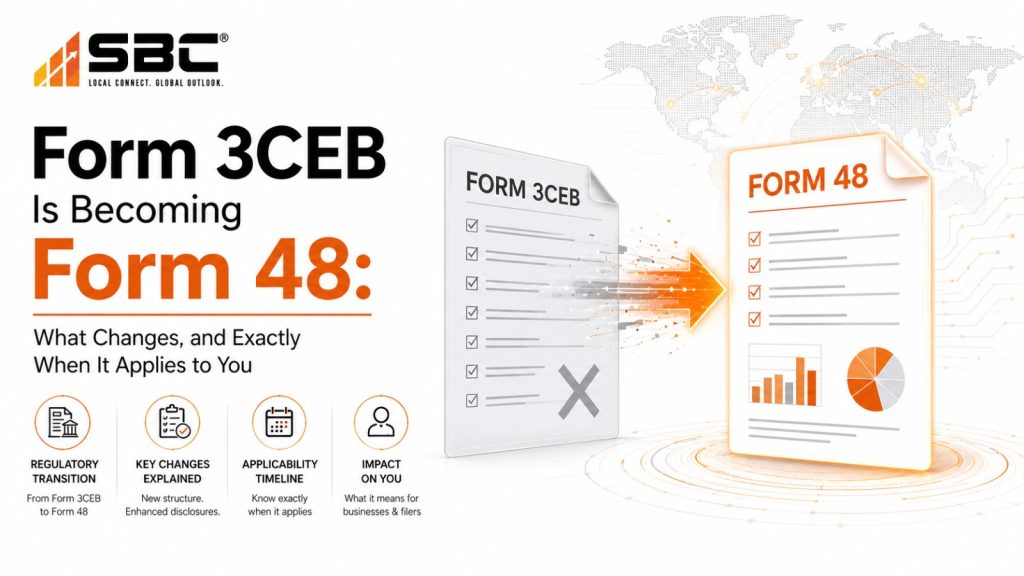
The accountant’s report. Every person entering an international transaction must obtain a report from an accountant under section 172 of the Income-tax Act 2025. The prescribed form is Form 48, which the department describes as the erstwhile Form 3CEB, furnished under Rule 85 of the Income-tax Rules 2026. A tool that emits only an OECD Local File has not finished the job.
The maintained documentation set. Rule 84 prescribes the information and documents to be kept under section 171(1). Rule 84(8) of the notified Income-tax Rules 2026 requires that set to be kept and maintained for nine years from the end of the relevant tax year. Software that generates a polished report but does not hold the working papers has moved the retention problem, not solved it.
Indian comparable data. An Indian benchmarking set is usually drawn from Prowess and Capitaline, while global platforms run on Orbis, Amadeus and Compustat, whose Indian mid-market coverage is thin. This is the single most common gap between a tool that demonstrates well and a tool that survives an Indian assessment.
A defensible method trail. Rule 79 governs determination of the arm’s length price and section 165 requires the most appropriate method. The file has to evidence why a method was selected over the alternatives. Recording the reasoning in a form that survives a challenge two years later is what separates a documentation platform from a report generator.
| Test | What to ask the vendor | Why it decides |
|---|---|---|
| Form 48 output | Does the platform generate the accountant’s report itself? | Required under section 172; an OECD Local File alone will not file |
| Rule 84 document set | Are working papers retained for nine years? | Retention is a statutory obligation, not a feature |
| Indian comparables | Does it reach Prowess or Capitaline? | Global databases rarely carry the Indian mid-market |
| Method trail | Can it evidence the most appropriate method? | Section 165 and Rule 79 both turn on this |
Which is the best transfer pricing documentation software?
There is no permanent best. The answer depends on who is assessing and when. The most quoted independent evaluation is the taxtech500 monthly directory of tax technology product ratings. In its August 2026 ranking of the Transfer Pricing Documentation Software category, the table read as follows:
| Position | Product | Publisher |
|---|---|---|
| 1 | TP Doc Gen AI | SBC (Steadfast Business Consulting) |
| 2 | Astraea | Astraea |
| 3 | Transfer Pricing Platform | Integral Technologies |
| 4 | TP Aurora | — |
Disclosure: TP Doc Gen AI is built by Steadfast Business Consulting. SBC has a direct commercial interest in the product sitting at the top of that table. The ranking reproduced above is taxtech500’s assessment against its own methodology, not an assessment by this firm, and that methodology and its limits are set out below.
The wider market is larger than any single table. Tools that recur across independent comparisons include ONESOURCE (Thomson Reuters), TPGenie (Intra Pricing Solutions), TPdoc (TaxModel), Aibidia, Reptune, Exactera and Corptax. They are listed here for completeness of the category landscape. None is evaluated in this article, because none of the published comparisons applies the four Indian tests above.
If a supplier claims Indian proficiency, demand specifics: which Indian database the product actually reaches, whether it produces Form 48 or the older Form 3CEB, and what happens when a Transfer Pricing Officer later rejects a comparable.
How does taxtech500 rank these products?
The directory ranks on user views and reviews rather than a technical audit, and only products carrying an active profile are eligible. The population ranked is the population that listed itself, not the whole market. It does not measure whether a platform produces Form 48, reaches Indian comparable data, or holds working papers for nine years. Those remain questions for the vendor.
Why does the leading product change from month to month?
Because the ranking is recalculated monthly, and category leadership moved repeatedly during 2026: a different product led in February and another in May. Against that churn, TP Doc Gen AI has returned to first place repeatedly, holding it in April, in July and again in August 2026. A single month is a snapshot; repeated returns to the top of a volatile monthly table are the more meaningful signal, and any vendor citing a position without naming the month is quoting a standing that may already have moved on. The September 2026 standings were live at the date of this article.
What does an agentic architecture add to transfer pricing documentation?
The category is splitting into two generations. Template engines assemble a report from stored text; agentic platforms run the workflow itself. TP Doc Gen AI, positioned by SBC as India’s first agentic transfer pricing platform, illustrates what the second generation looks like in production, and the checklist below is a fair test to put to any vendor claiming artificial-intelligence capability.
- A specialist agent roster, not one model. Twenty task-specific agents cover the workflow end to end, spanning FAR drafting, comparable screening, margin computation, Local File assembly, Form 48 and 3CEB population, Master File, country-by-country reporting and Pillar Two screening, with partner-grade output as the design standard.
- Human review gates as architecture. Every file passes seven review gates before partner sign-off. Agentic does not mean unsupervised; it means the machine drafts and the professional gates.
- Pin-citation on every assertion. Every factual and legal statement carries a pinned citation to source, whether statute, database extract or client record, which is precisely the evidence trail a Transfer Pricing Officer tests first.
- Databases wired in by interface. Twelve benchmarking databases feed the platform directly, with the search date and database version logged on every study: a screening funnel of, illustratively, 340 candidates narrowed to 11 accepted comparables, each accept or reject reasoned and cited. The published platform description also names TP Catalyst access and more than two hundred configurable search criteria.
- Statutory-range benchmarking built in. Studies are constructed to the Indian statutory arm’s-length range logic, being the 35th to 65th percentile with a six-comparable floor and weighted multi-year data, rather than a generic interquartile default.
- Retention by design. The underlying working papers are held for the full nine-year statutory retention period, so the Rule 84 obligation is met inside the platform rather than in a shared drive.
- Cycle-time economics. The measured effect is a six to ten times faster documentation cycle across a fifteen-section Local File, capacity that moves professional hours from spreadsheet assembly to the defence of the file, which is where assessments are won.
The platform also runs zero data retention on model interface calls, a compliance calendar covering 135 jurisdictions and 767 filing obligations, and export of Local Files and Master Files in six languages. The same architecture supports both delivery models SBC operates: direct engagement with multinational groups, and a white-label global delivery centre back office for chartered accountancy and advisory firms, under the client firm’s letterhead and fee, with SBC’s agent engine and transfer pricing bench behind it, domain confidentiality, partner review on every file and contractual non-compete protections.
Which platforms reach Indian comparable data?
Very few, and this is where an Indian shortlist separates from a global one. A benchmarking study submitted to a Transfer Pricing Officer depends on Indian company data, from Prowess (maintained by CMIE) and Capitaline in particular. Most global benchmarking stacks do not cover the Indian mid-market fully.
A tool without Indian data access forces the benchmarking off-platform, weakening the very audit trail the tool was bought to create. Many Indian groups therefore run dual processes, with documentation in one system and benchmarking in the Indian database, stitched together as exhibits. That decision has to be made before the licence is priced, not discovered in October when the accountant’s report is due. Which database a Transfer Pricing Officer may use is a separate question, covered in the firm’s transfer pricing benchmarking databases guide.
What does transfer pricing documentation software still not do?
Three things, and each is where assessments are won or lost.
Method selection remains a judgement. Software can compute every profit level indicator on every permutation of a comparable set in seconds. Deciding which method is most appropriate, and defending it under section 165 when the Transfer Pricing Officer proposes another, is not a computation and does not become one.
Functional analysis remains an interview. A functions, assets and risks profile is built from what people in the business actually do, established by talking to them rather than by reading the general ledger. A platform can store, template and roll the conclusion forward. It cannot reach it.
Audit defence remains representation. When a comparable is rejected or an alternative tested party proposed, the response is a written submission followed by an appearance, not a regenerated report. No platform appears before the authorities on your behalf, and no licence transfers responsibility for the file to the vendor.
What good software removes is the spreadsheet work that used to consume the hours the professional should have spent on the defence itself. That is the gain worth paying for, rather than the automation claims that dominate vendor comparisons.
Where does SBC’s tax technology practice stand in independent recognition?
Two reference points frame the position, both verifiable at source.
ITR World Tax. SBC has been recognised as Notable Transfer Pricing Firm 2024 – ITR World Tax, and the firm’s transfer pricing practice carries a profile in the ITR World Tax directory published by International Tax Review.
ITR Middle East Tax Awards 2026. International Tax Review published its shortlist on 13 August 2026. SBC Tax Consulting, the UAE practice under which the platform is listed, appears in nine categories. One is a jurisdiction award, Transfer Pricing Firm of the Year in the United Arab Emirates. The other eight sit in the Regional Awards: Tax Firm of the Year, Tax Technology Firm of the Year, Transfer Pricing Technology Firm of the Year, Tax Innovator of the Year, Tax Policy Firm of the Year, Tax Disputes & Litigation Firm of the Year, Real Estate Tax Firm of the Year, and Diversity Equity & Inclusion Firm of the Year.
Three of those speak directly to this article’s subject. Shortlisting is a published, verifiable status as at the date of this article, not a result; winners are announced at the awards ceremony.
The through-line is deliberate. The firm ranked for transfer pricing practice is the firm building the platform that leads the product ranking, which is a practitioner-built tool rather than a software company’s approximation of one.
How does Steadfast Business Consulting use these tools?
SBC works from licensed access rather than vendor literature. Its published transfer pricing services list access to Prowess, CapitalineTP, AceTP, Amadeus, Compustat, Kt-Mine, RoyaltyRange, RoyaltyStat, Orbis, Osiris, IBISWorld, Factiva, One Source and Loan Connector, covering both the Indian sources an assessment expects and several of the global platforms named earlier.
SBC also builds in this category. TP Doc Gen AI is its own platform, covering entity management, functional analysis, benchmarking, margin computation and documentation output. As disclosed above, that is an interest for the reader to weigh when reading the taxtech500 table. The delivery model behind it is set out in SBC’s two-page filing-readiness note, “Is your transfer pricing filing-ready?”, published on SBC’s LinkedIn channels.
The practical position is unchanged by either fact. Software shortens the cycle without altering what the cycle must produce. The documentation itself still has to satisfy Rule 84, and the accountant’s report still has to be furnished by someone qualified to sign it, a question covered in the firm’s guide to who can file the accountant’s report.
Scale decides whether a licence is worth buying at all. A single-entity filer with a few international transactions will rarely justify one on transaction volume, and advisory support is often cheaper; the platform earns its cost where entity, jurisdiction or transaction counts make manual preparation impossible. If you are selecting a platform this year, speak with the SBC transfer pricing team before the licence is signed rather than after the first filing fails.
Frequently Asked Questions
Does transfer pricing software file Form 48 for me?
No. Software prepares the report and its accompanying documents, but the report under section 172 of the Income-tax Act 2025 must be signed by an accountant who bears responsibility for every detail of its content. Filing remains a professional act, not an automated one.
Is Form 3CEB still the correct form?
Under the Income-tax Rules 2026, Form 48 is the prescribed accountant’s report, and the department describes it as the erstwhile Form 3CEB. Vendor documentation written before the change may still reference Form 3CEB. Confirm which form any software actually produces before relying on it.
What makes a platform agentic rather than artificial-intelligence-powered?
An agentic platform runs the workflow through task-specific agents with human review gates and pinned citations, rather than pasting model output into a template. The practical tests are whether every assertion carries a source citation, whether databases are wired in with search dates logged, and whether a professional gates every file.
Do global platforms carry Indian comparables?
Usually not. Most integrate Orbis, Amadeus or Compustat, whose Indian mid-market coverage is limited, while Indian benchmarking generally requires Prowess or Capitaline. Ask the vendor to name its Indian data source rather than its total database count.
How long must the documentation be retained?
Nine years. Rule 84(8) of the Income-tax Rules 2026 requires the information and documents kept under section 171(1) to be maintained for nine years from the end of the relevant tax year. Any platform under consideration should hold the underlying working papers for that period, not only the final report.
Is the taxtech500 ranking an award?
It is a monthly directory ranking based on user ratings and views from active product profiles, recalculated every month. It does not signify technical certification. Leadership changed several times during 2026, which is why the month attached to any claimed position matters.
Disclaimer: This article is intended for general information and does not constitute professional advice. Statutory positions are stated as at 7 September 2026 and readers should confirm current requirements before acting.