

Written by Jayasri P · Last updated 20 August 2026 · Statutory references current to the Income-tax Act 2025 and the Income-tax Rules 2026.
Quick Answer: An Indian subsidiary needs a FIN 48 transfer pricing opinion whenever the US parent cannot conclude that the Indian position is more likely than not to be sustained on examination. The trigger is the parent’s reporting obligation under ASC 740-10, not any Indian filing requirement, and the exposure measured is adjustment risk under section 165.
The Indian finance team is rarely the first to ask this question. It is usually posed in October or January by a group controller asked to support the consolidated tax accounts, who has just found an intra-group charge nobody has benchmarked since incorporation.
Looking for a transfer pricing consultant for an overseas parent company
A parent located overseas needs an adviser who can complete two separate assignments. The first is to defend the Indian position under Indian law, while the second is to quantify it in the form the parent’s reporting framework demands.
The two deliverables pull in opposite directions, since the Indian documentation file contends that the price is at arm’s length, while the FIN 48 opinion raises the question of how much of the claimed benefit would stand if that same file were examined by the Transfer Pricing Officer with complete knowledge of all relevant facts and no allowance for the chance of escaping scrutiny. An adviser who has never prepared the second document is more likely to produce advocacy, which audit teams do not accept as evidence.
What is a FIN 48 transfer pricing opinion?
It is a written analysis of how much of an Indian transfer pricing position may be recognised in the group’s consolidated accounts. FIN 48 is FASB Interpretation No. 48 on accounting for uncertainty in income taxes, now codified within ASC 740-10. It applies to every income tax position inside the consolidation.
Why does ASC 740-10 reach an Indian subsidiary at all?
Because the Indian entity is consolidated. A parent preparing its financial statements under US GAAP must account for the tax positions of every subsidiary it consolidates, which means the Indian position is recognised and measured under a US accounting standard even though the tax at stake is entirely Indian and will be assessed by an Indian officer applying Indian law long after the accounts are signed.
The financial statements of the Indian entity follow a different measurement model, and that difference is why a separate quantification exercise exists.
Which Indian positions usually qualify as uncertain?
Positions where the arm’s length price rests on judgement rather than on a rule. Formerly section 92C, section 165 of the Income-tax Act 2025 requires the price to be established by the most appropriate method under Rule 80; the method, the comparable set and every adjustment to it are matters of judgement, not arithmetic.
| Position | Why it carries uncertainty |
|---|---|
| Intra-group service charge with no benefit test | May be treated as duplicative or shareholder activity |
| Royalty for a group brand or licensed technology | Benchmarking rests on a narrow set of agreements |
| Interest on an inter-company loan | Currency, tenor and credit assumptions drive the rate |
| Corporate guarantee issued by the parent | Whether a fee is chargeable, and at what rate |
| Cost allocation from a shared services centre | Allocation keys and the mark-up on the cost base |
When does an Indian subsidiary actually need one?
Whenever the parent cannot conclude, on the technical merits, that the position is more likely than not to be sustained. That single threshold governs. The size of the Indian company is irrelevant to it.
Which circumstances make the requirement unavoidable?
- The entity has an international transaction with no contemporaneous benchmarking for the year
- A Transfer Pricing Officer has already proposed an adjustment on a position still being taken
- The pricing policy changed mid-year, or a new arrangement was introduced without a supporting study
- An appeal on a comparable issue is pending before the Dispute Resolution Panel or the Tribunal
- Specified domestic transactions exceed ₹20 crore for the tax year, bringing section 164 into play
In the Indian statutory sense, only the last of these qualifies as a threshold. International transactions carry no monetary threshold, so one management fee is enough to create a position the parent must evaluate. The materiality test is applied against the consolidated accounts, not the Indian balance sheet.
How is an Indian position recognised and measured?
In two steps, and the sequence cannot be varied. Recognition checks whether the position clears the threshold; measurement assesses how much benefit may be retained.
What does the recognition step ask?
Whether the position, by virtue of its technical merits, carries a greater than fifty per cent likelihood of being sustained. The standard assumes the tax authority will examine the position with full knowledge of every relevant fact, which removes detection risk and leaves only the strength of the underlying argument.
A position that would probably never be picked up in an Indian assessment earns no credit for that obscurity. Technical merit is the only currency accepted here.
How is the measurement step performed?
By taking the maximum benefit carrying a greater than fifty per cent probability of being realised upon settlement. Possible outcomes are listed from the most favourable downwards, cumulative probabilities are assigned to each, and the amount recognised is the point at which the running total first crosses fifty per cent.
Measurement cannot end with the primary adjustment, since an Indian transfer pricing adjustment carries consequences well beyond the tax on the adjusted figure. If the primary adjustment is not repatriated within the prescribed period, section 170 read with Rule 83 treats the excess sum as an advance and imputes interest on it year after year, as set out in the implications of a secondary adjustment. Documentation failures attract a penalty of two per cent of the transaction value under section 442. Failure to provide the information requested during the proceedings attracts a further penalty under section 457, dealt with in transfer pricing penalties.
What documentation does the opinion rest on?
On the same file that defends the position in India, together with the analysis that Indian file does not carry. The opinion holds only as much weight as the record beneath it.
| Source document | What the opinion draws from it |
|---|---|
| Documentation under section 171 read with Rule 84 | Functional analysis, method selection and the comparable set |
| The accountant’s report in Form 48 under section 172 | Every transaction reported and the method certified |
| Inter-company agreements | Whether the legal terms match the conduct actually priced |
| Prior assessment and appellate orders | Positions the department has already tested |
| Master File under section 171(4); Country-by-Country report under section 511 | Consistency with the narrative filed elsewhere |
The Central Board of Direct Taxes confirms that Form No. 48 is the report from an accountant furnished under section 172 covering international transactions and specified domestic transactions. That report fixes the method certified for each transaction. An analysis under FIN 48 that assumes a different method will not withstand examination by the parent company’s audit team.
Why does the US audit calendar not match the Indian assessment cycle?
Because the two run on entirely different timelines, and the gap between them is measured in years rather than weeks. The parent records a position long before India rules on it.
An American parent that closes its accounts in December discloses the uncertain tax position within weeks of that year end, while the Indian tax year ends on 31 March. The accountant’s report falls due at least one month before the due date for filing the return of income under section 263(1), the return is taken up afterwards, and only then does the Assessing Officer refer the matter to the Transfer Pricing Officer, who determines the arm’s length price by an order in writing under section 166. Where such a reference is made, the time limit for completing the assessment is extended by twelve months.
| Event | When it happens |
|---|---|
| Parent’s financial year ends and the position is disclosed | within weeks of year end |
| Indian tax year ends | 31 March |
| Accountant’s report in Form 48 furnished | one month before the return due date |
| Reference made to the Transfer Pricing Officer | after the return is taken up |
| Transfer Pricing Officer determines the arm’s length price | assessment extended by twelve months |
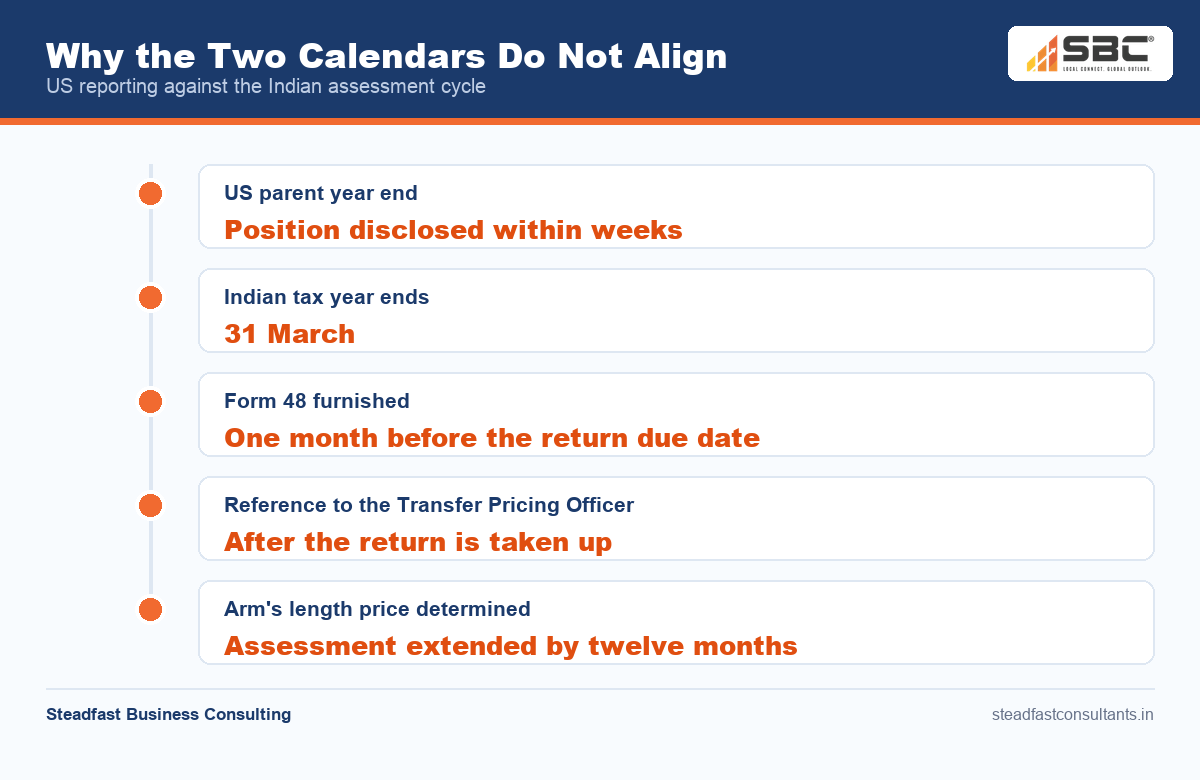
A single uncertain position therefore stays on the parent’s balance sheet across several reporting periods, passing through the reconciliation of unrecognised tax benefits as new evidence arrives. What the officer does with an unsettled position is explained in the transfer pricing assessment procedure.
How can a group shorten that exposure period?
By settling the price in advance. Two mechanisms do that: safe harbour under section 167, and an advance pricing agreement under section 168, where the Board may agree the arm’s length price with a taxpayer prospectively.
What is a transfer pricing comfort letter, and who is it for?
This memorandum is prepared for the audit team examining the Indian entity’s financial statements at year end. It states the transfer pricing position, the grounds of the tax charge and the reasoning behind any provision carried.
Steadfast Business Consulting (SBC) provides the audit team with these memoranda and supports the entity through the audit process. SBC does not audit the financial statements, and the comfort letter is an input into the audit rather than a part of the assurance opinion, which is why the memorandum states the basis of each conclusion instead of asserting it.
How does a comfort letter differ from a FIN 48 opinion?
The audience differs, and so does the standard applied. A comfort letter answers questions raised during the audit of the Indian entity’s own accounts, whereas the FIN 48 opinion feeds the parent company’s consolidated tax accounts and applies a US measurement model to an Indian position, which is why a group that has commissioned only one of the two documents usually finds the other requested within the same reporting season by the same audit team.
How should an overseas parent choose an Indian adviser?
Look for benchmarking capability, database access and genuine representation experience, because credentials on the letterhead count for far less than the file the adviser can defend.
The market includes global network firms, established domestic practices and specialist boutiques, and firms such as Deloitte, EY, Grant Thornton, BDO, Nangia and Dhruva are active in it. No firm is best in the abstract. The questions worth asking are narrower than the marketing suggests: which comparable databases the firm licenses, whether it has argued positions before the Transfer Pricing Officer and the Dispute Resolution Panel, and whether anyone on the team has produced an opinion an audit team accepted.
Which credentials and databases does SBC hold?
SBC was recognised as a Notable Transfer Pricing Firm 2024 by ITR World Tax, and is a member of PrimeGlobal, an association of more than three hundred independent firms across over one hundred countries. The team holds access to the comparable databases this work depends on, including Prowess, CapitalineTP, Amadeus, Orbis and RoyaltyRange, and provides transfer pricing services in India covering documentation, the accountant’s report, exposure quantification and representation.
If the audit is already running and the Indian position has not been reviewed this year, that review is the work to commission first. Ask the SBC transfer pricing team for a position assessment before the numbers are finalised.
Frequently Asked Questions
Is a FIN 48 opinion required under Indian law?
No. It arises from the US parent’s responsibilities under ASC 740-10, not from the Income-tax Act 2025. Indian law requires documentation under section 171 and the accountant’s report under section 172, and those obligations stand regardless.
Does a completed benchmarking study remove the uncertainty?
Not by itself. A study supports the recognition analysis, but the position must still meet the more-likely-than-not threshold on its technical merits. Weak comparables, an unsupported method or conduct deviating from the agreement can leave the position below that threshold.
Can detection risk be taken into account?
No. Under ASC 740-10 the tax authority is assumed to understand all relevant information fully when it examines the position. The possibility of avoiding scrutiny in an Indian assessment is therefore excluded entirely.
Does an advance pricing agreement help the FIN 48 position?
Yes. An agreement under section 168 determines the arm’s length price for the covered tax years, which converts a judgemental position into a settled one and releases the previously unrecognised benefit.
Who prepares the opinion, the Indian adviser or the US tax team?
Usually both. The Indian adviser examines the position under Indian law and quantifies the adjustment, interest and penalty exposure. The US tax team then applies the recognition and measurement model to that input.
Does the Indian entity need a comfort letter every year?
Wherever related-party transactions continue, yes. The audit team analyses the tax charge each year, and the transfer pricing basis of that charge must be explained afresh whenever the policy, the transaction set or the assessment position has moved.