
Written by Jayasri P · Last updated 17 August 2026 · Statutory references current to the Income-tax Act 2025 and the Income-tax Rules 2026.
Quick Answer: An Indian global capability centre or captive unit supplies services to its overseas parent, and that supply is an international transaction which must be priced at arm’s length. The functional and risk profile of the unit decides whether it is remunerated as a routine service provider or as an entity entitled to a share of residual profit.
Almost every India global capability centre begins with the same commercial story. A parent outside India needs engineering, finance, analytics or support capacity, incorporates an Indian subsidiary and pays a mark-up on its costs. The Indian entity carries no customers of its own and bears no market risk, so a routine cost-plus return is defensible on that description, and for the first several years it usually is.
The difficulty arrives later, because growth in a capability centre is rarely lateral: product ownership migrates, research teams are built in India rather than seconded to India, and decisions that once travelled to headquarters are now taken in Hyderabad, Pune or Bengaluru. The pricing model is renewed each year by copying the previous year.
What makes a GCC or captive unit a transfer pricing matter at all?
The supply of services by an Indian captive service provider to a non-resident group company is an international transaction, because Section 163 of the Income-tax Act 2025 carries forward the definition in Section 92B of the Income-tax Act 1961, which governs earlier years, and both require associated enterprises with one of them non-resident.
That single test opens everything else. No exemption applies to an entity that never deals with third parties, and none to a margin fixed by an intercompany agreement rather than by negotiation, so the arm’s length price and the assessment exposure that comes with it depend entirely on how the Indian entity is characterised.
How does the FAR profile decide the characterisation?
Characterisation follows a functional and risk analysis, and examining the functions each party performs, the assets it uses and the risks it assumes identifies the party with the simpler profile, which becomes the tested party.
A routine service provider is remunerated for effort. An entity which directs strategy, controls significant risk and drives the creation of valuable intangibles is remunerated for outcome. The distance between those two returns is the entire subject matter of a captive unit dispute.
The table below sets out both ends. Most capability centres more than five years old sit between the columns, and the useful question is which column the current transfer pricing file quietly assumes.
| Comparison point | Routine captive unit | Unit that has moved up the value chain |
|---|---|---|
| Functions performed | Executes work scoped and prioritised by the parent. No customer contact, no product decisions. | Defines the product roadmap, sets technical direction, manages global delivery and owns customer outcomes. |
| Risks assumed | Bears essentially none. Costs are reimbursed and market risk sits with the parent. | Bears risks it has the capacity to absorb and the authority to control. |
| Who owns the intangible | Legal title rests with the parent, which also performs the development, enhancement, maintenance, protection and exploitation functions. | Legal title may rest with the parent, but the substantive development functions are performed in India. |
| Pricing consequence | A mark-up on a fully loaded cost base is defensible, with no residual profit. | A cost-based return understates the contribution and the profit the entity generates. |
What is characterisation drift, and why does it create adjustments?
Characterisation drift is the slow movement of a captive unit from the left column to the right while the intercompany agreement, the mark-up and the transfer pricing study stay in the left, and it is the largest single driver of adjustments at Indian capability centres.
Drift is not a single event and no board resolution records it. A delivery team that performs well is given more scope, and that scope is steadily more valuable than the scope before it.
Why must the functional analysis be refreshed rather than rolled forward?
Because a rolled-forward analysis describes an entity which no longer exists. The functional description in most captive files is written once, when the unit is established, and then reproduced annually with only the year changed.
Refreshing the analysis means interviewing the people who actually do the work rather than the people who signed the agreement, asking who decides what gets built, where an escalation is finally resolved, and whether headquarters is informed or consulted.
Where the answers have changed, the documentation must change with them. A functional analysis contradicted by the organisation chart, the job titles and the appraisal criteria is the weakest position to defend.
Who owns the intangible when the development work happens in India?
Legal title and economic entitlement are separate questions, and only economic entitlement sets the price. Where an Indian team performs the development, enhancement, maintenance, protection and exploitation functions relating to an intangible, registration in the name of the parent does not by itself settle who is entitled to the return.
Capability centre files are most exposed here. Software, platforms, algorithms and process know-how are built in India by Indian employees, funded through a cost-plus arrangement, and then recorded as parent-owned, yet the internationally accepted analysis, reflected in the transfer pricing guidance published by the Organisation for Economic Co-operation and Development, asks who performs and controls those functions rather than who holds the registration.
How is the arm’s length price determined for a captive service provider?
Section 165 of the Income-tax Act 2025, which replaces Section 92C of the Income-tax Act 1961 for years governed by the new Act, requires the arm’s length price to be determined by the most appropriate method, chosen for the nature of the transaction, the availability of reliable comparable data and the adjustments that data requires.
For a routine captive, a net margin method applied to an operating cost base is the usual outcome, because comparable uncontrolled prices for bespoke intragroup services rarely exist. The tested party is the Indian entity, since its profile is the simpler one.
The Assessing Officer may refer the matter to the Transfer Pricing Officer under Section 166 of the Income-tax Act 2025, which replaces Section 92CA of the 1961 Act. These notes on transfer pricing assessment procedure set out how that reference runs.
Two questions about the cost base decide most captive adjustments. The first is whether a pass-through cost has been left inside the base on which the mark-up is computed, and the second is whether the base is genuinely full, carrying share-based payments, every allocated group charge and depreciation on assets used in India.
Does the safe harbour route remove the dispute?
Safe harbour buys certainty, not accuracy. Section 167 of the Income-tax Act 2025, which carries forward Section 92CB of the Income-tax Act 1961, empowers the Board to prescribe the circumstances in which the authorities accept the price declared by an eligible assessee without further enquiry.
Where an eligible Indian captive opts in and meets every prescribed condition, the declared price stands, with no Transfer Pricing Officer reference, no comparable search and no adjustment.
What it costs is flexibility. A safe harbour is an option the taxpayer exercises rather than a right, the conditions are set by the Board rather than negotiated, and accepting them means accepting a return which may sit above a properly benchmarked arm’s length outcome.
What margins does Rule 89 set for a GCC?
Rule 89 of the Income-tax Rules 2026 carries the margins that decide the answer for a capability centre. Sub-rule (1) provides that where the option has been validly exercised under Rule 90 and the declared price accords with the circumstances in sub-rule (2), the price declared shall be accepted, removing the comparable search, the Transfer Pricing Officer reference and the appeal cost that would otherwise follow that transaction. Rule 86 carries the definitions, Rule 87 defines the eligible assessee and Rule 88 lists the eligible international transactions. The separate safe harbour for specified domestic transactions at Rules 94 to 98 is not open to a capability centre, since it reaches only electricity supply and milk co-operatives.
Every threshold below is expressed as operating profit over operating expense, and each is a floor.
| Eligible international transaction under Rule 88 | Circumstance under Rule 89, sub-rule (2) |
|---|---|
| Provision of information technology services, being software development, information technology enabled services, knowledge process outsourcing, or contract research and development relating to software development | Operating profit margin not less than 15.5%, where the aggregate operating revenue of the transaction for the tax year does not exceed ₹2,000 crore |
| Provision of data centre services | Operating profit margin not less than 15% |
| Contract research and development relating to generic pharmaceutical drugs | Operating profit margin not less than 24%, where aggregate operating revenue does not exceed ₹300 crore |
| Receipt of low value-adding intra-group services | Aggregate amount not exceeding ₹10 crore including a mark-up not exceeding 5%, with the cost pooling, the exclusion of shareholder and duplicate costs and the allocation keys certified by an accountant |
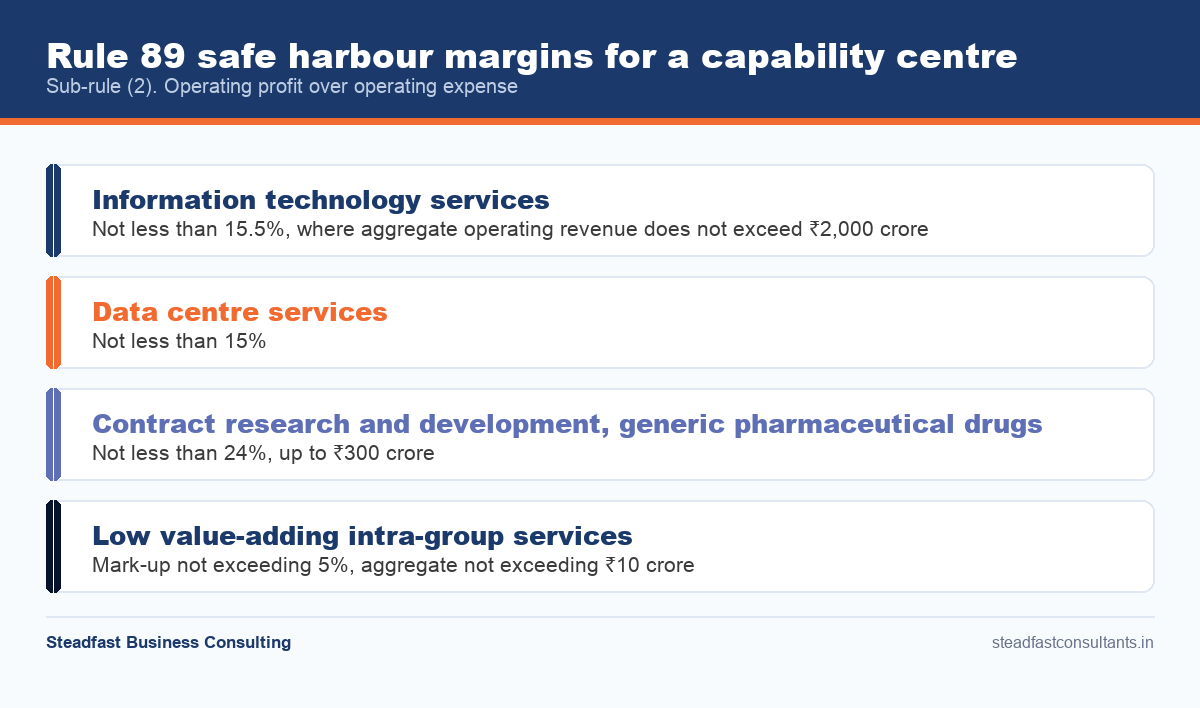
The four activities a capability centre is most likely to perform now sit inside one category and take one margin. Under the Income-tax Rules 1962 they were priced separately, and the difference between them was the whole of the risk.
What changed for a capability centre under the 2026 Rules?
Four things, and the first two remove an argument that used to dominate these files.
Software development, information technology enabled services, knowledge process outsourcing and contract research and development relating to software development are now a single eligible transaction under Rule 88, taking one margin of 15.5%. The separate thresholds of 20%, 22%, 25% and 30% are gone, as are the employee cost bands that sat beneath the knowledge process outsourcing rate.
The value ceiling moved from ₹500 crore to an aggregate operating revenue of ₹2,000 crore, which brings a materially larger centre inside the election. Data centre services entered the table for the first time at 15%.
Rule 89 also applies for a block period of three tax years commencing with the tax year 2026-2027, and sub-rule (5) bars any comparability adjustment to a price accepted under the election. Sub-rule (6) preserves the documentation and accountant’s report obligations under Sections 171 and 172 whether or not the option is exercised.
How long does the election bind you?
For information technology services, five consecutive tax years.
Rule 91 provides that where the option is exercised for that transaction and is validly made, it continues in force for five consecutive tax years, and the ₹2,000 crore threshold is tested for the first of those years. The option is made in Form No. 49 under Rule 90, on or before the due date for furnishing the return.
That length is the new commercial question. A centre electing in the tax year 2026-2027 is committing to a 15.5% margin through a period in which its functions may change considerably, and the threshold test is fixed at the start rather than reassessed annually.
Which rules apply to the tax year being filed?
That has to be settled before a single number above is used. The Income-tax Rules 2026 took effect on 1 April 2026 and govern the tax year 2026-2027 onward. Earlier tax years remain with the Income-tax Rules 1962, where the margins ran from 20% to 30% by category, the value ceiling was ₹500 crore and a separate later table carried lower rates by employee cost band. Never blend the two. SBC has published a working guide to safe harbour rules under Indian transfer pricing regulations and an update on the amendments the CBDT has made to those rules.
Does characterisation drift still threaten the safe harbour?
It threatens it differently, and the change is worth understanding rather than assuming the old risk survives.
Under the Income-tax Rules 1962 the margin attached to a narrow category, so drift from information technology enabled services into knowledge process outsourcing moved the floor from 20% to 25% and a centre could be five points short without changing a contract. Rule 88 collapses those four activities into one, so movement among them no longer moves the margin.
Three exposures replace it. Drift out of Rule 88 altogether is the first, because a centre that takes on functions falling outside the listed activities has no eligible transaction to elect on. Growth through the ₹2,000 crore aggregate operating revenue ceiling is the second, and Rule 91 fixes that test at the first of the five covered years rather than reassessing it annually. The third is the one the election cannot cure: where the functional analysis puts the centre on the entrepreneurial side, a prescribed routine margin understates the return whatever the table says.
The safe harbour margin is therefore still a test the functional analysis must pass, but the question has changed from which category you fall into to whether you remain inside the election at all.
The decision is arithmetic. Model the return under the notified terms against the benchmarked return, add the cost and probability of a contested assessment, then choose on the total.
When is an advance pricing agreement the better route?
An advance pricing agreement removes uncertainty from a recurring transaction for a fixed run of years, and Section 168 of the Income-tax Act 2025, carrying forward Section 92CC of the 1961 Act, allows the arm’s length price or the method of determining it to be agreed in advance. Section 169, carrying forward Section 92CD, governs the effect of that agreement on returns already filed.
For a capability centre whose functions are visibly expanding, the process itself carries value. Reaching an agreement requires the group to describe, on the record, what the Indian entity actually does, and that description usually reveals the drift long before an officer does. The trade-off is time and disclosure.
What documentation must a GCC maintain?
Section 171 of the Income-tax Act 2025 requires contemporaneous documentation and carries forward Section 92D of the Income-tax Act 1961, while Section 172 requires the accountant’s report on international transactions and carries forward Section 92E.
For a captive unit, the documentation that matters most is the part practitioners treat as narrative. That means the functional analysis, the intercompany agreements, the description of who controls which risk, and the evidence that the description is accurate. A weak comparable set is easier to defend than a functional story the organisation itself contradicts.
Collect that evidence with the study rather than reconstructing it two years later. Organisation charts, appraisal systems, approval matrices and escalation paths turn an assertion into a position. This summary of Indian transfer pricing compliances sets out the full annual cycle.
Who provides transfer pricing services for a global capability centre?
Work of this kind needs functional analysis and assessment experience together, because the characterisation has to be argued rather than merely computed. Steadfast Business Consulting (SBC) lists global capability centres among the sectors it serves and provides transfer pricing services in India from its Hyderabad, Mumbai, Pune and Dubai offices.
The team page records that SBC was founded by Big 4 alumni carrying a combined 150 or more years of experience, and ITR World Tax named the firm a Notable Transfer Pricing Firm in 2024.
Ask any prospective adviser two questions. Ask how they refresh a functional analysis rather than roll it forward, and whether they have carried a captive matter through a full assessment. You can take a specific fact pattern to SBC for a characterisation review.
A captive remunerated on a cost-plus basis should also settle whether an ESOP cross-charge belongs in the cost base before the margin is computed.
A related question is whether a captive must share the group’s location savings, on which India has published its own position.
Frequently Asked Questions
Is a captive unit automatically a routine service provider?
No. Routine characterisation is a conclusion drawn from the functions performed, assets employed and risks assumed, not a status conferred by the corporate structure, and a wholly owned captive which sets product direction, controls significant risk and builds intangibles in India is not routine, whatever the intercompany agreement records.
How often should a GCC refresh its functional analysis?
Annually, and immediately after any material change in scope. New product ownership, a new leadership layer, a shift in decision rights or an India-based research team each warrant a fresh review.
Does the parent holding legal title settle the intangible question?
No, because legal title and economic entitlement are separate questions. Where the Indian entity performs and controls the development, enhancement, maintenance, protection and exploitation functions relating to an intangible, entitlement to the return follows that conduct rather than registration.
What is the practical benefit of safe harbour for a captive?
The benefit is certainty. Sub-rule (1) of Rule 89 states the bargain plainly: where the option has been validly exercised under Rule 90 and the declared price accords with the circumstances in sub-rule (2), the transfer price declared by the assessee shall be accepted.
What margin must a captive declare under safe harbour?
It depends on the category. Under sub-rule (2) of Rule 89 of the Income-tax Rules 2026, information technology services, which covers software development, information technology enabled services and knowledge process outsourcing together, require operating profit over operating expense of not less than 15.5% where aggregate operating revenue does not exceed ₹2,000 crore. Data centre services require 15%.
Should a GCC choose safe harbour or an advance pricing agreement?
Safe harbour suits units whose profile is genuinely routine and which value administrative certainty above precision. An advance pricing agreement suits material, recurring arrangements where characterisation is uncertain and the group is prepared to invest several years in resolving it.
Which sections govern transfer pricing documentation for a GCC?
Section 171 of the Income-tax Act 2025 requires the documentation and Section 172 requires the accountant’s report on international transactions, and both carry forward Sections 92D and 92E of the Income-tax Act 1961, which continue to govern earlier years.