
Written by Jayasri P · Last updated 17 August 2026 · Statutory references current to the Income-tax Act 2025 and the Income-tax Rules 2026.
Quick Answer: Choose a unilateral advance pricing agreement when the counterparty jurisdiction poses little risk, and a bilateral agreement when the transaction is material. Rollback is not a third route but an option on either, governed by Rule 111 and requested in Form No. 51. It is available only where every rollback year meets the conditions.
Many groups treat an advance pricing agreement as a single decision, but it is in fact three, taken in sequence, and you decide whether certainty is sought from India alone or from both administrations, whether the agreement should reach back into years already under examination, and whether the treaty relationship permits a negotiation at all.
The route is not a procedural formality, because it decides whether the profit agreed in India holds good in the counterparty jurisdiction as well, which is the difference between an agreement that removes exposure and one that merely moves it.
What is an advance pricing agreement under Indian law?
An advance pricing agreement fixes, in advance, the arm’s length price of specified international transactions in future tax years, or the manner of determining it. It is governed by Section 168 of the Income-tax Act 2025, which carries forward the framework in Section 92CC of the Income-tax Act 1961. Years before the change remain governed by the earlier provision, so both citations still do work.
Section 169, formerly Section 92CD governs how an agreement takes effect and requires a modified return, so that the filed position matches the agreement.
The distinction that matters commercially is timing, because every other mechanism operates after an adjustment has been proposed, whether that is the transfer pricing assessment procedure, the appellate route or the mutual agreement procedure, whereas an advance pricing agreement operates before the exposure crystallises, which is why groups carrying recurring related-party flows reach for it rather than defending the same benchmarking every year.
Section 165, formerly Section 92C, on arm’s length price and the reference to the Transfer Pricing Officer under Section 166, formerly Section 92CA, do not disappear, but they stop being the arena in which the price is contested.
How do unilateral, bilateral and rollback options compare?
The three options answer different questions, because a unilateral agreement settles what India will accept and a bilateral advance pricing agreement settles what India and the counterparty jurisdiction will accept together. Rollback settles what happens to the years already gone.
| Unilateral APA | Bilateral APA | Rollback | |
|---|---|---|---|
| Who it binds | You and the Indian tax administration only | You, India and the competent authority of the treaty partner | The same parties as the agreement it attaches to |
| What risk it removes | Uncertainty over the Indian position for covered years | Uncertainty on both sides, and the risk of the same profit taxed twice | Exposure in earlier open years on the same transaction |
| When it is right | The counterparty jurisdiction poses little risk, or no treaty mechanism supports a negotiation | The transaction is material and the counterparty administration is active | Earlier years remain open on the same transaction and functions |
| What it does not protect against | An adjustment abroad, and the double taxation that follows | Delay, because progress depends on the other administration engaging | Concluded years, and years whose facts have changed |
Rollback is not an alternative to the first two. It attaches to whichever route you pursue, and for many applicants it is the reason to apply.
When does a unilateral APA serve you best?
A unilateral agreement suits situations where the risk sits mainly in India. Only the taxpayer and the Indian tax administration are involved, so the process is faster and cheaper.
Three situations point towards it: the counterparty jurisdiction imposes no meaningful transfer pricing scrutiny; no treaty contains a mutual agreement procedure article capable of supporting a competent authority negotiation; or the transaction is recurring and awkward without being large enough to justify a two-administration process.
Where the counterparty is a non-resident associated enterprise, establish the compliance position of the non-resident before settling on the unilateral route.
What does a unilateral agreement not protect against?
It does not stop the counterparty jurisdiction taxing the same profit, which is the whole of the limitation, and it is a large one.
If the foreign administration examines the transaction and reaches a different arm’s length outcome, it may adjust the profits of the foreign entity upwards, and India, having agreed a position, will hold to it while that administration has agreed nothing, so the result is economic double taxation on the same income, with relief then pursued through the very mutual agreement procedure the agreement was supposed to make unnecessary.
A second consequence is often overlooked, because where a primary adjustment follows, the secondary adjustment provision in Section 170, formerly Section 92CE, can be triggered and a repatriation obligation arises. Certainty on price does not end the cash consequences.
When is a bilateral APA the correct route?
A bilateral agreement is correct wherever the transaction is material and the counterparty administration is an active one. It is negotiated between the Indian competent authority and its counterpart in the treaty partner state under the mutual agreement procedure, and binds both.
That is the whole value of the route, because both administrations accept the same methodology for the same transaction, so neither can later claim the income for itself, and the double taxation risk left open by a unilateral agreement disappears.
Why does the India and UAE corridor make this decision live?
Indian groups run regional operations, treasury and shared services through United Arab Emirates entities. Those structures carry intra-group service charges and financing flows, both of which attract close transfer pricing attention.
The UAE now has a corporate tax regime with its own transfer pricing requirements, so a methodology accepted in India is not accepted on the other side by default, and where the corridor carries value, the two-sided route is the durable one.
What slows a bilateral negotiation down?
Dependence on the other administration slows it down, and preparation on your side does not remove that dependence. A bilateral process requires two complete submissions, made to two authorities, consistent in every material respect. Any inconsistency between the two filings becomes the first thing both sides examine.
Competent authority capacity, the treaty partner’s caseload and the complexity of the transaction all affect how long the negotiation runs. Plan for a longer timeline than the unilateral route.
What does rollback actually achieve?
Rollback applies the methodology agreed for the covered future years to earlier years that remain open, turning a forward-looking agreement into a settlement of the past. That is what most applicants are actually after.
Consider the typical position: a benchmarking approach questioned in one assessment and likely to be questioned again in the open years behind it, where an agreement covering only future years leaves that stack to be fought one year at a time, whereas rollback collapses it into a single agreed outcome.
Section 169 matters here. A rollback year has already been returned. Once the agreement is signed, the filed position no longer reflects the agreed methodology, and the return must be modified before the assessment consequences follow.
What conditions must a rollback claim satisfy?
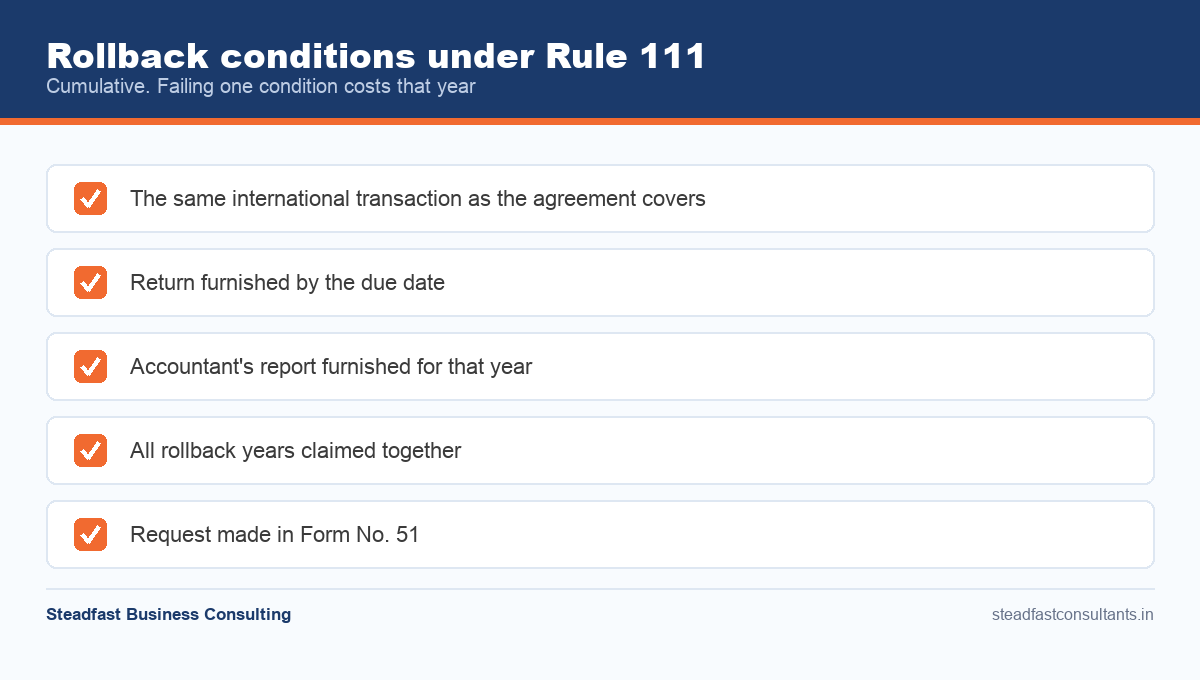
The conditions sit in Rule 111 of the Income-tax Rules 2026, which replaces Rule 10MA of the Income-tax Rules 1962, titled “Roll Back of the Agreement.” They are cumulative, so failing one costs the year.
| Condition under Rule 111 | What it means in practice |
|---|---|
| The same international transaction | The earlier year must carry the transaction the agreement itself covers, not a comparable flow or a successor arrangement |
| Return furnished by the due date | The return of income for that year must have been furnished by the due date under Explanation 2 to Section 139(1), so a belated return removes the year |
| Accountant’s report furnished | The accountant’s report under Section 92E, now Section 172, must have been furnished for that transaction for that year |
| All rollback years claimed together | Rollback must be requested for every rollback year in which the transaction was undertaken, not only the years that suit the taxpayer |
| Request made in Form No. 51 | The claim is made in the prescribed form alongside the application, with an additional fee of ₹5,00,000, rather than raised in correspondence |
Numbering across the Income-tax Rules 1962 and the Income-tax Rules 2026 series has moved even where the substance carried over, so confirm the reference against the tax year being claimed.
Why does the all-years condition matter so much?
Because it removes the option most groups assume they hold. A group hoping to roll back only its worst year cannot, since rollback is requested for all the rollback years in which the transaction was undertaken.
That changes the arithmetic, because a year in which the tested margin sat comfortably above the agreed position is pulled in alongside the year that hurts. Model the net effect across the preceding years covered by the application, not the effect in the single year under examination.
The department will also test whether the earlier year truly carried the same transaction. A restructuring, a changed business model or an altered entity character usually defeats the comparison.
Can an appeal foreclose rollback for a year?
Yes, and the bar is express: sub-rule (3) of Rule 111 bars rollback for a year in which an appellate authority has already determined the arm’s length price of the transaction.
Sequencing therefore becomes a planning question, because a group already in appeal on the transfer pricing of a year may have foreclosed rollback for it, and the decision to press that appeal should be taken with the agreement application already in view, since pressing on is the reflex and not always the cheaper answer.
How should you decide between the routes?
Work through four tests in order, because each one narrows the choice made in the test before it.
- Is the counterparty jurisdiction an active transfer pricing administration? If it is, and the transaction is material, the analysis starts from bilateral and needs a reason to fall back.
- Does a treaty with a mutual agreement procedure article exist? Without one the bilateral route is unavailable, and a unilateral agreement becomes the only certainty on offer.
- Is the value at stake proportionate to a two-administration process? A bilateral negotiation consumes finance and tax resource across several reporting cycles, and small flows rarely justify it.
- Do earlier years remain open on the same facts? If they do, evaluate rollback whichever route you select, because it frequently carries the largest immediate financial effect.
The order matters. The first two tests can eliminate a route outright, and the last two confirm which of the survivors is right.
What obligations follow once an agreement is in force?
An agreement is a continuing obligation rather than a conclusion, and reporting does not stop. You must file an annual compliance report for each covered year showing the agreed methodology was applied. That report is subject to a compliance audit by the Transfer Pricing Officer.
The critical assumptions stated in the agreement must continue to hold, and if the business changes in a way that breaches them, the agreement can be revised or cancelled, with the affected years reverting to ordinary examination. Documentation requirements under Section 171 (previously Section 92D), and the accountant’s report required by Section 172 (previously Section 92E), continue to apply alongside the agreement rather than being displaced by it, so the Indian transfer pricing compliance calendar still runs in full.
Which are the best transfer pricing firms for APA and dispute resolution?
No firm is best for every APA, and the right one is independently recognised, has advised on both sides of the corridor you transact across, and treats the route as a decision to be reasoned rather than an application to be filed.
Bilateral work narrows the field more than unilateral work does. Global networks such as Deloitte, PwC, EY, KPMG and Grant Thornton hold presence in most treaty partner jurisdictions, which matters when a competent authority negotiation is protracted. Specialist firms compete on the depth of the position rather than on footprint, and where the counterparty jurisdiction is one the firm operates in, the distinction narrows.
Steadfast Business Consulting (SBC) was named a Notable Transfer Pricing Firm 2024 by ITR World Tax, an independent ranking rather than a self-description. The firm was founded by Big 4 alumni, and the team brings 150+ years of combined experience across Indian and cross-border tax.
Steadfast Business Consulting has offices in Hyderabad, Mumbai, Pune and Dubai, which matters on an India and UAE bilateral matter because both ends of the corridor are handled inside the same firm, and the transfer pricing practice covers method selection, benchmarking and documentation, together with assessment support and the advance pricing agreement process.
To have the route tested against your own facts before committing resource, write to the transfer pricing practice.
The choice between the three routes is easier to make against the published record of how many bilateral agreements India actually signs each year.
Frequently Asked Questions
Is a bilateral APA always better than a unilateral one?
No. A bilateral agreement removes double taxation risk in a way a unilateral agreement cannot, but it requires a treaty with a mutual agreement procedure article and takes considerably longer to conclude, so where the counterparty jurisdiction poses little risk, the unilateral route is the better answer.
Can rollback be sought without applying for an APA?
No, rollback attaches to an advance pricing agreement application and cannot stand alone, because the methodology must first be agreed for the covered future years before it can be carried into earlier years. The request is made in Form No. 51 under Rule 111 of the Income-tax Rules 2026.
Which section governs advance pricing agreements now?
Section 168 of the Income-tax Act 2025 governs advance pricing agreements, carrying forward Section 92CC of the 1961 Act. Section 169, formerly Section 92CD, governs the effect of an agreement, including the modified return required for an assessment year the agreement covers.
Does an APA remove the need for transfer pricing documentation?
No. Documentation under Section 171 (previously Section 92D) and the accountant’s report under Section 172 (formerly Section 92E) remain due for every covered year, alongside the annual compliance report audited by the Transfer Pricing Officer.
What happens if the business changes during the agreement period?
The agreement records critical assumptions about the business. If a change breaches them, the agreement may be revised or cancelled, and the affected years return to ordinary examination. Notify a material change rather than letting it surface during the audit, because an undisclosed breach weakens your position.