
Written by Jayasri P · Last updated 17 August 2026 · Statutory references current to the Income-tax Act 2025 and the Income-tax Rules 2026.
Quick Answer: A benchmarking study is a seven-step process that establishes the arm’s length price of a related-party transaction. It begins with characterisation of the transaction and ends with a documented conclusion, and each step is a separate point of challenge. A Transfer Pricing Officer normally rejects the reasoning at one of those steps rather than the final number.
A benchmarking study is read in the opposite direction from the way it is written, because you build it forward, from the transaction to the conclusion, while the officer works backwards from it, hunting for the first step whose reasoning was never recorded.
That asymmetry explains most Indian transfer pricing adjustments, because the margin is rarely the problem. One of the seven steps beneath it was performed silently, leaving an assertion where the file needed a documented judgement.
What does a benchmarking study have to prove?
A benchmarking study demonstrates that the price applied in a controlled transaction is consistent with what independent enterprises would have agreed in comparable circumstances.
Which provisions govern the determination?
Section 165 of the Income-tax Act 2025, successor to Section 92C of the Income-tax Act 1961, governs how the arm’s length price is determined. The earlier provision still applies to tax years before the 2025 Act took effect. State the tax year whenever you cite either.
Section 163, formerly Section 92B, defines the international transaction, while Section 164, formerly Section 92BA, defines the specified domestic transaction, which arises once the aggregate of such transactions exceeds ₹20 crore in a tax year, and SBC sets out the resulting obligations in its note on Indian transfer pricing compliances.
The mechanics sit a layer lower, in the Income-tax Rules 1962. Rule 79 defines each method and its computation, Rule 80 settles which method is most appropriate, and Rule 81 governs how the results are used. The Income-tax Rules 2026 renumber these provisions while carrying the substance forward, so identify the 1962 rule and the tax year together.
Why is the Transfer Pricing Officer the real audience?
The Assessing Officer may refer the computation to a Transfer Pricing Officer under Section 166 of the Income-tax Act 2025, formerly Section 92CA. That officer examines the reasoning at each step, not the final figure.
Once referred, the study must survive a specialist who holds the file, issues the notices and can substitute a comparable set of his own. SBC describes that examination in its note on the transfer pricing assessment procedure.
What are the seven steps of a benchmarking study?
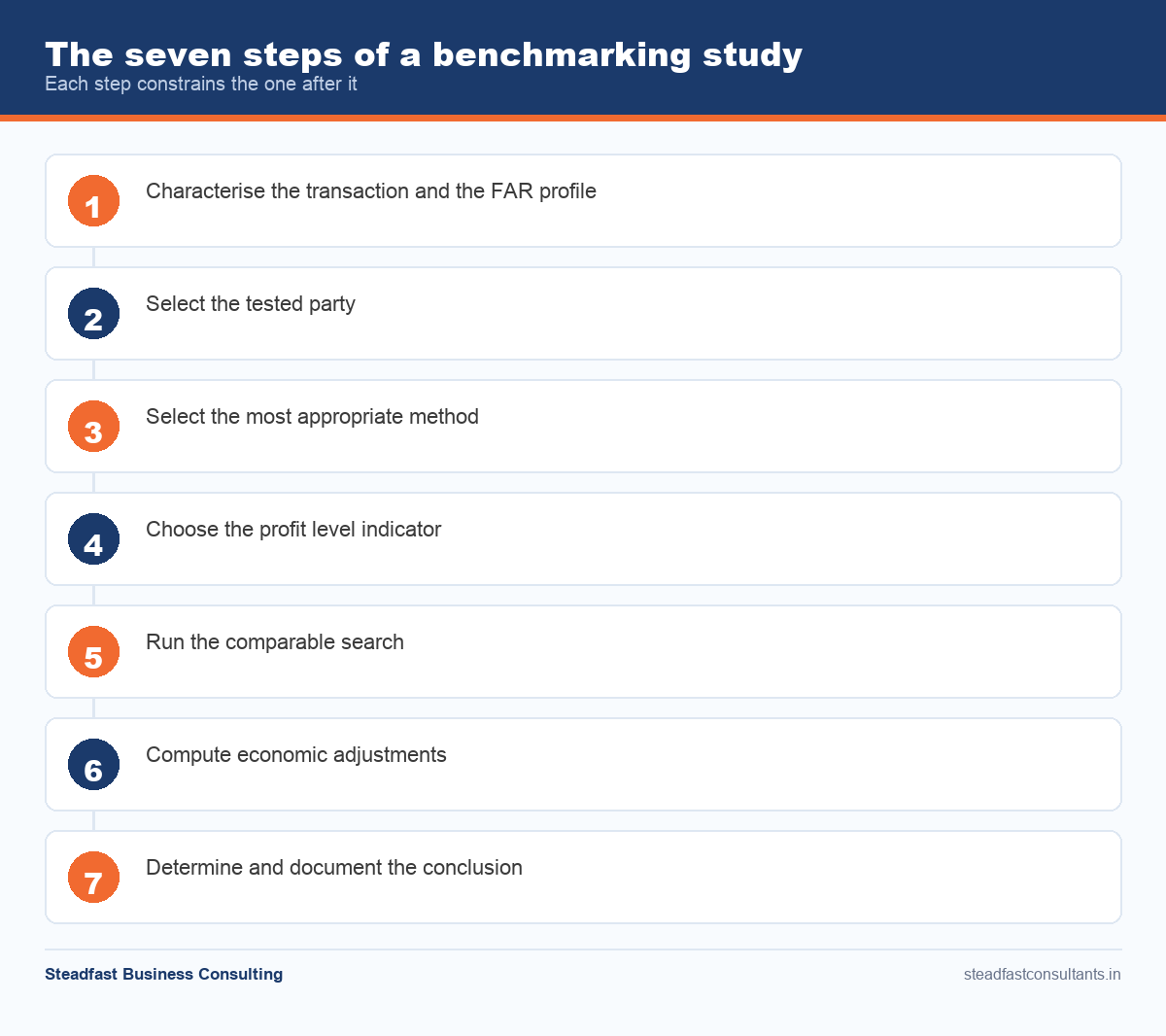
Each step constrains the one after it, and the table sets out what each involves, the rule that governs it, and where rejection follows.
| Step | What it involves | Governing rule (2026) | Where it is commonly rejected |
|---|---|---|---|
| 1. Characterise the transaction and the FAR profile | Identify the controlled transaction; analyse functions performed, assets employed and risks assumed | Rule 80(2), factor (b) | Profile copied from a group file, contradicting the intercompany agreement or the conduct of the Indian entity |
| 2. Select the tested party | Identify the less complex party, for which reliable data exists | No rule prescribes the choice | The overseas principal is tested when the Indian entity is simpler, or the choice is asserted without comparison |
| 3. Select the most appropriate method | Apply the six selection factors; record why each alternative was rejected | Rule 80, with the methods defined in Rule 79 | Method adopted by default rather than selected, with no recorded reasoning for rejecting the alternatives |
| 4. Choose the profit level indicator | Select the indicator reflecting how the tested party earns its return; define numerator and denominator consistently | Rule 79(1), method by method | Indicator does not match the tested party’s cost base, or the denominator includes items outside the transaction |
| 5. Run the comparable search | Apply documented accept and reject criteria; retain the reason against every exclusion and the data years used | Rule 80(2), factor (c), with Rule 79(5) on data years | Search strategy and rejection reasons not preserved, so the officer cannot reproduce the set |
| 6. Compute economic adjustments | Quantify working capital, capacity utilisation and material risk differences, retaining the workings | Rule 80(2), factor (e) | No adjustment computed at all, or an adjustment claimed while the supporting computation is missing |
| 7. Determine and document the conclusion | Arrive at the arm’s length result on the prescribed basis; record how the transfer price compares | Rule 81, with documentation under Rule 84 | Conclusion stated without workings, or companies retained despite functional dissimilarity identified earlier |
How do the first three steps build the framework?
The first three steps set the shape of the analysis, an error made here cannot be corrected later, and testing the wrong party makes everything downstream wrong.
How should the controlled transaction and FAR profile be established?
The functional profile must be drawn from what the Indian entity actually does, not from a group template, and it is a statutory test rather than a narrative preamble to the study. Under Rule 80(2) the class of the associated enterprises and the functions they perform, taking into account the assets they employ and the risks they assume, is the second of six factors.
Rejection more often follows from internal inconsistency than from a wrong conclusion. Where the intercompany agreement describes a limited-risk service provider, the local file describes an entrepreneur, and the reality matches neither, the officer is free to characterise the entity himself.
Which entity should be the tested party?
The tested party is normally the less complex of the two: the party that owns no valuable intangibles and bears no entrepreneurial risk. In most Indian inbound structures that is the local entity.
Selection fails when it is asserted instead of demonstrated. Show that the entity performs routine functions, owns no non-routine intangibles, and can be tested against available data. That is a selection. Naming the tested party is not.
How is the most appropriate method chosen?
Rule 80 of the Income-tax Rules 2026, which replaces Rule 10C of the Income-tax Rules 1962, requires the method best suited to the facts of the transaction, giving the most reliable measure of the arm’s length price.
Rule 80(2) lists six factors, and each is a place where a file is either reasoned or silent:
-
- The nature and class of the transaction.
-
- The class of associated enterprises and the functions performed, taking into account the assets employed and the risks assumed.
-
- The availability, coverage and reliability of the data.
-
- The degree of comparability between the controlled and the uncontrolled transactions, and between the enterprises entering into them.
-
- The extent to which reliable and accurate adjustments can be made.
-
- The nature, the extent and the reliability of the assumptions on which the method depends.
Three of those factors are themselves steps. Factor (b) is step 1, factor (c) drives step 5, and factor (e) drives step 6. Rule 79 defines the methods, from the Comparable Uncontrolled Price Method to the Other Method.
Officers reject method selection more often than any individual comparable, because the file records the outcome without the reasoning, and where nothing explains why a price-based or gross-margin method was unavailable on these facts, the step has been skipped rather than performed.
How do the remaining four steps produce the result?
The last four steps convert that framework into a defensible number. They are mechanical, and mechanical steps fail for mechanical reasons.
Which profit level indicator fits the tested party?
The indicator should reflect how the tested party actually earns its return. A cost-based indicator suits a service entity remunerated on its cost base, while a sales-based indicator suits a distributor or a reseller.
The common rejection is definitional. Where the denominator sweeps in costs that are unrelated to the tested transaction, the margin no longer compares like with like. The same follows where the numerator mixes operating and non-operating items inconsistently.
What makes a comparable search defensible?
A search is defensible when a third party can reproduce it from the file alone, which means recording the period covered and the classification applied, every filter in the order it was applied, and a stated reason against each rejected company.
Factor (c) of Rule 80(2) tests the availability, coverage and reliability of the data. Two failures dominate. The first is an undocumented strategy, where the final set appears without the funnel behind it, and the second is the retention of companies the functional analysis has already shown to be dissimilar.
Why does the choice of data years matter?
Rule 79(5) sets the conditions on which years of comparable data may be used, and the file must align the tax year under examination with the years analysed and explain the link between them.
Rejection follows where earlier-year data is used without justification, and equally where a single year is used when a wider period is called for.
Multiple-year data carries a consequence that files rarely anticipate: Rule 81(2) does not put three years of prices into the dataset. It puts one entry, a weighted average, computed on quantum of sales under the Resale Price Method, on quantum of costs under the Cost Plus Method, and on costs, sales or assets under the Transactional Net Margin Method, so eight single-year comparables can collapse to fewer than six dataset entries, and the range is lost with them.
Which economic adjustments should be computed?
Compute the adjustments the analysis has identified as material, and retain the workings. Working capital, capacity utilisation and risk differences arise most frequently in Indian analyses.
The frequent failure is silence. A study that identifies a difference, does not adjust for it and does not explain why none was required has recorded a problem without resolving it, and factor (e) of Rule 80(2) asks how far reliable adjustments can be made.
How is the arm’s length conclusion documented?
Close the study by stating the final comparable set, computing the arm’s length result, and measuring the transfer price against it.
Rule 81 provides in sub-rule (6) that a range from the thirty-fifth to the sixty-fifth percentile of the arranged data is formed where the most appropriate method is one of the four that sub-rule lists and at least six entries are available. A value within that range is treated as the arm’s length price under clause (a), and where the transfer price falls outside it, clause (b) substitutes the median. Where sub-rule (6) cannot apply, sub-rule (7) requires the arithmetical mean, subject to the prescribed tolerance not exceeding three per cent.
An incorrect price does not stop at the primary adjustment, because it can also trigger the secondary adjustment under Section 170 of the Income-tax Act 2025, formerly Section 92CE, which SBC examines in its note on secondary adjustment implications.
What documentation must support the study?
The study is supported by the documentation required under Section 171 of the Income-tax Act 2025, formerly Section 92D, and by the accountant’s report under Section 172, formerly Section 92E, while Rule 84 lists the documents to be maintained and Rule 85 prescribes the form of that report.
Why does a sound analysis still fail at documentation?
Because Rule 84 asks for documents, not conclusions. The analysis may be correct and the comparables sound while the file still fails, and that happens when the search output, the rejection matrix and the adjustment workings were never assembled into the record.
When is safe harbour an alternative to a full study?
Where a transaction falls within an eligible category and the election is validly made, the safe harbour route substitutes prescribed margins for a full benchmarking exercise, on terms SBC sets out in its guide to safe harbour rules under Indian transfer pricing regulations.
Which are the best transfer pricing firms for benchmarking studies?
No firm is best in the abstract. The studies that survive examination share one trait: the people who run the search and compute the adjustments also draft the replies to the notices.
Three kinds of firm operate in the Indian market: the large international networks such as Deloitte, PwC, Ernst & Young, KPMG and Grant Thornton, which provide scale and global coverage; established domestic practices that offer depth in Indian assessment practice; and specialist boutiques that concentrate on the benchmarking analysis itself. Which one fits depends on the shape of your related-party dealings, not on firm size.
What should you ask before appointing an adviser?
Ask to see the search documentation from a comparable engagement with client identifiers removed, because a firm that can produce a complete accept and reject matrix, the filter sequence and the adjustment workings prepares files for examination rather than for filing. Ask, second, who attends the proceedings.
What does SBC bring to a benchmarking engagement?
In 2024, ITR World Tax recognised Steadfast Business Consulting (SBC) as a Notable Transfer Pricing Firm, an independent ranking rather than a title the firm conferred on itself, and the firm was founded by Big 4 alumni whose team brings more than 150 years of combined experience.
SBC advises multinationals, Global Capability Centres and Indian groups from offices in Hyderabad, Mumbai, Pune and Dubai, and the team that prepares the analysis handles the assessment. Review the transfer pricing services in India or request a benchmarking review.
Frequently Asked Questions
Is a benchmarking study required every year?
Yes. The arm’s length price is determined for each tax year, and a study rolled forward without refreshing the data is treated as stale.
Can one study cover several related-party transactions?
It can, provided each transaction is separately characterised and benchmarked. Aggregating unrelated transactions into a single blended margin is a common ground of challenge.
What happens if the officer rejects your comparable set?
The officer can exclude companies from your set, introduce comparables of his own and recompute the result, and your ability to contest that turns on the record, because an exclusion can only be challenged where your own criteria were documented against it.
Does the accountant’s report replace the benchmarking study?
No. The report under Rule 85 is a compliance filing that reports the transactions entered into, and it does not contain the search documentation, the adjustment workings or the reasoning behind the method and the tested party, all of which sit in the Rule 84 documentation.
How many comparables does a benchmarking study need?
Six is the threshold, because Rule 81(4) allows the range only where at least six entries are available and the method is neither the Profit Split Method nor the Other Method, with the arithmetic mean applying below that number.
How early should a benchmarking study be started?
Start during the year rather than after it closes. Early work reconciles the functional analysis against conduct and leaves time to assemble the documentation.