
CategoriesTransfer Pricing

Transfer Pricing Compliance in India for FY 2025–26


Transfer Pricing Compliance in India for FY 2025–26

Transfer Pricing Compliance in India for FY 2025–26

A practical checklist of applicability, documentation, forms and filing dates for AY 2026–27

The short answer

An Indian taxpayer that entered into an international transaction or a specified domestic transaction during FY 2025–26 must first identify the complete transaction population, test the pricing under the arm’s length principle, maintain the prescribed documentation where applicable and obtain Form 3CEB. For a taxpayer subject to transfer pricing, Form 3CEB is due one month before the return due date. On the ordinary statutory calendar for AY 2026–27, this means 31 October 2026 for Form 3CEB and 30 November 2026 for the income-tax return. Group-level Master File and Country-by-Country Reporting obligations must be evaluated separately.Form 3CEB

Which law applies to FY 2025 26

FY 2025–26 is governed by the Income-tax Act, 1961. This remains the position even though the return and related reports are filed after 1 April 2026. The Income Tax Department has expressly clarified that a return for income earned during FY 2025–26 relates to AY 2026–27 and continues under the 1961 Act. Accordingly, section 92E reporting continues through Form 3CEB for this year.Section 92E

Step 1 Identify every controlled transaction

Begin with a legal-entity and counterparty map. Match the associated enterprise definition against shareholding, control, management, financing, dependency and other relevant conditions. The ledger description alone is unreliable: a guarantee may carry no fee, a group service may sit in an expense account, and a deemed international transaction may appear to involve an unrelated counterparty.

Review tangible goods, services, royalties, licences, loans, guarantees, equity-linked funding, reimbursements, cost allocations and business restructuring.

Examine year-end balances, ageing and agreed credit periods for receivables and payables.

Identify free-of-cost support, use of group intangibles, employee secondments and transactions settled through another group company.

Evaluate specified domestic transactions separately. The aggregate threshold under section 92BA is INR 20 crore, but only the transactions covered by that provision enter the computation.

Step 2 Reconcile the books before benchmarking

Prepare a transaction-wise reconciliation from the general ledger to the related-party note in the financial statements, Form 3CD, invoices, agreements and the proposed Form 3CEB. Capture opening items reversed during the year, debit and credit notes, year-end true-ups, foreign-exchange differences and transactions booked under centralised vendor or employee codes. Differences should be explained in a working paper rather than left for the accountant to infer.

Step 3 Confirm the pricing actually followed

The intercompany agreement, invoices and financial results must tell the same story. Check the price or margin for each transaction against the agreed policy and the latest benchmarking. For a cost-plus arrangement, verify the cost base, exclusions, pass-through costs and allocation keys. For a distribution model, test the correct segment and ensure that non-operating items do not distort the margin.

Where a true-up or true-down is required, complete the analysis early enough to address accounting, GST, customs, withholding tax and foreign-exchange implications. A journal entry passed only to reach a target margin is weak evidence if the underlying invoice, agreement and business rationale remain inconsistent.

Step 4 Prepare reliable segmental results

Entity-level profitability may be unsuitable where the taxpayer undertakes different controlled transactions or also deals with independent parties. Direct revenue and costs should be identified first. Common costs should then be allocated using a key that reflects consumption or causation. The segmental statement must reconcile to the audited financial statements. Independent certification can strengthen the evidence where the segment is material and not reported in the audited accounts.

Step 5 Select and apply the most appropriate method

Method selection must follow the nature of the transaction, functional profile and reliability of available data. Database availability does not by itself make TNMM the correct method. Internal comparable transactions should be examined before external comparables, and adjustments should be made only where their effect on comparability can be reasonably quantified. Document the search date, filters, accept-reject reasons, financial computations and treatment of unusual items.

Step 6 Maintain the prescribed documentation

Section 92D read with Rule 10D prescribes the local transfer pricing documentation. The detailed Rule 10D requirement is subject to the applicable INR 1 crore threshold for international transactions, while the section 92E reporting obligation is broader. In other words, a taxpayer should not assume that Form 3CEB disappears merely because the transaction value is below INR 1 crore. The accountant’s report applies when an international transaction or covered specified domestic transaction exists.transfer pricing documentationRule 10DSection 92D

Group and business overview, ownership structure and associated enterprises

Description and terms of each controlled transaction

Functional, asset and risk analysis

Method selection and economic analysis

Agreements, invoices, ledgers, calculations and supporting evidence

Forecasts, budgets or market data relied upon for the pricing position

Step 7 Complete the applicable forms

Compliance Broad trigger Ordinary due date Key point
Form 3CEB International transaction or specified domestic transaction 31 October 2026 No general monetary threshold for an international transaction
Income tax return Taxpayer subject to transfer pricing 30 November 2026 Reconcile return disclosures with Form 3CEB
Form 3CEAA Part A Constituent entity of an international group 30 November 2026 Part A applies even when Part B thresholds are not met
Form 3CEAA Part B Consolidated group revenue above INR 500 crore plus transaction threshold 30 November 2026 International transactions above INR 50 crore or intangible transactions above INR 10 crore
Form 3CEAB Multiple Indian constituent entities designating a filer 30 days before Form 3CEAA Confirm the designated Indian entity
CbCR forms Section 286 conditions Group-year based Evaluate Form 3CEAC notification and Form 3CEAD separately

Step 8 Run a final review before signing

Confirm that the associated enterprise list agrees across the group chart, ledgers, financial statements and Form 3CEB.

Tie each reported value to a ledger extract and retain the reconciliation.

Check the transaction description, method, arm’s length price and adjustment disclosure clause by clause.

Review loans, guarantees, receivables, reimbursements and transactions with nil or no separate consideration.

Confirm that agreements were valid during the year and reflect actual conduct.

Retain signed financials, reports, database output and management approvals in one controlled file.

The filing date is not the finish line

A well-prepared compliance file should also be usable during assessment. Keep the evidence that explains the result: allocation workings, benefit records, pricing approvals, segmental ledgers, comparable screening and explanations for losses or unusual movements. The strongest defence is usually the record created when the transaction occurred, not a narrative assembled after a notice.

Frequently asked questions

Is Form 3CEB required when international transactions are below INR 1 crore

Yes. The INR 1 crore threshold relates to the detailed Rule 10D documentation requirement. Form 3CEB under section 92E applies when the taxpayer has entered into an international transaction, subject to the law applicable to the facts.

What is the Form 3CEB due date for FY 2025 26

Under the ordinary statutory calendar, it is 31 October 2026, one month before the 30 November 2026 return due date for a transfer pricing case. Any later CBDT extension should be checked.

Can one entity level margin support all transactions

Not automatically. Separate transactions or classes of transactions may require separate testing unless aggregation is economically justified and the transactions are closely linked.

Does every Indian company need to file a Master File

No. Form 3CEAA applies to constituent entities of an international group, and Part B is subject to the prescribed group-revenue and transaction thresholds. Part A and Part B should be evaluated separately.


Disclaimer: This article is intended for general informational purposes and is not a substitute for professional advice. Applicability should be evaluated based on the specific facts and legal provisions relevant to each taxpayer.


CategoriesUncategorized

Form 3CEB reporting mistakes


Form 3CEB Reporting Mistakes Companies Must Avoid

Form 3CEB Reporting Mistakes Companies Must Avoid

A clause-by-clause readiness guide for Indian taxpayers before the FY 2025–26 filing

The short answer

Form 3CEB is the tax authority’s first structured view of a taxpayer’s controlled transactions. It identifies the associated enterprises, transaction values, method used and the accountant’s conclusion. A weak disclosure can therefore create an issue before the transfer pricing report is read. The most common failures are not complex valuation errors. They are incomplete transaction mapping, vague descriptions, unsupported aggregation and inconsistencies between the form, books, agreements and transfer pricing documentation.transfer pricing documentation

Why Form 3CEB deserves a separate review

Section 92E requires every taxpayer that entered into an international transaction or specified domestic transaction to obtain an accountant’s report in Form 3CEB. The accountant also comments on whether the prescribed information and documents have been maintained. Once filed, the form becomes a fixed statement of the taxpayer’s facts. Changes in language or method during assessment will invite questions unless the original position was properly qualified and documented.Section 92E

Mistake 1 Starting with the related party note

The financial-statement related-party note is an accounting disclosure, not a complete transfer pricing transaction register. It may exclude guarantees with no fee, free-of-cost services, year-end balances, deemed international transactions or arrangements routed through another entity. Build the population from the group chart, ledgers, treasury records, legal agreements, tax filings and management discussions, then reconcile it to the note.

Mistake 2 Applying a monetary threshold to Form 3CEB

A frequent error is to assume that international transactions below INR 1 crore do not require reporting. The INR 1 crore threshold is relevant to the detailed documentation obligation under Rule 10D. Form 3CEB applies when an international transaction exists. For specified domestic transactions, the statutory INR 20 crore aggregate threshold under section 92BA must be tested separately.Rule 10D

Mistake 3 Using vague transaction descriptions

Descriptions such as “services received,” “expenses” or “other transaction” do not explain the arrangement. The description should match the legal and economic substance: software development services, regional management support, reimbursement of travel costs, performance guarantee, foreign-currency term loan or licence of trademark. Overly broad labels also make it harder to demonstrate that the selected method fits the transaction.

Mistake 4 Omitting transactions with no consideration

A nil charge does not necessarily mean that no transaction exists. Corporate guarantees, use of intellectual property, group support, business restructuring and extended credit may require examination even if the books contain no income or expense. The taxpayer must first identify the arrangement and then determine whether a separate arm’s length charge is required on the facts.

Mistake 5 Ignoring reimbursements and cost allocations

Cost-to-cost treatment is a pricing position, not a reason to omit the transaction. Determine who incurred the cost, who received the underlying benefit, whether the payer performed an additional service and whether the allocation key is reliable. The reported value should agree with invoices and ledgers, including costs netted against income or recovered through a central group entity.

Mistake 6 Reporting the method selected without applying it

The method stated in Form 3CEB should agree with the transfer pricing report and actual computation. If TNMM is reported, the file should identify the tested party, profit level indicator, comparable set and adjustments. If CUP is used, the uncontrolled price and comparability adjustments must be available. A method should not be selected merely because it appeared in the prior-year form.

Mistake 7 Aggregating transactions without an economic basis

Closely linked transactions may be evaluated together, but aggregation needs a reason. Purchase of goods, management services, financing and royalty payments do not become one transaction merely because they involve the same associated enterprise. Explain the commercial link, common pricing mechanism and why separate testing would be unreliable. Otherwise, report and benchmark the transactions separately.

Mistake 8 Using entity level margins where segments matter

A profitable entity-level result can conceal an under-remunerated controlled segment. Conversely, a loss at entity level may be driven by an uncontrolled business. Where the taxpayer performs different activities, prepare segmental results using direct identification followed by reasonable allocation of common costs. Reconcile the segmental statement to audited accounts before relying on it in the form or report.

Mistake 9 Overlooking financing and year end balances

Loans and guarantees must be captured from treasury and legal records, not only the profit and loss account. Review the currency, principal, interest, tenure, security and borrower credit profile. For receivables and payables, compare actual ageing with contractual credit terms and analyse whether delayed balances require separate treatment or are already reflected in primary transaction pricing.

Mistake 10 Allowing the form and TP report to disagree

The transaction value, associated enterprise name, nature of transaction, method and conclusion must be consistent across Form 3CEB, the transfer pricing report, financial statements, Form 3CD and the income-tax return. A documented reconciliation should explain differences caused by GST, withholding tax, foreign exchange, pass-through costs, year-end provisions or gross-versus-net presentation.

A focused pre-filing review

Review area Question to answer Evidence to retain
Completeness Have all AEs and transaction categories been identified? Group chart, ledgers, agreements and treasury data
Value Does each amount reconcile to the books? Transaction-wise reconciliation
Characterisation Does the description reflect actual conduct? Agreement, invoices and functional interviews
Method Was the stated method actually applied? Benchmarking and computation files
Adjustments Are true-ups and voluntary adjustments disclosed correctly? Debit or credit notes and tax analysis
Consistency Do all statutory and financial disclosures agree? Cross-form review sheet

What should be completed before the accountant signs

Freeze the associated enterprise and transaction master after obtaining confirmation from finance, legal, treasury and business teams.

Reconcile the transaction values to the signed financial statements or document the bridge to the latest final numbers.

Complete the economic analysis and confirm the method and result reported for every material transaction.

Review the form clause by clause with the transfer pricing report open, rather than reviewing each document in isolation.

Retain a signed management representation and the supporting working papers supplied to the accountant.

Correction is harder after filing

If an error is discovered, assess it promptly with the accountant and return-filing team. The response depends on the nature of the error, the procedural options then available and whether other filings are affected. A later explanation can correct a genuine mistake, but it does not remove the need to demonstrate reasonable care. The better control is a documented pre-filing review with clear ownership of the data.

Frequently asked questions

Is Form 3CEB required below INR 1 crore

Yes, where an international transaction exists. The INR 1 crore threshold relates to detailed Rule 10D documentation, not the basic section 92E reporting trigger.

Should reimbursements be reported

They should be evaluated and generally reported when they constitute an international transaction. Cost-to-cost recovery addresses the arm’s length price; it does not automatically remove the reporting obligation.

Can several transactions be aggregated under TNMM

Yes, where they are closely linked and aggregation produces a reliable arm’s length analysis. The taxpayer should document the economic link rather than aggregate unrelated transactions for convenience.

What is the penalty for not filing Form 3CEB

Section 271BA provides for a penalty of INR 100,000. Other documentation or reporting failures may attract separate provisions depending on the default.


Disclaimer: This article reflects the law and official guidance reviewed as at 9 September 2026. Any CBDT extension or later notification should be checked before filing. This article is for general informational purposes and is not a substitute for professional advice.


CategoriesTransfer Pricing

Transfer Pricing Penalties in India

Transfer Pricing Penalties in India

What non-compliance can cost and how taxpayers should manage the risk for FY 2025–26

The short answer

Indian transfer pricing penalties can be fixed, linked to the value of each transaction or calculated for every day of continuing default. Failure to furnish Form 3CEB may attract INR 100,000 under section 271BA. Documentation and information failures can attract 2% of the value of each affected international or specified domestic transaction under sections 271AA and 271G. Master File and Country-by-Country Reporting defaults carry separate fixed or daily penalties. The exposure therefore depends on the precise failure; it should never be described simply as “2% of total related-party transactions.”Form 3CEBMaster FileSection 271BA

Why penalty exposure is often underestimated

Companies usually focus on the transfer pricing adjustment: the additional income that a Transfer Pricing Officer may propose. Penalties are a separate layer. A taxpayer may face questions about whether it maintained prescribed documents, reported the transaction, furnished information requested during proceedings or complied with group reporting. More than one provision may be examined because each addresses a different obligation.

The main penalty provisions

Provision Default Potential penalty Practical risk
271BA Failure to furnish Form 3CEB INR 100,000 A fixed penalty for the reporting failure
271AA(1) Failure to maintain documents, report a transaction or maintaining/furnishing incorrect information 2% of value of each affected transaction Exposure can be material even if the tax adjustment is small
271G Failure to furnish information or documents required under section 92D(3) 2% of value of each affected transaction Notice response and document control are critical
271AA(2) Failure to furnish prescribed Master File information and documents INR 500,000 Separate from local documentation
271GB CbCR reporting or information default Fixed or daily amounts depending on the failure Continuing delay can increase exposure

Failure to file Form 3CEB

Section 271BA permits a penalty of INR 100,000 where a taxpayer fails to furnish the accountant’s report required by section 92E. The official Form 3CEB guidance confirms both the reporting obligation and this consequence. The fixed amount may look modest beside a large adjustment, but non-filing also signals that the underlying transaction mapping and documentation may be incomplete.Section 92E

Documentation and incorrect information

Section 271AA(1) addresses distinct defaults, including failure to keep and maintain prescribed information and documents, failure to report a transaction required to be reported, and maintaining or furnishing incorrect information or documents. The prescribed penalty is 2% of the value of each international transaction or specified domestic transaction for the relevant failure. The computation must therefore identify the transaction affected by the default; it should not be casually applied to an unrelated transaction population.Section 271AA

This provision makes transaction completeness especially important. An unreported guarantee, reimbursement or deemed international transaction can create a penalty question even before the arm’s length result is debated. A taxpayer should preserve the analysis supporting its conclusion where an arrangement was reviewed but considered outside a particular reporting clause.

Failure to furnish documents during proceedings

Section 271G applies where the taxpayer fails to furnish information or documents required under section 92D(3). The potential penalty is 2% of the value of each international transaction or specified domestic transaction for which the failure occurs. A large volume of records does not justify a disorganised response. The taxpayer should map every item in the notice, state what is enclosed, explain what does not exist and seek appropriate time where the request is extensive.Section 271G

Master File failures

The local transfer pricing file and Master File are different obligations. Section 271AA(2) provides a penalty of INR 500,000 for failure to furnish information and documents prescribed under section 92D(4). Groups should separately test Form 3CEAA Part A and Part B applicability, identify the designated Indian entity where relevant and retain the group information needed to support the filing.

Country by Country Reporting failures

Section 271GB contains a graduated regime for Country-by-Country Reporting defaults. Depending on the failure, penalties may accrue daily and increase where the default continues, while furnishing inaccurate information can attract a fixed penalty. The exact amount depends on whether the issue concerns non-furnishing, continued default after an order, failure to provide requested information or inaccurate reporting. Because the exposure grows with delay, CbCR ownership and escalation should be agreed well before the deadline.Section 271GB

A penalty is not the same as a TP adjustment

An arm’s length adjustment concerns the taxable income. A penalty concerns the taxpayer’s conduct or compliance with a statutory obligation. One does not mechanically establish the other. A pricing position may ultimately fail without proving that the taxpayer concealed a transaction or ignored its documentation duty. Equally, a transaction may be priced at arm’s length but still create exposure if Form 3CEB was not filed or information was not furnished.

Reasonable cause and procedural fairness

Section 273B provides reasonable-cause protection for specified penalties, including important transfer pricing defaults. Relief is fact-specific and is not automatic. The taxpayer should show the cause of the failure, the controls normally followed, the corrective action taken and the absence of deliberate disregard. Contemporaneous emails, system records, legal interpretations and reconciliation workings carry more weight than a general statement that the omission was inadvertent.

Penalty provisions also use language that requires the authority to exercise judgment. The taxpayer should address the precise statutory ingredients, transaction base and evidence rather than responding only on equity. Where the same facts are cited under multiple provisions, the response should distinguish the obligation covered by each section.

Compliance controls that reduce exposure

  • Maintain an associated enterprise and transaction register owned jointly by tax and finance.
  • Reconcile the register with ledgers, agreements, financial statements, treasury records and Form 3CEB.
  • Complete benchmarking and true-up decisions before the filing data is frozen.
  • Keep version-controlled Rule 10D documentation and database evidence.Rule 10D
  • Track Master File and CbCR obligations separately from the local file.
  • Use a notice-response index that maps every question to the document furnished and the date submitted.
  • Escalate a discovered omission immediately and document the corrective decision.

Where compliance teams usually go wrong

  • Assuming a low transaction value removes the Form 3CEB obligation
  • Using the financial-statement related-party note as the only completeness check
  • Leaving agreements unsigned or renewing them after the year has ended
  • Preparing segmental accounts without a bridge to audited financial statements
  • Responding to a section 92D notice with a report but without the underlying evidence
  • Treating Master File and CbCR as a parent-company responsibility without confirming the Indian filing position

The right response to a potential default

First identify the exact obligation, period and transaction affected. Second, establish what was maintained or filed and when. Third, quantify the penalty only under the relevant provision and transaction base. Finally, preserve the facts supporting reasonable cause and correct the compliance failure through the procedurally available route. Delay usually narrows the options, particularly for daily penalties.

Frequently asked questions

What is the penalty for failure to file Form 3CEB

Section 271BA provides for INR 100,000.

Is the penalty always 2% of all international transactions

No. Sections 271AA and 271G refer to the value of each affected international transaction or specified domestic transaction in relation to the relevant default. The statutory basis and transaction base must be identified.

Can a taxpayer claim reasonable cause

Section 273B provides protection for specified defaults where the taxpayer proves reasonable cause. Evidence of the cause and the compliance steps taken is essential.

Can penalties apply even when the transaction is at arm’s length

Yes. Filing and documentation obligations are separate from the arm’s length outcome. A compliant price does not cure failure to file Form 3CEB or furnish prescribed information.


Disclaimer: This article reflects the law and official guidance reviewed as at 9 September 2026. Any CBDT extension or later notification should be checked before filing. This article is for general informational purposes and is not a substitute for professional advice.

CategoriesTransfer Pricing

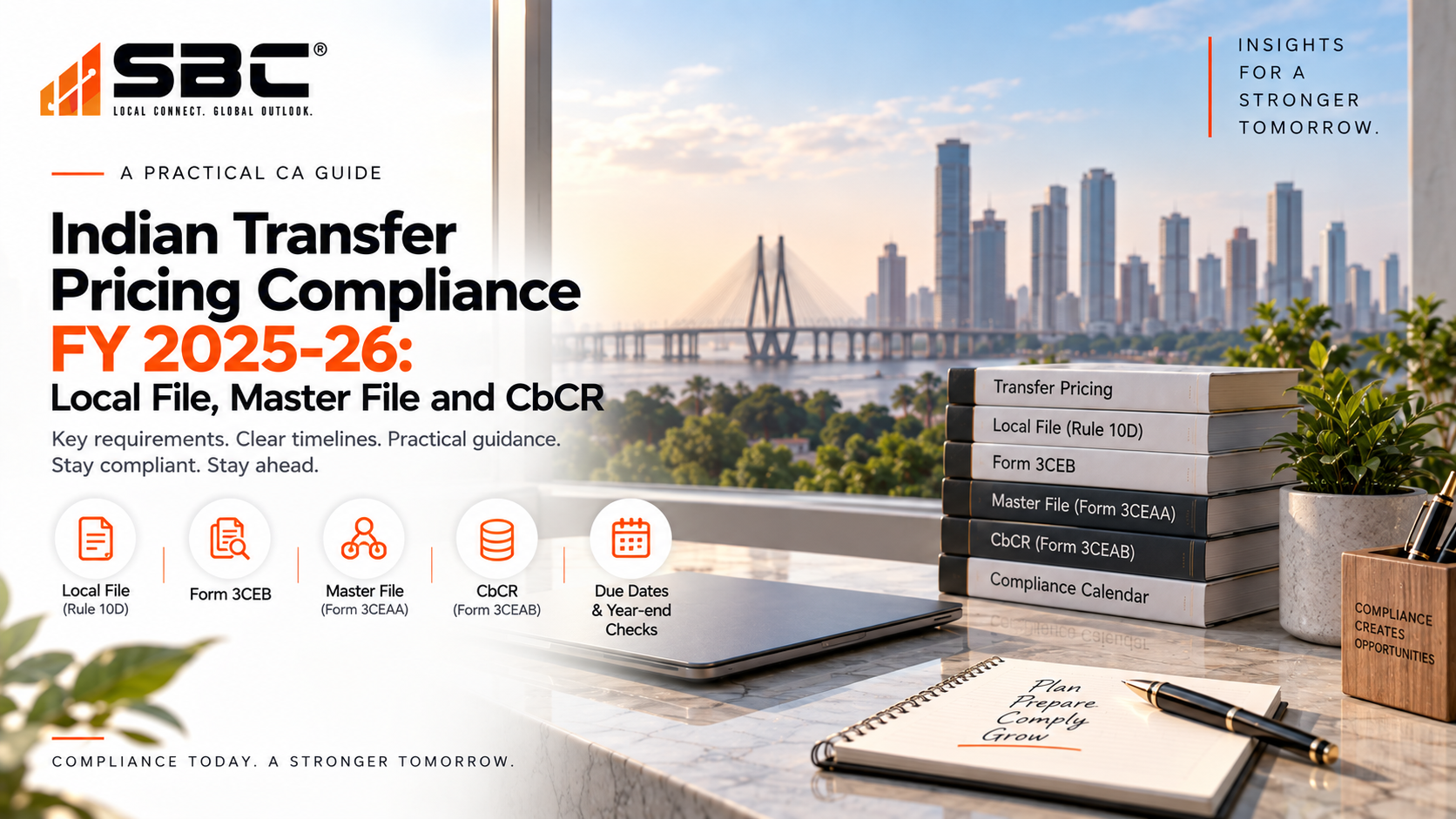
Indian transfer pricing compliance FY 2025-26

Indian Transfer Pricing Compliance for FY 2025-26: Local File, Master File, CbCR, Due Dates and Key Checkpointstransfer pricing complianceTransfer Pricing

A practical compliance guide for Indian MNEs and taxpayers entering the FY 2025-26 transfer pricing filing season

For businesses with cross-border related-party transactions, transfer pricing compliance is not merely a year-end filing exercise. The compliance framework can involve maintaining transfer pricing documentation, filing Form 3CEB, evaluating Master File requirements, and, for large multinational groups, meeting Country-by-Country Reporting (CbCR) obligations. The real compliance risk arises when these filings are prepared in isolation from the underlying agreements, financial statements, transaction ledgers, benchmarking and actual conduct.transfer pricing documentationForm 3CEB

For FY 2025-26, businesses should therefore start with a simple question: which transfer pricing compliances apply to us, what are the relevant thresholds and due dates, and is our underlying transfer pricing position ready to support the filings?

1. Local File and Form 3CEB: the starting point

A transfer pricing study under section 92D is required to be maintained where the aggregate value of international transactions exceeds INR 1 crore, or where specified domestic transactions (SDTs) exceed INR 20 crore in the circumstances covered by the transfer pricing provisions. The compliance material also identifies 31 October 2026 as the relevant due date for FY 2025-26 and notes a penalty exposure of 2% of the value of international transactions or SDTs for non-compliance.Section 92D

Form No. 3CEB, the accountant's report under section 92E, applies where international transactions are undertaken with foreign Associated Enterprises (AEs), irrespective of threshold. It can also apply to covered SDTs with Indian AEs where the prescribed conditions are met. For FY 2025-26, the indicated due date is 31 October 2026, with a stated penalty of INR 1,00,000 for failure to furnish the report.Section 92E

Practical point: Form 3CEB should not be treated as a transaction-listing exercise. Before sign-off, reconcile the related-party schedule, general ledger, agreements, invoices, foreign remittances and the TP study so that the nature and value of each reportable transaction are consistent.

TP compliance Applicability Due date Penalty for non-compliance
TP Study to be maintained u/s 92D If aggregate value of international transactions > INR 1 crore

or

If specified domestic transactions (SDT) > INR 20 crore in the circumstances covered by the transfer pricing provisions.

31 October 2026
(1 month prior to ITR filing due date)
2% of value of international transactions or SDT
Form No. 3CEB
Report by an Accountant u/s 92E
If international transactions (irrespective of threshold) are undertaken with foreign Associated Enterprises (AEs), or if covered SDTs are undertaken with Indian AEs where prescribed conditions are met. 31 October 2026
(1 month prior to ITR filing due date)
INR 1,00,000

2. Master File: Part A, Part B and Form 3CEAB

Master File compliance is separate from the entity-level Local File. Form No. 3CEAA Part A is applicable where international transactions are undertaken during the financial year and, as highlighted in the compliance material, applies to MNEs irrespective of the monetary threshold.

The detailed Master File in Form No. 3CEAA Part B applies where both threshold conditions are met: consolidated group revenue exceeds INR 500 crore and the aggregate value of international transactions exceeds INR 50 crore, or intangible-property-related international transactions exceed INR 10 crore. The indicated filing due date is 30 November 2026.

Where more than one constituent entity of the qualifying MNE group operates in India, Form No. 3CEAB is used for Master File intimation. The compliance material specifies 31 October 2026, being 30 days before the Master File filing due date.

Why this matters: The Master File tells the broader group story—business, global operations, intangibles, financing and transfer pricing policies. Indian entity-level documentation should therefore not contradict the group's Master File narrative.

TP compliance Applicability Due date Penalty for non-compliance
Form No. 3CEAA (Part A)
Master File u/s 92D(4) — One Page Form
Part A is applicable if international transactions are undertaken during the financial year. It applies to MNEs irrespective of the monetary threshold. 30 November 2026
(Same as ITR filing due date)
Form No. 3CEAA (Part B)
Master File u/s 92D(4) — Detailed Form
Part B is applicable if both conditions are satisfied:
• Consolidated group revenue exceeds INR 500 crore and
• Aggregate value of international transactions exceeds INR 50 crore or intangible-property-related international transactions exceed INR 10 crore.
30 November 2026 INR 5,00,000 — non-furnishing of information and documentation
Form No. 3CEAB
Master File intimation u/s 92D(4)
Applicable to MNEs crossing the Master File filing thresholds and having more than one entity operating in India. 31 October 2026
(30 days prior to Master File filing due date)

3. Country-by-Country Reporting: know whether India has a filing or notification obligation

CbCR obligations are relevant to large multinational groups. The compliance material states that Form No. 3CEAD applies where consolidated group revenue for the preceding accounting year exceeds INR 6,400 crore. Where an activated bilateral automatic exchange relationship exists between India and the jurisdiction of the Parent Entity or Alternate Reporting Entity (ARE), the Indian constituent entity may not need to file the CbC Report in India and would instead generally have a notification obligation through Form No. 3CEAC.

For a group with an accounting year ending 31 December, the material identifies 31 December 2026 as the CbCR filing date, i.e., 12 months from the end of the group's accounting year. Form No. 3CEAC is indicated as due 10 months from the end of the group's accounting year—31 October 2026 for a 31 December year-end.

Compliance trap: Do not assume that because the parent entity files CbCR overseas, there is nothing to do in India. The Indian constituent entity should verify the reporting entity, jurisdiction, automatic exchange relationship and the resulting Indian notification/reporting obligation.

TP compliance Applicability Due date Penalty for non-compliance
Form No. 3CEAD
CbC Report u/s 286(2)/(4) — Detailed Form
If consolidated group revenue for the preceding accounting year exceeds INR 6,400 crore.

If an activated bilateral automatic exchange relationship exists between India and the jurisdiction of the Parent Entity or Alternate Reporting Entity (ARE), the Indian entity may not need to file CbCR in India and may instead have a notification obligation through Form No. 3CEAC.

Reference: OECD CbCR exchange relationships

For a group year ending 31 December: on or before 31 December 2026 (12 months from the end of the group’s accounting year). INR 5,00,000 for furnishing inaccurate information in CbCR.

INR 5,000 / 15,000 / 50,000 per day for non-furnishing, depending on the delay.

Form No. 3CEAC
CbCR Notification u/s 286(1) — One Page Form
Filed when the Parent Entity/ARE files CbCR in its jurisdiction and an activated automatic exchange relationship exists between that jurisdiction and India. 10 months from the end of the group’s accounting year
i.e., 31 October 2026 for a 31 December year-end.

4. FY 2025-26 transfer pricing compliance calendar at a glance

Compliance Indicative due date Key trigger / note
TP Study / Local File 31 October 2026 International transactions > INR 1 crore or covered SDTs > INR 20 crore
Form 3CEB 31 October 2026 International transactions with foreign AEs; covered SDTs as applicable
Form 3CEAB 31 October 2026 Qualifying Master File group with more than one entity in India
Form 3CEAA 30 November 2026 Part A / Part B depending on applicability and thresholds
Form 3CEAC 10 months from group year-end CbCR notification, where applicable
Form 3CEAD 12 months from group year-end CbC Report, where Indian filing obligation applies
Income-tax return for TP cases 30 November 2026 As stated in the FY 2025-26 compliance material

5. Filing is only one part of TP compliance: year-end checkpoints

A technically correct form can still leave the taxpayer exposed if the underlying pricing and documentation do not align. Before closing the compliance cycle, businesses should review whether actual prices and margins follow the intercompany agreements and TP policy; whether true-up or true-down adjustments are required; and whether the consequences under GST, Customs, accounting standards and foreign exchange regulations have been considered.

The review should also cover overdue intercompany receivables and the applicable credit period, economic adjustments, segmental information, extraordinary items, foreign exchange differences, primary and secondary transactions, and the consistency of transaction characterisation across accounting records and statutory filings. Where Safe Harbour or an Advance Pricing Agreement applies, the agreed framework should be reflected in the year-end position.

For management fees, royalties and other intra-group service payments, contemporaneous need-benefit evidence is especially important. Emails, deliverables, cost allocation workings, benefit quantification, invoices and agreements should be collated while the evidence is readily available—not only after a TP assessment begins.

6. A practical pre-filing checklist

Map all international transactions and covered SDTs and reconcile them with the related-party disclosures and ledgers.

Check whether the actual transfer price or margin is within the agreed TP policy and the applicable arm's length benchmark.

Complete required true-up / true-down entries and assess secondary adjustment implications before finalisation, where relevant.

Review intercompany receivable and payable ageing against contractual credit periods.

Prepare reliable segmental workings for distinct business activities or internal comparables, where the TP method requires segmentation.

Ensure agreements reflect the actual functions, assets and risks (FAR) and renew or update intercompany agreements where necessary.

Collate supporting documentation for services, royalties, financing, guarantees, intangibles and business restructurings.

Check Local File, Form 3CEB, Master File and CbCR obligations independently—one filing does not automatically satisfy another.

7. Penalties make documentation quality a real financial issue

The compliance material highlights material penalty exposure: 2% of the value of international transactions or SDTs for specified TP documentation non-compliance; INR 1,00,000 in relation to Form 3CEB non-furnishing; INR 5,00,000 for non-furnishing of prescribed Master File information and documentation; and separate CbCR penalties, including consequences for inaccurate information and continuing delays.

The better approach is therefore to build the compliance file around audit defence from day one. The numbers in the return, Form 3CEB, financial statements, Local File and Master File should tell the same story.

Conclusion: prepare the TP position before preparing the forms

FY 2025-26 transfer pricing compliance should be approached as a connected process: identify transactions, test the pricing, complete year-end adjustments, reconcile financial information, establish documentation evidence and then file the applicable forms. This reduces last-minute inconsistencies and creates a much stronger defence if the case is selected for transfer pricing scrutiny.

For multinational groups, the immediate action is to confirm the applicability of the Local File / TP Study, Form 3CEB, Master File and CbCR requirements and build a compliance calendar around the relevant FY 2025-26 deadlines.

How SBC can assist

SBC supports businesses through the complete transfer pricing compliance lifecycle, including transaction mapping, benchmarking, Local File / TP Study, Form 3CEB review, Master File, CbCR, year-end TP health checks, TP adjustments and audit-defence readiness. The focus is not only on filing the required forms, but on ensuring that the underlying TP position is technically supportable and consistent across the business records.

Disclaimer: This article is intended for general informational purposes and is not a substitute for professional advice. Applicability should be evaluated based on the specific facts and legal provisions relevant to each taxpayer.

arm's length principle

Rule 10D

OECD India transfer pricing profile

CbCR exchange relationships

Income Tax e-Filing portal

Rule 10E

Section 92C – Computation of arm’s length price

Section 92D – Maintenance of information and documents

Income Tax e-Filing – statutory forms

Income-tax Act, 1961 – official text

Income-tax Act, 2025 – transition resources

OECD Base Erosion and Profit Shifting project

CBDT official website

Section 92BA – Specified domestic transactions

Section 92CA – Reference to Transfer Pricing Officer

Section 92CB – Safe harbour rules

Section 92CE – Secondary adjustment

Advance Pricing Agreement programme


Disclaimer: This article is intended for general informational purposes and is not a substitute for professional advice. Applicability should be evaluated based on the specific facts and legal provisions relevant to each taxpayer.