
India Transfer Pricing Penalties
India Transfer Pricing Penalties: Key Provisions
| Provision | Typical compliance issue | Potential consequence |
|---|---|---|
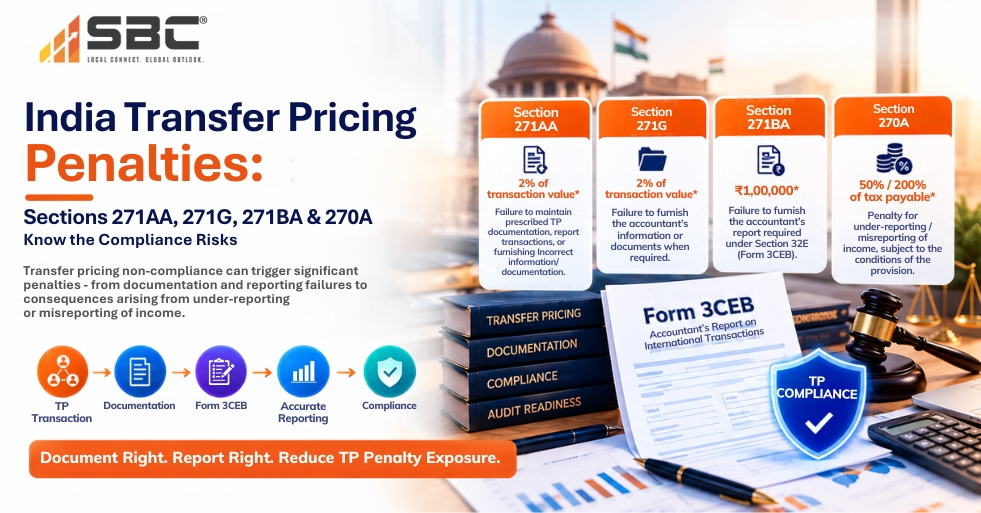
| Section 271BA | Failure to furnish Form 3CEB | ₹1,00,000 |
| Section 271AA | Specified documentation/reporting failures | 2% of value of relevant transaction |
| Section 271G | Failure to furnish required information/documents | 2% of value of relevant transaction |
| Section 270A | Applicable under-reporting/misreporting | 50%–200% of tax on under-reported income |
| Master File / CbCR provisions | Specified reporting failures | Fixed and/or daily penalties depending on default |
Section 271BA: Penalty for Failure to Furnish Form 3CEB
Section 271BA is relevant when a taxpayer obligated to submit an accountant’s report in Form 3CEB does not meet the necessary compliance requirements. The typical penalty for this failure is ₹1,00,000.
Since Form 3CEB is a fundamental requirement for transfer pricing reporting, companies should implement a systematic approach to identify transactions that need reporting, align them with their financial records, and guarantee that the information provided to the accountant is accurate and comprehensive. This is especially important for ensuring compliance with Section 271BA Form 3CEB.
Section 271AA: Penalties for Transfer Pricing Documentation and Reporting
Section 271AA addresses particular infractions associated with transfer pricing documentation and reporting. A taxpayer may face penalties for not maintaining necessary information and records, neglecting to report an international transaction, or submitting incorrect information.
For certain defaults, the penalty can amount to 2% of the value of the pertinent international transaction. This highlights the significance of Section 271AA compliance for entities engaged in substantial or frequent intercompany transactions.
Section 271G: Non-Compliance with Transfer Pricing Documentation Submission
Section 271G addresses the issue of not submitting necessary information or documents required under the transfer pricing regulations within the timeline set by the Transfer Pricing Officer.
The penalty for non-compliance may reach 2% of the value of the relevant international transaction, contingent on statutory guidelines. It is essential for businesses to maintain their transfer pricing documentation in a readily accessible format for prompt production if requested.
Familiarity with Section 271G requirements is crucial, as documentation that exists but cannot be provided promptly may still lead to compliance risks.
Section 270A: Under-Reporting and Misreporting of Income
A transfer pricing adjustment may trigger implications under Section 270A, contingent on the specifics and applicable legal criteria. This regulation differentiates between under-reporting and misreporting of income.
Potential penalties may include:
- 50% of the tax due on under-reported income in relevant under-reporting situations.
- 200% of the tax due on under-reported income in relevant misreporting scenarios.
Transfer Pricing Documentation and Penalty Mitigation
Establishing a solid transfer pricing documentation structure is essential for alleviating Transfer Pricing Documentation Penalty risk. Documentation must be compiled contemporaneously and align with the taxpayer’s financial records, Form 3CEB, and transfer pricing stanceNature and value of international transactions.
An effective transfer pricing file should typically cover:
- The nature and value of cross-border transactions.
- Related entities and terms of transactions.
- Functions executed, assets utilized, and risks undertaken (FAR analysis).
- Selection and implementation of the most suitable transfer pricing method.
- Economic assessments and comparable information.
- Intercompany contracts, invoices, and supportive documentation.
Deemed International Transactions and Reporting Risk
Transfer pricing compliance is not limited to transactions directly entered into with an associated enterprise. Certain transactions with third parties may be treated as international transactions where the statutory conditions are satisfied.
Consequently, identifying these transactions is a vital aspect of Transfer Pricing Compliance India. An effective compliance review must encompass both direct and potentially deemed international transactions.
Transfer Pricing Penalties India: Compliance Checklist
Transaction review
• Identify all international transactions.
• Examine potential deemed international transactions.
• Reconcile transaction values with financial records.
Documentation review
• Ensure transfer pricing documentation is maintained as per requirements.
• Keep FAR analysis and benchmarking data up to date.
Preserve agreements, invoices, and other supporting documentation.
Form 3CEB review
• Verify proper disclosure of reportable transactions.
Align Form 3CEB with transfer pricing documentation and financial statements.
Assessment readiness
• Track notices and adhere to response deadlines.
• Maintain documents in an easily accessible format.
• Ensure internal consistency in calculations and supporting evidence.
Why Transfer Pricing Penalties Matter for Indian Businesses
The ramifications of TP Penalties India extend beyond the visible amount of an individual penalty. Firms may incur additional taxes, interests, professional fees, management time, and lengthy assessment or dispute processes.
Therefore, businesses should view transfer pricing as an ongoing compliance activity rather than a mere annual filing duty. Strong oversight in transaction identification, documentation, reporting, and notice management can significantly minimize unnecessary risks.
Frequently Asked Questions
What are the main transfer pricing penalties in India?
The main provisions include Sections 271AA, 271G, 271BA and 270A. Depending on the default and statutory conditions, penalties may involve 2% of the value of relevant transactions, ₹1 lakh for failure to furnish Form 3CEB, or 50%–200% of tax in applicable under-reporting or misreporting cases.
What is the penalty under Section 271AA?
For specified documentation or reporting failures, Section 271AA can impose a penalty of 2% of the value of the relevant international transaction, subject to the applicable statutory provisions.
What is the penalty under Section 271G?
Section 271G can impose a penalty of 2% of the value of the relevant international transaction for applicable failures to furnish required information or documents within the prescribed period.
What is the penalty for not filing Form 3CEB?
Section 271BA provides for a penalty of ₹1,00,000 for failure to furnish the required accountant’s report, subject to the applicable statutory provisions.
Does a transfer pricing adjustment automatically result in a penalty?
No. A transfer pricing adjustment and penalty proceedings are separate matters. The facts, disclosures, documentation, statutory provisions and applicable exclusions are relevant to the penalty outcome.
Can Section 271AA and Section 271G both apply?
They address different types of compliance failures. Whether both provisions apply depends on the specific facts, defaults and statutory requirements.
How can companies reduce transfer pricing penalty risk?
Companies can reduce compliance risk by identifying reportable transactions correctly, maintaining contemporaneous documentation, filing Form 3CEB accurately, reconciling disclosures with financial records and responding promptly to information requests.
Do Master File and CbCR requirements carry penalties?
Yes. Specific penalty provisions apply to certain Master File and Country-by-Country Reporting failures. The amount and calculation depend on the particular default and reporting requirement.
Conclusion
India Transfer Pricing Penalties can arise at multiple stages of the compliance lifecycle, including transaction reporting, documentation, Form 3CEB filing and responses to information requests.
A proactive approach to Transfer Pricing Penalties India should focus on complete transaction identification, contemporaneous documentation, accurate reporting and timely compliance. Businesses with significant related-party transactions should periodically review their transfer pricing controls to identify gaps before they become assessment-stage issues.