
Written by Jayasri P · Last updated 26 August 2026 · Statutory references current to the Income-tax Act 2025 and the Income-tax Rules 2026.
Quick Answer: A mark-up not exceeding 5% applies under the Rule 89 safe harbour, but India prescribes no single mark-up otherwise. The safe harbour requires the charge to stay within ₹10 crore and an accountant to certify the cost pooling. Everything outside it is benchmarked.
What separates a low value-adding service from a high value service?
The classification turns on the character of the activity, not on the size of the charge. A service costing ₹50 lakh can be high value, and a service costing ₹8 crore can be low value-adding. The definition asks what the activity is, not what it costs.
Steadfast Business Consulting (SBC) prices intra-group services, management charges and cost contribution arrangements within its transfer pricing services in India. In the charges SBC reviews, the exclusion list decides the classification more often than the mark-up does.
Rule 86 of the Income-tax Rules 2026 defines low value-adding intra-group services as services performed by one or more members of a multinational enterprise group on behalf of other members of the same group, which meet every one of six conditions:
- they are in the nature of support services;
- they are not part of the core business of the group, meaning they neither constitute the profit-earning activities nor contribute to the economically significant activities of the group;
- they are not shareholder services or duplicate services;
- they neither require the use of unique and valuable intangibles nor lead to the creation of them;
- they neither involve the assumption or control of significant risk by the service provider nor give rise to significant risk for that provider; and
- they do not have reliable external comparable services that can be used to determine an arm’s length price.
Every condition must hold. Fail one and the service is not low value-adding, whatever the invoice says, and whatever the group calls it in its intercompany agreement.
Which services does the definition exclude outright?
Ten categories are excluded by name, which makes the exclusion list far more decisive in practice than the six conditions above.
Rule 86 removes research and development services, manufacturing and production services, information technology services in the nature of software development, knowledge process outsourcing, business process outsourcing, purchasing activities for raw materials or other materials used in manufacturing or production, sales and marketing and distribution activities, financial transactions, extraction and exploration and processing of natural resources, and insurance and reinsurance.
That list captures most of what an Indian entity in a global group actually receives. A shared services centre supplying software development is excluded even where the work is entirely routine.
How does the OECD simplified approach price these services?
The OECD offers an elective shortcut rather than a rule. Under the simplified approach in Chapter VII of the OECD Transfer Pricing Guidelines, a group that pools the costs of qualifying low value-adding services applies a standard mark-up of 5% to the relevant cost base, and that mark-up does not need to be supported by a benchmarking study.
The same mark-up applies to every category of qualifying service, so a group does not calculate one figure for payroll support and a different figure for accounting support.
The trade-off is documentation. The simplified approach relieves the group of the benchmarking exercise, and in exchange it expects a coherent cost pool, allocation keys that can be explained, and a benefit test applied at the category level rather than transaction by transaction.
The OECD has since run a public consultation on revisions to Chapter VII, so groups relying on the simplified approach should expect the surrounding guidance to move even where the 5% figure does not.
Does India accept the OECD simplified approach?
India runs its own route, and its published position stops short of saying that the route follows Chapter VII. The instrument is a safe harbour made under Section 167 of the Income-tax Act 2025, which carries forward the safe harbour power previously at Section 92CB, and it is domestic law rather than an adoption of OECD guidance.
The distinction matters commercially. A safe harbour is a statutory election the department can reject on its own conditions; a simplified approach in the Guidelines is interpretive material that an officer may or may not find persuasive.
What has India told the OECD about its own position?
India’s answers are published, and they are narrower than they first appear. In its transfer pricing country profile submitted to the OECD, India records that Indian transfer pricing law does not explicitly recognise the direct applicability of the OECD Guidelines, and that India has framed its own rules broadly in line with them.
When it comes to intra-group services alone, the same profile indicates that India does not have guidance for such transactions but uses the most appropriate method for each transaction based on its facts.
Asked whether it has a simplified approach for low value-adding intra-group services, India answered yes, and then described its safe harbour rule rather than the OECD approach.
One point deserves care. The current country profile template asks a second question, namely whether the domestic simplified approach follows the low value-adding services approach in Chapter VII, and India’s profile was last updated before that question existed. So there is no published Indian answer to it, and a group should not read the earlier yes as an adoption of the OECD approach.
Which conditions attach to the Indian safe harbour?
Four conditions, and each of them is a place where the shelter is commonly lost.
The first is quantitative. Under Rule 89, the aggregate amount of the low value-adding intra-group services during the tax year, including the mark-up, must not exceed ₹10 crore, so the cap swallows the mark-up rather than sitting above it.
The second is the certificate, because the method of cost pooling, the exclusion of shareholder costs and duplicate costs from the cost pool, and the reasonableness of the allocation keys used to allocate costs to the Indian entity must all be certified by an accountant.
The third is direction. Rules 87 and 88 extend the safe harbour to an assessee that is in receipt of low value-adding intra-group services from members of its group, which means an Indian entity supplying such services to the group receives no shelter at all from this entry.
Location is the fourth factor: Rule 92 withdraws the entire safe harbour block when the associated enterprise is located in a country covered by Section 176, or in any no-tax or low-tax country or territory defined by the maximum level of income tax equal to or lower than 15%.
There is also a cost to electing. Rule 93 provides that once a declared transfer price is accepted under the safe harbour, the assessee may not invoke the mutual agreement procedure under a tax treaty, so the shelter is bought by giving up the mutual agreement procedure route if the other jurisdiction later disagrees.
How does the treatment differ between low value-adding and high value services?
The two sit on entirely different machinery, and the table below sets out where they part company.
| Feature | Low value-adding intra-group services | High value intra-group services |
|---|---|---|
| Governing provision | Section 167, with Rules 86 to 93 | Section 165, with Rules 79, 80 and 81 |
| How the mark-up is fixed | Prescribed. Not exceeding 5%, if the safe harbour is elected | Derived. Whatever the benchmarking evidence supports |
| Benchmarking study | Not required inside the safe harbour | Required, using the most appropriate method |
| Ceiling on the charge | ₹10 crore in the tax year, inclusive of the mark-up | None |
| Certification | An accountant must certify cost pooling, cost exclusions and allocation keys | No separate certificate beyond the accountant’s report |
| Direction of the transaction | Receipt by the Indian entity only | Either direction |
| How it is claimed | Elected by furnishing Form No. 49 under Rule 90 | Applied by default, no election |
| Where the counterparty may sit | Not a notified or a no tax or low tax territory | Anywhere |
| Effect on treaty relief | Mutual agreement procedure barred once accepted | Mutual agreement procedure remains available |
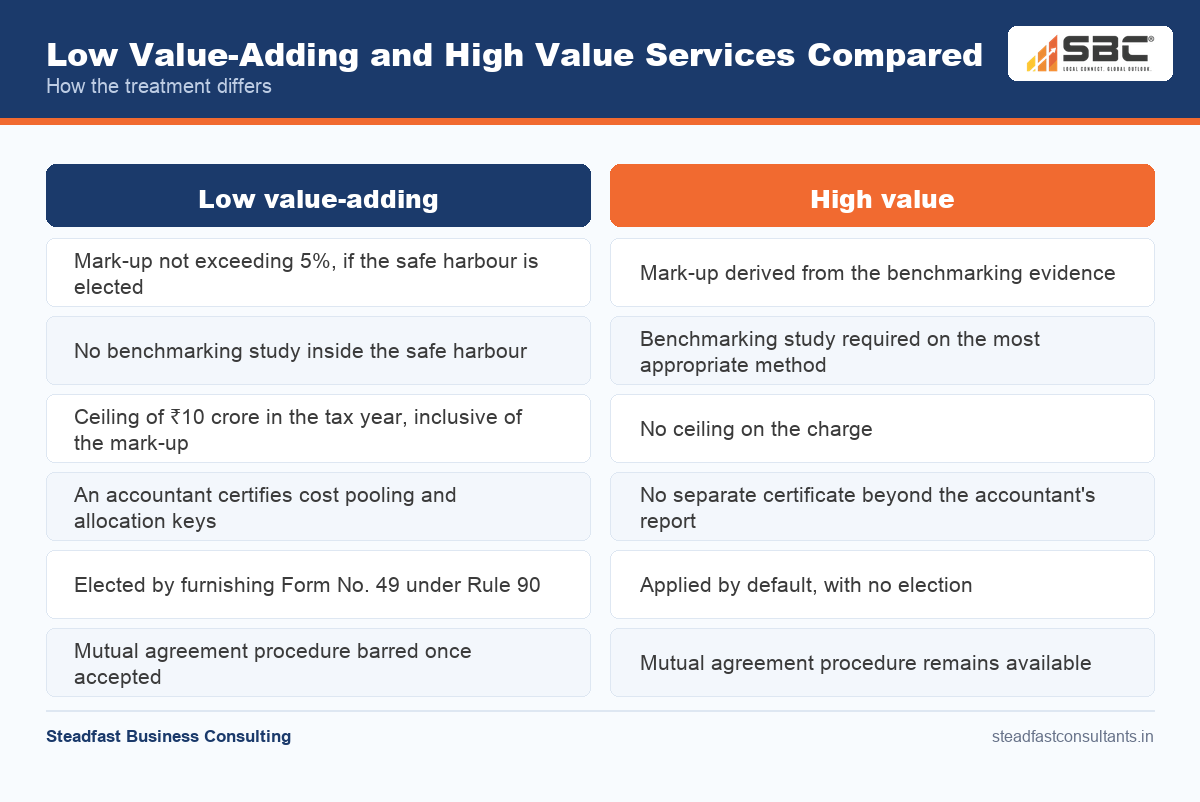
Read across the middle row and the commercial choice becomes clear. A group with a ₹4 crore support charge is weighing a fixed 5% against the cost and the uncertainty of a study, while a group with a ₹40 crore charge has no choice to make.
Both columns still assume the charge is payable at all. Whether the activity conferred an identifiable benefit is a prior question, answered in our note on the benefit test for intra-group services.
What does a Transfer Pricing Officer test when the classification is disputed?
The officer tests the classification before the mark-up. Reclassifying a service out of the low value-adding category defeats the safe harbour without any argument about pricing.
Three lines of attack recur. The service is said to fall in one of the ten excluded categories. The cost pool is said to contain shareholder or duplicate costs, which breaks the third condition in Rule 86 and the certificate at the same time. Or the aggregate is said to exceed ₹10 crore once the mark-up and the reimbursements are added back.
Why does the exclusion list decide most disputes?
Because it is a question of fact with a published answer, and the officer does not need economic analysis to reach it.
Arguing that a service is not economically significant invites a debate about the group’s business model. Arguing that a service is not software development, not marketing and not procurement is a much narrower exercise, and the file either describes the activity precisely or it does not.
This is where a service register earns its keep. A group that records what each activity was, who performed it and which category it belongs to has already answered the officer, whereas a group that produces a single line on an invoice is inviting the officer to choose the category for it.
Where the charge falls outside the safe harbour, the analysis reverts to the ordinary route. The choice among the prescribed methods is set out in our guidance on which transfer pricing method applies. The related question of what mark-up a broader management charge can sustain is covered separately in our note on management fee mark-ups.
What should you check before the next service charge is priced?
Start with the classification, not the mark-up. Take each activity in the current charge and test it against the ten excluded categories first, since a single excluded activity inside a pooled charge can remove the whole pool from the safe harbour.
Then total the charge including the mark-up and any reimbursements, and see how much headroom remains below ₹10 crore. A group sitting at ₹9.4 crore should know that now rather than in an assessment.
Finally, decide whether the election is worth its price in a year where a counterparty adjustment is plausible. Groups reviewing their inbound service charges are welcome to raise the classification with our transfer pricing specialists before the next intercompany invoice.
Frequently Asked Questions
Is the Indian 5% mark-up the same as the OECD 5% mark-up?
The figure coincides, the mechanism does not. India’s 5% is a ceiling inside a safe harbour elected under Rule 89, subject to a ₹10 crore cap and an accountant’s certificate. The OECD figure is a standard mark-up within interpretive guidance.
Does the safe harbour apply if my Indian company provides the services?
No. Rules 87 and 88 extend this entry to an assessee in receipt of low value-adding intra-group services from members of its group. An Indian entity supplying such services to the group is outside this category and must price the transaction under the ordinary rules.
What happens if the charge exceeds ₹10 crore?
The safe harbour is unavailable for that year and the charge is priced under Section 165 using the most appropriate method. The cap applies to the aggregate amount including the mark-up, so total the charge carefully before electing.
Does electing the safe harbour affect treaty relief?
Yes. Rule 93 provides that where the declared transfer price is accepted under Section 167, the assessee may not invoke the mutual agreement procedure under a double taxation avoidance agreement. That matters where the counterparty jurisdiction may make its own adjustment.
Which rule now carries the definition?
Rule 86 of the Income-tax Rules 2026 carries the definitions for the international transaction safe harbour, replacing Rule 10TA of the Income-tax Rules 1962. The circumstances and the margins sit at Rule 89, and the election procedure with Form No. 49 sits at Rule 90.
Can services be split so that part of the charge qualifies?
Only where the underlying records support the split. Each activity must be identified and tested separately, with excluded activities and their costs kept out of the pool. A split asserted after the year has closed, without a contemporaneous service register, is difficult to sustain.