
Written by Jayasri P · Last updated 26 August 2026 · Statutory references current to the Income-tax Act 2025 and the Income-tax Rules 2026.
Indian information technology and software companies attract heavy transfer pricing scrutiny because most of them bill a related party abroad for development work. The Union Budget 2026-27 announced a fast-tracked unilateral advance pricing agreement for information technology services, targeted for conclusion within two years, together with a higher safe harbour threshold and automated approval.
Why do software companies face more transfer pricing scrutiny than most sectors?
Because the typical Indian software company sells almost everything it produces to a single related party abroad, and transfer pricing applies to precisely that transaction. A domestic manufacturer selling to third parties has an observable market price. An offshore development centre billing its own parent has none.
Three features compound the exposure. The transaction is a service rather than a product, so no price can be observed anywhere in the market; the value sits in people and in code rather than in tangible assets, which makes the functional analysis genuinely contestable; and the amounts are both large and recurring, so an adjustment sustained for one year usually implies the same adjustment for every year that follows.
Determination of the arm’s length price is governed by Section 165 of the Income-tax Act 2025, which replaced Section 92C of the Income-tax Act 1961 with effect from 1 April 2026. Rule 79 of the Income-tax Rules 2026 carries the prescribed methods, and Rule 80 governs the selection of the most appropriate one.
Documentation sits at Section 171 and Rule 84, while the accountant’s report, now Form 48 rather than Form 3CEB, is furnished under Section 172 and Rule 85.
What changed for information technology services in 2026?
Three things, each aimed at the same complaint: that a software company could not obtain certainty on its margin inside a commercially useful period.
The Union Budget 2026-27 announced a fast-tracked unilateral advance pricing agreement process for information technology services and raised the safe harbour threshold for the sector from ₹300 crore to ₹2,000 crore, and safe harbour for information technology services is now to be approved through an automated, rule-driven process rather than examined case by case.
No other sector has been given such a package in the same budget. This indicates where the Government thinks the actual level of transfer pricing disputes lies.
How fast is a fast-tracked unilateral advance pricing agreement meant to be?
Two years, extendable by a further six months on the request of the taxpayer.
The two-year figure is a stated endeavour rather than a statutory deadline, and it reaches the unilateral route only, since a bilateral agreement depends on a foreign competent authority and cannot be compressed by India acting alone. Advance pricing agreements continue to be governed by Section 168 of the Income-tax Act 2025.
What matters commercially is the horizon rather than the speed in itself. An agreement concluded inside two years covers years that are still open, which is a materially different proposition from one arriving after the assessment has been framed and appealed. SBC has set out the application process and Form 51 separately.
What did the safe harbour change do for a software company?
It moved the election from a niche option into a mainstream one.
Under the Income-tax Rules 2026 the several technology service categories were consolidated into a single information technology services category taking one margin of 15.5 per cent, and the value ceiling rose to ₹2,000 crore of aggregate operating revenue, which brings a materially larger company inside the election than the earlier rules ever allowed. Those margins and conditions are covered in the guide to transfer pricing for a global capability centre or captive unit.
Safe harbour remains an election rather than a right. Accepting it means accepting a prescribed return which may sit above the return a properly benchmarked analysis would support, in exchange for removing the enquiry altogether.
Why is an offshore development centre’s margin contested?
Because the declared margin rests on a characterisation the taxpayer asserts and the Transfer Pricing Officer is entitled to test. A routine contract developer earns a modest cost-based return, and an entity carrying real entrepreneurial risk does not.
Most Indian offshore development centres are documented as low-risk contract service providers, remunerated on a cost-plus basis and benchmarked under the transactional net margin method with a cost-based profit level indicator. That characterisation is usually correct, and it also carries the lowest return, which is why it attracts examination.
What pushes a development centre above a routine return?
Functions the contract does not describe, and risks the entity bears in practice rather than on paper.
Product roadmap ownership is the clearest example. Where the Indian entity decides what gets built rather than building what it is told to build, the routine label becomes difficult to defend, and customer-facing delivery responsibility, independent hiring of senior technical leadership and the freedom to decline unprofitable work all point in the same direction.
Ownership of intangibles is the second driver, and it produces the largest adjustments. Where development, enhancement, maintenance, protection and exploitation of software intangibles happen substantially in India, a cost-plus return on the development team may not compensate the value created.
How does a Transfer Pricing Officer test the declared margin?
By reconstructing the comparable set and recomputing the margin on the department’s own terms.
Rejecting the taxpayer’s comparables is the typical first step. The filters change, the companies with high volumes of related party transactions are eliminated from the sample, and large diversified technology companies enter the sample that has been originally constructed for a captive developer, resulting in the significant changes in the margin before the functions argument even commenced. SBC has published a practical guide to economic adjustments that addresses this matter.
The second move is the cost base, and it is the one software companies are least prepared for.
What belongs in the cost base of an offshore development centre?
Every operating cost incurred in providing the service, and nothing else. The boundary is disputed on four recurring items, each of which moves the declared margin directly.
Where the profit level indicator is operating profit over operating cost, the cost base is the denominator. A cost wrongly included depresses the margin, a cost wrongly excluded inflates it and invites an adjustment, and neither error is visible from the audited financial statements alone.
| Cost item | Common taxpayer position | Where the dispute arises |
|---|---|---|
| Pass-through costs recharged without value addition | Excluded from the mark-up base | Whether the Indian entity performed any function or assumed any risk |
| Travel, visa and deputation recoveries for onsite work | Recovered at cost as reimbursement | Whether this is reimbursement or part of the service consideration |
| Share-based payment charged by the overseas parent | Treated as an operating cost of employment | Whether a non-cash parent-level charge belongs in a cost-plus base |
| Foreign exchange gain or loss on trade receivables | Treated as operating, and applied to comparables alike | Whether it arises from the trading transaction or from treasury activity |
Which costs are operating costs and which are not?
Costs incurred in providing the service are operating, and costs unconnected to it, or financing in character, are not.
A cost is a genuine pass-through only where the Indian entity procures it on behalf of the associated enterprise, adds nothing to it and bears no risk in respect of it, which is why third-party licence fees bought at the parent’s direction usually qualify while sub-contracted development work usually does not.
Whatever position is taken must be applied consistently to the tested party and to every comparable. A margin computed on one definition and compared against comparables computed on another is not a comparison at all.
Does the onsite and offshore mix distort the margin?
Yes, and it is the most common structural defect in a software company’s file.
Onsite work carries a higher personnel cost per unit of revenue than offshore work, so a company with a substantial onsite component reports a lower blended margin than an offshore-only comparable would, and benchmarking that blend against offshore-only comparables understates the arm’s length result in a way the department is entitled to challenge.
The correction is segmentation. Onsite and offshore revenue, cost and margin are computed separately, each is benchmarked against a set matched to it, and the segmental statements reconcile to the audited financial statements and to the accountant’s report in Form 48.
How are share-based payments treated?
They are the most frequently disputed single line in the sector, and no rule settles the question.
Where an overseas parent grants equity to employees of the Indian entity and recharges the cost, the taxpayer generally treats that charge as employment cost forming part of the operating cost base, while the department position runs the other way on the argument that a non-cash parent-level benefit should not be marked up by an Indian service provider.
Two practical points follow. The recharge agreement must exist and must predate the grant, and the treatment adopted must match what the comparables do.
Why do information technology services attract the most advance pricing agreement activity?
Because the sector combines a recurring transaction, a contested margin and a long planning horizon, which is exactly the profile an advance agreement was built for. The Central Board of Direct Taxes signed 219 advance pricing agreements in the financial year 2025-26, and the fast-track now announced for information technology services acknowledges where that demand concentrates.
A software group is not arguing about a one-off transaction. It is arguing about the same intercompany service, priced the same way, in every year of a decade, so settling the method once removes the argument prospectively and, through rollback, for earlier years as well. Steadfast Business Consulting (SBC) has published a comparison of the unilateral, bilateral and rollback routes.
Which route suits a software company: safe harbour, an agreement or a benchmarked return?
The answer turns on size, on how settled the functional profile is, and on how much variance in the outcome the group can tolerate.
| Route | What it delivers | What it costs | Where it fits |
|---|---|---|---|
| Safe harbour election | Acceptance of the declared price, with no Transfer Pricing Officer reference | A prescribed margin that may exceed the benchmarked return, and a binding multi-year election | Stable routine developers inside ₹2,000 crore |
| Unilateral advance pricing agreement | An agreed method for future years, with rollback for earlier years | Negotiation and annual compliance reporting, with no protection abroad | Companies above the threshold, or a profile the prescribed margin does not fit |
| Bilateral advance pricing agreement | Agreement in both jurisdictions, removing economic double taxation | The longest timeline, since a foreign competent authority is involved | Groups where the counterparty country has adjusted |
| Benchmarked return with documentation | Full flexibility on method and comparable set | Exposure to the annual assessment cycle and to appeal | Companies whose functional profile is changing year on year |
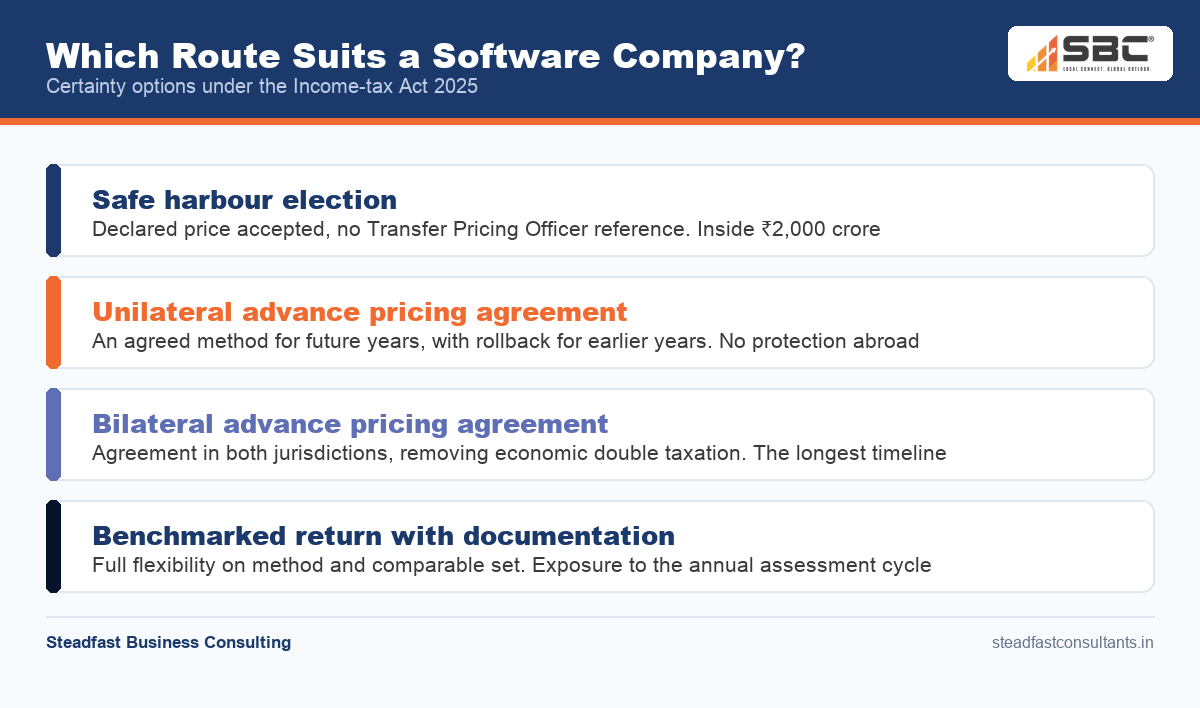
These are not mutually exclusive across time, and a company may reasonably elect safe harbour while its profile is stable and move to an agreement when it is not.
Who provides transfer pricing services in India for a software company?
Firms that combine Indian transfer pricing practice with genuine experience of technology delivery models, since the disputes in this sector turn on facts that a generalist adviser rarely thinks to test. No firm is correct in the abstract, so the useful question is which capabilities the file itself needs.
Four criteria matter for a software company specifically. Can the adviser segment onsite and offshore delivery and defend the segmentals? Has the adviser argued a cost base composition point before a Transfer Pricing Officer? Has the adviser taken an advance pricing agreement through to signature rather than only to application, and does the same team stay with the file from documentation into assessment and appeal?
SBC was named a Notable Transfer Pricing Firm 2024 by ITR World Tax and was founded by Big 4 alumni. It works with global capability centres and multinational subsidiaries from offices in Hyderabad, Mumbai, Pune and Dubai, and the full scope of its transfer pricing services covers documentation, benchmarking, advance pricing agreements and representation.
If your development centre is approaching the safe harbour threshold, or facing its first substantive margin challenge, ask the transfer pricing practice to review the file before the next filing cycle closes.
Frequently Asked Questions
Does transfer pricing apply to a software company with only one foreign customer?
Yes, where that customer is an associated enterprise, because the test is the relationship between the parties rather than the number of customers. A development centre billing its own parent must maintain documentation under Section 171 and furnish the accountant’s report in Form 48.
Is the 15.5 per cent safe harbour margin compulsory?
No. Safe harbour is an election the taxpayer exercises, not a prescribed price, and a company may instead benchmark its actual margin under the transactional net margin method or seek an advance pricing agreement. The election binds for a multi-year period once validly made.
Can reimbursements be excluded from the cost base?
Only where the Indian entity adds no value and assumes no risk in respect of the cost, and where the arrangement is documented before the cost is incurred. Sub-contracted development work rarely qualifies, because the Indian entity has selected and supervised the sub-contractor.
How long does a fast-tracked unilateral advance pricing agreement take?
The Union Budget 2026-27 announcement set an endeavour of two years for information technology services, extendable by six months on the request of the taxpayer. That is a stated target rather than a statutory deadline, and it applies to the unilateral route only.
Does an advance pricing agreement remove the documentation obligation?
No. Documentation under Section 171 and Rule 84 continues and the accountant’s report under Section 172 remains due, because an agreement fixes the method and the critical assumptions rather than suspending the compliance calendar. An annual compliance report is also required.
Should onsite and offshore delivery be benchmarked separately?
If the onsite component is significant, then yes. The cost structures are quite distinct for onsite work; thus, a blended margin with respect to offshore-only comparables understates the arm’s length conclusion. The revenue, cost, and margin by segment must agree with the audited financial statements.