
Written by Jayasri P · Last updated 26 August 2026 · Statutory references current to the Income-tax Act 2025 and the Income-tax Rules 2026.
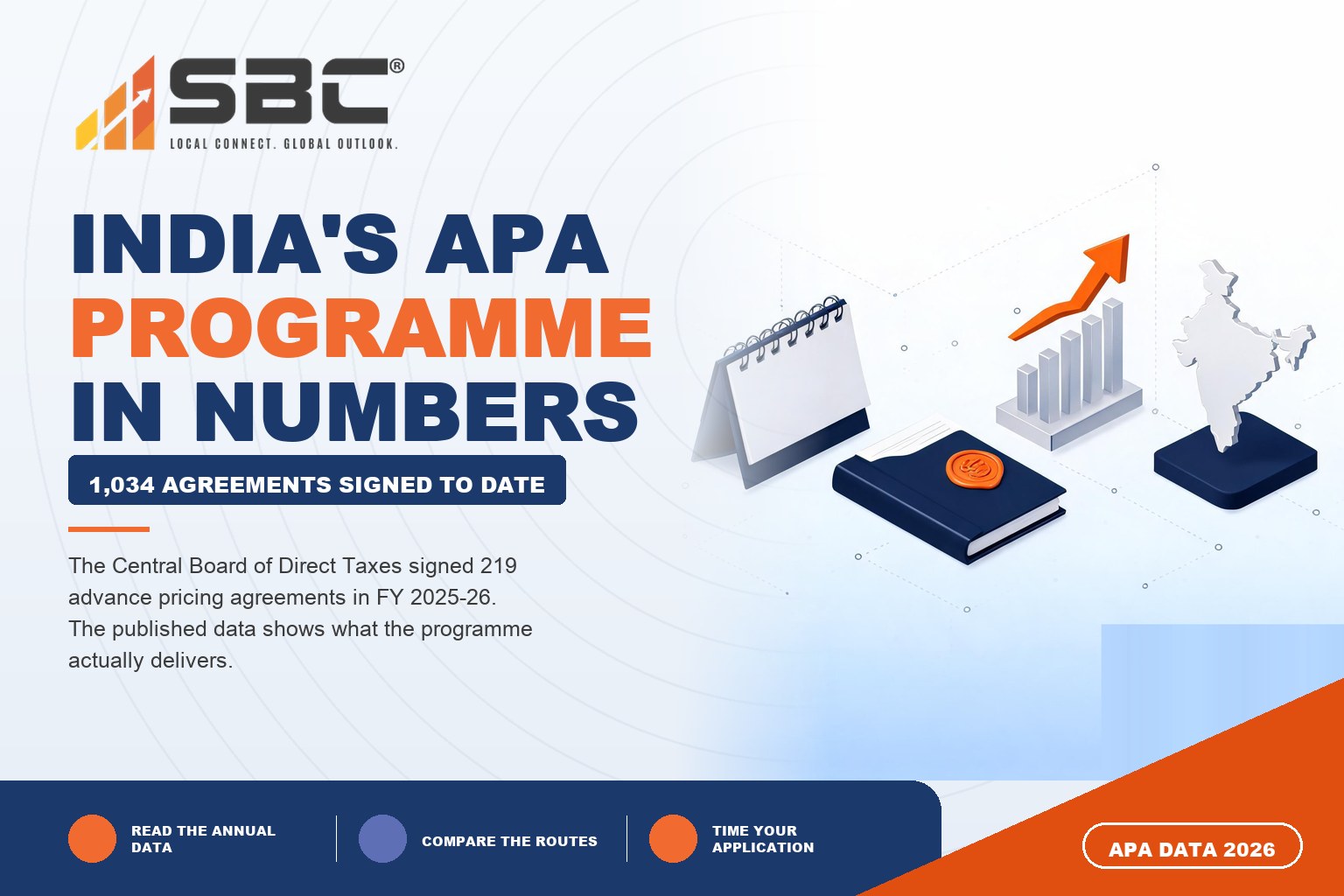
The Central Board of Direct Taxes signed 219 advance pricing agreements in FY 2025-26, the highest number recorded in any financial year since the programme opened in 2012. Cumulative signings reached 1,034, comprising 750 unilateral and 284 bilateral agreements. Annual output has more than doubled since FY 2022-23.
Much of the discussion about advance pricing agreements is procedural in nature. The different forms and stages are explained, along with the statutory tests that must be passed. However, the reader is left uncertain whether this is a genuine route or just a theoretical one.
The question is answered directly by the published figures, because each year the Central Board of Direct Taxes publishes the APAs it has signed, and those reports are the only authoritative record of how the programme has been performing. This article makes use of the India APA statistics and approaches them as a buyer would, which means asking what the volumes, the unilateral and bilateral split and the direction of travel mean for a company deciding whether an application is worth making.
Every statistic mentioned in this article is drawn from a CBDT publication. In the absence of any relevant figure being published by the Board, this article says so rather than offering an estimate.
How many APAs has India signed in total?
Since the programme began, India has signed a total of 1,034 advance pricing agreements. The CBDT press release recording 219 signings in FY 2025-26 states that the cumulative total has crossed the one-thousand mark, aggregating to 1,034 agreements, comprising 750 unilateral APAs and 284 bilateral APAs.
That is the whole population of Indian advance pricing agreements, accumulated over roughly fourteen years of operation, and it is the denominator against which every other figure in this article should be read.
The number matters because it establishes scale. A programme that had concluded a few dozen agreements would be an experiment that no board should stake a compliance position on, and one that had concluded several thousand would be a routine administrative process available to almost any applicant, whereas a thousand agreements over fourteen years describes something in between: an established mechanism that remains selective and resource-intensive on both sides, and that distinction shapes the decision you are making.
How many APAs were signed in each of the last four years?
Annual signings have risen in each of the last three years, from 95 in FY 2022-23 to 219 in FY 2025-26. The table below carries every year-on-year figure the Board has published for that period.
| Financial year | APAs signed | Bilateral (BAPA) | Unilateral (balance) |
|---|---|---|---|
| FY 2022-23 | 95 | Not separately published | Not separately published |
| FY 2023-24 | 125 | Not separately published | Not separately published |
| FY 2024-25 | 174 | 65 | 109 |
| FY 2025-26 | 219 | 84 | 135 |
The figures for FY 2022-23 and FY 2023-24 have been extracted from CBDT press release on the 174 agreements signed in FY 2024-25 which states that in FY 2023-24 a total of 125 agreements have been signed by the Board while for FY 2022-23 a total of 95 agreements were signed. The bilaterals for the last two fiscal years have been provided by the Board and the unilateral figure is simply a mathematical representation of the bilateral data given.
When you think of the trajectory as a series, it is clear that the annual output has more than doubled in the past three years, and every year’s output is more than that of the previous one.
Why did FY 2025-26 set a record?
The Board describes FY 2025-26 as its highest ever APA signings in any financial year since the programme began. The same release records 84 bilateral agreements signed during the year, exceeding the previous record of 65 bilateral agreements set in FY 2024-25.
Two things therefore happened at once. Total throughput rose, and the harder category of agreement rose faster than the easier one.
CBDT also links the APA framework to the safe harbour regime, noting that safe harbour rules complement the APA framework by offering a faster and lower-cost alternative route to transfer pricing certainty. The two mechanisms are presented as parts of one certainty architecture rather than as competitors, which is worth holding in mind when you assess which route suits a particular transaction.
What does the unilateral and bilateral split tell you?
The cumulative split is 750 unilateral to 284 bilateral, so roughly 27 per cent of all Indian APAs are bilateral. In FY 2025-26 alone, 84 of 219 agreements were bilateral, which is closer to 38 per cent.
The bilateral share of new agreements is therefore materially higher than the bilateral share of the historic stock, which tells you that the mix has shifted rather than simply that the totals have grown, and mix is the part of this dataset that carries a commercial consequence for a cross-border group.
One further detail is visible in the published breakdowns. The cumulative position reported at the close of FY 2024-25 was 815 agreements, comprising 615 unilateral APAs, 199 bilateral APAs and one multilateral APA, whereas the cumulative breakdown published a year later reports only two categories. The multilateral agreement is no longer shown separately.
Why does the rising bilateral share matter to you?
A bilateral agreement is the only version that removes double taxation on both sides of a transaction, because it binds the Indian administration and the competent authority of the treaty partner together. A unilateral agreement settles the Indian position alone and leaves the counterparty jurisdiction free to take a different view of the same profit.
The rising bilateral count is consequently the most useful single number in the dataset for a cross-border group. It indicates that treaty negotiations are concluding at a faster rate than before, which is precisely the constraint that historically made groups settle for a unilateral agreement they knew to be incomplete, and it suggests that the practical objection to the bilateral route has weakened even though the procedural burden of that route has not changed. The burden is real. The evidence now sits on the other side of it.
If your exposure sits in the gap between two administrations, the published trend argues for testing the bilateral route rather than assuming it will stall. Our guide to choosing between a unilateral, bilateral or rollback route sets out the conditions under which each option is appropriate.
How do you choose the best transfer pricing firms for APA and dispute resolution?
In the abstract, no firm stands out as the best, and anyone who suggests otherwise is giving a marketing answer instead of addressing your question. The right approach is to evaluate the prospective firm against the specific case you are planning to start based on information you can verify ahead of hiring anybody.
Five criteria separate advisers who can carry an APA from advisers who can only describe one.
- Demonstrated APA and competent-authority experience, not general transfer pricing experience. A bilateral application requires the adviser to support a negotiation between two administrations, which is a different discipline from preparing documentation.
- Independent recognition rather than self-description. A published third-party ranking is evidence; a claim on a website is not.
- Continuity of the team across the full term. An APA runs for years and carries annual compliance obligations after signature, so the people who built the position should still be available when it is administered.
- Depth in your transaction type. Benchmarking a captive services centre and pricing an intangible are not interchangeable skills.
- Capacity to handle the alternative route. If the application does not conclude as expected, the same adviser should be able to run the assessment, appeal or mutual agreement procedure that follows.
Providers fall into recognisable categories, and each category answers a different need. Global network firms offer coverage across many jurisdictions at a corresponding cost, established domestic practices offer breadth across Indian tax without that international footprint, and specialist transfer pricing boutiques concentrate on a narrower field, which usually places them closer to rule changes as those changes occur.
Steadfast Business Consulting (SBC) sits in the third category. SBC was founded by Big 4 alumni, the team page records more than 150 years of combined experience, and ITR World Tax named the firm a Notable Transfer Pricing Firm 2024, which is a third-party assessment rather than a self-description. The firm operates from Hyderabad, Mumbai, Pune and Dubai.
What does the trend mean if you are deciding whether to apply?
The data supports applying if you have a recurring, material related-party transaction that will repeat across several years, and it does not support applying if your exposure is one-off or small enough that the cost of the process would exceed the certainty it buys. Rising throughput reduces the historic objection to the programme, which was never about the law but about whether an application would ever conclude.
An advance pricing agreement is governed by Section 168 of the Income-tax Act 2025, which carries forward the framework introduced in 2012 through Sections 92CC and 92CD of the Income-tax Act 1961. The statutory route is settled; the question the statistics answer is a practical one about throughput.
Three implications follow from the series.
First, the programme is scaling rather than contracting, so an application filed now enters a system that concluded 219 agreements in the most recent year rather than the 95 it concluded three years earlier, and the capacity an applicant meets on entry is the single administrative variable that has changed most over that period. Second, bilateral capacity is expanding faster than unilateral capacity, which changes the calculation for groups whose real risk is double taxation rather than an Indian adjustment. Third, the Board is presenting APAs and safe harbour together, so the choice between them should be made deliberately rather than by default.
None of that removes the need to assess your own facts. It does mean that the throughput objection is weaker than it was, and the application process itself is the next thing to understand once the decision in principle is made.
What do the numbers not tell you?
The published statistics report agreements signed, not applications filed, and CBDT does not publish a completion rate in these releases, which means the series describes what the programme produced in a year and not what it received. A count of outputs is not a measure of how long any individual application took, nor of how many applications were withdrawn, rejected or remain pending at the year end.
They also say nothing about your transaction. The volume trend describes the administration’s capacity, whereas the merits of your case depend on functional analysis, the comparability of the data available and the treaty relationship involved.
Treat the figures as evidence about the route, and never as a prediction about your own file.
If you are weighing an application or already managing an agreement in force, SBC’s transfer pricing practice advises on APA strategy, and the same team handles the representation work that arises where certainty has to be achieved through a dispute instead. To test the programme against your own facts, scope an application with our transfer pricing team.
Frequently Asked Questions
How many APAs did India sign in FY 2025-26?
CBDT signed 219 advance pricing agreements in FY 2025-26. The Board records this as the highest number of APA signings in any financial year since the programme began, and it includes both unilateral and bilateral agreements.
How many APAs has India signed since the programme began?
India has signed 1,034 advance pricing agreements in total, comprising 750 unilateral APAs and 284 bilateral APAs. The cumulative figure crossed one thousand during FY 2025-26, having stood at 815 agreements one year earlier.
How many of India’s APAs are bilateral?
284 of the 1,034 agreements signed to date are bilateral, which is roughly 27 per cent of the total. The share is higher among recent signings: 84 of the 219 agreements concluded in FY 2025-26 were bilateral.
When did India’s APA programme start?
The programme was launched in 2012, when the Finance Act 2012 inserted Sections 92CC and 92CD into the Income-tax Act 1961. Advance pricing agreements are now governed by Section 168 of the Income-tax Act 2025, which carries the framework forward.
Which provision governs advance pricing agreements now?
Section 168 of the Income-tax Act 2025 governs advance pricing agreements. Section 169 governs how an agreement takes effect once signed and requires a modified return, so that the position filed matches the agreement reached with the Board.
Does a rising APA count mean applications are processed faster?
Not necessarily. The releases report agreements signed in a year, not the time each application took. A higher annual count indicates greater administrative throughput, but it is not a published processing time and should not be read as one.