
Written by Jayasri P · Last updated 27 August 2026 · Statutory references current to the Income-tax Act 2025 and the Income-tax Rules 2026.
An ESOP cross-charge belongs in an Indian captive’s operating cost base where the Indian entity actually bore the expenditure under a recharge arrangement covering its own employees. It stays outside where the charge is notional, never recovered, or disallowed in the return. Whichever position is taken must also be applied to every comparable company.
Two questions decide most captive transfer pricing adjustments in India: what the entity actually does, and what sits in the cost base on which its mark-up is calculated. The second question is where an ESOP cross-charge does its damage.
The facts are ordinary. A parent outside India grants restricted stock or options to employees of its Indian capability centre, carries the cost in its own accounts, and recovers it by debit note. Nothing looks contentious until a Transfer Pricing Officer opens the file and asks whether the recovery should have carried a mark-up.
What is an ESOP cross-charge, and how does the debit note work?
A foreign parent recovers its cost of equity granted to the Indian subsidiary’s employees as an ESOP cross-charge. The parent issues its own shares, bears the cost of doing so, and charges that cost onward to the entity whose employees received the benefit.
The mechanism is important in that it indicates that no money changes hands at the time of the granting of the stock, since one company gives the equity and another company receives the services, so a contractual bridge has to carry the cost across the border.
What exactly does the parent recover?
Usually the difference between the market value of the shares on the date of exercise or vesting and the price the employee paid, measured employee by employee; that difference is the economic cost of the grant, and it is what most recharge agreements define as recoverable.
Some groups recover something else entirely: a parent applying an option-pricing model may recharge the accounting charge it recognised over the vesting period, a fair-value estimate resting on assumptions about volatility, attrition and expected life rather than on any realised outflow. The two figures rarely match, and that gap is the first thing a Transfer Pricing Officer looks for.
Why does the debit note matter more than the accounting entry?
Because the debit note is what turns a parent-level accounting charge into an expenditure the Indian entity has borne, whereas an entry in the profit and loss account made under a group accounting policy proves only that a cost was recognised somewhere. It does not prove that the Indian company incurred it.
A debit note raised under an agreement that predates the grant, supported by an employee-wise computation and settled by remittance, proves something quite different, and the department reads that trail as evidence of a real cost. Where it is missing, the same charge reads as a book entry.
Why does including the cost change the margin at all?
Because the cost base is the denominator. When an Indian captive receives payment based on costs incurred and is evaluated using the transactional net margin method, the profit level indicator is operating profit divided by operating expense. Therefore, the addition of even one rupee to the operating expense leads to a decrease in profit margin declared by the captive without changes in the service price.
That is the whole of the department’s interest, and deductibility is beside the point: what matters is the base. Section 165 governs the computation of the arm’s length price, while Rule 79 of the Income-tax Rules 2026 prescribes the methods and Rule 80 settles which is most appropriate.
What does the arithmetic look like?
Take a capability centre with an operating cost base of ₹100 crore before any share-based charge, a service fee of ₹115 crore, and an ESOP cross-charge of ₹8 crore.
| Line item | ESOP charge outside the base | ESOP charge inside the base |
|---|---|---|
| Service fee received from the parent | ₹115 crore | ₹115 crore |
| Operating cost base | ₹100 crore | ₹108 crore |
| Operating profit | ₹15 crore | ₹7 crore |
| Declared margin on operating cost | 15 per cent | 6.48 per cent |
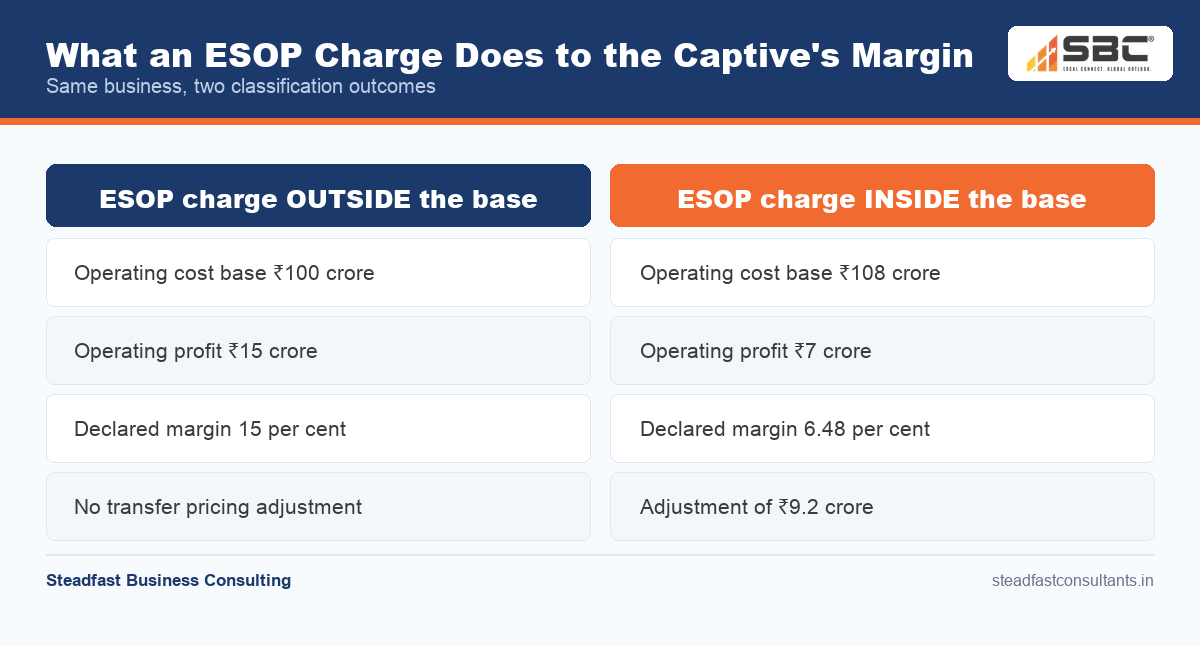
If the arm’s length margin is 15 per cent, the fee on the larger base should have been ₹124.2 crore. The adjustment is ₹9.2 crore, produced entirely by a classification decision rather than by anything the business did differently. That is why it sits alongside characterisation in any review of transfer pricing for a GCC or captive unit.
When is an ESOP cross-charge included in the cost base, and when is it not?
The dividing line is economic incidence. Where the Indian entity actually bore the expenditure for the benefit of its own workforce, the charge is employment cost and belongs in the base, and where it did not, the charge is a parent-level cost that India neither incurred nor should be asked to mark up.
The table below sets out the two ends. Most files sit closer to one column than the other, so read down both and mark honestly which side each row falls on.
| Test | Cost IS in the operating base | Cost is NOT in the operating base |
|---|---|---|
| Economic incidence | The Indian entity bore the cost and settled it | The parent absorbed the cost and never recovered it |
| Instrument | A recharge agreement in force before the grant | No agreement, or one signed after the event |
| Documentary trail | Debit note, employee-wise computation, remittance advice | A journal entry made on a group accounting instruction |
| Amount charged | The realised spread on exercise or vesting | A modelled fair value never converted into a recovery |
| Whose employees | Persons on the Indian payroll performing the tested service | Expatriates or parent staff, or employees of another group entity |
| Treatment in the return | Claimed as a deduction and defended as such | Added back in the computation of total income |
| Comparability | Comparable companies also carry a share-based payment charge | Comparables recognise no such charge at all |
| Consequence | Denominator rises, declared mark-up falls | Denominator excludes the item on both sides |
What pushes a charge into the cost base?
Substance in the employment relationship. Options granted to people who perform the very services being tested are compensation, and compensation is an operating cost of delivering those services whoever issued the paper.
A capability centre competing for engineering talent in Hyderabad or Pune uses equity to recruit and to retain. The cost is incurred with the expectation of earning the service fee for itself and not for the parent.
What keeps a charge out of it?
The absence of an actual outflow. Where no debit note was raised, no remittance was made and no agreement obliged the Indian entity to pay, there is no expenditure of the Indian entity to include, and a reversal of the accounting charge in the computation usually confirms it.
Two further situations keep a charge out. Options held by seconded expatriates whose employment cost is met elsewhere do not relate to the Indian workforce. Nor does an unallocated share of a global scheme pushed down to India, because an arbitrary allocation establishes nothing.
Is the deduction question the same as the transfer pricing question?
No, and treating them as one question is the most common error in this area. Deductibility is decided under the business expenditure provisions of the Income-tax Act 2025, and for earlier years under Section 37(1) of the Income-tax Act 1961, on whether the expenditure was laid out wholly and exclusively for the purposes of the business.
Inclusion in the cost base is decided under the transfer pricing provisions, on whether the item is an operating cost of the tested transaction, so a cost can in principle be allowed as a deduction and still be argued out of the mark-up base. The reverse is equally arguable. How the benefit is taxed in the employee’s hands belongs to a third regime again, and none of the three answers settles either of the others.
What happens when the cost is disallowed and still marked up?
The taxpayer pays twice, and this asymmetry is the sharpest argument available on the transfer pricing limb. Where an assessing officer disallows the ESOP charge as expenditure and the same charge is nevertheless retained in the operating cost base, the entity loses the deduction and is required to earn a mark-up on the amount it was told it never spent.
That contention is on the public record. In an appeal by an Indian information technology enabled services provider against a disallowance of ESOP expenditure, the taxpayer argued in the alternative that the disallowed amount must at least be removed from operating expenses when the revised mark-up is computed. Whatever view is taken of the deduction, the two limbs have to be reconciled.
Must the comparables be treated the same way?
Yes, and this is the point most files miss: a margin computed on a cost base that includes a share-based payment charge, compared against companies whose accounts carry no such charge, is not a comparison at all.
Indian accounting practice on share-based payment is not uniform across the comparable set, and companies that do recognise a charge measure it on different assumptions. Taxpayers have therefore argued before the Income Tax Appellate Tribunal that, to make the comparison meaningful, the ESOP charge should be added back both to the tested party and to every comparable before the margin on cost is computed, and the symmetry point is the one worth pressing because it does not depend on winning the underlying classification argument.
Where symmetry cannot be achieved from published accounts, the alternative is an adjustment, held to the same standard as any other economic adjustment a Transfer Pricing Officer is asked to accept: quantifiable, reliable and evidenced.
What evidence decides the question?
Documents that establish who bore the cost, prepared before the dispute rather than during it. The argument is seldom won on principle, since both positions are respectable; it is won on whether the file shows a real obligation and a real payment.
Seven items carry the weight, and their absence is itself an answer:
- The group scheme document, showing what was granted and on what terms.
- The recharge or cost-sharing agreement, in force before the grant date rather than executed afterwards.
- The debit note, with the employee-wise computation supporting the amount.
- Proof of remittance, tying the debit note to an actual outflow from India.
- Payroll records establishing that the recipients performed the tested service in India.
- The intercompany service agreement, stating expressly whether the cost base includes or excludes share-based payment.
- A reconciliation between the audited financial statements, the tax computation and the working underlying the accountant’s report in Form 48.
It is in that last piece that most cases fail. The duty to maintain contemporaneous documentation is set out in Section 171 of the Income-tax Act 2025 with the requirements specified in Rule 84 of the Income-tax Rules 2026. The accountant’s report follows in Section 172. A cost base that is inconsistent across all three surfaces sets the stage for the Transfer Pricing Officer to construct one after a reference under Section 166, which is a far worse position from which to commence the argument. Preparing such a reconciliation at an early stage is transfer pricing documentation work, not litigation.
Where the amounts recur, the classification can be fixed prospectively instead of argued annually, which is one reason groups weigh the unilateral, bilateral or rollback agreement routes.
Who provides transfer pricing services for a global capability centre with an ESOP cross-charge?
Steadfast Business Consulting (SBC) provides transfer pricing services to global capability centres from offices in Hyderabad, Mumbai, Pune and Dubai. The transfer pricing practice covers documentation, benchmarking, safe harbour and advance pricing agreement strategy, and representation across judicial forums for groups whose Indian entities are remunerated on a cost-plus basis.
On this question the work is evidentiary before it is argumentative. SBC reviews the recharge documentation against the accounting treatment, tests whether the comparable set can support a symmetric adjustment, and reconciles the cost base across the financial statements, the computation and the Form 48 working.
If your capability centre carries a share-based payment recharge that has never been tested, ask our team to review the cost base before the next assessment cycle.
Frequently Asked Questions
Is an ESOP cross-charge an international transaction?
Yes, where it is between associated enterprises as defined in Section 162 of the Income-tax Act 2025 and one of them is non-resident. It then falls within the definition of international transaction in Section 163, and must be reported and priced at arm’s length whether or not it carries a mark-up.
Does a mark-up have to be charged on the recovery itself?
Not necessarily. Where the parent recovers only its actual cost and performs no service in doing so, groups commonly treat the recovery as a pass-through and charge nothing on it. The separate question is whether the same amount then sits inside the Indian entity’s own cost base for its service fee.
Does the recharge agreement have to predate the grant?
It should. An agreement executed after the grant, or after a notice is received, is far harder to present as the source of a real obligation, because departmental scrutiny focuses on whether the Indian entity was contractually bound to bear the cost at the time the benefit was conferred.
Can the ESOP charge be excluded from the comparables instead?
Where the comparable companies disclose a share-based payment charge separately, yes, and that is often the cleaner route. It removes the item from both sides of the comparison rather than arguing about which side it belongs on. The difficulty is that many Indian comparables do not disclose the figure at all.
Does electing safe harbour remove the argument?
Largely, for the years covered. An election under Section 167 of the Income-tax Act 2025, on the circumstances and margins in Rule 89 of the Income-tax Rules 2026, replaces benchmarking with a declared margin. The operating cost base still has to be computed correctly, so the definitional question does not disappear.
Is this the same as the tax on ESOPs in an employee’s hands?
No. How an option is taxed when an employee exercises it is governed by different provisions. The outcome there does not decide whether the employer’s recharge belongs in a transfer pricing cost base, and advice on one should never be read as advice on the other.