
What Guarantee Fee Counts as Arm’s Length?
Written by Jayasri P · Last updated 17 August 2026 · Statutory references current to the Income-tax Act 2025 and the Income-tax Rules 2026.
Quick Answer: A guarantee commission of not less than 1% per annum on the amount guaranteed is accepted under Rule 89. Rule 88 decides eligibility: up to ₹100 crore qualifies, and above ₹100 crore only where the associated enterprise is rated adequate to highest. Outside the safe harbour, the fee is whatever your evidence supports under Section 165.
Group treasurers ask this expecting a figure, and one exists, but it arrives attached to a bargain most groups have never priced, because the safe harbour rate is the cost of certainty rather than a measurement of what the guarantee is worth.
The officer asks something more specific. Did the Indian entity take on a genuine obligation, did the borrower receive terms that it would not have been able to obtain on its own, and can the charge be traced to that difference?
What guarantee fee counts as arm’s length?
Two answers exist.
The first one is the safe harbour, where you elect it, meet the prescribed circumstance and the declared price is accepted without a benchmarking contest, while the second is the normal route, under which the fee is whatever your evidence produces for that borrowing under a method applied under Section 165 of the Income-tax Act 2025, carrying forward Section 92C of the Income-tax Act 1961.
The earlier provision governs earlier tax years. There are three elements to consider in this regard; first, the guarantee must be explicit, meaning an undertaking the lender can enforce, rather than an expectation drawn from group membership; second, the borrower must have received a quantifiable benefit in the terms actually sanctioned; and thirdly, the charge must follow from the selected method.
In the scenarios where all three are valid, a wide range of outcomes is defensible; on the other hand, the fee is exposed in the situations where one does not apply.
Does any Indian rule state a guarantee fee percentage?
Yes, one does, and Rule 89 of the Income-tax Rules 2026 is the only provision that attaches a rate to a corporate guarantee under Indian law.
Sub-rule (1) sets the bargain out plainly. Where the option has been validly exercised under Rule 90 and the declared price accords with the circumstances in sub-rule (2), the transfer price declared by the assessee shall be accepted by the income-tax authorities. Rule 86 carries the definitions, Rule 87 defines the eligible assessee and Rule 88 lists the eligible transactions.
Item 4 of the table in sub-rule (2) deals with guarantees, and it states a single figure: a commission or fee of not less than 1% per annum on the amount guaranteed. There is no second band. The ₹100 crore test has not disappeared, but it has moved, and where it moved to is the whole of the analysis.
Where did the ₹100 crore test go?
It became a condition of eligibility rather than a choice of rate.
Rule 88 admits a corporate guarantee to the safe harbour in two situations: where the amount guaranteed does not exceed ₹100 crore, or where it exceeds ₹100 crore and the associated enterprise carries a credit rating of adequate to highest safety from an agency registered with the Securities and Exchange Board of India.
Read the two rules together and the consequence is sharper than the old split. Under the Income-tax Rules 1962 a large guarantee still reached a safe harbour rate, merely a lower one. Under Rule 88 a guarantee above ₹100 crore to an unrated or weakly rated associated enterprise is not an eligible international transaction at all, so there is no safe harbour to elect and the fee must be defended on evidence.
The authority for making these rules lies with the Board as stated in Section 167 of the Income-tax Act 2025, which is the successor of Section 92CB under the 1961 Act.
What are the safe harbour circumstances for financial transactions?
Guarantees and intra-group loans travel together in treasury structures, and one table prices both.
| Eligible international transaction | Circumstance under Rule 89, sub-rule (2) |
|---|---|
| Corporate guarantee, eligible under Rule 88 | Commission or fee not less than 1% per annum on the amount guaranteed |
| Intra-group loan denominated in Indian rupees | Interest not less than the one-year marginal cost of funds lending rate of the State Bank of India as on 1 April of the relevant tax year, plus 175 to 625 basis points according to the credit rating of the associated enterprise |
| Intra-group loan denominated in foreign currency | Interest not less than the reference rate for that currency as on 30 September of the relevant tax year, plus 150 to 600 basis points according to credit rating and the size of the loan book |
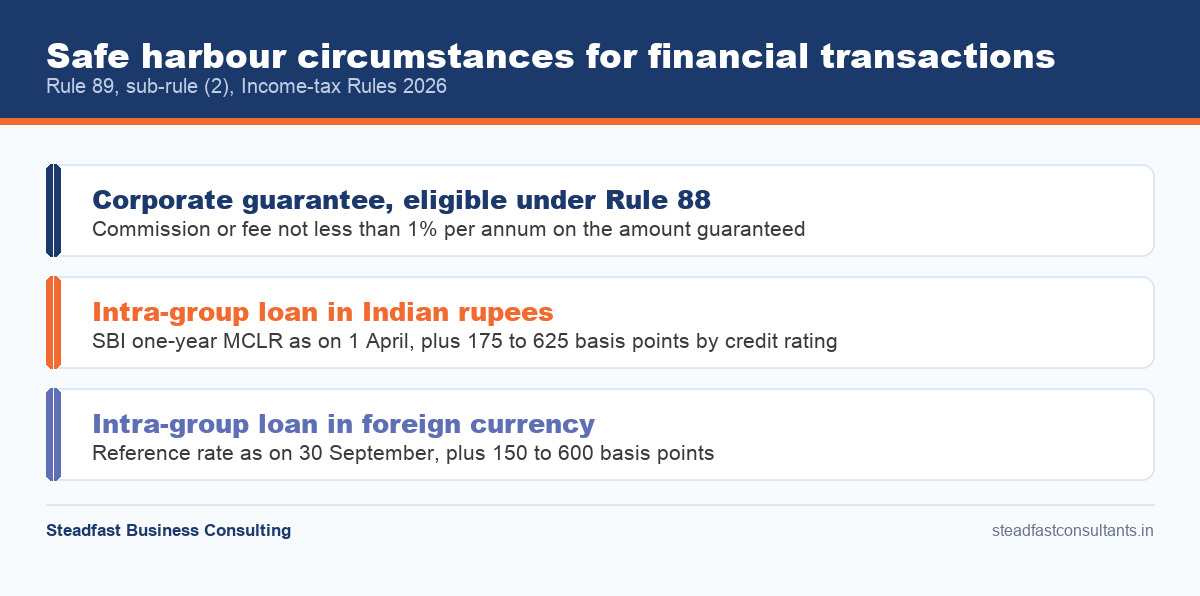
These are Income-tax Rules 2026 provisions, in force from 1 April 2026, and sub-rule (4) applies them for a block period of three tax years commencing with the tax year 2026-2027. The Income-tax Rules 1962 continue to govern earlier tax years, where the guarantee rates were 2% and 1.75% and the loan margins ran from the State Bank of India base rate as on 30 June. The department publishes the earlier provision at Rule 10TD of the Income-tax Rules 1962. Confirm which set governs the year you are filing for.
Is 1% the arm’s length fee, or the price of certainty?
It is the price of certainty.
At 1% per annum the calculation is closer than it was. The earlier 2% frequently sat well above what a benchmarking analysis of the same facility would support, so electing it often meant paying tax on income the transaction did not economically generate. A single 1% rate narrows that gap, and for a borrower with a weak standalone position it may now sit below the fee the evidence would justify.
The trade-off still cuts in both directions. Where the borrower is strong and the guarantee shaved only a modest margin off the sanctioned rate, 1% may still overstate what the undertaking was worth.
The decision is therefore commercial. Before electing, one should price the guarantee according to both methods, as the safe harbour is an alternative to the analysis below, not a replacement for it.
Does a corporate guarantee to a subsidiary need a transfer pricing charge?
An explicit guarantee given so that a subsidiary can borrow qualifies as an international transaction, subject to the rules of transfer pricing.
Section 163 of the Income-tax Act 2025, as a continuance of Section 92B under the 1961 Act, relates to guarantees given for borrowings between associated enterprises.
That is why the familiar treasury position fails. Treating a guarantee as an internal formality requiring no charge is difficult to hold where the parent assumed a real obligation for another entity, because the absence of a fee must then be explained on the facts rather than asserted as group policy.
What is the benefit test for a corporate guarantee?
The purpose of the benefit test is to determine whether the guarantee improved the borrower’s position, and since it establishes whether anything exists to price, it must be done first.
If we consider that the subsidiary could have raised the same amount on its own, then the parent supplied nothing the borrower needed, and an officer reaching that conclusion disallows the charge in the payer’s hands rather than debating the fee.
No benchmarking exercise repairs that position once the benefit test has failed.
How do you show the borrowing terms actually improved?
You compare what the lender offered against what it would have offered the subsidiary independently, and the best evidence is contemporaneous, since term sheets as well as credit approval memoranda, lender’s internal notes and any correspondence treating the guarantee as a condition of sanction all demonstrate that the undertaking changed the outcome.
Where the borrower could neither obtain nor service the debt alone, the guarantee creates access to capital rather than reducing a cost, and an officer may then ask whether an independent party in the parent’s position would have subscribed equity instead. Address the characterisation point in the file.
How does an explicit guarantee differ from implicit parental support?
An explicit guarantee is an undertaking the lender can enforce against the parent. Implicit support is the comfort a lender draws from the borrower belonging to a strong group, with no undertaking given.
The differentiator is chargeability. An explicit guarantee transfers risk. A lender anticipating support it cannot compel, by contrast, has made an assessment of the borrower, not received anything from the parent.
The reverse holds as well. The implicit support must be taken into consideration when evaluating the borrower in the standalone context. The reason for that is that a subsidiary of a well regarded group is generally viewed as a better credit than the same business standing outside any group. In this connection, it is important to analyse the standalone position on the basis of leverage, interest cover, cash generation, the asset base, market position and sector volatility before any adjustment for affiliation is made.
Which analytical approaches support a guarantee fee?
Three approaches are used in practice, and the choice depends on what data you can defend.
How does the interest saving approach work?
The measurement involves assessing the difference between what the borrower would pay standing alone and what it pays with the guarantee. It then goes on to ask how that difference is divided.
The saving is not automatically the fee. An independent borrower would not give up the entire advantage, as it would leave the borrower no better off than unguaranteed borrowing. Hence, reason through how much each side retains.
When can observable guarantee pricing be used?
When real arrangements in respect of third party guarantees exist, those can provide direct evidence, but making comparison is demanding since one has to take into consideration the credit standing of the guaranteed party, the tenor, the security position, the currency and the covered proportion, and if these terms are unknown then the comparison becomes mere assertion masquerading as analysis.
Often, internal arrangements are better, because a guarantee the group gave to an unrelated party is evidence you already hold.
What does the guarantor’s exposure approach measure?
It measures what the guarantor put at risk, by reference to the likelihood of the guarantee being called, as well as the related loss that would follow.
Treasury teams find the methodology to be intuitive, because it mirrors the economics that the parent company faces, but its credibility will ultimately depend on whether the assumptions can be evidenced.
Which guarantee types attract a charge?
Not every instrument called a guarantee transfers risk, and the label in the group’s records does not decide the analysis.
| Guarantee type | Whether a charge is generally expected | What evidence is required |
|---|---|---|
| Explicit financial guarantee | Yes, where the borrower obtained better terms | Executed guarantee deed, board approval, lender credit papers showing the guarantee was a condition, comparison of sanctioned terms with the standalone position |
| Implicit parental support | Generally not, as no undertaking was given | Confirmation that no enforceable undertaking exists, group structure documentation, and the standalone credit assessment recognising the affiliation benefit |
| Performance guarantee | Depends on the obligation assumed and the likelihood of it being called | Underlying contract, scope of the obligation guaranteed, assessment of performance risk, evidence of whether the guarantor has ever been called |
| Letter of comfort | Depends entirely on whether it is legally enforceable | Full text of the letter, legal analysis of enforceability in the relevant jurisdiction, lender correspondence on the weight placed on it |
The second column turns on substance rather than the conventions of drafting, meaning that a letter of comfort framed as a moral assurance and one that the lender may sue upon are different transactions. Our note on inter-company agreements explains what these documents must record.
What does a Transfer Pricing Officer examine first?
The officer examines whether the guarantee exists in documented form, before examining the fee.
Where the transaction is referred under Section 166 of the Income-tax Act 2025, previously Section 92CA of the 1961 Act, the review follows a settled sequence. Was an enforceable undertaking given, did the borrowing terms improve because of it, and has the fee moved without explanation? Our summary of the transfer pricing assessment procedure sets out how that sequence unfolds.
Why do undocumented or unexplained fees invite adjustment?
An undertaking nobody recorded is difficult to distinguish from implicit support, which is not chargeable.
Guarantees are often given at board level and never papered between group entities, so the lender holds a deed and the group records nothing. A fee that moves without a commercial event suggests it is responding to group profits rather than to risk, and where the file shows no refinancing, no change of tenor and no shift in the borrower’s credit position, the adjustment is easy to propose.
What happens after an adjustment to a guarantee fee?
A primary adjustment carries a consequence treasury teams routinely overlook.
Section 170 of the Income-tax Act 2025, earlier Section 92CE of the 1961 Act, stipulates that if a primary adjustment satisfies the prescribed conditions, then the excess money would need to be repatriated to India within the prescribed period or be treated as an advance carrying imputed interest until the repatriation takes place, thus making guarantee adjustments more costly than the headline figure suggests. The details of this obligation are provided in our note on secondary adjustments.
Can an advance pricing agreement cover recurring group guarantees?
An advance pricing agreement fits a guarantee programme, because the arrangement recurs and the facts are stable.
Section 168 of the Income-tax Act 2025, which continues Section 92CC of the 1961 Act, allows for the conclusion of an agreement to fix the arm’s length price, or how it is to be fixed, in relation to future transactions, whereby a group guaranteeing borrowings for several subsidiaries benefits the most as one methodology then applies across the structure.
What should you check in your own guarantee arrangements?
The initial task consists of listing every borrowing where an Indian entity is either a guarantor or a guaranteed party, because most groups find arrangements nobody has priced.
For each one, ask whether an enforceable undertaking exists in writing and whether the lending file shows the guarantee changed the terms offered. Then price it twice, once against the safe harbour circumstance and once against the evidence, and record why you chose the route you chose.
Sections 171 and 172 of the Income-tax Act 2025, successors to Sections 92D and 92E of the 1961 Act, govern the documentation and the accountant’s report. Our note on wider compliance obligations outlines the requirements that need to be fulfilled before filing.
Steadfast Business Consulting (SBC) was founded by Big 4 alumni and named a Notable Transfer Pricing Firm 2024 by ITR World Tax. SBC advises Indian groups on intra-group financing and guarantees, and its transfer pricing practice covers Hyderabad, Mumbai, Pune and Dubai. Groups carrying guaranteed borrowings across the structure may ask SBC to review the arrangements.
Frequently Asked Questions
What is the safe harbour rate for a corporate guarantee in India?
Rule 89 of the Income-tax Rules 2026 prescribes a single rate of not less than 1% per annum on the amount guaranteed. Rule 88 decides eligibility: a guarantee up to ₹100 crore qualifies, and one above ₹100 crore qualifies only where the associated enterprise is rated adequate to highest safety. Earlier tax years took 2% and 1.75% under the Income-tax Rules 1962.
What is the safe harbour interest rate on an intra-group loan?
For a rupee loan the minimum is the one-year marginal cost of funds lending rate of the State Bank of India as on 1 April of the relevant tax year, plus 175 to 625 basis points according to the credit rating of the associated enterprise. The margin follows credit rating rather than loan size, under sub-rule (2) of Rule 89.
Is a corporate guarantee an international transaction in India?
An explicit guarantee provided to or by an associated enterprise outside India falls within Section 163 of the Income-tax Act 2025, carrying forward Section 92B of the 1961 Act. Transfer pricing therefore applies.
Which method applies to a corporate guarantee fee?
The most appropriate method under Section 165 of the Income-tax Act 2025, determined on the facts. Where genuine third party arrangements with comparable terms exist, they provide direct evidence, and otherwise approaches based on the borrower’s interest saving or the guarantor’s exposure apply. — Sources: Section 165, Income-tax Act 2025 · Section 166, Income-tax Act 2025