
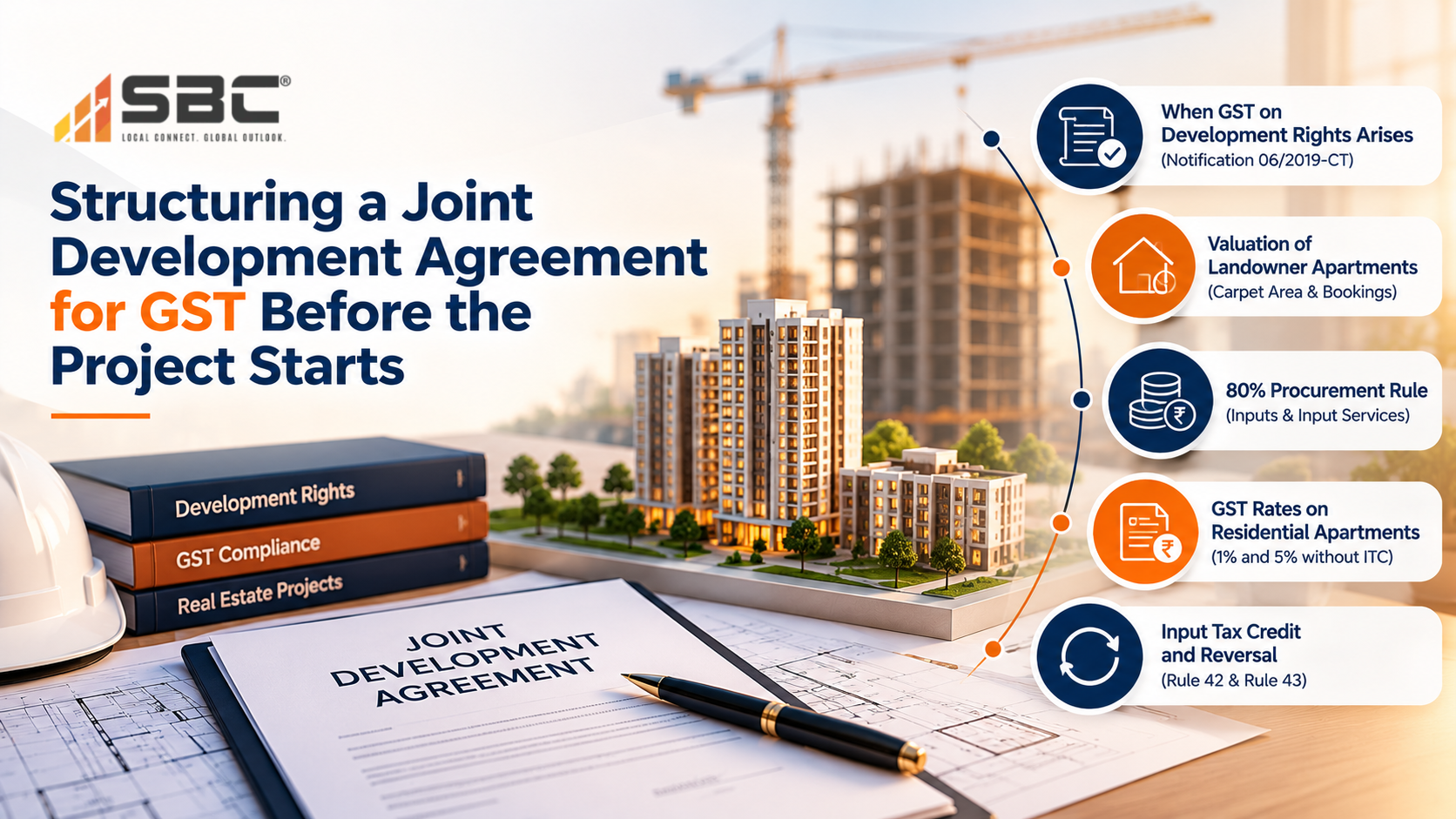
Structuring a Joint Development Agreement for GST Before the Project Starts
By CA Mithilesh Reddy, Founder and CEO, and CA Rajesh Vaishnav, Partner, Steadfast Business Consulting LLP | Indirect Tax Advisory
Quick answer
GST on a joint development agreement turns on four questions: when tax on development rights arises, how much is taxable, how landowner apartments are valued, and which credits survive. For rights received from 1 April 2019, Notification 06/2019-Central Tax (Rate) defers liability to the completion certificate or first occupation, whichever is earlier, payable by the promoter under reverse charge.
Key takeaways
- For development rights, floor space index or long term leases received on or after 1 April 2019, Notification 06/2019-Central Tax (Rate) fixes liability at the earlier of the completion certificate or first occupation, and the promoter pays under reverse charge through entries 5B and 5C of Notification 13/2017-Central Tax (Rate).
- The exemption for development rights in entry 41A of the exemption notification covers only the share attributable to residential apartments booked before completion; unbooked residential apartments and commercial areas remain taxable in the promoter’s hands.
- Residential apartments carry headline central tax of 0.75 per cent (affordable) and 3.75 per cent (others), which become effective rates of one and five per cent after a deemed one-third land deduction, without input tax credit.
- At least 80 per cent of inputs and input services must come from registered suppliers; the shortfall bears 18 per cent under reverse charge, payable by June after the financial year, and cement from unregistered suppliers is taxed separately.
- Valuation of the landowner’s apartments, carpet area definitions, who bears each tax and the evidence of bookings should be fixed in the agreement, because both the final tax and any credit reversal move with pre-completion sales.
Practice illustration: GST at the structuring stage of a joint development project
Issue. An arrangement exchanging development rights for construction services required an analysis of taxability, timing, value and input tax credit.
Approach. The advisory distinguished the GST supplies, tested the applicable real-estate notifications and recommended appropriate documentation.
Outcome. The reported deliverable was a GST structuring framework; no departmental ruling or exemption approval was claimed.
Practical lesson. Credit and reversal rules must follow the project’s applicable rate and transition regime.
This illustration is deliberately generalised and must not be used to identify a taxpayer or matter.
Introduction
A joint development agreement is not one transaction. The landowner supplies development rights. The developer supplies construction services, often partly for money and partly for constructed apartments handed back. Units are then sold to buyers, some before completion and some after. Each of those legs has its own GST treatment, its own timing and its own valuation, and the legs interact: how much of the first is taxable depends on how many of the last were sold before the project completed.
Settling the treatment of each leg at structuring stage is not a compliance nicety. The timing provision determines whether a developer funds a material tax outflow at the start of a project or at the end of it, and the credit analysis determines the cost base of every unit sold.
This note deals with settling all of that at structuring stage, before the agreement is executed, rather than at the first audit. It covers the 2019 notification framework and the rate structure, when liability on the transfer of development rights crystallises and on whom, how much of that transfer is actually taxable given that the exemption is partial, how the landowner’s constructed units are valued, which input credits survive the residential restrictions, the eighty per cent procurement condition with a worked computation, and the credit reversal attributable to unsold inventory at completion.
1. The framework
Six notifications dated 29 March 2019, effective from 1 April 2019, together make up the regime.
| Notification | Effect |
|---|---|
| 03/2019-Central Tax (Rate) | Amends the principal rate notification to insert the new real estate rate entries, with the annexures governing transitional credit for ongoing projects. |
| 04/2019-Central Tax (Rate) | Amends the exemption notification to exempt transfer of development rights, floor space index and long term lease, to the extent attributable to residential apartments booked before completion. |
| 05/2019-Central Tax (Rate) | Amends the reverse charge notification to insert entry 5B, covering transfer of development rights or floor space index for construction of a project by a promoter, and entry 5C, covering a long term lease of land of thirty years or more against upfront consideration. Both are payable by the promoter. |
| 06/2019-Central Tax (Rate) | Issued under section 148, notifies promoters receiving development rights, floor space index or a long term lease as a class of registered persons and fixes the time of supply. |
| 07/2019-Central Tax (Rate) | Notifies the supplies attracting reverse charge where the eighty per cent procurement condition is not met, and the cement mechanism. |
| 08/2019-Central Tax (Rate) | Amends the goods rate notification 1/2017 for the real estate sector. The reverse charge on shortfall inputs, cement and capital goods is notified separately in 07/2019. |
The rate structure introduced by notification 03/2019 is 0.75 per cent central tax for affordable residential apartments and 3.75 per cent for other residential apartments and for commercial apartments in a residential real estate project, each with the matching state tax. These are headline rates of 1.5 per cent and 7.5 per cent; because land is deemed to be one third of the total amount charged and is excluded from the taxable value, the effective rates are one per cent and five per cent of the total consideration. Both are without input tax credit and payable in cash. Ongoing projects could elect, by 10 May 2019, to continue at the earlier rates with credit.
The eighty per cent condition requires that at least eighty per cent of inputs and input services be procured from registered suppliers, excluding development rights, long term lease of land, floor space index, electricity, high speed diesel, motor spirit and natural gas from the computation. The shortfall is taxed at eighteen per cent under reverse charge in the promoter’s hands, payable by June following the end of the financial year. Cement procured from an unregistered supplier attracts reverse charge at the applicable rate irrespective of the eighty per cent threshold.
2. Question one: when does liability on development rights arise
This is the provision that most affects project cash flow, and it is the reason the framework is workable at all.
Notification No. 06/2019-Central Tax (Rate), issued under section 148, notifies registered promoters who receive development rights or floor space index on or after 1 April 2019 against consideration in the form of construction services or otherwise, and promoters who receive a long term lease of land for residential apartments against upfront premium, as a class of registered persons in whose case the liability to pay tax arises on the date of issuance of the completion certificate by the competent authority, or on first occupation of the project, whichever is earlier.
Three consequences follow for a developer.
For the supplies covered by notification 06/2019, the tax on development rights is not payable when the agreement is executed, nor when construction begins, nor when units are sold. It is payable at the end of the project. The deferral covers consideration paid as construction service and monetary consideration relatable to residential apartments; cash consideration for a commercial component is not deferred in the same way and has to be analysed separately. A developer that provides for it at signing is funding a liability that has not arisen.
The liability sits on the promoter under reverse charge by virtue of entry 5B inserted by notification 05/2019, not on the landowner. For a landowner who is an individual not otherwise registered, that is a material point and should be recorded in the agreement so that neither party later assumes the other is accounting for it.
Because the trigger is the completion certificate or first occupation, the project needs a protocol for identifying and documenting that date. First occupation in particular is a question of fact, and a developer that cannot evidence it is exposed on the timing of its own liability.
3. Question two: how much is taxable
Notification 04/2019 exempts the transfer of development rights, floor space index and long term lease to the extent attributable to residential apartments booked before completion. The exemption is partial and proportionate, and the proportion is not known until the end of the project.
That produces a computation that has to be run at the trigger date. The taxable portion corresponds to the residential apartments that remain unbooked as at the completion certificate or first occupation date, together with the commercial portion, for which the exemption does not apply in the same way.
The practical implication is that the eventual liability on development rights depends on sales performance, and a project that sells well before completion has a materially lower liability than one that does not. For a developer modelling a project, this should be in the cash flow as a range rather than as a fixed number, with the drivers identified. The proviso to entry 41A also caps the tax on the unbooked residential share at 0.5 per cent central tax for affordable apartments and 2.5 per cent for other residential apartments (one and five per cent including state tax) of the value of those apartments, so the range has a ceiling.
4. Question three: valuing the landowner’s constructed units
Where the developer gives the landowner constructed apartments as consideration for the development rights, the developer has supplied construction services and received non monetary consideration. Value is determined under section 15 of the CGST Act and the valuation rules, and for development rights acquired against apartments the 2019 notifications deem the value to be the amount the promoter charged for similar apartments to independent buyers nearest to the date on which the development rights are transferred.
Three points matter in the drafting.
Identify the reference transaction. The agreement should record how the value of the landowner’s share will be determined and against which comparable sales. Leaving it to be worked out years later, from a price list that has changed many times, is how valuation disputes start.
Fix the area allocation precisely. The landowner’s entitlement should be specified in carpet area terms, by unit where possible, with the mechanism for substitution if a unit becomes unavailable. Area definitions should follow the statutory definition rather than a local convention.
Record who bears the tax. The agreement should state expressly which party bears the tax on the development rights and which bears the tax on the construction service provided to the landowner. Silence on this point produces a dispute between the parties in addition to the dispute with the department.
5. Question four: which credits survive
Qualifying residential construction taxed under the post-2019 one per cent or five per cent effective rate generally does not carry input tax credit; transitional projects and other supplies must be reviewed under their own applicable entries and conditions. That is the defining commercial feature of the regime and it shapes procurement, because credit that cannot be taken becomes cost.
Where a project has both residential and commercial components, or where an ongoing project elected to continue under the earlier rates with credit, apportionment becomes necessary. Rules 42 and 43 of the CGST Rules, as amended by Notification No. 16/2019-Central Tax with effect from 1 April 2019, contain the real estate machinery. The ratio is computed per project on a carpet area basis rather than on turnover, and the exempt element includes apartments that remain unbooked as at the completion certificate or first occupation date. A final computation is required, with reversal and interest or re-credit as the case may be.
Rule 43 treatment of capital goods must be assessed in the context of the relevant credit regime and transitional provisions; it must not be applied mechanically to a project under the post-2019 no-ITC residential rate.
The planning point is that the reversal attributable to unsold inventory at completion is a real and often large number, it is driven by sales performance, and it should be modelled from the outset rather than discovered at the end of the project.
6. A worked example
A developer enters into a joint development agreement with landowners for a residential project. The landowners contribute development rights; the developer constructs and markets; the landowners receive a specified number of constructed apartments plus a monetary element.
Development rights. Liability arises under entry 5B on reverse charge in the developer’s hands, at the completion certificate or first occupation, whichever is earlier. The exemption in notification 04/2019 applies to the extent attributable to residential apartments booked before completion, so the taxable base is a function of unsold inventory at that date. The cash flow model carries a range, not a point estimate.
Landowner’s units. The construction service supplied to the landowners is valued by reference to the price charged to independent buyers for similar apartments nearest the date of transfer of the development rights. The agreement records the mechanism and the comparable set.
Procurement. The eighty per cent condition is monitored from the first procurement rather than computed at year end. Cement is tracked separately because it attracts reverse charge from an unregistered supplier regardless of the threshold. A register of registered and unregistered procurement, by value, is maintained monthly.
Credit. Under the one per cent and five per cent regime no credit is taken, and the procurement strategy reflects that credit is cost. Where an eligible or transitional component falls outside the no-credit regime, the relevant Rule 42 or Rule 43 methodology and any special project-level computation must be considered separately.
Documentation. A dated file records each position taken, the provision relied on, and the computation. That file is what answers the audit three years later, and it cannot be reconstructed.
7. The eighty per cent condition, in figures
The shortfall mechanism is widely misunderstood, so a short illustration helps. Suppose a project incurs the following during a financial year, in crore, excluding the items the computation leaves out.
| Procurement | Amount |
|---|---|
| From registered suppliers | 72 |
| From unregistered suppliers | 28 |
| Total inputs and input services in the computation | 100 |
Registered procurement is 72 per cent against a requirement of 80 per cent, so there is a shortfall of 8. That shortfall is taxed at eighteen per cent under reverse charge in the promoter’s hands, giving a liability of 1.44, payable by June following the end of the financial year.
Two points follow. First, the charge is on the shortfall, not on the whole of the unregistered procurement, so a project at 72 per cent pays on 8 rather than on 28. Second, cement sits outside this arithmetic entirely: cement procured from an unregistered supplier attracts reverse charge at the applicable rate whether or not the eighty per cent threshold is met, so cement procurement has to be tracked and taxed separately and is not available to cure a shortfall elsewhere.
The practical consequence is that the condition has to be monitored during the year. A project that discovers in April that it finished at 72 per cent can do nothing about it. A project that sees in October that it is tracking at 74 per cent can change its procurement.
8. Ongoing projects and the transitional computation
The regime distinguishes between projects that commenced on or after 1 April 2019, which are compulsorily within the new structure, and ongoing projects, which could elect by 10 May 2019 to continue at the earlier rates with input tax credit. The election was exercisable separately for each project, and a developer with several projects may therefore be operating under both regimes at once.
For a project that moved to the new structure, Annexures I and II to the principal amending notification govern the transitional credit computation, under which credit attributable to the portion of the project completed before the changeover is determined and the balance is reversed. A developer running both regimes needs to keep the computations and the credit ledgers for each project genuinely separate, because the apportionment machinery operates per project and a consolidated approach cannot be reconciled afterwards.
9. Carpet area, which decides more than it appears to
Carpet area carries three separate consequences and it is frequently computed on an internal convention rather than the statutory definition.
It determines whether an apartment is affordable, and therefore whether the one per cent or the five per cent rate applies, in combination with the value threshold. It is the basis on which the landowner’s entitlement under the agreement is usually expressed, and therefore the basis of the valuation of the construction service supplied to the landowner. And it is the basis of the apportionment ratio in Rules 42 and 43 for a real estate project, where the exempt element is computed on the carpet area of unbooked apartments at completion rather than on turnover.
A single inconsistency in how carpet area is measured therefore propagates into the rate, the valuation and the credit reversal. It is worth settling the definition once, in writing, at the start of the project, and applying it everywhere.
10. Where these projects go wrong
First, the liability on development rights is accrued at signing. The timing provision defers it to completion, and accruing early distorts the project economics and the tax provision.
Second, the completion certificate or first occupation date is not documented. Both are factual, and first occupation in particular needs an evidenced position.
Third, the eighty per cent condition is computed once, at year end, and the shortfall is a surprise. It should be monitored monthly, because by year end nothing can be done about it.
Fourth, cement is treated as part of the eighty per cent computation rather than as a separate reverse charge obligation.
Fifth, the valuation of the landowner’s units is left to be determined later. The comparable prices available at the relevant date are the ones that matter, and they are hard to reconstruct.
Sixth, the agreement is silent on who bears the tax. This produces a commercial dispute on top of the tax question.
Seventh, the credit reversal attributable to unsold inventory is not modelled, so a project that sells slowly produces an unbudgeted charge at completion.
Eighth, carpet area is computed on an internal convention rather than the statutory definition, which affects both the rate entry for affordable apartments and the Rules 42 and 43 ratio.
11. A structuring checklist
- Classify the project and each apartment against the affordable and other residential definitions, using the statutory carpet area and value thresholds.
- Confirm whether the project is new or ongoing, and for an ongoing project whether the election was made.
- Record in the agreement that the liability on development rights is on the promoter under reverse charge and arises at completion or first occupation.
- Specify the landowner’s entitlement in carpet area, by unit, with a substitution mechanism.
- Record the valuation mechanism for the landowner’s units and the comparable set to be used.
- State expressly which party bears each tax.
- Set up monthly monitoring of the eighty per cent procurement condition, with cement tracked separately.
- Model the development rights liability as a range driven by pre completion bookings.
- Model the credit position, including any Rules 42 and 43 apportionment on a carpet area basis and the reversal attributable to unsold inventory.
- Establish a protocol for identifying and evidencing the completion certificate and first occupation dates.
- Maintain a dated positions file recording each conclusion and the provision relied on.
- Review the position at each project milestone rather than treating the structuring note as final.
Practitioner’s perspective
Joint development agreements are among the most technically demanding transactions under GST, and the difficulty is less in the law than in the sequencing. Almost every question that generates a dispute at audit is one that could have been settled, cheaply, in the agreement.
The timing provision in notification 06/2019 is the most commercially significant feature of the regime and the most frequently misapplied. Deferring the liability on development rights to completion or first occupation is a substantial cash flow benefit, and a developer that provides for the tax at signing is giving it up for no reason.
The other point worth emphasising is that the eventual liability and the eventual credit reversal are both functions of how much of the project is sold before completion. That makes them commercial variables, not fixed compliance costs, and they belong in the project model from the first appraisal rather than in a tax computation at the end.
Development rights supplied before 1 April 2019: Notification 4/2018 and the transition
The March 2019 framework applies to development rights, floor space index and long term leases received on or after 1 April 2019. Earlier supplies sit under a different regime. Notification No. 4/2018-Central Tax (Rate), issued on 25 January 2018 under section 148 of the CGST Act, fixed the time of supply for development rights granted against construction service: the liability arises when the developer transfers possession or rights in the constructed property to the person who supplied the development rights, through a conveyance deed or an instrument such as an allotment letter. Notification No. 23/2019-Central Tax (Rate), dated 30 September 2019 and effective from 1 October 2019, added an explanation that Notification 4/2018 does not apply to development rights supplied on or after 1 April 2019, so the two regimes do not overlap.
For a developer with several projects the date on which the development rights were first transferred therefore decides which regime applies, and that date has to be evidenced from the agreement, any registered deed or power of attorney and the related correspondence. The Tax Research Unit’s real estate FAQs of May 2019 also record that the exemption for development rights is available only for rights transferred on or after 1 April 2019. Commentary on the 2019 changes describes earlier transfers as taxable at 18 per cent with input tax credit.
Whether the transfer of development rights under a joint development agreement is a taxable service at all remains contested in the courts. The Telangana High Court upheld the levy in February 2024, and the Patna High Court in May 2025 declined to interfere with a reverse charge demand on construction service supplied against development rights. A Division Bench of the Bombay High Court in 2025 quashed a show cause notice on the footing that entry 5B reaches only a transfer of TDR or FSI as understood under the local development control regulations, not rights obtained under a private development agreement. Related questions are before the Supreme Court, and the GST Council has had the taxation of joint development agreements before a Group of Ministers. A developer should record both the character of the rights and the timing position, and revisit them as the law settles.
What counts as a booked apartment, and why it matters
The share of development rights that escapes tax, and the share of credit that is treated as attributable to exempt supply, both turn on whether an apartment was booked by the completion certificate or first occupation date. The 2019 notifications and Rules 42 and 43 define a booked apartment by three tests that must all be met by that date: at least part of the construction service has a time of supply on or before the date; at least one instalment has been credited to the registered person’s bank account; and an allotment letter, agreement for sale or similar document has been issued. A booking that exists only in a sales register, or one supported by a token paid in cash that never reached the bank, will not count.
Notification 06/2019 also deals with the other leg of an area-sharing arrangement. The construction service the promoter supplies to the landowner against development rights is brought within the same completion certificate or first occupation timing, so both legs of the swap crystallise on the same date and should be valued, documented and reconciled together. Because the value of unbooked apartments is taken at the price of similar apartments sold nearest to the completion certificate or first occupation date, the pricing history of the project becomes evidence in its own right and should be kept in a form that an officer can follow.
Frequently asked questions
1. When does GST on the transfer of development rights become payable?
Notification No. 06/2019-Central Tax (Rate), issued under section 148, provides that for notified promoters the liability arises on the date of issuance of the completion certificate by the competent authority, or on first occupation of the project, whichever is earlier.
2. Who pays the tax on development rights, the landowner or the developer?
The promoter, under reverse charge, by virtue of entry 5B inserted into the reverse charge notification by Notification No. 05/2019-Central Tax (Rate).
3. Is the transfer of development rights exempt?
Partly. Notification No. 04/2019-Central Tax (Rate) exempts it to the extent attributable to residential apartments booked before completion. The taxable portion therefore depends on how much of the project remains unbooked at the trigger date.
4. What rates apply to residential apartments?
Central tax of 0.75 per cent for affordable residential apartments and 3.75 per cent for other residential apartments and commercial apartments in a residential real estate project, with the matching state tax, giving effective rates of one per cent and five per cent. Both are without input tax credit and payable in cash.
5. What is the eighty per cent procurement condition?
At least eighty per cent of inputs and input services must be procured from registered suppliers, excluding development rights, long term lease of land, floor space index, electricity, high speed diesel, motor spirit and natural gas. The shortfall is taxed at eighteen per cent under reverse charge in the promoter’s hands.
6. How is cement treated?
Cement procured from an unregistered supplier attracts reverse charge at the applicable rate irrespective of whether the eighty per cent threshold is met, so it has to be tracked separately from the main computation.
7. How are the landowner’s constructed apartments valued?
As a supply of construction service for non monetary consideration, valued under section 15 and the valuation rules, in practice by reference to the price charged to independent buyers for similar apartments nearest the date of transfer of the development rights.
8. How is credit apportioned where a project has exempt and taxable elements?
Under Rules 42 and 43 as amended by Notification No. 16/2019-Central Tax with effect from 1 April 2019, computed per project on a carpet area basis, with unbooked apartments at the completion certificate or first occupation date forming part of the exempt element.
9. Is there a credit reversal for unsold inventory?
Yes. The apportionment treats apartments unbooked as at the completion certificate or first occupation date as attributable to exempt supply, so slower sales produce a larger reversal. A final computation is required with reversal and interest or re-credit as the case may be.
10. Could an ongoing project continue under the earlier rates with credit?
Yes, by an election exercised separately for each project by 10 May 2019. New projects commencing on or after 1 April 2019 are compulsorily under the new structure.
11. What is a booked apartment for the purpose of GST on development rights?
An apartment is treated as booked at the completion certificate or first occupation date only if three tests are met by that date: part of the construction service has a time of supply, at least one instalment has reached the promoter’s bank account, and an allotment letter or agreement for sale has been issued. Unbooked apartments are the taxable share.
12. How does the one-third land deduction work in the 1% and 5% GST rates for apartments?
Notification 11/2017-Central Tax (Rate) deems land to be one third of the total amount charged. The headline rates (central tax 0.75 and 3.75 per cent, plus equal state tax) apply on the remaining two thirds, which gives effective rates of one per cent for affordable and five per cent for other residential apartments on the full price.
13. Does GST on development rights apply to joint development agreements signed before 1 April 2019?
The 2019 exemption and deferred time of supply apply only to development rights transferred on or after 1 April 2019. Earlier transfers fall under Notification 4/2018-Central Tax (Rate), under which liability arises when possession or rights in the constructed property pass to the landowner. Notification 23/2019 confirms that Notification 4/2018 does not apply to later supplies.
14. When must the shortfall under the 80 per cent procurement rule be paid?
The promoter computes the shortfall in purchases from registered suppliers at the end of the financial year, and the 18 per cent reverse charge on it must be added to output tax liability by June following the year-end. Cement bought from unregistered suppliers is taxed separately, in the month of receipt, regardless of the 80 per cent test.
Talk to SBC’s tax team
If you are structuring a joint development agreement or reviewing an existing project against the 2019 framework, our indirect tax team can walk through the timing, valuation and credit positions with you before the agreement is finalised. Explore our GST services | Contact SBC
Related reading from SBC
- The 180-Day Payment Condition: Why an ERP Clearing Date Is Not a Payment Date
- Place of Supply for an Event Held Outside India
- More articles on the SBC blog
About the author
CA Mithilesh Reddy, Founder and CEO, Steadfast Business Consulting LLP, led the team that handled this engagement.
CA Rajesh Vaishnav is a Partner at Steadfast Business Consulting LLP. SBC provides direct and indirect tax, international tax and transfer pricing advisory and dispute support.
Disclaimer
This article is for general information and does not constitute professional advice. It reflects the law as understood at the date of publication and does not take account of later developments, including subsequent amendments to the rate and exemption notifications. The GST treatment of a joint development agreement turns on the terms of the particular agreement, the classification of the project and the facts of its execution. No reader should act on the basis of this article without taking advice on their own circumstances.