
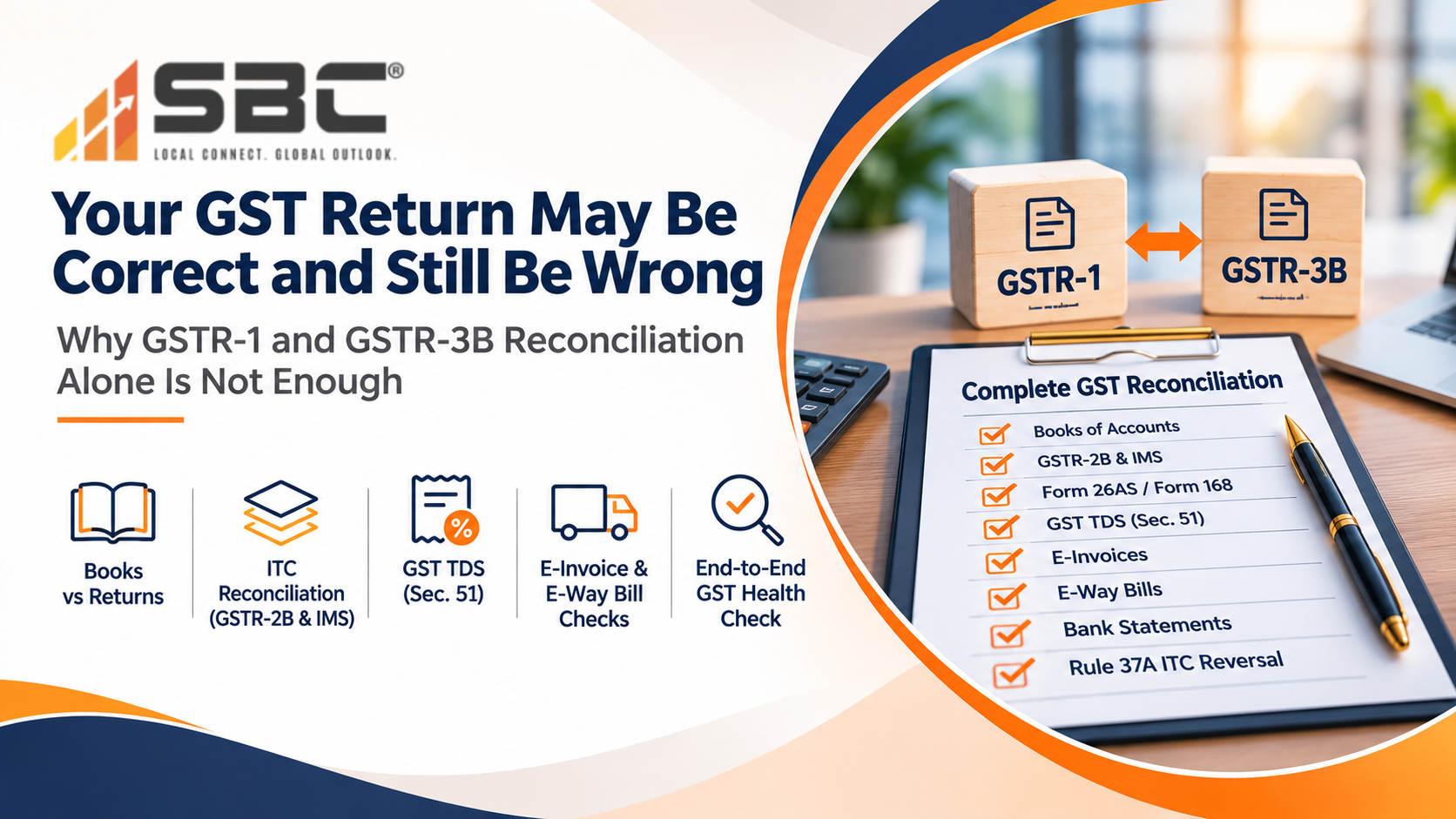
Your GST Return May Be Correct and Still Be Wrong
Why GSTR-1 and GSTR-3B Reconciliation Alone Is Not Enough to Establish GST Compliance
Quick Answer
Matching GSTR-1 and GSTR-3B does not establish complete GST compliance. It only proves that two returns agree with each other. Transactions that never reached the returns, such as scrap sales, expense recoveries, advances, asset disposals or related-party supplies, will not show up as a mismatch at all. A complete GST review must also test the returns against books of accounts, GSTR-2B and the Invoice Management System (IMS), Form 26AS/Form 168, GST TDS credits, e-invoices, e-way bills and bank statements.
Introduction: The Reconciliation That Gives False Comfort
In many years of reviewing GST positions for companies of every size, I have seen one sentence more often than any other at the start of an engagement: “Our GSTR-1 and GSTR-3B are fully reconciled.” It is usually said with confidence, and usually it is true. The two returns do agree.
The difficulty is that the GST department, and increasingly its analytics systems, do not stop there. A notice rarely asks whether your two returns match. It asks why your income-tax return shows higher receipts than your GST turnover, why your e-way bills suggest more outward movement than your invoices, why a government customer has deducted GST TDS on contracts you have not reported, or why you claimed credit that your supplier never paid.
In other words, your GST return may be arithmetically correct and still be wrong. This article explains why, which records you should reconcile, and how to set up a review that holds up when the department looks at your data from every angle.
Why Return-to-Return Matching Has Become the Easy Part
The GST system itself has made the GSTR-1 vs GSTR-3B match more automatic over the past few years. On the GST Portal, liability in GSTR-3B is auto-populated from GSTR-1, and input tax credit (ITC) is auto-populated from GSTR-2B. Some recent changes have tightened this further:
- GSTR-1A was introduced in 2024 so that taxpayers can correct the current period’s GSTR-1 before filing GSTR-3B, rather than overriding figures directly in GSTR-3B.
- The Invoice Management System (IMS), operational from October 2024, lets a recipient accept, reject or keep pending each supplier invoice before it flows into GSTR-2B.
- Table 3.2 of GSTR-3B (inter-state supplies to unregistered persons, composition dealers and UIN holders) has been made non-editable from the November 2025 tax period, with corrections routed through GSTR-1A or GSTR-1/IFF.
- System-generated intimations now flag mismatches automatically: Form GST DRC-01B under Rule 88C for liability differences between GSTR-1 and GSTR-3B, and Form GST DRC-01C under Rule 88D for ITC claimed in excess of GSTR-2B.
Process manuals and advisories on these features are published on the GSTN tutorial portal. The practical consequence is that the two returns will increasingly match by design. That makes the match a weaker test of compliance than ever. The real exposure now sits in what never entered GSTR-1 in the first place, and in credit that appears in GSTR-2B but is not legally eligible.
1. Matching Returns Does Not Mean Complete Compliance
GSTR-1 and GSTR-3B may match even when certain business transactions remain unreported. Miscellaneous income, expense recoveries, advances or sale of fixed assets may not have been examined while preparing returns, because the return preparer typically works from the sales register and not from the general ledger.
Section 35 of the CGST Act, 2017 requires every registered person to keep true and correct accounts of production or manufacture, inward and outward supplies, stock, ITC availed, output tax payable and tax paid. The full text of the Act and the CGST Rules, 2017 is available on the CBIC GST website. The obligation is to report what actually happened in the business, not what was captured in a register.
GST compliance must therefore be verified against the underlying books and business transactions, rather than relying only on return-to-return reconciliation.
A simple illustration
Consider a manufacturer with monthly sales of ₹8 crore. GSTR-1 and GSTR-3B match to the rupee every month. During a review, the general ledger shows:
- ₹42 lakh credited to “Miscellaneous Income” from sale of process scrap
- ₹18 lakh recovered from a group company towards shared office rent and staff costs
- A used machine sold for ₹25 lakh, recorded directly against the fixed asset account
None of these passed through the sales register, so none reached GSTR-1. The returns matched perfectly, yet more than ₹85 lakh of potentially taxable value was never examined. The issue is not a mismatch; it is an omission.
2. Examine Books of Accounts for Unreported Transactions
Books of accounts give a far broader picture of business activity than any return. The reconciliation should cover sales and purchase registers, general ledgers, journal entries, the fixed asset register, debit and credit notes, expense recoveries and miscellaneous income.
Particular attention should be given to:
- Sale of scrap and fixed assets. These are supplies in the course or furtherance of business and are often booked outside the sales module.
- Liquidated damages, reimbursements and other expense recoveries. Each needs to be tested against the definition of supply and Schedule II.
- Related-party transactions and stock transfers. Supplies between related persons or distinct persons (for example, branches in different States) are treated as supply even without consideration under Schedule I. Valuation also follows the specific rules for related-party supplies, which is why GST reviews often need to be read alongside the group’s transfer pricing position.
- Schedule I supplies without consideration. Permanent transfer of business assets on which ITC has been availed and gifts to employees beyond ₹50,000 in a year are common examples.
- Cross-charges within the group. For Global Capability Centres (GCCs) and shared-service models, cost allocations, secondment arrangements and recoveries of common expenses frequently carry GST implications that are not visible in the sales register.
- Advances received for services. Under the time-of-supply provisions, GST on services is generally triggered on receipt of an advance. Advances for goods stand on a different footing, as most taxpayers have been relieved from paying GST on such advances.
Each transaction must be examined under the definition of supply in Section 7, Schedules I, II and III, applicable exemptions and the time-of-supply provisions. Rule 33 of the CGST Rules should also be considered to determine whether the pure-agent exclusion is genuinely available for reimbursements. In practice, many reimbursements do not meet all the pure-agent conditions, and the recovery is then part of the value of supply.
3. ITC: Eligibility, Reconciliation and Reversals
An invoice appearing in GSTR-2B does not by itself establish ITC eligibility. Businesses must independently verify the conditions under Section 16 and the restrictions under Section 17 of the CGST Act, including blocked credits under Section 17(5).
Under Section 16, credit is available only where the recipient holds a valid tax invoice or debit note, the details have been furnished by the supplier and communicated to the recipient, the goods or services have been received, the tax has actually been paid to the Government by the supplier, and the recipient has filed its return. Credit must also be claimed within the time limit in Section 16(4), which is generally 30 November following the end of the financial year, or the date of filing the annual return, whichever is earlier.
Reconciliation between the purchase register, IMS, GSTR-2B and GSTR-3B should identify:
- Missing or duplicate invoices.
- Incorrect GSTINs and differences in taxable value or tax amount.
- Unreported credit and debit notes, including credit notes rejected or kept pending in IMS.
- Ineligible or blocked credits, such as motor vehicles, food and beverages, works contracts for immovable property and goods or services used for personal consumption.
- Reversals required for non-payment to suppliers within 180 days (Rule 37), for exempt or non-business use (Rules 42 and 43), and for supplier default (Rule 37A).
Rule 37A: the reversal most businesses miss
Rule 37A deals with a specific risk. Where a supplier has reported an invoice in GSTR-1 but has not filed GSTR-3B for that period by 30 September following the end of the financial year, the recipient must reverse the related ITC in a GSTR-3B filed on or before 30 November. If not reversed in time, the amount is payable with interest. The credit can be re-availed once the supplier files the pending return. Because this depends on the supplier’s filing status, it cannot be caught by comparing your own two returns.
How to report reversals
CBIC has clarified how ITC availed, reversed and reclaimed should be reported in Table 4 of GSTR-3B in Circular No. 170/02/2022-GST. Getting the table right matters, because it is the basis on which the system tracks credit that has been reversed and can later be reclaimed.
Businesses should also respond promptly to any DRC-01C intimation under Rule 88D. The objective of this entire exercise is simple: ITC claimed should be both correctly reported and legally eligible.
4. Form 26AS / Form 168, GST TDS and Bank Statements
Form 26AS and Form 168
Form 26AS, available on the Income Tax e-filing portal, records income-tax TDS and TCS reported by customers against your PAN, along with other reported transactions. It is a useful independent check on customer receipts. With the Income-tax Act, 2025 now in force, this statement is issued as Form No. 168 (the Annual Information Statement) under Rule 245 of the Income-tax Rules, 2026, as explained in the Income Tax Department’s Form 168 FAQs. For periods up to 31 March 2026, Form 26AS remains the relevant reference.
When comparing these figures with GST turnover, remember that the tax base is different. CBDT Circular No. 23/2017 dated 19 July 2017, issued under the Income-tax Act, 1961 and available through the Income Tax Department, clarified that where GST on services is indicated separately in the agreement, income-tax TDS is to be deducted on the amount excluding GST. Differences in timing, PAN-level versus GSTIN-level reporting, and the treatment of the GST component should all be expected. Readers should also confirm the corresponding position under the Income-tax Act, 2025 for tax years from 2026-27. This is one area where coordination between the GST team and the income-tax compliance team pays for itself.
GST TDS under Section 51
GST TDS under Section 51 of the CGST Act is a separate mechanism. Notified deductors, mainly Government departments, local authorities and specified public sector bodies, deduct GST TDS on payments to suppliers of taxable goods or services above the prescribed contract value. They report it in GSTR-7, and the credit is made available to the supplier on the GST portal, including in Part C of GSTR-2A.
A GST TDS credit is, in effect, a customer telling the department that you made a taxable supply. If the corresponding invoice is not in GSTR-1, the gap is visible. Differences should be examined with reference to invoices, contracts and accounting records.
Bank statements
Bank statements should be reconciled with the books to identify customer receipts, advances, security deposits, loans, capital contributions, inter-account transfers and refunds. Every bank credit is not taxable turnover. Its underlying nature and the applicable time-of-supply provisions must be established before determining GST liability. What matters is that every material credit can be explained with documents.
5. Reconcile E-Invoices and E-Way Bills
E-invoices
Under Rule 48(4), notified taxpayers must report specified invoices and credit or debit notes on the Invoice Registration Portal (IRP) and obtain an Invoice Reference Number (IRN). Since 1 August 2023, e-invoicing applies to taxpayers whose aggregate turnover in any financial year from 2017-18 onwards exceeds ₹5 crore. From 1 April 2025, taxpayers with aggregate annual turnover of ₹10 crore or more cannot report a document on the IRP more than 30 days after its date. The e-invoice portal is the official source for the applicable schema and advisories.
E-invoice details are auto-populated into the relevant tables of GSTR-1. Businesses should reconcile accounting invoices, generated and cancelled IRNs, GSTR-1 and GSTR-3B to identify omissions, duplicate entries and reporting differences. A common gap is an IRN cancelled on the IRP but not reversed in the books, or the reverse.
E-way bills
Rule 138 governs the movement of goods, including movements for reasons other than supply, such as job work, branch transfers, sales returns and goods sent on approval. E-way bills generated on the e-way bill portal should be compared with tax invoices, delivery challans, stock records, quantities and recipient GSTINs.
An e-way bill does not necessarily represent a taxable outward supply. However, an e-way bill with no matching invoice or challan is exactly the kind of data point that leads to questions. The purpose of every movement must be established and documented.
6. Integrated GST Reconciliation
An effective reconciliation covers multiple records rather than only two GST returns. The table below sets out the comparisons that I recommend as a minimum:
| Records compared | Purpose | What it typically reveals |
|---|---|---|
| Books of accounts vs GSTR-1 | Identify omitted supplies | Scrap, asset sales, recoveries, related-party supplies |
| GSTR-1 vs GSTR-3B | Verify liability and payment | Short payment, period mismatches, DRC-01B risk |
| Purchase register vs IMS / GSTR-2B | Identify ITC differences | Missing invoices, supplier errors, DRC-01C risk |
| GSTR-2B vs eligibility review | Confirm legal eligibility | Blocked credits, Rule 37/37A/42/43 reversals |
| Form 26AS / Form 168 vs sales records | Examine receipt differences | Unreported customers, timing gaps |
| GST TDS (GSTR-2A Part C) vs GSTR-1 | Test Government contract reporting | Invoices not reported, rate errors |
| E-invoices vs GSTR-1 | Identify reporting gaps | Cancelled IRNs, duplicates, late reporting |
| E-way bills vs stock records | Verify movement of goods | Unexplained outward movements |
| Bank statements vs books | Identify unreconciled receipts | Advances, unrecorded income |
| Expense ledgers vs GSTR-3B | Examine RCM and ITC | Missed reverse-charge liability |
Classifying the differences
Not every difference is a tax exposure. Once differences are identified, classify each one into one of the following categories before deciding on the action:
- Timing differences that reverse in a later period.
- Accounting adjustments such as provisions, reclassifications and accruals.
- Reporting errors where tax was paid but reported in the wrong table or period.
- Incorrect tax treatment, for example wrong rate, wrong place of supply or wrong classification.
- Documentation gaps, where the treatment is right but the evidence is missing.
- Actual tax exposure, where tax, interest or reversal is genuinely due.
Only the last category needs to be paid. The others need to be corrected, documented or explained. This classification is also the most useful format for discussing the outcome with management and auditors.
7. A Step-by-Step Approach to a GST Health-Check
Businesses should undertake periodic reviews rather than waiting for annual return filing. A structured GST health-check typically follows these steps:
- Define scope and period. Cover each GSTIN separately and decide the financial years in scope.
- Collect data. Extract the trial balance, ledgers, sales and purchase registers, fixed asset register, GSTR-1, GSTR-1A, GSTR-3B, GSTR-2A/2B, IMS actions, e-invoice and e-way bill data, Form 26AS/Form 168 and bank statements.
- Map the general ledger. Tag every income and recovery ledger as taxable, exempt, non-GST or not a supply, with reasons.
- Run the reconciliations. Perform the comparisons in the table above.
- Test ITC eligibility. Review Section 16 conditions, Section 17(5) blocked credits and required reversals.
- Review reverse-charge liability. Check legal services, goods transport agency services, import of services, renting by unregistered persons and other notified categories.
- Classify and quantify. Sort differences into the six categories above and compute tax and interest under Section 50 where applicable.
- Correct and document. Use GSTR-1A, subsequent returns or Form DRC-03 for voluntary payment, and build a file of evidence for positions taken.
The annual return in GSTR-9 and, where applicable, the reconciliation statement in GSTR-9C are good occasions for this review, but they should not be the first time it happens. Corrections are time-bound. ITC is lost after the Section 16(4) date, and following amendments made by the Finance Act, 2023, returns generally cannot be filed after three years from their due date. Many organisations choose to run these reviews monthly or quarterly as part of their finance and compliance outsourcing framework so that issues are caught while they can still be fixed.
Common Red Flags That Return Matching Will Not Catch
From practical experience, the following situations are the ones that most often lead to notices even when returns match:
- Income-tax turnover or Form 26AS receipts higher than GST turnover with no reconciliation on file.
- Large “Other Income” or “Miscellaneous Income” balances with no GST analysis.
- Group cost recharges and secondment arrangements treated as non-taxable without a documented basis.
- ITC claimed on invoices from suppliers who have stopped filing returns or whose registration has been cancelled.
- E-way bills generated for outward movement where no invoice or challan was raised.
- GST TDS credits from Government customers with no matching outward supply in GSTR-1.
- Reverse-charge liability on legal fees, transport or imported services not paid.
- Credit notes issued commercially but not reported, or reported without the required reduction of ITC by the recipient.
Why This Matters Now: Consequences of Getting It Wrong
GST is increasingly enforced through data. The department has access to e-invoice, e-way bill, GSTR-1, GSTR-2B, GSTR-3B and income-tax data, and the GST Council continues to recommend changes that put more reliance on system-based matching. Unexplained differences can lead to:
- Automated intimations in DRC-01B or DRC-01C that require a reply or payment, failing which the filing of subsequent GSTR-1 may be restricted.
- Scrutiny of returns under Section 61 and audit under Section 65.
- Demand proceedings under Section 73 or 74 for earlier years, and under Section 74A for financial year 2024-25 onwards, with interest under Section 50 and penalties.
- Blocking of credit in the electronic credit ledger and, in serious cases, suspension of registration.
Policy and enforcement are administered by the Central Board of Indirect Taxes and Customs (CBIC) under the Department of Revenue, Ministry of Finance. For practitioners, the Institute of Chartered Accountants of India (ICAI) also publishes technical guidance on GST audits and reconciliations that is useful for structuring reviews.
The Practitioner’s Perspective
Over the years, three principles have consistently separated businesses that handle GST scrutiny well from those that struggle:
- Transaction-level verification. Compliance should reflect actual business activities, not merely figures reported in returns.
- Evidence-based examination. Every difference must be evaluated with invoices, contracts, bank statements and ledger records, and the conclusion must be documented at the time, not reconstructed years later in response to a notice.
- Early identification. Timely reconciliation helps correct reporting errors, address genuine liabilities and keep interest and litigation to a minimum.
GST compliance must be evaluated against the transaction, not merely against the return.
Frequently Asked Questions
1. If GSTR-1 and GSTR-3B match, does it mean that GST compliance is complete?
No. Matching only shows that the two returns are consistent for the information reported. It does not show that all business transactions were captured, correctly valued or correctly taxed, or that ITC claimed is eligible.
2. Why should books of accounts be reconciled with GST returns?
Section 35 of the CGST Act requires registered persons to keep true and correct accounts of supplies, stock, ITC, output tax and tax paid. Reconciling books with returns identifies transactions that never reached the sales register, such as scrap sales, asset disposals and expense recoveries.
3. Does every difference between books of accounts and GSTR-1 result in additional GST liability?
No. Differences may arise from timing, accounting treatment, non-GST transactions, exempt supplies, capital receipts or other reasons. Each difference must be examined based on its nature and the applicable GST provisions, and only genuine exposures require payment.
4. Does the appearance of an invoice in GSTR-2B automatically make ITC eligible?
No. GSTR-2B reflects what the supplier has reported. The recipient must independently satisfy the conditions in Section 16, check the restrictions in Section 17 including blocked credits under Section 17(5), and make reversals required under Rules 37, 37A, 42 and 43.
5. What is the role of the Invoice Management System (IMS) in ITC reconciliation?
IMS allows a recipient to accept, reject or keep pending each invoice uploaded by suppliers before it flows into GSTR-2B. It is a useful control point, but accepting an invoice in IMS does not by itself confirm that the credit is legally eligible.
6. Can Form 26AS be used to identify unreported GST turnover?
Form 26AS (now Form 168 under the Income-tax Rules, 2026) can serve as an additional source because it contains income-tax TDS and TCS reported by customers. Differences may arise due to periods, tax bases, PAN-level reporting and the GST component, so it should be used as an investigative tool, not as a direct measure of taxable turnover.
7. Is GST TDS the same as income-tax TDS reflected in Form 26AS?
No. Income-tax TDS operates under income-tax law, while GST TDS operates under Section 51 of the CGST Act. GST TDS is reported by the deductor in GSTR-7 and made available to the supplier on the GST portal.
8. Why should e-invoices be reconciled with GSTR-1?
E-invoice data is auto-populated into GSTR-1 for applicable taxpayers. Reconciliation identifies invoices not reported on the IRP, cancelled IRNs still in the books, duplicate entries and documents that cannot be reported because of the 30-day time limit for taxpayers with turnover of ₹10 crore or more.
9. Does every e-way bill indicate a taxable outward supply?
No. E-way bills may relate to taxable supplies, movements for reasons other than supply such as job work or branch transfers, inward supplies from unregistered persons and other prescribed movements. The purpose and supporting documents must be examined for each movement.
10. Can bank credits be treated as taxable turnover for GST purposes?
Not automatically. Bank credits may represent customer receipts, loans, capital contributions, inter-account transfers, refunds or deposits. Their nature must be established before determining GST implications, though advances for services may trigger GST on receipt.
11. What happens if there is a difference between GSTR-1 and GSTR-3B?
Where the difference exceeds the prescribed limits, the system issues an intimation in Form GST DRC-01B under Rule 88C. The taxpayer must pay the difference or explain it within the prescribed time, failing which the filing of subsequent GSTR-1 can be restricted and recovery proceedings may follow.
12. What happens when ITC claimed in GSTR-3B exceeds the amount in GSTR-2B?
Where the excess crosses the prescribed thresholds, an intimation is issued in Form GST DRC-01C under Rule 88D. The taxpayer must either pay the excess with interest through Form DRC-03 or explain the difference in Part B of DRC-01C within the prescribed time.
13. What is Rule 37A and why does it matter?
Rule 37A requires a recipient to reverse ITC where the supplier has reported the invoice in GSTR-1 but has not filed GSTR-3B for that period by 30 September following the financial year. The reversal must be made by 30 November, and the credit can be re-availed once the supplier files.
14. How often should businesses undertake integrated GST reconciliation?
Monthly or quarterly, depending on transaction volume and complexity, with a comprehensive annual review before filing GSTR-9 and GSTR-9C. Waiting until the year end risks losing ITC after the Section 16(4) deadline and missing the window for correcting returns.
Talk to SBC’s Tax Team
SBC assists businesses in identifying GST reconciliation gaps, evaluating statutory implications, quantifying potential tax exposure and establishing a defensible compliance framework. Explore our GST advisory services or Contact SBC to discuss a review of your GST position.
Disclaimer
This article is provided for general informational and educational purposes only and should not be considered legal, tax, financial or professional advice. GST applicability depends on the facts of each transaction, the relevant statutory provisions and the amendments applicable to the tax period. Tax laws, rules, notifications, thresholds and portal functionalities change from time to time, and the information in this article may not reflect the latest position. Readers should verify the current position from official government sources such as the CBIC, the GST Portal and the Income Tax Department, and should consult a qualified professional for advice specific to their circumstances before acting on any information in this article.