
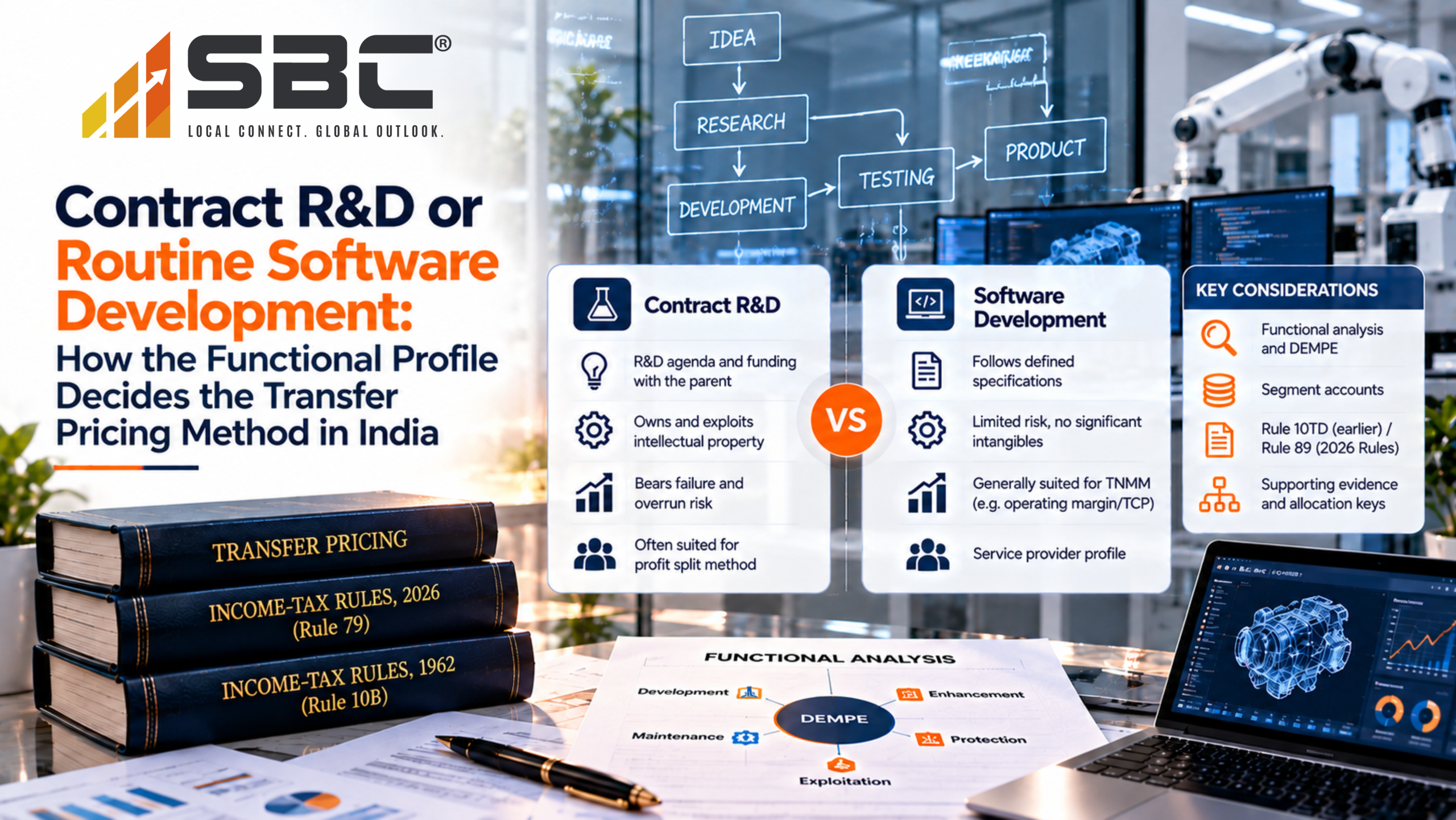
Contract R&D or Routine Software Development: How the Functional Profile Decides the Transfer Pricing Method in India
By CA Mithilesh Reddy, Founder and CEO, and CA Sudheer Polana, Steadfast Business Consulting LLP | Transfer Pricing
Quick answer
Contract R&D is not defined solely by the use of researchers, patents or product terminology. The test is who controls the research agenda, funds the programme, owns and exploits the results, and bears failure and overrun risk. The method and any safe harbour claim must follow that demonstrated profile.
Key takeaways
- Contract R&D is identified by who sets and controls the research agenda, who funds the programme, who owns and exploits the results and who bears failure and cost-overrun risk, not by the use of researchers, patents or product terminology.
- A transfer pricing officer who recharacterises a development centre as a high-end R&D service provider is making a functional claim, and it is answered with primary records of decision rights, funding and IP, not with a general statement that the entity is captive.
- One Indian entity may carry several controlled transactions, such as maintenance, development and contract R&D, so classification should start with the transaction and, where the records support it, use separate segment accounts that reconcile to the audited totals.
- Safe harbour is a separate statutory test: Rule 10TD of the Income-tax Rules, 1962 governs earlier years and rule 89 of the Income-tax Rules, 2026 governs tax years under the Income-tax Act, 2025, so an old margin should never be copied into a current-year memorandum.
- For tax years under the 2025 Act, section 165 and rules 79 and 80 of the Income-tax Rules, 2026 replace section 92C and Rules 10B and 10C of the 1961 framework, which continues to govern earlier years.
Practice illustration: Two distinct issues: contract R&D policy and software-services benchmarking
Issue. Advisory example: A development function required a prospective contract R&D policy reflecting funding, risk control and rights over resulting intellectual property.
Approach. Separate controversy example: In a different engagement, an Indian software-services function challenged comparables chosen on the premise that it was a higher-end R&D provider.
Outcome. The advisory example produced a revised pricing and documentation framework. The controversy example established a margin within the reconstructed arm’s-length range; that statement alone does not establish a final DRP direction or deletion of an adjustment.
Practical lesson. These are separate engagements; their facts and results should not be combined.
This illustration is deliberately generalised and must not be used to identify a taxpayer or matter.
Introduction
The phrase “software development services” can describe almost any stage of a technology business, from writing code against detailed instructions to deciding the architecture of a new platform. In transfer pricing, those activities do not become comparable merely because they both produce software. The relevant distinction concerns functions, decision-making, ownership of results and economic risks.
A contract R&D arrangement often appears clear in its intercompany agreement: the overseas principal funds development and owns the intellectual property, while the Indian entity undertakes a defined research programme and earns a cost-plus return. During an assessment, however, the authority may examine research staff, technical initiatives and costs that are not neatly captured by the contract. The resulting disagreement is one of characterisation before it becomes a dispute about a margin.
This article addresses how to establish the functional profile of an R&D centre, how to distinguish its output from routine software development, and when it is defensible to adopt a separate benchmarking segment. The documentation approach builds on SBC’s FAR analysis guide.
1. Classify transactions before classifying the entity
A single legal entity may supply application maintenance, software development, product testing and contract R&D to the same overseas group. Each category can involve different functions and risk assumptions. The analysis should begin with the controlled transactions in the agreements, invoices and accounting records rather than assigning the entity one description and trying to fit every activity within it.
The Income-tax Department transfer pricing guidance makes clear that characterisation and comparability are function-specific. For historical periods, the 1961 Act and Rule 10B framework remain relevant; for tax years under the Income-tax Act, 2025, the corresponding provisions are section 165 of that Act and rules 79 and 80 of the Income-tax Rules, 2026.
2. The difference between execution and direction
A developer may select code libraries, resolve complex bugs and propose technical improvements while remaining within specifications and budget set by the overseas principal. Those activities involve skill, but do not necessarily mean the Indian entity controls the development programme as an entrepreneurial principal.
Ask who approves product roadmaps, allocates strategic R&D funding, chooses whether to abandon a project, authorises major functionality, controls commercialisation and decides what to do if a research hypothesis fails. The relevant evidence includes architecture minutes, project charters, research steering committee records and acceptance criteria.
3. Funding and failed-project risk
An agreement may state that the overseas entity bears all research risks, but that claim should be supported by actual behaviour. Where a research project overruns its budget or produces unusable results, who absorbs the cost? Is the Indian centre reimbursed automatically, reimbursed only after approval, or exposed to uncompensated expenditure?
Risk control and financial capacity are as important as contractual risk allocation. Retrospective true-up entries unsupported by board approvals and actual settlements may weaken the narrative. Keep failed-project expenses in the functional analysis instead of selecting only successful programmes as evidence.
4. Intangible development and DEMPE contributions
DEMPE examines development, enhancement, maintenance, protection and exploitation of intangibles. A local team may undertake development activity without owning the outcome. Conversely, legal ownership abroad does not make substantive local design or commercial decision-making disappear.
The study should reconcile IP registrations, assignment clauses, source repositories, inventor records, release approvals and funding with the actual participants. Determine whether the Indian entity simply implements principal-controlled development or exercises significant independent control deserving a different reward.
5. Segment accounts must be constructed, not asserted
If an entity undertakes more than one business model, a combined operating margin can obscure differences in the cost base and functional profile. Separate segment accounts should reconcile to audited totals and use documented allocation keys for staff, equipment, occupancy, shared software and management overhead.
Projects should be classified on contemporaneous records, not relabelled after an adjustment is proposed. A study is stronger where ERP cost centres, contracts, invoices and time records independently produce the proposed segments. The denominator for benchmarking should be consistent with the treatment of pass-through and non-operating costs.
6. Method selection and comparable screening
The transactional net margin method may be usable for a properly characterised service provider, but it does not eliminate the need for functional comparability. Product companies, owners of valuable intangibles, full-risk R&D centres and routine development providers cannot be equated without examining their economic differences.
Comparable selection should test service mix, owned IP, R&D expenditure, contract profile, outsourced delivery and risks. A company with its own products may earn returns that do not reflect the routine fee of a contract development centre. Equally, a research-intensive captive centre should not automatically be compared with every conventional IT services company.
7. Safe harbour eligibility needs its own statutory test
Indian safe harbour rules distinguish specified eligible service categories. They may prescribe different margins or conditions for routine software development and contract R&D; the applicable table depends on the year and type of transaction. It is unsafe to lift an older percentage into a current-year memorandum.
For earlier assessment years, the official Rule 10TD text should be checked with its amendments. For tax years under the Income-tax Rules, 2026, safe harbour is in rule 89 (eligible international transactions, which includes IT services and contract R&D for generic pharmaceuticals) with the option made in Form No. 49 under the procedure rule that follows it; confirm the notified thresholds, qualifying transactions and block period before relying on any margin. Eligibility depends on the actual functional characteristics, not simply the selection of a favourable category.
8. Defending a recharacterisation before the TPO and DRP
An effective defence begins with a transaction matrix: contractual scope, decision owner, funding, risk controller, IP rights, activity records, cost centres and remuneration. The matrix should identify which facts are accepted and which the proposed adjustment overlooks.
If the authority proposes high-end R&D classification, answer with primary records showing the distribution of decision rights, not generic statements that the company is captive. Where the facts support substantial research functions, the pricing analysis should address them rather than deny their existence. An alternative comparable set may be appropriate without conceding the primary position.
9. A current-year review that anticipates business change
A development centre may move from routine support to platform architecture, independent research or ownership of commercially significant technology over time. Changes in delegated authority and compensation should trigger a review of the agreement and the pricing policy.
Annual updating should capture material project wins and failures, changes in key-person decision-making, new IP assignments, cost overruns and any shift in risk funding. A historic margin remains defensible only if the operating model to which it relates remains materially the same.
Documentation checklist for an Indian development centre
A defensible file is built per controlled transaction and prepared before the return is filed. The records below are the ones a transfer pricing officer most often asks for, and they are most persuasive when they pre-date any notice.
Agreements and scope: the intercompany services or R&D agreement, statements of work, change orders and the pricing schedule, with the invoices and ledger entries showing how revenue was actually recognised. If the agreement says the overseas principal bears research risk, the file should contain the true-up or reimbursement entries showing that it did.
Decision rights: project charters, steering committee minutes, roadmap approvals, architecture decision records, acceptance sign-offs and any delegation-of-authority matrix. These show whether the Indian team executes a brief or sets one.
People and cost: role mapping by project, seniority and qualifications, time records, and ERP cost-centre reports that reconcile to the audited accounts. A role map built from contemporaneous records carries more weight than interviews arranged after an adjustment is proposed.
Intellectual property: assignment clauses, registrations, repository access and commit records, contributor and inventor records, and evidence of who funds filing, maintenance and enforcement.
Benchmarking: the search strategy, a rejection matrix giving the reason each company was excluded, and the working that derives each segment margin from the accounts.
Common mistakes in assessments and appeals
First, describing the entity by a label such as captive or low risk instead of by evidence. A label does not answer a question about who decided what.
Second, relying on the contract to allocate risk when the books show the Indian entity absorbed overruns or unapproved costs. An officer will follow the money, and a risk allocation contradicted by actual settlements weakens the whole characterisation.
Third, preparing segment accounts after the notice with allocation keys that were never used in management reporting. Segments should be traceable to ERP cost centres, contracts and time records.
Fourth, accepting a single characterisation for the whole entity. A small research stream can pull the entire margin into a high-end comparable set unless the activities are separated and each is supported on its own records.
Fifth, treating a margin inside the range as proof of profile. A margin does not establish who controls the programme, and the authority can still recharacterise the entity.
Sixth, not preserving an alternative. Where the primary position is routine development, the submission can still address a comparable set for the activities that genuinely involve research, without conceding the primary case.
Seventh, leaving the factual record thin before the transfer pricing officer. That record is what the Dispute Resolution Panel and the Tribunal read, so role maps and decision-rights evidence should be filed at the first stage.
Safe harbour under the Income-tax Rules, 2026: points to check
For earlier years, Rule 10TD of the Income-tax Rules, 1962 prescribes the safe harbour, and its sub-rules apply different tables to different assessment years, with sub-rule (3B) covering assessment years 2020-21 to 2026-27. Sub-rule (4) bars comparability adjustments to an accepted transfer price, and sub-rule (5) preserves the documentation and reporting requirements.
For tax years under the Income-tax Act, 2025, rule 89 of the Income-tax Rules, 2026 applies. As published on the Income Tax Department website, its table lists IT services with an operating profit margin on operating expense of at least 15.5 per cent up to a revenue ceiling of Rs 2,000 crore, and contract R&D for generic pharmaceuticals at least 24 per cent up to Rs 300 crore, and sub-rule (4) fixes a block of three tax years from 2026-27. The option is made in Form No. 49 within the procedure rule, and the Assessing Officer may refer doubtful cases to the Transfer Pricing Officer.
Two practical points follow. Eligibility turns on the entity’s actual functions, so a centre that performs genuine research cannot assume that a routine software margin applies to it. And an accepted safe harbour price still has to be documented and reported, so the functional file described above remains necessary.
Conclusion
A contract R&D dispute is not won by insisting that a subsidiary is low risk. It is won by demonstrating the programme actually undertaken, the rights in its output, who made the significant decisions and how the real financial results were shared.
The functional assessment, segmented accounts and pricing method should reinforce each other. If they do not, no level of sophistication in comparable screening can correct the underlying mismatch.
Frequently asked questions
1. Is every centre doing research an entrepreneurial R&D entity?
No. Risk control, decision-making, funding and ownership of results need to be examined.
2. Can a captive centre do contract R&D?
Yes. Captive status does not preclude research activity or settle the appropriate return.
3. When are separate segment accounts useful?
Where materially different controlled transactions or functional profiles are recorded and can be reliably reconciled.
4. Does a safe harbour percentage automatically establish the arm’s length price?
No. Safe harbour requires meeting its statutory eligibility, procedural and temporal conditions.
5. Does ownership of a patent decide the DEMPE allocation?
Not by itself. Actual contributions and risks must be analysed with legal rights.
6. What is the difference between contract R&D and software development services in transfer pricing?
Software development services usually execute defined specifications under the principal’s direction. Contract R&D involves a research programme, but the label alone does not decide the profile. What matters is who sets the agenda, funds the work, owns the results and bears failure risk. Both can be low-risk services; either can be entrepreneurial if the Indian entity controls those decisions.
7. Is contract R&D covered by the transfer pricing safe harbour in India?
Rule 10TD of the Income-tax Rules, 1962 covered contract R&D for specified categories for earlier years. For tax years under the Income-tax Act, 2025, rule 89 of the Income-tax Rules, 2026 lists IT services and contract R&D for generic pharmaceuticals among eligible transactions. Eligibility, thresholds and the block period must be checked against the notified text for the year concerned.
8. How can a company respond if the TPO treats its development centre as a high-end R&D provider?
Answer the characterisation with primary records: role mapping, project charters, steering committee minutes, IP assignment and funding records showing that design, ownership and key decisions sit with the principal. Rebuild the comparable set around routine software development, and keep an alternative position on any genuine research activity before the Dispute Resolution Panel.
9. Which documents show who controls an R&D programme?
Roadmap approvals, project charters, architecture decision records, steering committee minutes, budget approvals, acceptance sign-offs, delegation-of-authority matrices and repository records. Funding entries for overruns and failed projects are equally important, because they show who absorbed the cost when a hypothesis failed.
Talk to SBC’s tax team
If a development centre’s characterisation, segment accounts or safe harbour position is under review, SBC’s transfer pricing team can walk through the functional evidence with you. Explore our Transfer Pricing services | Contact SBC
Related reading from SBC
- When Is the Berry Ratio the Right Profit Level Indicator for a Limited Risk Contract Manufacturer in India?
- Defending the Residual Profit Split Method in India When the TPO Proposes TNMM for an Intangible-Owning Entity
- A Trading Entity Is Not a Service Provider: How to Defend the Resale Price Method Against a TNMM Adjustment in India
- More articles on the SBC blog
About the author
CA Mithilesh Reddy, Founder and CEO, Steadfast Business Consulting LLP, led the team that handled the engagements described in this article.
CA Sudheer Polana, Steadfast Business Consulting LLP. SBC provides direct and indirect tax, international tax and transfer pricing advisory and dispute support.
Disclaimer
This article is general professional commentary and not advice on any particular facts. Treaty eligibility, applicable law, procedural requirements and statutory amendments must be verified for the relevant tax period. It is not a description of an identifiable client engagement.