
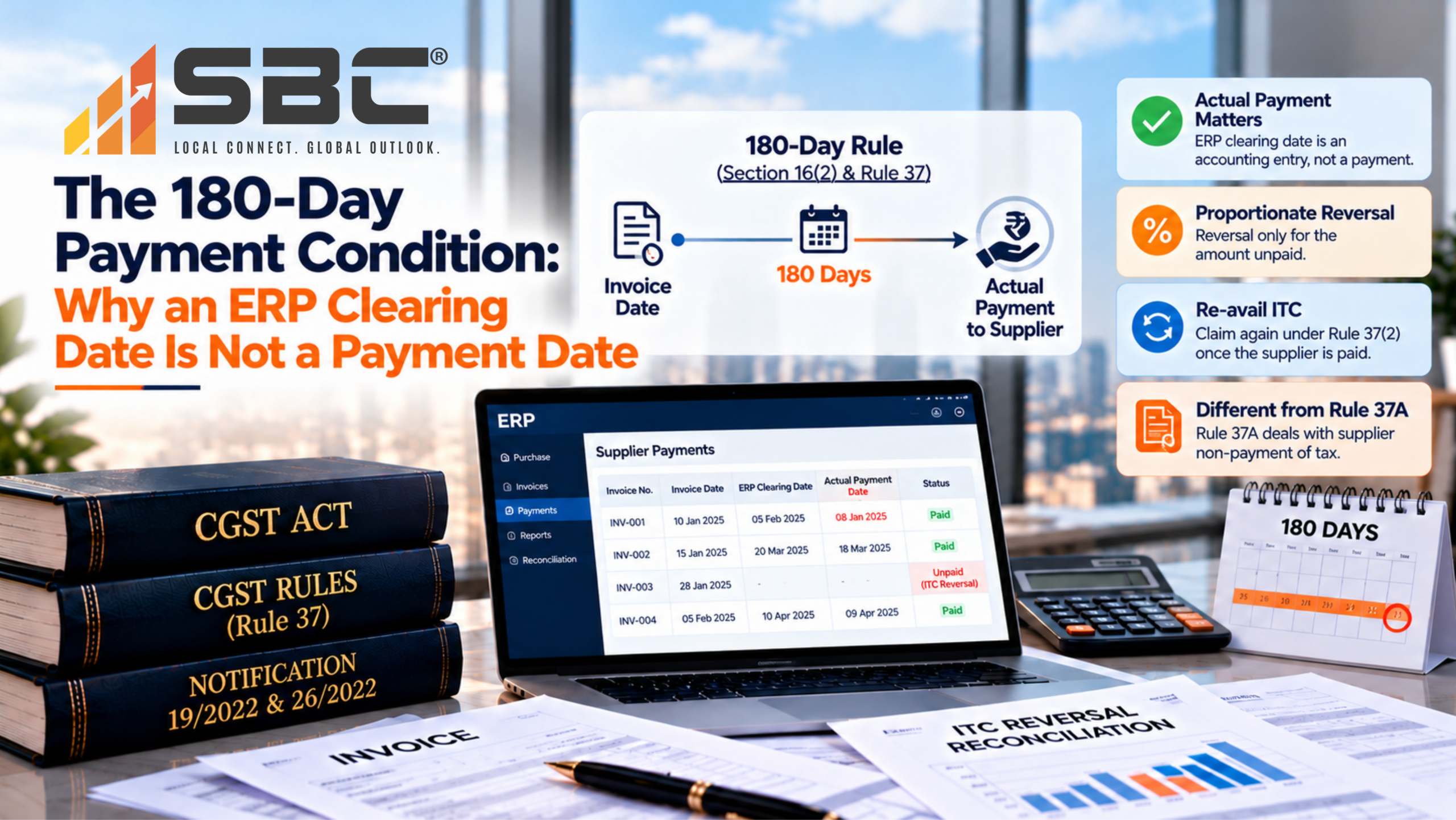
The 180-Day Payment Condition: Why an ERP Clearing Date Is Not a Payment Date
By CA Rajesh Vaishnav, Partner and CA Mithilesh Sai Sannareddy, Founder and CEO, Steadfast Business Consulting LLP | Indirect Tax Litigation / Controversy
Quick answer
Rule 37 of the CGST Rules requires reversal of input tax credit, proportionate to the amount unpaid, only where the recipient has not actually paid the supplier within 180 days of the invoice date (second proviso to section 16(2)). An ERP clearing date is an accounting entry, not proof of non-payment; the invoice-level settlement evidence, including banking records where applicable, decides the question.
Key takeaways
- Rule 37 of the CGST Rules requires reversal of input tax credit only where the recipient has failed to pay the supplier the value and tax within 180 days of the invoice date; an accounting entry is not that failure.
- Since 1 October 2022 the reversal is proportionate to the amount unpaid (Notification No. 19/2022-Central Tax and No. 26/2022-Central Tax), and the credit can be re-availed under Rule 37(2) once the supplier is paid.
- Reverse charge supplies, supplies without consideration under Schedule I and amounts added to value under section 15(2)(b) are outside the reversal.
- The practical answer to an ERP-driven allegation is an invoice-level reconciliation of the department’s own list to bank value dates, with a systems note explaining how clearing dates were generated.
- Rule 37 is different from Rule 37A, which deals with ITC where the supplier has not paid tax to the government, and the 180-day condition is itself under constitutional challenge in the Gujarat High Court.
Practice illustration: An ERP clearing date was mistaken for a payment date
Issue. A GST audit used accounting-system entries to infer delay in settlement of supplier invoices.
Approach. The response reconciled invoices, supplier accounts, banking records and system-migration entries against the 180-day statutory condition.
Reported position or outcome. The broader audit closed without a show cause notice, subject to a limited adjustment. This article addresses the Rule 37 question only, not every allegation considered in that audit.
Practical lesson. The evidence must establish actual payment rather than reliance on a single system field.
This illustration is deliberately generalised and must not be used to identify a taxpayer or matter.
Introduction
Input tax credit under GST is conditional. One of the conditions is commercial rather than documentary: the recipient must actually pay the supplier, and must do so within a prescribed period running from the invoice date. If it does not, the credit attributable to the unpaid amount has to be reversed, with interest, and re-availed only when payment is eventually made. The condition exists to prevent credit being taken on invoices that are never settled.
The allegation that the condition has been breached has become a standard audit finding, and it is almost always a data problem rather than a compliance failure. It surfaces most often after an enterprise system migration, when historical payments are carried across with system generated dates that bear no relationship to the underlying bank transactions. The answer is an invoice level reconciliation against bank records, and a submission that makes the statutory point explicitly rather than assuming it.
This note deals with the audit allegation that now arises most often under that condition, which is not that a supplier went unpaid but that the taxpayer’s own accounting records appear to say so. It covers the statutory condition and the current text of the rule, why an accounting clearing date is not evidence of payment, the invoice level reconciliation that answers the allegation, the partial payment and retention cases where a genuine exposure does arise, the interest computation, and the controls that prevent the issue arising at all.
1. The statutory condition
The second proviso to section 16(2) of the CGST Act provides:
Provided further that where a recipient fails to pay to the supplier of goods or services or both, other than the supplies on which tax is payable on reverse charge basis, the amount towards the value of supply along with tax payable thereon within a period of one hundred and eighty days from the date of issue of invoice by the supplier, an amount equal to the input tax credit availed by the recipient shall be paid by him along with interest payable under section 50, in such manner as may be prescribed:
The closing words were substituted by the Finance Act 2023 with effect from 1 October 2023, replacing the earlier formulation under which the amount was added to the recipient’s output tax liability. The third proviso preserves the right to re-avail the credit on subsequent payment, and the words “to the supplier” were inserted into it by the same Act from the same date.
Three features of the proviso decide most disputes. The trigger is a failure to pay to the supplier, which is a factual question about money. The period runs from the date of issue of the invoice, not from the accounting date or the goods receipt date. And reverse charge supplies are expressly outside the condition.
2. The current text of Rule 37
Rule 37 was substituted by Notification No. 19/2022-Central Tax dated 28 September 2022, with effect from 1 October 2022. It was further amended by Notification No. 26/2022-Central Tax, which is dated 26 December 2022 but also takes effect from 1 October 2022. Sub-rule (3) was omitted. The current text provides:
(1) A registered person, who has availed of input tax credit on any inward supply of goods or services or both, other than the supplies on which tax is payable on reverse charge basis, but fails to pay to the supplier thereof, whether wholly or partly, the amount towards the value of such supply along with the tax payable thereon, within the time limit specified in the second proviso to sub-section (2) of section 16, shall pay or reverse an amount equal to the input tax credit availed in respect of such supply proportionate to the amount not paid to the supplier, along with interest payable thereon under section 50, while furnishing the return in FORM GSTR-3B for the tax period immediately following the period of one hundred and eighty days from the date of the issue of the invoice:
Provided that the value of supplies made without consideration as specified in Schedule I of the said Act shall be deemed to have been paid for the purposes of the second proviso to sub-section (2) of section 16:
Provided further that the value of supplies on account of any amount added in accordance with the provisions of clause (b) of sub-section (2) of section 15 shall be deemed to have been paid for the purposes of the second proviso to sub-section (2) of section 16:
(2) Where the said registered person subsequently makes the payment of the amount towards the value of such supply along with tax payable thereon to the supplier thereof, he shall be entitled to re-avail the input tax credit referred to in sub-rule (1).
(4) The time limit specified in sub-section (4) of section 16 shall not apply to a claim for re-availing of any credit, in accordance with the provisions of the Act or the provisions of this Chapter, that had been reversed earlier.
The emphasis in sub-rule (1) is added. The words “whether wholly or partly”, “or reverse” and “proportionate to the amount not paid to the supplier” were inserted by Notification No. 26/2022-Central Tax, and they are the words that convert the reversal from an all or nothing consequence into a proportionate one.
The 2022 substitution made two changes that matter in practice. Reversal is now proportionate to the unpaid value rather than of the whole credit on the invoice, which is significant where an invoice is partly settled or partly in dispute. And the amount is paid directly rather than added to output tax liability, which affects how it is reported and reconciled.
The two provisos are worth noting because they are routinely forgotten. Supplies made without consideration under Schedule I are deemed paid, which disposes of the question for related party supplies made without a payment. So are amounts added to value under section 15(2)(b), which covers amounts the recipient was liable to pay that were incurred by the supplier.
3. Why an ERP clearing date is not a payment date
The allegation in a typical audit runs as follows. The department extracts payment dates from the taxpayer’s system, compares them against invoice dates, identifies invoices where the gap exceeds the prescribed period, and proposes reversal of the credit on those invoices with interest across several years.
The flaw is in the first step. A clearing date in an enterprise system records when an accounting entry was posted or cleared, which is a book-keeping event. It is affected by the posting calendar, by batch processing, by period end procedures and, most dramatically, by a system migration in which historical transactions are loaded with the migration date or with a default. None of those is the date the supplier was paid.
The statutory condition is not drafted by reference to anything in the recipient’s accounting system. It asks whether the recipient failed to pay. Payment is a transfer of funds, and it is evidenced by the bank. Where bank records show that the supplier received the money within the period, the condition is not satisfied and no reversal arises, whatever the ledger says.
Framed that way, the dispute becomes evidential rather than legal, and the taxpayer holds the better evidence.
4. The reconciliation
The reconciliation has to be at invoice level. A summary comparison of aggregate payables against aggregate payments does not answer an allegation made invoice by invoice, and offering one invites the response that the taxpayer has not addressed the specific transactions identified.
The working should link, for each invoice in the department’s list:
- The supplier invoice, with its number, date and value, and the tax charged.
- The entry in the vendor ledger, with the system clearing date that the department has relied on.
- The bank statement line showing the outward remittance, with its value date.
- The payment advice or remittance reference tying the bank line to the invoice.
- The computed interval between the invoice date and the bank value date, and whether it falls within the period.
- Where a payment covered several invoices, the allocation applied and its basis.
Two supporting documents materially strengthen the submission. A short note from the systems team explaining how clearing dates were generated during the migration, with an illustration, converts the explanation from an assertion into a documented account of what happened. And a sample of supplier confirmations, acknowledging receipt on the dates claimed, corroborates the bank evidence from the other side of the transaction.
5. The partial payment and disputed invoice cases
Since the 2022 substitution, reversal is proportionate to the unpaid value. That matters in two common situations.
Retention and holdback. Where a contract provides for a retention released on completion or after a defect liability period, the retained amount is unpaid within the meaning of the proviso until it is released. The credit attributable to the retained portion is reversible, and it is re-availed on release under Rule 37(2). The right answer is to track retentions as a class and reverse proportionately rather than to argue that the whole invoice is paid.
Disputed amounts. Where part of an invoice is withheld pending resolution of a dispute, the same analysis applies to the withheld portion. A credit note issued by the supplier is a different matter, because it reduces the value of the supply rather than leaving it unpaid, and the treatment follows the credit note provisions instead.
In both cases the position should be computed and disclosed rather than left for an auditor to find. A taxpayer who has reversed proportionately on retentions, voluntarily and with workings, is in a very different position from one who has not considered the question.
6. A worked example
A manufacturer migrates its enterprise system during a financial year. In a departmental audit covering four years, the officers extract vendor clearing dates, identify a population of invoices where the interval from invoice date to clearing date exceeds the prescribed period, and propose reversal across all four years with interest.
Step one. Obtain the department’s working, invoice by invoice. A reconciliation cannot be built against an allegation stated in aggregate.
Step two. For each invoice, extract the bank value date and the remittance reference. Where the payment was made by a batch run covering multiple invoices, obtain the batch detail and the allocation.
Step three. Build the reconciliation table, showing the clearing date, the bank value date and the interval on each basis. The pattern that usually emerges is that the clearing dates cluster around the migration date while the bank dates are spread normally, which is itself persuasive.
Step four. Prepare the systems note explaining how the clearing dates were generated, with one worked illustration traced end to end.
Step five. Make the statutory argument explicitly. The proviso and Rule 37(1) are triggered by a failure to pay. Payment is evidenced by the bank. An accounting date that does not correspond to the transfer of funds is not evidence of non payment.
Step six. Identify any invoices that genuinely were paid late, compute the proportionate reversal with interest, and disclose it. A submission that concedes the small true exposure is considerably more persuasive on the rest than one that contests everything.
7. Interest, which is often the larger number
Where a reversal is genuinely due, the interest can exceed the tax, because the period runs from the date the credit should have been reversed to the date it is paid, and audits reach back several years.
Three points are worth making in any submission that concedes part of the population. The interest runs under section 50, and the rate and the period should be computed rather than accepted as stated in the notice, because departmental computations frequently run interest from the invoice date rather than from the end of the period in which the reversal fell due. Where credit has been re-availed on subsequent payment, interest runs only for the intervening period and not beyond, and a computation that ignores re-availment overstates the liability. And where the reversal is proportionate, the interest is proportionate too, which a computation built on the full invoice value will miss.
It is worth preparing the taxpayer’s own interest computation and putting it in the submission rather than contesting the department’s in the abstract. A notice that proposes tax and interest, met by a response that concedes a small tax figure with a worked interest computation attached, is very often closed at that stage.
8. Credit notes, which are a different question
A reduction in the amount payable is not always a failure to pay, and the distinction decides which provision applies.
Where the supplier issues a credit note reducing the value of the supply, the value itself falls. There is no unpaid amount to trigger the proviso, and the consequences follow the credit note provisions instead, including the requirement that the recipient reverse the corresponding credit. Where the recipient simply withholds part of the invoice without a credit note, the value is unchanged and the withheld portion is unpaid, so the proportionate reversal applies.
The practical problem is that commercial teams often treat a disputed invoice and a credit noted invoice as the same thing, and the accounting may not distinguish them. A response that applies the wrong provision to either category invites a correction on a point the taxpayer could have got right.
9. What the department is working from
It helps to understand the shape of the extraction, because it explains both the allegation and the answer.
The typical working is built from two tables: the purchase register or vendor ledger, and a payments extract. The invoice date comes from the first, the payment date from the second, and the interval is computed between them. Nothing in that process looks at a bank statement, and nothing in it distinguishes a posting date from a value date.
That has two consequences for the response. The first is that the error is systematic rather than random, so it will affect a whole class of transactions in a recognisable pattern, and demonstrating the pattern is more persuasive than contesting invoices one at a time. The second is that the department’s own extract is the right starting point: asking for it, reconciling against it line by line, and returning it with two additional columns showing the bank value date and the corrected interval is far more effective than submitting a reconciliation built on the taxpayer’s own schedule, which the officer then has to map back to the allegation.
10. Where these responses go wrong
First, the response is a legal argument without a reconciliation. The point is correct and the officer will not accept it unsupported.
Second, the reconciliation is at summary level. It must be at invoice level and it must address the department’s own list.
Third, the taxpayer contests the entire population. Where some invoices were genuinely paid late, contesting them costs credibility on the rest.
Fourth, retentions are not considered. This is the most common genuine exposure in the area, and a response that does not address retentions leaves an open flank.
Fifth, reverse charge supplies are included in the population. They are expressly excluded by the proviso and by Rule 37(1), and their presence in the department’s list should be pointed out.
Sixth, the Schedule I and section 15(2)(b) provisos are overlooked, with the result that related party supplies made without consideration are treated as unpaid.
Seventh, re-availment is not tracked. Where credit has been reversed and the supplier is later paid, the credit is re-available under Rule 37(2), and a taxpayer that reverses without tracking re-availment pays twice. Rule 37(4) is important here and is frequently overlooked: the time limit in section 16(4) does not apply to a claim for re-availing credit that was reversed earlier, so a reversal made in an earlier year does not become irrecoverable merely because the ordinary time limit for taking credit has passed.
11. Preventing the allegation
The exposure is systemic and so is the fix. Three controls remove most of it.
An ageing report run on invoice date. Most payables ageing is run on due date or on posting date. A report run on invoice date, flagging invoices approaching the prescribed period, identifies the exposure before it crystallises.
A documented mapping between the bank and the ledger. Where the enterprise system holds a payment date field that is populated from the bank rather than from the posting run, the entire dispute disappears. Where it does not, the reconciliation should be maintained as a standing control rather than built under audit pressure.
A retention register. Retentions tracked as a class, with proportionate reversal and scheduled re-availment, convert the single largest genuine exposure into a routine computation.
Where a system migration is planned, the treatment of historical payment dates should be specified as a requirement before the migration rather than discovered afterwards. The cost of specifying it is trivial. The cost of reconstructing four years of payment dates under audit is not.
Practitioner’s perspective
This issue illustrates something broader about how GST audits are now conducted. The department works from extracted data, and the data it extracts is the data the taxpayer’s system happens to hold. Where a field means something different from what its name suggests, the extraction produces a false positive, and the burden of explaining it falls on the taxpayer.
On the statutory construction there is little room for argument. Rule 37 and the second proviso to section 16(2) are triggered by a failure to pay the supplier, and a clearing date is not a payment. What makes the difference between a response that closes the issue at audit stage and one that proceeds to a show cause notice is whether the reconciliation exists and whether it is at the right level of granularity.
For businesses with large payable populations, the right investment is in the controls rather than in the defence. An ageing report on invoice date and a documented bank to ledger mapping cost very little and remove the issue entirely. For businesses already facing the allegation, concede the genuine late payments, compute the proportionate reversal, and contest the rest on evidence.
Rule 37A and the pending challenge to the 180-day condition
Rule 37 should not be confused with Rule 37A. Rule 37 deals with the recipient’s own failure to pay the supplier within 180 days. Rule 37A was inserted by Notification No. 26/2022-Central Tax dated 26 December 2022, following the 48th GST Council meeting, and deals with a different default: where the recipient has taken credit but the supplier has not furnished the return in Form GSTR-3B for the corresponding period by 30 September following the end of the financial year, the credit must be reversed, through Form GSTR-3B, on or before 30 November following the end of that financial year, with interest under section 50. It first applied to financial year 2022-23. The credit can be re-availed if the supplier later files the return. The two rules have different triggers, evidence and timelines, and a notice that cites one should be checked against the facts of the other.
Two further developments are worth tracking. First, the 180-day condition in the second and third provisos to section 16(2) is under constitutional challenge before the Gujarat High Court in Priya Blue Industries v. Union of India, in which notice was reported in November 2025; no stay of the provisos was reported, so the provisions and Rule 37 continue to apply and should be complied with. Any later amendment must be checked for the actual tax period involved; an ongoing constitutional challenge by itself does not suspend the statutory obligation.
Appeals against an adjudication order that confirms a Rule 37 demand lie first to the first appellate authority under section 107 of the CGST Act and then to the GST Appellate Tribunal under section 112. The Tribunal was launched on 24 September 2025 and, per commentary, began hearing cases on 16 February 2026, with benches being added through 2026. The pre-deposit and time limits for each stage should be confirmed from the statute and the GSTAT portal at the time of filing.
Conclusion
The test for Rule 37 is payment and the supporting records, not the ERP clearing field. A defensible response reconciles each invoice and distinguishes genuine overdue payments from migration or posting artefacts.
Frequently asked questions
1. What triggers reversal under Rule 37?
A failure to pay the supplier the value of the supply together with the tax within the period specified in the second proviso to section 16(2), being one hundred and eighty days from the date of issue of the invoice. Supplies on which tax is payable under reverse charge are excluded.
2. Is the reversal of the whole credit or only part?
Proportionate. Rule 37(1) requires payment or reversal of the credit availed on the supply proportionate to the amount not paid to the supplier, following the amendments that took effect from 1 October 2022. It is no longer an all or nothing reversal of the credit on the whole invoice.
3. From what date does the period run?
From the date of issue of the invoice by the supplier. Not from the goods receipt date, the accounting date or the due date under the contract.
4. Is an ERP clearing date evidence of the payment date?
No. A clearing date records an accounting event. The statutory condition looks to whether the recipient paid the supplier, which is evidenced by the bank. Where bank records show payment within the period, no reversal arises.
5. How should the reversal be reported?
Rule 37(1) requires the amount to be paid along with interest under section 50 while furnishing the return in Form GSTR-3B for the tax period immediately following the one hundred and eighty day period. Since the Finance Act 2023 amendment effective 1 October 2023 the amount is paid rather than added to output tax liability.
6. Can the credit be taken back if the supplier is paid later?
Yes. Rule 37(2) entitles the recipient to re-avail the credit on subsequently making payment of the value together with the tax to the supplier, and the third proviso to section 16(2) preserves that right. Rule 37(4) provides that the time limit in section 16(4) does not apply to a claim for re-availing credit reversed earlier.
7. How are retentions treated?
A retained amount is unpaid until released, so the credit attributable to it is reversible proportionately and re-availed on release. Retentions should be tracked as a class and reversed voluntarily with workings.
8. Do related party supplies made without consideration attract reversal?
No. The first proviso to Rule 37(1) deems supplies made without consideration as specified in Schedule I to have been paid for the purposes of the second proviso to section 16(2).
9. What about amounts the supplier incurred that the recipient was liable to pay?
The second proviso to Rule 37(1) deems amounts added to value under section 15(2)(b) to have been paid, so they do not trigger reversal.
10. What controls prevent this becoming an audit issue?
A payables ageing report run on invoice date, a documented mapping between the bank and the ledger so that the system holds a true payment date, and a retention register with scheduled re-availment.
11. What is the difference between Rule 37 and Rule 37A of the CGST Rules?
Rule 37 requires the recipient to reverse input tax credit if it has not paid the supplier within 180 days of the invoice. Rule 37A requires reversal where the supplier has not filed its GSTR-3B for the period by 30 September following the financial year. Both allow re-availment once the default is cured, but their triggers and evidence differ.
12. What interest is payable when ITC is reversed under Rule 37?
Rule 37(1) requires the reversal to be made along with interest under section 50 of the CGST Act. The rule does not state the start date or the rate, and commentary is divided on whether 18 per cent under section 50(1) or 24 per cent under section 50(3) applies. The computation should be worked out and disclosed rather than accepted from a notice without checking.
13. Is the 180-day rule for ITC under challenge in any High Court?
Yes. The Gujarat High Court issued notice in November 2025 in Priya Blue Industries v. Union of India on the second and third provisos to section 16(2) of the CGST Act. No stay was reported, so the provisions and Rule 37 remain in force. The current status of the petition should be confirmed before relying on it.
14. Does an ERP clearing date prove that a supplier was paid late for GST purposes?
No. The second proviso to section 16(2) asks whether the recipient paid the supplier within 180 days of the invoice date. A clearing date records when an accounting entry was posted, which can differ from the bank value date, especially after a system migration. An invoice-level reconciliation to bank statements answers the allegation.
Talk to SBC’s tax team
If a GST audit has proposed reversal of credit on supplier payments, the first step is usually to obtain the department’s invoice list and test it against bank records. Our GST team can walk through what the reconciliation should contain. Explore our GST services | Contact SBC
Disclaimer
This article is for general information and does not constitute professional advice. It reflects the law as understood at the date of publication and does not take account of later developments. Rule 37 was substituted with effect from 1 October 2022 and the second proviso to section 16(2) was amended with effect from 1 October 2023, so the applicable text depends on the period concerned. Outcomes turn on the specific facts and the documentary record. No reader should act on the basis of this article without taking advice on their own circumstances.