
CategoriesLitigation

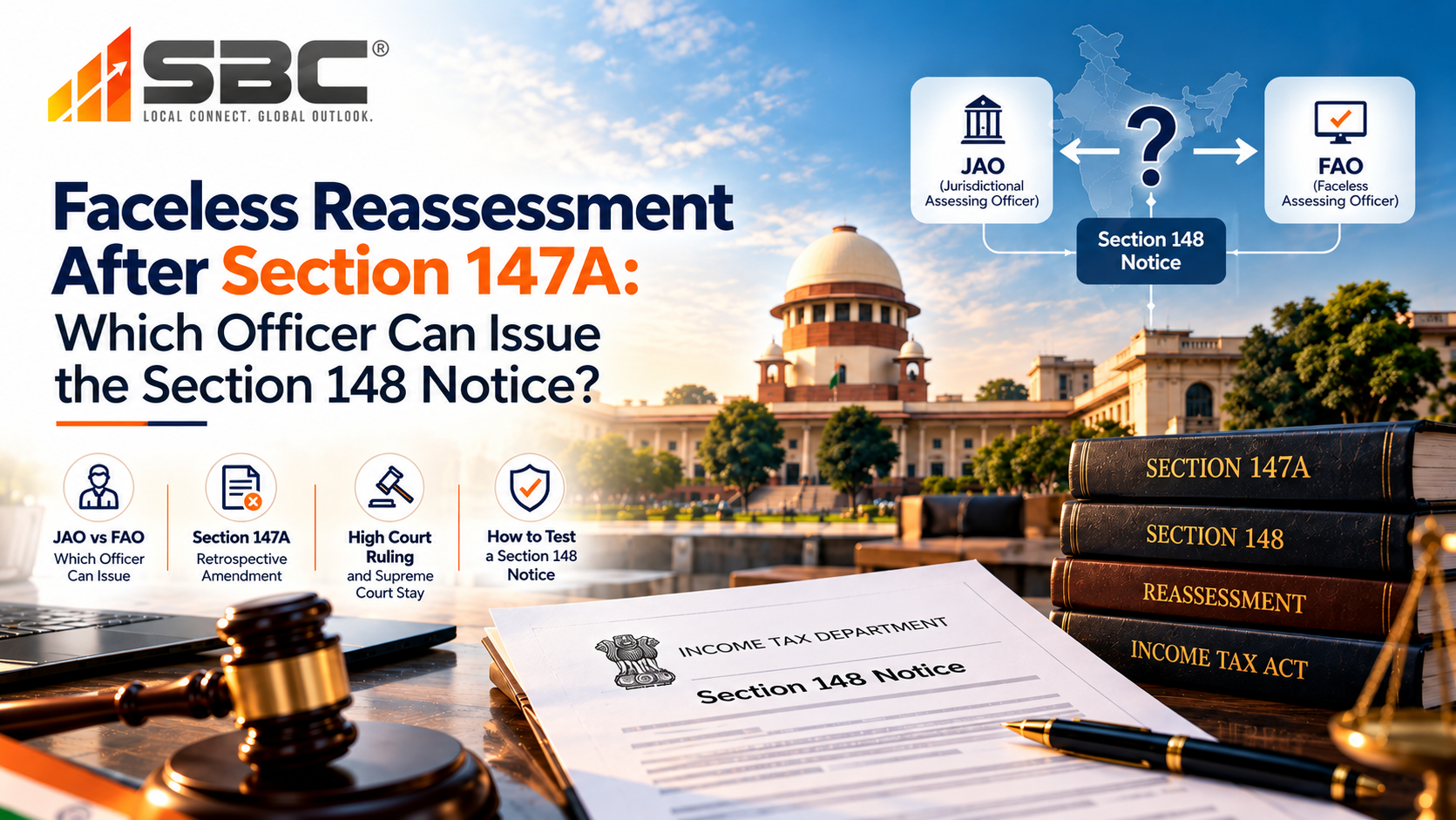
Faceless Reassessment After Section 147A: Which Officer Can Issue the Section 148 Notice?

Faceless Reassessment After Section 147A: Which Officer Can Issue the Section 148 Notice?

By CA Mithilesh Reddy, Founder and CEO, and CA Rajesh Vaishnav, Partner, Steadfast Business Consulting LLP | Direct Tax Litigation / Controversy

Quick answer

Section 147A, inserted retrospectively from 1 April 2021 by the Finance Act 2026, lets jurisdictional officers act for sections 148 and 148A. The Punjab and Haryana High Court struck down its retrospective operation on 10 September 2026, but the Supreme Court stayed that judgment on 18 September 2026. Preserve jurisdictional objections and test sanction, limitation and service separately.

Key takeaways

  • Section 147A, inserted in the Income-tax Act, 1961 by the Finance Act 2026 with effect from 1 April 2021, provides that for sections 148 and 148A the “Assessing Officer” can be a jurisdictional officer rather than only a faceless officer.
  • On 10 September 2026 the Punjab and Haryana High Court in Jyoti Sareen v. Union of India declared the retrospective operation of section 147A unconstitutional and set aside the notices before it.
  • On 18 September 2026 the Supreme Court stayed that High Court judgment (Union of India v. Bharat Industrial Enterprises Pvt. Ltd., SLP (C) No. 33196 of 2026), reportedly with the related reassessment proceedings not to proceed further; the final hearing is reported as listed for 3 December 2026.
  • Officer identity, sanction, limitation and service are separate objections and should be pleaded in separate grounds, because an amendment that answers one does not answer the others.
  • For tax years beginning on or before 31 March 2026 reassessment continues under sections 147 to 153 of the 1961 Act; sections 279 to 286 of the Income-tax Act, 2025 apply from tax year 2026-27.

Practice illustration: Jurisdictional challenge to reassessment notices

Issue. Reassessment notices raised objections about the authorised issuing officer and the statutory faceless procedure.

Approach. Counsel challenged the issuance procedure and prepared a separate factual defence to the underlying material relied on by the department.

Outcome. Interim protection from coercive recovery was obtained in the reported litigation. No final adjudication of the writ petition or underlying tax addition is claimed. Subsequent legislative and appellate developments require a period-specific assessment.

Practical lesson. Interim orders preserve positions; they do not determine the merits.

This illustration is deliberately generalised and must not be used to identify a taxpayer or matter.

Introduction

For some years, the first question in reassessment was sometimes not whether income had escaped assessment but which officer had issued the notice. The faceless reassessment scheme changed how jurisdiction was allocated, while notices continued to be issued through jurisdictional channels. That mismatch produced litigation across several High Courts. A procedural point which looked straightforward in one jurisdiction could produce a different result in another.

The Finance Act 2026 materially altered that landscape by inserting section 147A in the Income-tax Act, 1961. It would be unsafe either to repeat earlier High Court conclusions without addressing that amendment or to assume that retrospective legislation has disposed of every pending challenge. A challenge now has to identify the exact notice, the statutory year, the purported defect and the effect of the amended text on that defect.

This article deals with the jurisdictional examination of a reassessment file. It does not substitute a generic claim that a notice was issued by the wrong officer for a review of jurisdiction, limitation, approval, service and the material said to disclose escapement. The separate problem of automated return processing is considered in our note on the limits of section 143(1).

1. Where the jurisdiction question came from

Section 151A of the 1961 Act enabled a scheme for reassessment and the issuance of reassessment notices that was intended to reduce direct interaction and allocate functions electronically. The relevant scheme and notifications matter because they give practical effect to the enabling section. Courts were asked whether a notice issued by a jurisdictional Assessing Officer, instead of being assigned through the faceless mechanism, was competent.

That is a question of legal power, not merely the choice of portal used to upload a document. A taxpayer challenging jurisdiction needs the notice itself, the digital signature, the authority named on the document, the applicable notification, and the relevant dates. A label on an e-proceedings screen is not necessarily conclusive evidence of the statutory identity of the issuing authority.

2. Why the Finance Act 2026 cannot be overlooked

The Finance Act 2026 inserted section 147A into the 1961 Act, with retrospective effect from 1 April 2021. As reported, it provides that for sections 148 and 148A the “Assessing Officer” means an officer other than the National Faceless Assessment Centre or an assessment unit under section 144B(3), so that a jurisdictional officer can issue those notices. Its retrospectivity and interaction with the existing schemes are central to the dispute. The precise enacted language and commencement must be quoted rather than paraphrased from a departmental summary.

In Jyoti Sareen v Union of India, decided by a Division Bench of the Punjab and Haryana High Court on 10 September 2026 (CWP No. 15791 of 2024 and connected petitions), the Court held the retrospective operation of section 147A unconstitutional and set aside the reassessment notices before it. On 18 September 2026 the Supreme Court stayed that judgment in Union of India v. Bharat Industrial Enterprises Pvt. Ltd., SLP (C) No. 33196 of 2026, and the final hearing is reported as listed for 3 December 2026. The Supreme Court has therefore not yet decided the validity of section 147A, and the High Court judgment should not be treated as settled law. Read the judgment and procedural history before relying on it in a particular jurisdiction.

3. Start with the date and governing statute

Two reassessments with similar facts can be governed by different legal frameworks. Record the assessment year or tax year, the original return date, the alleged year of escapement, the first information or risk-management input, any section 148A show-cause notice, the order on objections and the section 148 notice. Identify whether an earlier notice was subject to transitional treatment.

For years governed by the 1961 Act, analyse the repeal-and-savings provisions alongside later validating legislation. For periods governed by the Income-tax Act, 2025, use the corresponding operative provisions as enacted. A submission which cites only the 2025 Act for a historical assessment year risks answering the wrong statutory question.

4. Jurisdiction, sanction and limitation are distinct objections

The officer permitted to issue a notice is one issue. Whether the designated authority validly sanctioned that notice is another. Whether the notice is within the outer time limit is a third. A jurisdictional submission should put them in separate grounds because an amendment addressing one defect does not necessarily answer the others.

Limitation also demands a quantified enquiry into the kind and value of income alleged to have escaped assessment where the law uses a higher threshold for an extended period. The file should identify the evidence on which the authority relies. A large figure mentioned in a report is not automatically a finding that the statutory threshold has been satisfied for the year under examination.

5. Distinguish a procedural irregularity from want of authority

Courts distinguish between defects that can be cured and acts performed without statutory competence. It is tempting to label every processing failure a jurisdictional nullity, but the characterisation must follow the section and the relevant amendment. DIN defects, deficient internal approvals, service disputes and the competence of the notice issuer should not be presented as interchangeable.

When legislation purports to validate earlier actions, counsel should test exactly what the provision validates, which periods it covers and whether the asserted defect lies within its terms. A broad constitutional challenge can require a different forum and remedy from a conventional statutory objection made before the Assessing Officer or appellate authority.

6. Develop the merits defence while reserving jurisdiction

A serious dispute strategy has two tracks. One preserves threshold objections without acquiescence. The other answers the alleged escapement with records, transaction history and reconciliations. Procedural litigation may fail, become moot after a legislative change or be decided differently in another jurisdiction. The underlying factual file must still be able to withstand scrutiny.

For example, where the information relates to an alleged unexplained investment, preserve the original bank entries, sources of funds, counterparties and property records. Where the allegation relates to income from a non-resident payer, obtain the agreement, invoices, ledger, withholding certificate and treaty documentation. The legal objection is stronger, not weaker, when the facts have been investigated.

7. Evidence index for a jurisdictional challenge

A useful index has the following order: original assessment and return; all reopening communications; electronically delivered notices and acknowledgements; digital signatures and officer identification; sanction records to the extent supplied; information relied on for reopening; response to section 148A; final notice; statutory limitation working; relevant notifications and judgments.

Put each procedural objection in a matrix showing the provision, factual event, record proving it, Revenue response anticipated and requested relief. Avoid sweeping statements that the entire reassessment is invalid without identifying the event that attracts the objection.

8. Relief, strategy and preservation of rights

The right next step depends on the stage. Before an order, record objections in time and answer fact-specific enquiries. On receipt of an adverse order, preserve appeal periods and consider demand stay. A writ is not a universal substitute for the statutory appeal: its appropriateness depends on the asserted jurisdictional defect and available alternative remedy.

An objection which may ultimately succeed does not by itself suspend collection. Protective applications for stay, penalty abeyance and correction of outstanding demand should be considered separately. The matter is not finished when an appellate order is received: implementation and consequential refunds or demands must be verified.

Which Act governs the notice: the 1961 Act or the 2025 Act?

The CBDT’s FAQs on interplay and transition state that reassessment for tax years beginning before 1 April 2026 continues under the Income-tax Act, 1961, and that sections 279 to 286 of the Income-tax Act, 2025 apply from tax year 2026-27. The mapping given there is: section 147 to 279, section 148 to 280, section 148A to 281, section 149 to 282, section 150 to 283, section 151 to 284, section 152 to 285 and section 153 to 286. Section 147A, being a 1961 Act provision, is the operative text for notices relating to the earlier years that are the subject of most current disputes.

A file should therefore record both numberings from the outset. A submission for a 2020-21 notice that cites section 280 of the 2025 Act answers the wrong statute, and a submission for tax year 2026-27 that cites section 147A may be answering a provision that does not apply to it.

How the JAO-FAO dispute reached section 147A

The revised reassessment procedure under sections 147, 148 and 148A applied from 1 April 2021. The e-Assessment of Income Escaping Assessment Scheme, 2022 and the faceless jurisdiction scheme were notified on 29 March 2022, and the Supreme Court dealt with the transition for old notices in Union of India v. Ashish Agarwal on 4 May 2022. High Courts then divided: the Bombay High Court in Hexaware Technologies (3 May 2024) held that a jurisdictional officer and a faceless officer cannot hold concurrent jurisdiction, and other High Courts took a similar approach, while the Delhi High Court in T.K.S. Builders (28 October 2024) took the contrary view. The Supreme Court dismissed the Revenue’s special leave petition in Deepanjan Roy on 16 July 2025 without a reasoned order.

The Finance Act 2026 then inserted section 147A, with effect from 1 April 2021 and a non-obstante clause. In April and May 2026 the Supreme Court remitted a batch of pending appeals to the High Courts in the light of the new section, leaving its validity open. The Punjab and Haryana High Court decided the lead petition, Jyoti Sareen v. Union of India, on 10 September 2026 together with a large batch of connected petitions, and held the retrospective operation of section 147A unconstitutional. Reported grounds include separation of powers, because Parliament may cure a defect identified by a court but may not simply nullify the judgment, and the fact that the amendment did not address the randomised, automated allocation that the faceless scheme requires. The Supreme Court stayed that judgment on 18 September 2026.

Practical steps while the stay operates

First, do not treat the High Court judgment as an operative authority in your own proceeding while it is stayed; commentary on the stay suggests it cannot be relied on to support a case, but the position in your High Court should be checked. Second, read the Supreme Court’s stay order itself, because reports describe its effect on pending reassessment proceedings differently, and an officer who proceeds when the proceedings are meant to remain stayed creates a separate ground. Third, keep the objection alive in the reply to the section 148A notice and in any writ petition, and record that the reply is given without prejudice to it.

Fourth, diarise the appeal periods and any demand-stay application independently of the constitutional question, as an objection that may eventually succeed does not suspend recovery. Fifth, keep the merits file current. If the final hearing in December 2026 upholds section 147A, the jurisdictional ground in many pending cases will fall away and the case will be decided on the material said to show escapement, the sanction and the limitation position.

Conclusion

The useful question for a reassessment team in 2026 is no longer simply whether a faceless officer issued the notice. It is whether the complete chain of statutory authority remains valid after the latest amendment and the judicial decisions governing the relevant period.

The strongest file preserves threshold objections precisely and prepares the substantive defence independently. A challenge to procedure should never become a reason for leaving the underlying facts unexplained.

Frequently asked questions

1. Are all notices issued by jurisdictional officers invalid?

No. That proposition ignores section 147A inserted by the Finance Act 2026, the Punjab and Haryana High Court judgment of 10 September 2026 and the Supreme Court stay of 18 September 2026. The validity of a particular notice requires a period-specific review.

2. Does a defect in sanction raise the same issue as faceless jurisdiction?

No. They are legally distinct. The notice file must be tested against each applicable requirement.

3. Can a taxpayer rely only on a High Court decision from another State?

Its persuasive value depends on the legal issue, amendments, and subsequent judicial developments. The jurisdictional High Court and binding Supreme Court law must be checked.

4. Should merits be addressed while the jurisdiction objection remains pending?

Usually the safer approach is to preserve the objection expressly while complying with applicable requirements and substantiating the facts.

5. Is a reassessment dispute closed when the appeal is allowed?

Not necessarily. Giving-effect action, interest, refunds, recovery status and linked penalty proceedings require separate verification.

6. Has the Supreme Court decided whether section 147A is valid?

Not yet. The Punjab and Haryana High Court declared the retrospective operation of section 147A unconstitutional on 10 September 2026, and the Supreme Court stayed that judgment on 18 September 2026. The final hearing is reported as listed for 3 December 2026. Until then the validity of the section remains undecided at the apex level.

7. What is section 147A of the Income-tax Act, 1961?

Section 147A was inserted by the Finance Act 2026 with effect from 1 April 2021. In substance it provides that, for sections 148 and 148A, the Assessing Officer means an officer other than the National Faceless Assessment Centre or an assessment unit under section 144B(3), which allows a jurisdictional officer to issue reassessment notices. Read the enacted text before relying on this summary.

8. Which sections of the Income-tax Act, 2025 replace sections 147, 148 and 148A?

According to the CBDT’s FAQs on interplay and transition, section 147 corresponds to section 279, section 148 to section 280 and section 148A to section 281. These sections apply from tax year 2026-27. Reassessment for earlier tax years continues under the 1961 Act under the repeal and savings provisions of section 536.

9. Can a section 148 notice issued by a jurisdictional officer be challenged today?

Yes, but the challenge must address section 147A and the Supreme Court stay. Preserve the officer-identity objection, and also test the sanction, limitation, service and reasons separately. The right forum, whether a writ petition or the statutory appeal route, depends on the stage and on the law in the relevant High Court.

Talk to SBC’s tax team

If you have received a section 148 or 148A notice, SBC’s direct tax litigation team can review the notice trail, limitation and forum options with you before the response is due. Explore our Income Tax services | Contact SBC

About the authors

CA Mithilesh Reddy, Founder and CEO, Steadfast Business Consulting LLP, led the team that handled this case.

CA Rajesh Vaishnav is a Partner at Steadfast Business Consulting LLP. SBC provides direct and indirect tax, international tax and transfer pricing advisory and dispute support.

About SBC | Meet the SBC team

Disclaimer

This article is general professional commentary and not advice on any particular facts. Treaty eligibility, applicable law, procedural requirements and statutory amendments must be verified for the relevant tax period. It is not a description of an identifiable client engagement.

CategoriesLitigation

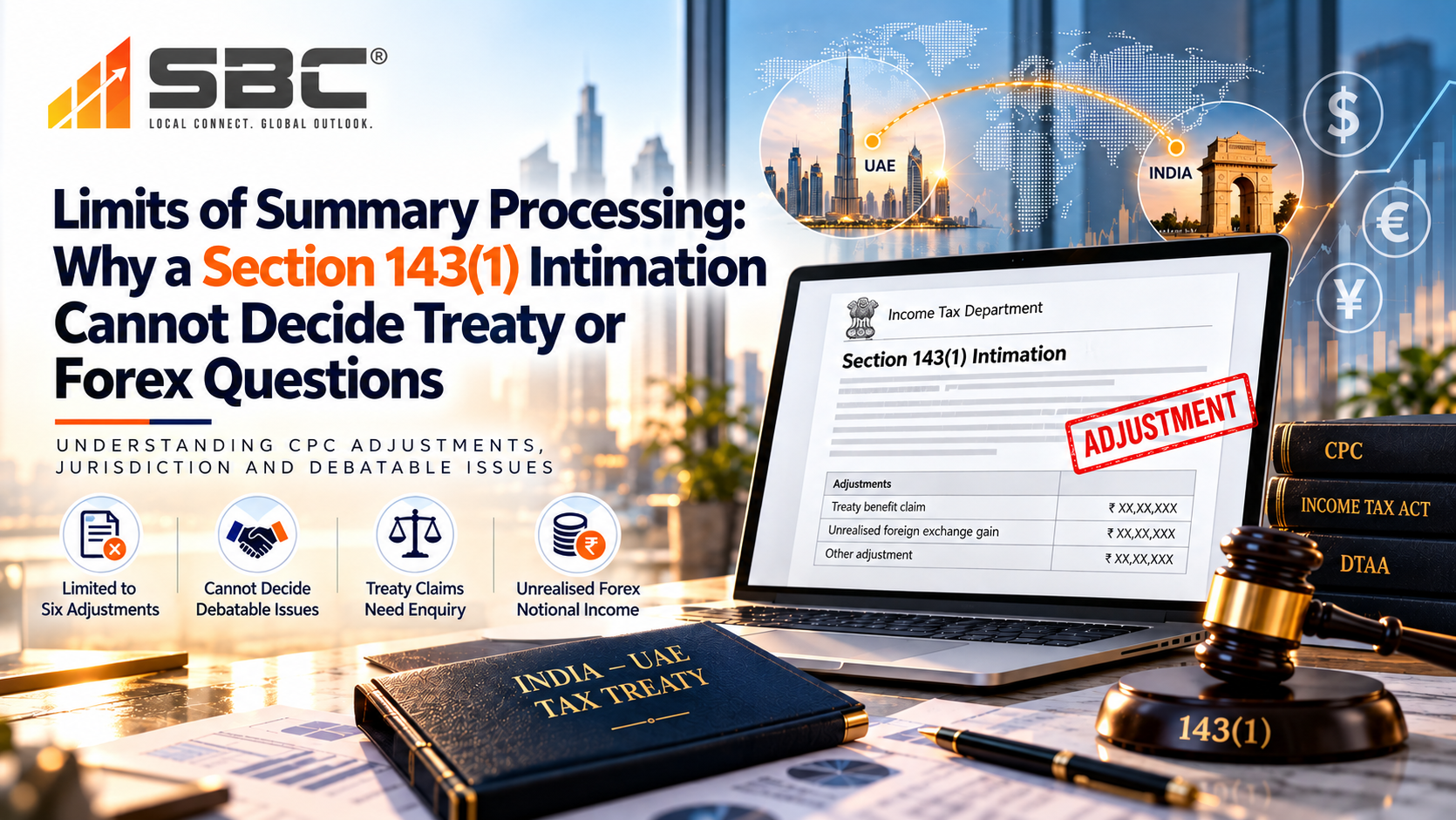
Limits of Summary Processing: Why a Section 143(1) Intimation Cannot Decide Treaty or Forex Questions

Limits of Summary Processing: Why a Section 143(1) Intimation Cannot Decide Treaty or Forex Questions

By CA Mithilesh Reddy, Founder and CEO, and CA Rajesh Vaishnav, Partner, Steadfast Business Consulting LLP | Direct Tax Litigation / Controversy

Quick answer

Section 143(1) processing is limited to six listed adjustments, such as arithmetical errors and incorrect claims apparent from the return. It cannot decide debatable questions of treaty interpretation or notional income. An intimation that does so can be challenged first on jurisdiction, with the merits argued in the alternative.

Key takeaways

  • Section 143(1)(a) of the 1961 Act (section 270(1)(a) of the Income-tax Act, 2025) allows only six categories of adjustment, each tied to what is ascertainable from the return, audit report or a prescribed source.
  • The Bombay High Court in Khatau Junkar v. K.S. Pathania (1992) held that debatable questions or claims needing enquiry cannot be decided in processing; the officer must issue a scrutiny notice instead.
  • A treaty claim denied by the CPC, and unrealised forex gains taxed because they were disclosed in the tax audit report, are both vulnerable on jurisdiction before they are argued on the merits.
  • The power to adjust for inconsistency with the preceding year’s return was inserted in the 1961 Act by the Finance Act 2025 (clause (iia), from 1 April 2025) and is carried into section 270(1)(a)(iii) of the 2025 Act, so consistency across years now has a processing consequence.
  • File the appeal within time and argue the merits in the alternative; a rectification application does not extend the limitation period and a debatable question is not a mistake apparent from the record.

Practice illustration: CPC adjustment of a non-resident treaty claim

Issue. An intimation treated receipts claimed as exempt under a tax treaty as taxable under the domestic income-tax provisions.

Approach. The response separated the statutory limits on adjustments during summary processing from the merits of the treaty and permanent-establishment position.

Outcome. The appellate authority granted relief on the jurisdictional issue and directed recomputation. A separate foreign-exchange appeal covered elsewhere in this article resulted in relief subject to verification of the relevant ICDS reporting.

Practical lesson. Do not merge a treaty-related appellate direction with the different conditions attached to an ICDS appeal.

This illustration is deliberately generalised and must not be used to identify a taxpayer or matter.

Introduction

Processing a return is a mechanical step. The return is received, checked against what it contains and against prescribed sources, and an intimation issues. It is not an assessment, no one examines the taxpayer’s position, and nothing in the process is designed to resolve a question on which two views are possible. The statute recognises that by placing the enquiry route in the same provision, immediately after the processing route, for use when a question needs one.

Two fact patterns now generate a large share of these appeals. The first is the denial of a treaty claim during processing, where the return was filed on the footing that business profits are not taxable in India absent a permanent establishment and the system has instead applied the domestic special rate. The second is the taxation of notional foreign exchange gains which the taxpayer disclosed, correctly, as an income computation standard adjustment in the tax audit report. Although the two appear unrelated, they raise the same argument, and it is an argument about jurisdiction rather than about the merits.

This note deals with what follows when an intimation has decided something it had no power to decide. It sets out the categories of adjustment the provision actually permits, the authority confining them, and two fact patterns that now generate a large share of these appeals: treaty claims disallowed during processing, and notional foreign exchange gains taxed because they were disclosed in the tax audit report. It also covers how the submission should be structured and why the rectification route is usually the wrong one. For the underlying treaty question in the first of those fact patterns, see our note on treaties with no fees for technical services article.

1. What the provision actually permits

Section 270(1) of the Income-tax Act, 2025 (section 143(1) of the 1961 Act, summary processing of a return) permits the total income or loss to be computed after specified adjustments. Those adjustments are confined to the six categories listed in section 270(1)(a):

  1. any arithmetical error in the return;
  2. an incorrect claim, if such incorrect claim is apparent from any information in the return;
  3. any such inconsistency in the return with respect to the information in the return of any preceding tax year, as may be prescribed;
  4. disallowance of a loss claimed by way of set off, where the return for the year in which the loss arose was furnished beyond the due date under section 263(1);
  5. disallowance of expenditure, or increase in income, indicated in the audit report but not taken into account in computing the total income; and
  6. disallowance of a deduction under section 144 or under Chapter VIII-C where the return was furnished late.

The third category deserves particular attention, because it is recent. An equivalent power was inserted into the 1961 Act as section 143(1)(a)(iia) by the Finance Act 2025 with effect from 1 April 2025, and the 2025 Act carries it forward, and the scope of what is prescribed under it will determine how far it reaches. It also bears directly on the point made later in this note about taking consistent positions across years, because an inconsistency that would once only have invited a scrutiny notice may now support an adjustment in processing.

It is worth noting what is no longer there. Section 143(1)(a)(vi) of the 1961 Act permitted an adjustment for income appearing in a statement or form but not included in the return, but a proviso bars any such adjustment for returns for assessment year 2018-19 onwards, and the 2025 Act has no equivalent. Neither Act now permits that adjustment, and a submission that proceeds on the footing that it does is answering a case the Revenue is not making.

Two features of that list decide most appeals. First, every category is tied to something ascertainable from the return, the accompanying documents or a prescribed source. None invites an enquiry. Second, an incorrect claim must be apparent from any information in the return. A claim that requires the reader to construe a statute, read a treaty or evaluate a legal doctrine before deciding whether it is correct is not apparent from anything.

The 2025 Act consolidated the processing provision with scrutiny. Sections 143(1), 143(2) and 143(3) of the 1961 Act are now one section: processing and intimation are section 270(1) to (5), and the notice for scrutiny and the assessment order are section 270(8) to (10). The structural point this makes is useful in argument. The statute itself places the enquiry route in the same section, immediately after the processing route. Where a question needs enquiry, the statute supplies the mechanism, and the officer is required to use it.

2. The authority

The leading case remains Khatau Junkar Ltd. v. K.S. Pathania, Bombay High Court, 1992, decided by Sujata Manohar and S.H. Kapadia JJ. The Court held that adjustments in summary processing are confined to arithmetical errors and to deductions prima facie admissible or inadmissible on the face of the return and the accompanying documents alone. Where a disallowance requires enquiry, or turns on a debatable point, the officer must issue a notice for scrutiny; he cannot decide it in processing.

The principle has been applied consistently since. Its practical force is that it converts a substantive dispute into a jurisdictional one. The appellate authority does not have to agree with the taxpayer on the treaty question or the accounting question. It has only to agree that the question was debatable, which is a much lower bar, and that finding disposes of the appeal.

3. First application: treaty claims disallowed in processing

A non resident files a return claiming nil taxability on service income under the business profits article of the applicable treaty, supported by a tax residency certificate, Form 10F and a declaration that it has no permanent establishment in India. The system disregards the treaty position and applies the domestic rate under section 207 of the 2025 Act (section 115A, the special rate on royalty and fees for technical services in the hands of non-residents), generating a demand.

Consider what the system had to decide in order to reach that result. It had to determine that the income was fees for technical services rather than business profits. It had to determine that no permanent establishment existed, or that the existence of one was irrelevant. It had to determine that section 159(4) (section 90(2), treaty relief where more beneficial) did not displace the domestic charge. Each of those is a question of characterisation and treaty construction. The Supreme Court in Union of India v. Azadi Bachao Andolan, (2003) 263 ITR 706 (SC), held that a treaty overrides the Act where it is more beneficial. Whether it does so on particular facts is not a matter capable of determination on the face of a return.

The submission follows from that. The adjustment is not within any category in section 270(1)(a). It is not an arithmetical error. It is not an incorrect claim apparent from the information in the return, because the information in the return supports the claim and the certificate and declaration were filed. Determining otherwise required an exercise in treaty interpretation for which the provision supplies no power.

It is worth adding the alternative. Even if jurisdiction existed, the claim is correct on the merits, and the appellate authority should say so to avoid a second round. A ground that wins only on jurisdiction protects the year but leaves the same adjustment available in the next.

4. Second application: notional foreign exchange gains

A company with foreign currency trade receivables restates them at the closing rate on the balance sheet date, as the accounting standards require, and the restatement produces a gain. The restatement produces an unrealised gain. The company discloses the gain in its tax audit report as an income computation standard adjustment, identifying it as unrealised. The system reads the disclosure as a declaration of income and taxes the full amount.

The adjustment is unsustainable on two grounds, and both should be run.

Jurisdiction. Deciding whether an unrealised restatement is taxable requires reading section 43 of the 2025 Act (section 43AA, the treatment of gain or loss arising from change in foreign exchange rates), the relevant income computation and disclosure standard, and the judicial doctrine on what constitutes real income. That is interpretation, not correction. An audit report disclosure is a reconciliation item. It exists so that the difference between the accounting treatment and the tax treatment is visible. Treating the disclosure as an admission of taxable income inverts its purpose and penalises the transparency the disclosure requirement was designed to produce.

Substance. The real income doctrine is long settled. In CIT v. Shoorji Vallabhdas & Co., (1962) 46 ITR 144 (SC), the Supreme Court held that if income does not result at all, there cannot be a tax. The Court restated the principle in CIT v. Excel Industries Ltd., Civil Appeal No. 125 of 2013, judgment of 8 October 2013, adding that income tax cannot be levied on hypothetical income. In Godhra Electricity Co. Ltd. v. CIT, (1997) 225 ITR 746 (SC), the Court held that although the company followed the mercantile system and had made the book entries, no real income had accrued, and that accrual must be judged by the probability or improbability of realisation in a realistic manner.

One authority needs careful handling. CIT v. Woodward Governor India (P.) Ltd., (2009) 312 ITR 254 (SC), is frequently cited in this context. What it actually decided is that an unrealised exchange loss on restatement of liabilities at the closing rate is allowable expenditure, that expenditure is not confined to cash outgo, and that a consistently followed method of accounting is presumed correct unless the officer gives reasons for rejecting it. It is not a direct holding on the taxability of notional exchange gains. What it does supply is the symmetry principle: among the factors the Court set out is that losses and gains must receive the same treatment. That is a sound argument, but it should be presented as what it is rather than as a holding the case does not contain.

5. The shape of the submission

A submission on either fact pattern should run in this order.

  1. State the adjustment made, with the amount, the intimation date and the precise clause of section 270(1)(a) (section 143(1)(a)) under which it purports to fall. Often the intimation does not identify one, which is itself worth saying.
  2. Set out what the processing authority had to determine in order to make the adjustment, as a list of discrete questions.
  3. Show that each question is debatable, by reference to the statutory provisions that have to be construed and, where available, to decisions going both ways.
  4. Conclude on jurisdiction, relying on Khatau Junkar and the structure of section 270.
  5. Argue the merits in the alternative, fully, so that a favourable finding disposes of the issue for later years.
  6. Annex the documents: the return, the audit report with the relevant clause, the certificate and declaration where treaty benefit is claimed, the reconciliation schedule, the ledger extracts and the accounting entries.

6. A worked example

A manufacturer records unrealised exchange gains on year end restatement of foreign currency trade receivables. The gain is shown in the tax audit report as a disclosure item, described as unrealised. Processing adds the full amount and raises a demand at the applicable rate of tax.

What the file should contain. The tax audit report with the relevant clause; the reconciliation schedule showing how the accounting profit was adjusted to arrive at returned income; the accounting entries recording the restatement; ledger extracts for each foreign currency receivable; the invoice level listing with the transaction rate and the closing rate; and evidence of subsequent realisation, which is often the most persuasive document in the file because it shows what the receivable was actually worth.

What the submission argues. That the adjustment required a determination under section 43 (section 43AA) and the relevant income computation standard, read with the real income doctrine, and that such a determination is outside the processing power. That, in substance, a restatement entry is not a receipt or an accrual, and the charge attaches to income, not to an accounting measurement. That the disclosure was a reconciliation item, not a declaration of income. And that, on the symmetry principle, a position that taxes unrealised gains while disallowing unrealised losses cannot be right.

What usually resolves it. The appellate authority accepting that the question was not capable of summary determination, and directing deletion subject to verification of the disclosure. The verification direction is routine and should not be resisted; it is the mechanism by which the authority disposes of the appeal without conducting an enquiry itself.

7. Where these appeals go wrong

First, the appeal is argued only on the merits. A submission that spends its length on treaty characterisation and never mentions jurisdiction has given away the easier ground.

Second, the jurisdictional ground is stated but not developed. Asserting that the officer exceeded his powers is not an argument. The argument is the list of questions he had to answer, each shown to be debatable.

Third, the rectification route is used first and the limitation period for appeal is allowed to run. A rectification application does not extend the time for appeal, and a debatable question is by definition not a mistake apparent from the record, so the application is likely to fail on the very ground that makes the appeal strong. File the appeal; pursue rectification alongside if it is worth pursuing at all.

Fourth, the documents that make the claim apparent were not filed with the return. Where a certificate or declaration was obtained late, the taxpayer is arguing that the claim was apparent from information that was not before the processing system. That is a harder case, and it should be met directly rather than left for the Revenue to point out.

Fifth, the position across years is inconsistent. Where the same restatement was offered to tax in an earlier year, or the same treaty claim was not made, the inconsistency has to be explained.

Sixth, no stay application is filed. An intimation is a demand, and recovery can follow while the appeal is pending. The jurisdictional ground is usually a strong basis for a stay, and it is wasted if it is not deployed for that purpose.

8. Preventing the adjustment in the first place

Several of these adjustments are avoidable at filing. Where a treaty claim is made, the residency certificate and Form 10F should be in place and filed before the return, and the return should be completed in a way that makes the basis of the claim visible rather than leaving it to inference. Where an income computation standard adjustment is disclosed, the disclosure should state in terms that the amount is unrealised and has not been offered to tax, and the reconciliation should be capable of being read on its own. Where a position is novel, a note in the computation costs nothing and converts a silent claim into a stated one.

None of this guarantees that the system will not make the adjustment. It does mean that when the appeal is filed, the file supports the argument that the claim was apparent on the face of the return, which is precisely the question the appeal turns on.

Practitioner’s perspective

The common thread in these appeals is that an automated process is making determinations the statute reserves for an assessing officer exercising judgment. That is a structural feature of a digitised administration rather than an error in any individual case, and it will continue to produce demands of this kind.

For taxpayers the practical consequence is that the jurisdictional ground should be the first ground in every such appeal, not an afterthought, and the merits should be argued in full alongside it. For non residents in particular, the risk is systemic: a treaty position that is correct, documented and accepted in scrutiny can still generate a demand in processing, and the cost of resolving it falls entirely on the taxpayer.

Two practical habits reduce the exposure materially. Make the basis of every claim visible on the face of the return rather than leaving it to be inferred. And treat the tax audit report as a document that will be read literally by a system that does not distinguish between a disclosure and an admission.

Conclusion

Summary processing cannot adjudicate contested treaty and income-characterisation questions. A procedural ground should be supported by the statutory adjustment limits and a complete alternative argument on the merits.

Frequently asked questions

1. What adjustments are permitted in summary processing?

Section 270(1)(a) of the 2025 Act (section 143(1)(a)) permits six: an arithmetical error; an incorrect claim apparent from any information in the return; a prescribed inconsistency with the information in a preceding year’s return; disallowance of a set off loss where the loss year return was late; an audit report disallowance or increase in income not taken into account; and disallowance of a deduction under section 144 or Chapter VIII-C where the return was late. The third was inserted in the 1961 Act by the Finance Act 2025 (from 1 April 2025) and is carried into the 2025 Act. The power to adjust for income appearing in a statement but not in the return is barred by a proviso for returns for assessment year 2018-19 onwards and has no successor in the 2025 Act.

2. Can a treaty claim be denied during processing?

Denying a treaty claim requires characterising the income, considering whether a permanent establishment exists and applying the treaty override. Those are interpretational questions and are outside the processing power. The denial should be challenged first on jurisdiction and then on the merits.

3. What does it mean for a question to be debatable?

That two views are reasonably possible on it. The taxpayer does not have to show that its view is correct in order to succeed on the jurisdictional ground, only that the question was not capable of determination on the face of the return.

4. Are foreign exchange gains disclosed in the tax audit report automatically taxable?

No. The disclosure is a reconciliation item identifying a difference between the accounting treatment and the tax treatment. It is not a declaration that the amount is taxable income, and treating it as one reverses the purpose of the disclosure requirement.

5. Does Woodward Governor decide that unrealised exchange gains are not taxable?

No. It decided that an unrealised exchange loss on restatement of liabilities is allowable expenditure, and that a consistently followed method of accounting is presumed correct. It supports a symmetry argument, because the Court said losses and gains must receive the same treatment, but it is not a holding on the taxability of unrealised gains and should not be cited as one.

6. Should a rectification application be filed instead of an appeal?

Rectification is confined to a mistake apparent from the record. A debatable question is by definition not such a mistake, so the application is likely to fail on the same ground that makes the appeal strong. Filing rectification also does not extend the limitation period for appeal. File the appeal.

7. Can recovery be enforced while the appeal is pending?

An intimation that raises a demand is enforceable, so a stay application should be filed. A well developed jurisdictional ground is usually a strong basis for a stay, because it goes to the validity of the demand rather than only to its quantum.

8. What if the residency certificate was obtained after the return was filed?

The argument becomes harder, because the taxpayer is contending that the claim was apparent from information that was not before the processing system. The substantive entitlement survives, but the point should be addressed directly in the submission rather than left to be raised against you.

9. Does winning on jurisdiction settle the issue for later years?

No. A finding that the question could not be decided in processing says nothing about the correct answer. That is why the merits should be argued in full in the alternative, so that a favourable finding on substance is available for subsequent years.

10. Which Act applies to an intimation for an earlier year?

Section 536 of the 2025 Act, the repeal and savings provision, preserves the 1961 Act for proceedings pending on 31 March 2026 and for proceedings relating to tax years beginning before 1 April 2026. Most current appeals are therefore argued on 1961 Act numbering, with the 2025 provisions relevant going forward.

11. Is there a time limit for issuing a section 143(1) intimation?

Yes. Under the 1961 Act the intimation must be issued within nine months from the end of the financial year in which the return is furnished (as amended by the Finance Act 2021). Section 270(4) of the Income-tax Act, 2025 carries the same nine-month outer limit. An intimation issued beyond that period is open to challenge.

12. Does the Income-tax Act, 2025 allow an adjustment for inconsistency with the previous year’s return?

Yes. Section 270(1)(a)(iii) allows an adjustment for an inconsistency, as prescribed, with the information in the return of a preceding tax year. The 1961 Act received the same power as section 143(1)(a)(iia) through the Finance Act 2025, effective 1 April 2025. Positions taken across years should therefore be consistent.

Talk to SBC’s tax team

If a CPC intimation has denied a treaty claim or taxed a disclosure item, SBC’s direct tax litigation team can review the intimation, the filing record and the appeal timeline with you. Explore our Income Tax services | Contact SBC

About the authors

CA Mithilesh Reddy, Founder and CEO, Steadfast Business Consulting LLP, led the team that handled this case.

CA Rajesh Vaishnav is a Partner at Steadfast Business Consulting LLP. SBC provides direct and indirect tax, international tax and transfer pricing advisory and dispute support.

About SBC | Meet the SBC team

Disclaimer

This article is for general information and does not constitute professional advice. It reflects the law as understood at the date of publication and does not take account of later developments. The Income-tax Act, 2025 came into force on 1 April 2026, and section 536 preserves the Income-tax Act, 1961 for proceedings pending on 31 March 2026 and for earlier tax years, so the applicable numbering depends on the year and the stage of the proceeding. Outcomes turn on the specific facts and documentation. No reader should act on the basis of this article without taking advice on their own circumstances.

CategoriesLitigation

No FTS Article in the India-UAE Treaty: How Offshore Engineering Income Is Taxed in India

No FTS Article in the India-UAE Treaty: How Offshore Engineering Income Is Taxed in India

By CA Mithilesh Reddy, Founder and CEO, and CA Rajesh Vaishnav, Partner, Steadfast Business Consulting LLP | Direct Tax Litigation / Controversy

Quick answer

Where a tax treaty has no fees for technical services article, India cannot apply its domestic deeming rule through the treaty. The income is generally tested under Article 7 and is taxable in India only if attributable to a permanent establishment. The India UAE treaty has no such article, and Article 22(1) leaves residual income to the State of residence.

Key takeaways

  • The India UAE treaty (signed 29 April 1992, in force 22 September 1993) has no article on fees for technical services, so the domestic deeming rule in section 9(1)(vii) of the 1961 Act (section 9(7) of the Income-tax Act, 2025) cannot be used to tax the receipt on a gross basis.
  • Article 22(1) of the India UAE treaty leaves other income to the State of residence, so the Revenue cannot fall back on the residuary article; engineering income is tested under Article 7 and is taxable in India only if attributable to a permanent establishment.
  • Under Article 5(2)(h) and (i) the project and services thresholds are more than nine months, and the services limb aggregates presence across any twelve-month period for the same or a connected project, so the day-count record usually decides the file.
  • Ishikawajma-Harima (Supreme Court, 2007) still protects offshore supply, but its offshore-services limb was reversed by statute and now sits in section 9(11)(b) of the 2025 Act; submissions that cite it without that caveat are exposed.
  • For foreign companies, an assessment finalised before the Dispute Resolution Panel has issued its directions under section 275 of the 2025 Act (section 144C) is open to challenge as void, and the ground must be pleaded expressly.

Practice illustration: Treaty characterisation of offshore services

Issue. A non-resident service provider challenged Indian taxation of work substantially performed outside India. The applicable treaty did not contain a separate article for fees for technical services.

Approach. The submission examined business-profits classification, the absence of an Indian permanent establishment and, independently, whether the statutory assessment procedure had been followed.

Outcome. On appeal, the substantive additions were deleted and a procedurally defective assessment was set aside. Results in any matter turn on its own record and the applicable treaty.

Practical lesson. Treaty characterisation and procedural validity should be evidenced and argued separately.

This illustration is deliberately generalised and must not be used to identify a taxpayer or matter.

Introduction

A double taxation avoidance agreement does not impose tax. It allocates the right to tax between two States, and it limits what the source State may do. The domestic Act creates the charge; the treaty decides how far that charge may reach a resident of the other State. Where the two differ, section 159(4) of the Income-tax Act, 2025 (section 90(2) of the 1961 Act, under which the treaty applies to the extent it is more beneficial) gives the treaty priority. That ordering is the whole of the argument in this area, and most disputes turn on a point of fact within it rather than on the ordering itself.

Where a treaty omits an article dealing with fees for technical services, the argument that follows is simple to state and routinely lost on execution. Assessing officers do not generally dispute the absence of the article. They dispute the facts that make Article 7 the operative provision: whether a permanent establishment exists, where the work was actually performed, and whether the taxpayer’s documentary position was in place at the time the payments were made rather than assembled afterwards. This note sets out the statutory framework, the authorities that govern each limb, and the evidence an assessment file needs to carry.

This note deals with the source State side of that question for technical and engineering services: how income is characterised when the treaty contains no article dealing with fees for technical services, what the permanent establishment analysis requires, where the work has to have been performed, and what the assessment file must contain before any of it can be argued. It also covers the procedural ground that frequently decides these assessments before the merits are reached. A companion note on the limits of summary processing under section 143(1) deals with the related problem of treaty claims disallowed without an assessment at all.

1. Why the treaty and the Act answer different questions

Section 9(7) of the Income-tax Act, 2025 (section 9(1)(vii) of the 1961 Act, which deems fees for technical services to accrue in India) brings within the Indian charge consideration for managerial, technical or consultancy services paid by a resident, subject to the exclusions in the provision. Section 207 (section 115A, the special rate for royalty and fees for technical services received by non-residents) then fixes the rate. Section 393(2), Table serial number 17 (section 195, withholding on sums payable to non-residents) imposes the deduction obligation on the payer.

None of this decides whether India may actually tax the income. Section 159(4) of the 2025 Act (section 90(2), under which the treaty applies to the extent it is more beneficial to the assessee) makes the treaty the governing instrument wherever it is more favourable. The Supreme Court settled the position in Union of India v. Azadi Bachao Andolan, (2003) 263 ITR 706 (SC), holding that a treaty operates even where it is inconsistent with the Act and overrides the Act in computing total income and tax liability.

One provision deserves attention. Section 159(6) of the 2025 Act, which carries forward section 90(2A) of the 1961 Act, provides that the general anti avoidance rules in Chapter XI apply even where they are not more beneficial to the assessee. The treaty override in section 159(4) is therefore expressly made subject to the anti avoidance chapter on the face of the statute. For a genuine operating business with real activity in the treaty state this changes nothing. For a structure whose only substance is the treaty claim, it narrows the room considerably.

2. Which treaties have no fees for technical services article

The India UAE treaty, signed on 29 April 1992 and in force from 22 September 1993, runs from Article 1 (Personal Scope) to Article 32 (Termination). Its articles include Article 5 (Permanent Establishment), Article 7 (Business Profits), Article 12 (Royalties), Article 14 (Independent Personal Services) and Article 22 (Other Income). There is no article headed Fees for Technical Services or anything equivalent. Article 12 covers royalties, including payments for information concerning industrial, commercial or scientific experience, but it is not a technical services provision.

India has several treaties in the same position, the UAE and Thailand among them. The position varies and has in some cases been altered by protocol, so the absence of a technical services article should be confirmed for the particular treaty rather than assumed from a list. The point to take from this is procedural rather than substantive: before building an argument on the absence of an article, read the operative text of the treaty as currently amended, including any protocol and the synthesised text reflecting the Multilateral Instrument. A treaty article that was absent in the original text may have been inserted later.

3. Where the income goes when the treaty is silent

If the treaty has no technical services article, the income must be allocated under some other article. Two candidates present themselves: Article 7, which deals with business profits, and the residuary Other Income article, which in the India UAE treaty is Article 22.

On the India UAE treaty the residuary route is closed by the text itself. Article 22(1) allocates income not expressly dealt with in the other articles exclusively to the State of residence, wherever it arises, subject only to the carve out in Article 22(2) for income effectively connected with a permanent establishment or fixed base. A Revenue argument that technical service income is taxable in India as other income therefore fails on the face of the article, without needing to go further.

That is not true of every treaty, because residuary articles are not uniformly drafted. Where the residuary article permits source State taxation, the question becomes live, and the answer is supplied by the Madras High Court in Bangkok Glass Industry Co. Ltd. v. ACIT, (2013) 34 taxmann.com 77 (Mad), dealing with the India Thailand treaty, which likewise contains no technical services article. The Court held that such income cannot be taxed under the residuary article; it falls to be considered under Article 7 and is taxable in India only where the non resident has a permanent establishment to which it is attributable.

The logic is one of structure. Technical service income earned by an enterprise in the course of its trade is, as a matter of ordinary characterisation, business profit. The residuary article is designed for items of income that fit nowhere else, not for the central receipts of an operating business. An authority that treats a residuary article as a general source taxing power would make the business profits article largely redundant in any treaty that has both.

4. The permanent establishment question

Once Article 7 applies, everything turns on the permanent establishment. For a UAE engineering company contracting with an Indian customer, the exposures are the usual four.

  • Fixed place. An office, workshop, yard or other fixed place of business in India at the disposal of the enterprise.
  • Project or installation. A building site, construction, assembly or installation project in India, where the treaty’s duration threshold is exceeded. Under the India UAE treaty, Article 5(2)(h) and Article 5(2)(i) each set a threshold of more than nine months, and in the case of Article 5(2)(i) that period is measured in the aggregate within any twelve month period for the same or a connected project. The threshold is therefore expressed in months and it aggregates, which makes the computation of duration, and the question of which activities form part of a connected project, the usual battleground.
  • Service presence. Where the treaty contains a service permanent establishment clause, the furnishing of services through employees or other personnel present in India beyond the stated period.
  • Dependent agent. A person in India habitually concluding contracts, or habitually playing the principal role leading to their conclusion, on behalf of the enterprise.

Most offshore engineering disputes are decided on the second and third of these. Where the contract is for fabrication, conversion or manufacture performed wholly at the contractor’s own yard outside India, with Indian presence limited to short supervisory or commissioning visits, the question is whether the visits cross the threshold and whether they are properly characterised as a separate installation project or as incidental to an offshore supply.

5. Where the work was done: offshore supply and offshore services

The Supreme Court’s decision in Ishikawajma-Harima Heavy Industries Ltd. v. DIT, (2007) 288 ITR 408 (SC), remains the starting point. The Court held that only income attributable to operations carried out in India is taxable; where property in the goods and payment both passed outside India, the offshore supply was not taxable in India, and the place at which the contract was signed was immaterial.

The decision has a second limb that must be handled carefully. On offshore services the Court held that, for section 9(1)(vii) to apply, the services had to be both rendered in India and utilised in India. That limb was legislatively reversed. The requirement of rendition in India was removed by the Explanation below section 9(2) of the 1961 Act, inserted by the Finance Act 2010 with retrospective effect from 1 June 1976, and the position is now carried in section 9(11)(b) of the 2025 Act, which deems income of the kinds described in sections 9(5), 9(6) and 9(7) to accrue in India whether or not the non resident has rendered services in India. Citing Ishikawajma for the territorial nexus proposition without flagging the reversal is a common and serious error in written submissions. The surviving and still powerful part of the decision is the offshore supply analysis and the principle that only operations carried out in India can generate Indian source profit under the treaty.

The Court followed the same approach in CIT v. Hyundai Heavy Industries Co. Ltd., (2007) 291 ITR 482 (SC). The installation permanent establishment came into existence only after the sale was concluded, so profits of the Korean design and fabrication operations had no economic nexus with the Indian permanent establishment and were not taxable in India. Only the profit attributable to Indian installation and commissioning was brought to tax.

More recently the Delhi Bench of the Tribunal considered related questions in Andritz AG v. Dy. CIT (IT), (2024) 165 taxmann.com 76 / (2025) 122 ITR 479 (Delhi Trib), a case under the India Austria treaty. The Bench held that consideration for drawings and designs was inseparable from the offshore supply and could not be carved out and taxed separately as fees for technical services, and that cost reimbursements without mark up were not fees for technical services. The decision should be cited with care rather than as a clean win on every point. The non taxability of the offshore supply was a premise already accepted in the proceedings rather than a holding in that order; the net basis treatment of onshore supervisory receipts under Article 7 was remanded rather than decided; and the Bench also observed that supervisory fees fall within the technical services article irrespective of a permanent establishment, which cuts against part of the proposition the decision is often cited for.

6. The contrary line, and why a submission should address it

A submission that presents this area as settled invites the Revenue to produce the other half of the jurisprudence. In Voith Paper GmbH v. Dy. DIT, (2020) 80 ITR (Trib) 589 (Delhi Trib), the Tribunal held that the contracts could not be viewed independently of one another, that the buyer’s dominant purpose throughout was the installation of a plant under the supplier’s supervision, that a business connection was therefore established, and that a service permanent establishment existed with thirty five per cent of profits attributed to it. Interest was held exigible because the assessee had conceded the permanent establishment before the assessing officer.

Two lessons follow. First, the composite nature of a contract cuts both ways. A taxpayer who argues that a contract is commercially indivisible in order to defend an expense deduction cannot simultaneously argue that it is severable in order to keep an offshore supply outside the Indian charge. The positions must be reconciled across the whole file. Second, a concession on the existence of a permanent establishment made at assessment stage is very difficult to withdraw later, and carries consequences for advance tax and interest that are not always considered when the concession is made.

7. What the treaty position requires by way of documentation

Treaty entitlement is substantive, but it is proved by documents, and the documents must exist contemporaneously. For a UAE resident claiming Article 7 treatment the file should carry the following.

  • A valid tax residency certificate issued by the UAE authority for each relevant year, covering the period in which the income arose.
  • Form 10F, filed electronically, with the particulars matching the residency certificate.
  • A no permanent establishment declaration from the non resident, specific to the contract and the year rather than generic.
  • Evidence of where the work was performed: yard records, fabrication logs, production records, shipping and delivery documents, and the contractual terms governing passage of title and risk.
  • A day count record for every employee or representative who travelled to India in connection with the contract, with dates, purpose and location. This is the single document most often missing and most often decisive.
  • The contract itself, with the scope of work, the division of responsibilities, the pricing of each component and the delivery terms.

On the timing of Form 10F, a procedural lapse should not be allowed to defeat a substantive entitlement. Where residency and the absence of a permanent establishment are established on the evidence, the position is that treaty benefit flows from the treaty and the statute, not from the form. That argument is considerably stronger where the certificate itself was in existence at the relevant time and only the filing was late.

8. The procedural limb: finalising an assessment before the Panel has spoken

For an eligible assessee, which under section 275 of the 2025 Act means a person in whose case a variation arises from an order of the transfer pricing officer, a non resident who is not a company, or a foreign company, section 275 of the 2025 Act (section 144C, the Dispute Resolution Panel) prescribes a mandatory sequence. The assessing officer must pass a draft order. The assessee then has the option of filing objections before the Panel. The Panel issues directions, which bind the officer, and only then may the final order be passed.

Where an officer passes a final order without first issuing a draft, or passes it before the Panel’s directions are received, the weight of tribunal and High Court authority treats the defect as jurisdictional rather than procedural, so that the order is void rather than merely irregular and the defect is not cured by the eventual issue of directions. The consequence, on that line of authority, is that the entire assessment falls and the substantive merits never arise. The point should be pleaded with the authorities relevant to the particular bench, because the consequence claimed is a strong one and the officer will resist it.

Two practical points. First, the defect must be pleaded as a ground; it is not something a tribunal will usually take up unprompted. Second, pleading it does not require abandoning the substantive grounds, and a well constructed appeal runs both tracks. A taxpayer who wins on the jurisdictional ground alone secures the year but establishes nothing for the years that follow, which is why the substantive treaty argument should be fully developed even where the procedural ground looks strong.

9. A worked example

Consider a hypothetical UAE-resident engineering enterprise providing an offshore work package to an Indian customer. The substantive work and supporting records are overseas, and only limited activities occur in India. The legal enquiry is whether any Indian presence satisfies Article 5 and, if so, which profit can properly be attributed to it. Documentary evidence of where the work was done, visits and contract performance is essential.

The Revenue’s likely position. The payments are consideration for technical services, section 9(7) (section 9(1)(vii)) applies, section 207 (section 115A) fixes the rate, and the Indian payer was obliged to withhold under section 393(2), Table serial number 17 (section 195). The Indian visits are relied on as evidence of a taxable presence, and the single lump sum is relied on to resist any splitting of the consideration.

The taxpayer’s position. The treaty has no technical services article, so the domestic deeming provision cannot be imported into it. Article 22(1) allocates other income exclusively to the State of residence, so the residuary route is closed on the text, and the income is business profits under Article 7. The aggregate presence falls well below the nine month threshold in Article 5(2)(i), and the visits are incidental to delivery of the offshore supply rather than a separate project of their own. Under Ishikawajma and Hyundai Heavy Industries, no profit attributable to the UAE fabrication operations has an economic nexus with India. Under Andritz AG, even if some element of the consideration were attributable to an Indian presence, it would be taxed as business profits on a net basis, not on a gross basis as technical service fees.

What decides it. Not the legal proposition, which is reasonably well settled, but the presence record, the yard documentation, the delivery terms and whether the contract on its face supports the characterisation. Where those four hold, the position is defensible. Where presence is reconstructed after the event from passport stamps and the contract describes the scope in terms of services rather than supply, it is not.

10. Where these files are usually weak

First, the treaty text relied on is not the current text. Protocols and the Multilateral Instrument have altered a number of Indian treaties, and a submission built on an outdated article invites a short answer.

Second, the presence record is incomplete. Visits by subcontractor personnel, by personnel of group companies, and short trips not recorded in the project file are routinely omitted and then produced by the Revenue from immigration data. Because the India UAE threshold aggregates across connected projects, an omission in one project file can affect the position in another.

Third, the contract describes the work in service language throughout. Commercial teams draft for commercial clarity, and a contract that speaks of providing engineering services will be read as what it says, whatever the underlying activity.

Fourth, the positions taken across years are inconsistent. A permanent establishment conceded or returned in one year is very difficult to disclaim in the next on materially identical facts.

Fifth, the residuary article argument is not anticipated. On the India UAE treaty it is answered by the text of Article 22(1), but under a treaty whose residuary article is drafted to permit source State taxation it is a live point, and a submission built only on the absence of a technical services article has nothing further to say.

Sixth, the withholding and the recipient’s position are argued separately. The payer’s obligation under section 393(2) (section 195) and the recipient’s liability are related but distinct, and a submission that conflates them loses the benefit of the arguments available on each.

11. A pre assessment review

  1. Obtain the current text of the treaty, including protocols and the synthesised text, and confirm the article structure.
  2. Identify every article under which the Revenue could seek to tax the receipt, and prepare a position on each, not only on the technical services characterisation.
  3. Reconstruct the presence record from primary sources, for every person connected with the contract, aggregate it across connected projects within the relevant twelve month period, and reconcile it to immigration records before the Revenue does.
  4. Read the contract as an assessing officer would, and identify the clauses that work against the characterisation being advanced.
  5. Confirm that the residency certificate, Form 10F and the no permanent establishment declaration exist for every relevant year and are internally consistent.
  6. Map where title and risk passed, and assemble the shipping and delivery evidence that proves it.
  7. Check the positions taken in earlier and later years, including in the payer’s withholding filings, and resolve any inconsistency before it is put to you.
  8. If the matter is at draft order stage, verify that the Panel sequence has been followed and record the dates.
  9. Where any part of the receipt is attributable to an Indian presence, prepare the net basis computation under Article 7 as an alternative position.
  10. Consider whether the anti avoidance chapter could be invoked, and document the commercial substance of the arrangement in the treaty state.

Practitioner’s perspective

The absence of a technical services article is a strong position, but it is a position about the law, and assessments are decided on facts. In our experience the cases that fail do not fail because the tribunal disagrees that Article 7 governs. They fail because the day count was incomplete, the contract was drafted in the language of services, or the taxpayer had taken a different position in an earlier year and could not explain the change.

Two developments should be factored into any current review. The Income-tax Act, 2025 came into force on 1 April 2026, and while section 536 preserves the 1961 Act for pending proceedings and for earlier tax years, submissions filed from here on will increasingly need to carry both sets of references. Separately, section 159(6), which carries forward section 90(2A) of the 1961 Act, makes the treaty override expressly subject to the anti avoidance chapter, which raises the premium on demonstrable substance in the treaty state.

For UAE engineering and technical service providers with Indian contracts, the practical conclusion is that the defence is built at contracting stage and maintained through the project, not assembled when the notice arrives. The documents that decide these cases are generated in the ordinary course of the project, and they are only available later if someone decided to keep them.

Frequently asked questions

1. Does the India UAE treaty contain a fees for technical services article?

No. The agreement runs from Article 1 to Article 32 and contains no article headed Fees for Technical Services or any equivalent. Article 12 deals with royalties, which includes payments for information concerning industrial, commercial or scientific experience, but it is not a technical services provision.

2. If the treaty has no technical services article, can India still tax the income under its domestic law?

Only to the extent the treaty permits. Section 9(7) of the 2025 Act (section 9(1)(vii)) creates the domestic charge, but section 159(4) (section 90(2)) applies the treaty where it is more beneficial. The treaty allocates the income to Article 7, which confines Indian taxing rights to profits attributable to a permanent establishment.

3. Why does it matter whether the income falls under Article 7 or the residuary article?

Article 7 requires a permanent establishment before India may tax, while a residuary article may, depending on its drafting, permit source State taxation without one. Under the India UAE treaty the point does not arise, because Article 22(1) allocates other income exclusively to the State of residence. For treaties whose residuary article is drafted differently, Bangkok Glass holds that technical service income falls under Article 7 rather than the residuary article.

4. Is Ishikawajma-Harima still good law?

In part. The offshore supply analysis and the territorial nexus principle survive. The holding that services had to be both rendered in India and utilised in India was reversed by the Explanation below section 9(2) of the 1961 Act, inserted by the Finance Act 2010 with retrospective effect from 1 June 1976, and now carried in section 9(11)(b) of the 2025 Act. A submission that cites the decision without noting the reversal is vulnerable.

5. What presence in India creates a permanent establishment under the India UAE treaty?

Article 5(2)(h) and Article 5(2)(i) each set a threshold of more than nine months, and under Article 5(2)(i) that period is measured in the aggregate within any twelve month period for the same or a connected project. The threshold is in months, not days, and it aggregates across connected projects.

6. What happens if Form 10F was filed late?

A late filing does not by itself extinguish treaty entitlement where residency and the absence of a permanent establishment are established on the evidence. The position is stronger where the residency certificate was in existence during the relevant period and only the filing of the form was delayed.

7. Can the Indian payer be treated as in default if the recipient is ultimately held not taxable?

The payer’s obligation under section 393(2), Table serial number 17 (section 195) and the recipient’s substantive liability are distinct questions. Where the income is not chargeable in India, the foundation for the deduction obligation falls away, but the payer should be in a position to show the basis on which it formed that view at the time of payment.

8. What is the effect of an assessment order passed before the Dispute Resolution Panel issues directions?

Section 275 of the 2025 Act (section 144C) prescribes a mandatory sequence of draft order, objections and binding directions. An order passed outside that sequence is void rather than irregular, and the defect is not curable. The ground must be specifically pleaded.

9. If part of the income is taxable in India, how is it computed?

Under Article 7 the attributable profit is computed on a net basis, with deduction of expenses incurred for the purposes of the permanent establishment. This is materially different from gross basis taxation at the special rate under section 207 (section 115A), and the distinction was applied in Andritz AG.

10. Does the general anti avoidance rule affect a treaty claim?

Section 159(6) of the 2025 Act provides that Chapter XI applies even where it is not more beneficial to the assessee, so the treaty override in section 159(4) is expressly subject to the anti avoidance chapter. A genuine operating business with real activity in the treaty state is unaffected; a structure whose only function is to support the treaty claim is exposed.

11. Is Form 10F still used after the Income-tax Act, 2025 came into force?

For tax years beginning on or after 1 April 2026, the Income Tax Department lists Form 41 under the Income-tax Rules, 2026 (self-declaration under section 159(8)) as the counterpart of Form 10F under the 1962 Rules. Form 10F continues to be relevant for earlier years. Both are filed electronically with the tax residency certificate.

12. Can fees for technical services under the India-Thailand treaty be taxed as other income?

Tribunal decisions say not where the income is business profits. The Madras High Court in Bangkok Glass Industry and the Delhi Tribunal in Denso (2024 and 2026 orders) held that a residuary article cannot be used for such receipts if the services form part of the recipient’s business and there is no permanent establishment. Each case turns on its facts.

Talk to SBC’s tax team

If you are preparing a treaty position or responding to an assessment on offshore engineering or technical services, SBC’s direct tax team can walk through the documentation and the forum options with you. Explore our Income Tax services | Contact SBC

About the authors

CA Mithilesh Reddy, Founder and CEO, Steadfast Business Consulting LLP, led the team that handled this case.

CA Rajesh Vaishnav is a Partner at Steadfast Business Consulting LLP. SBC provides direct and indirect tax, international tax and transfer pricing advisory and dispute support.

About SBC | Meet the SBC team

Disclaimer

This article is for general information and does not constitute professional advice. It reflects the law as understood at the date of publication and does not take account of developments after that date. The Income-tax Act, 2025 came into force on 1 April 2026 and section 536 preserves the Income-tax Act, 1961 for proceedings pending on 31 March 2026 and for proceedings relating to earlier tax years, so the applicable numbering depends on the year and the stage of the proceeding. Treaty positions turn on the specific facts, the contractual documentation and the current text of the applicable agreement. No reader should act on the basis of this article without taking advice on their own circumstances.