
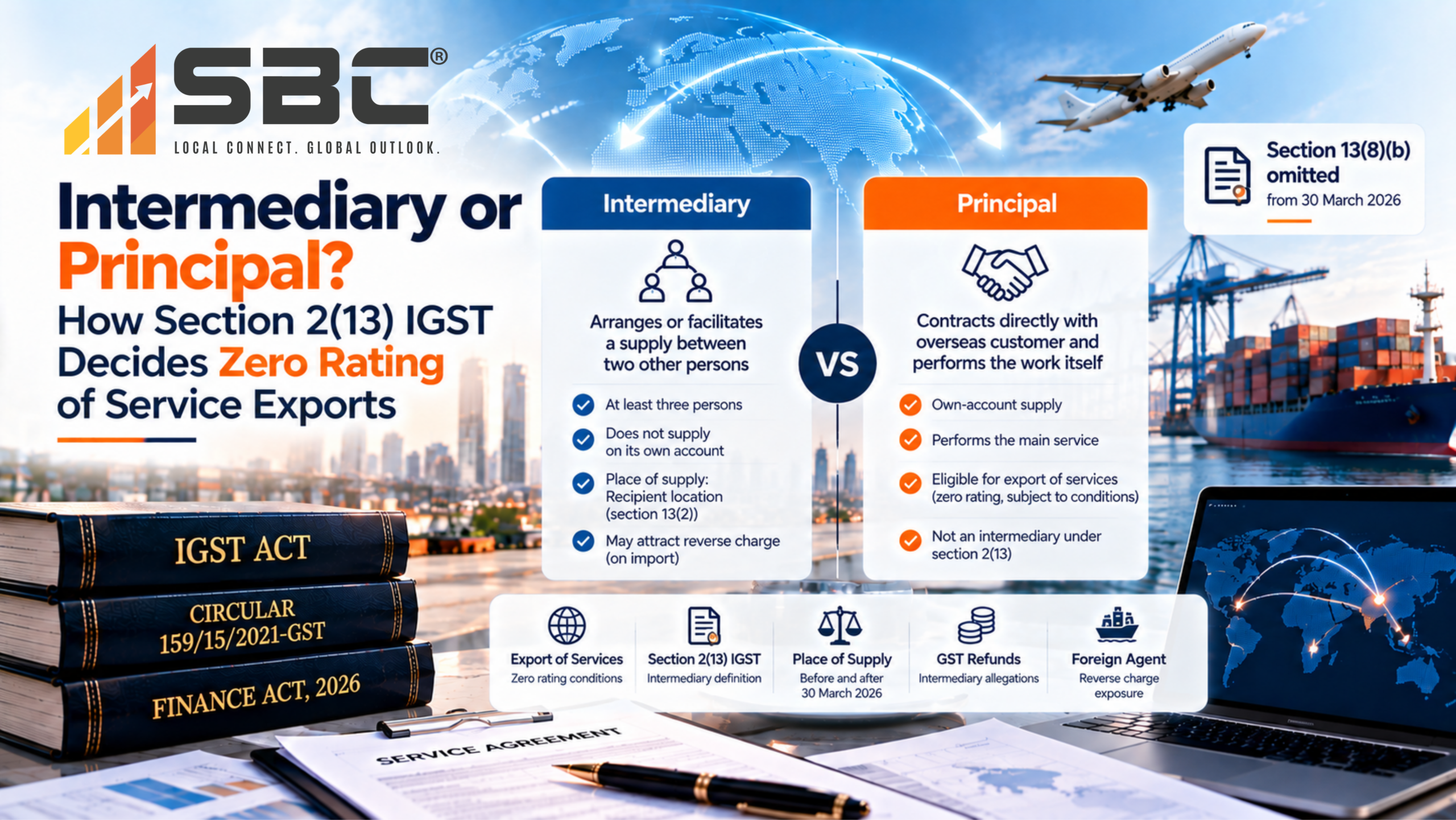
Intermediary or Principal? How Section 2(13) IGST Decides Zero Rating of Service Exports
By CA Rajesh Vaishnav, Partner and CA Mithilesh Sai Sannareddy, Founder and CEO, Steadfast Business Consulting LLP | Indirect Tax Litigation / Controversy
Quick answer
Under section 2(13) of the IGST Act, an intermediary arranges or facilitates a supply between two other persons and does not supply on its own account. A provider that contracts directly with an overseas customer and performs the work itself is a principal. Section 13(8)(b) was omitted from 30 March 2026, so earlier periods still turn on this classification.
Key takeaways
- Section 2(13) of the IGST Act applies only where there are at least three persons, two distinct supplies, and a person who arranges the main supply between the other two without supplying it on its own account (Circular No. 159/15/2021-GST dated 20 September 2021).
- A sub-contractor that performs the main service itself is not an intermediary, so working alongside other contractors on a customer’s project does not by itself create intermediary status.
- Section 13(8)(b) of the IGST Act was omitted by section 157 of the Finance Act 2026, with effect, according to published commentary, from Presidential assent on 30 March 2026; intermediary services now follow the recipient-location rule in section 13(2).
- For supplies before 30 March 2026 the classification remains decisive, and High Court decisions in 2025 and 2026 (Bombay, Delhi) have favoured exporters who supply on their own account to foreign recipients.
- The omission creates an import-side exposure: a foreign agent or introducer supplying an Indian recipient now has its place of supply in India, so reverse charge may apply.
Practice illustration: Own-account service versus intermediary classification
Issue. A service exporter was challenged on whether it made its own supply or merely facilitated a transaction between others.
Approach. The defence distinguished the principal supply from any alleged facilitation, tested the contracts and applied the export-of-services conditions.
Reported position or outcome. The own-account service characterisation and related export position were preserved in the matter. The result is fact-specific and is not a precedent applying automatically to other arrangements.
Practical lesson. The distinct underlying supplies and the provider’s own obligations are decisive.
This illustration is deliberately generalised and must not be used to identify a taxpayer or matter.
Introduction
An intermediary, in GST, is not simply a business that sits between two others. The term has a statutory definition, and the definition describes a particular commercial structure: a person who brings about a supply between two other parties while not making that supply itself. A great many businesses operate within a chain of parties without answering that description, and the distinction between facilitating someone else’s supply and making one’s own is the question on which the classification turns.
What turns on the classification is the whole of the export position. If it is sustained, the place of supply shifts, zero rating is denied, accumulated credit becomes unrefundable, and the exposure is retrospective across open periods. The defence is contractual and functional, and it is built before the refund application rather than after the objection.
This note deals with establishing the distinction for a service provider exporting to overseas customers. It covers the statutory definition, the five prerequisites the Board has set out, the contractual and functional evidence that establishes principal status, the export conditions that must independently be satisfied, and the change in the place of supply rule that alters the analysis for periods going forward while leaving earlier periods untouched. It also covers the new liability that change creates on the import side. For the related question of sourcing a supply connected with an overseas event, see our note on place of supply for events held outside India.
1. The definition
Section 2(13) of the IGST Act provides:
“intermediary” means a broker, an agent or any other person, by whatever name called, who arranges or facilitates the supply of goods or services or both, or securities, between two or more persons, but does not include a person who supplies such goods or services or both or securities on his own account;
The definition has not been amended since the Act came into force. Every word of the exclusion matters, and the exclusion is where most defences are won.
2. What the Board’s circular requires
Circular No. 159/15/2021-GST dated 20 September 2021 sets out the prerequisites for intermediary status, and it is the most useful single document in the area because it is the department’s own statement of the test.
- A minimum of three parties. Two principals transacting with each other, and the intermediary who arranges or facilitates that transaction. An arrangement between two parties cannot produce an intermediary.
- Two distinct supplies. The main supply between the two principals, and an identifiable ancillary supply of facilitation. Both must exist.
- The character of a broker or agent. The person must act in a subsidiary capacity in relation to the main supply, not as a party to it.
- No supply on one’s own account. A person supplying the main service on a principal to principal basis, in whole or in part, is excluded.
- Sub-contracting is expressly outside the definition. A sub-contractor who performs the main service is not an intermediary.
The fifth point is frequently decisive and frequently overlooked. A department that characterises a service provider as an intermediary because it works within a larger project, alongside contractors engaged by the customer, is characterising a sub-contractor, and the circular says in terms that a sub-contractor is not an intermediary.
3. Building the defence
The analysis is contractual first and functional second, and the two must agree.
Identify the parties and the supplies. The submission should state, in a short numbered passage, who the parties are, what each supplies to whom, and where the alleged main supply between two other persons is said to be. Very often this exercise alone disposes of the allegation, because the department has not identified a main supply at all. It has identified a service provider working in a complex environment and inferred facilitation from the complexity.
Show that the provider contracts on its own account. The evidence is the agreement: who the counterparty is, what obligations are assumed, what the deliverables are, who is liable for defective performance, who carries the risk of non performance, and how consideration is determined. A provider paid for its own output at its own price is not earning a facilitation fee.
Show that the provider performs the service. Resource deployment, personnel, methodology, the deliverables themselves. A person who arranges a supply does not produce the work product.
Address the pricing structure. Remuneration on a commission basis, or calculated as a percentage of the value of a transaction between two other parties, is an indicator of facilitation. A fee for the provider’s own services, computed on its own cost base or on a defined scope, is not.
Deal with the counter indicators directly. Where the provider coordinates with third party contractors, attends meetings on the customer’s behalf, or holds a role described in the agreement as coordination or liaison, those facts will be in the notice. They should be addressed and explained rather than left for the department to emphasise. Coordination performed as part of delivering one’s own scope is not facilitation of someone else’s supply.
4. The export conditions, which must also be satisfied
Defeating the intermediary allegation is necessary but not sufficient. Section 2(6) of the IGST Act defines export of services, and all five conditions must hold:
(i) the supplier of service is located in India; (ii) the recipient of service is located outside India; (iii) the place of supply of service is outside India; (iv) the payment for such service has been received by the supplier of service in convertible foreign exchange or in Indian rupees wherever permitted by the Reserve Bank of India; and (v) the supplier of service and the recipient of service are not merely establishments of a distinct person in accordance with Explanation 1 in section 8.
Two points on these. The words permitting receipt in Indian rupees were inserted by the IGST (Amendment) Act 2018 with effect from 1 February 2019, and Circular No. 202/14/2023-GST dated 27 October 2023 confirms that rupees received through a Special Rupee Vostro Account under the Reserve Bank’s framework satisfy the condition. The fifth condition is the one that catches captive arrangements: where the Indian supplier and the overseas recipient are merely establishments of the same person, the transaction is not an export however it is contracted.
Zero rating itself flows from section 16 of the IGST Act, and the structure of that provision changed with effect from 1 October 2023. Following the substitution of section 16(3) by the Finance Act 2021, the general route is supply under bond or letter of undertaking without payment of tax, with refund of unutilised credit under section 54 of the CGST Act. The route of paying tax and claiming refund is now available only to a class of persons or a class of goods or services notified under section 16(4) as amended by the Finance (No. 2) Act 2024. Section 16(5), inserted by the same Act, bars refund of unutilised credit or of tax paid on zero rated supply of goods subject to export duty. A submission that describes the two routes as freely interchangeable is describing the pre-2023 position.
5. The place of supply rule has changed
For the whole of the period in which this dispute has been litigated, section 13(8)(b) of the IGST Act placed the supply of intermediary services at the location of the supplier. That is what made the classification so consequential: an Indian provider held to be an intermediary had its place of supply in India, and the export fell away.
The constitutional challenge produced a divided answer. In Dharmendra M. Jani v. Union of India, Writ Petition No. 2031 of 2018, a Division Bench of the Bombay High Court delivered a split verdict, one judge holding the provision ultra vires and the other upholding it. On reference, the third judge held the provision valid and constitutional but confined in its operation to the IGST Act alone, so that it could not found a levy under the central and state legislation, and held that the petitioners’ transactions were exports under section 2(6).
The provision has since been omitted. Section 13(8)(b) was omitted by the Finance Act 2026. The consequence is that intermediary services fall to the default rule in section 13(2), under which the place of supply is the location of the recipient.
One point of detail should be settled against the gazette before any position is taken for supplies made in the early part of 2026. Published commentary treats the omission, made by section 157 of the Finance Act 2026, as effective from Presidential assent on 30 March 2026, because that section falls outside the commencement clauses of section 1(2) of the Act and carries no separate commencement date. The enacted text, and any later notification or clarification, should still be checked for supplies made around that date, particularly where an invoice or payment straddles 30 March 2026.
Three practical consequences follow, and they pull in different directions.
- For periods from 30 March 2026, the classification question loses most of its force in the export context. A provider characterised as an intermediary, supplying an overseas recipient, now has its place of supply outside India under section 13(2) and the export analysis proceeds on the remaining conditions in section 2(6).
- For earlier periods, nothing has changed. Open assessments, pending refund rejections and appeals for periods before the omission continue to be governed by section 13(8)(b), and the classification remains determinative. The omission is not expressed to be retrospective, and whether pending demands and refund rejections for earlier periods are affected remains open to argument before the forum concerned, so earlier periods should still be defended on the law as it stood.
- The classification still matters for other purposes, including the identity of the person liable, documentation and the treatment of domestic arrangements. The definition in section 2(13) is unchanged.
There is a consequence running the other way, and for many Indian businesses it is the more important one. Because the place of supply for intermediary services now follows the general rule in section 13(2) and is the location of the recipient, a foreign intermediary supplying an Indian recipient now has its place of supply in India. That makes the supply an import of services, on which the Indian recipient is liable to discharge integrated tax under reverse charge, with credit available where the recipient is otherwise eligible.
Indian businesses that pay overseas agents, introducers, placement agents or similar facilitators should therefore review those arrangements. Under the previous rule those payments attracted no Indian tax because the place of supply was the overseas supplier’s location. A business that reads the omission only as relief for its own exports, and does not look at what it buys, may acquire a reverse charge liability it has not budgeted for.
6. A worked example
An Indian company supplies specialised infrastructure support services, including system design optimisation, operational performance monitoring and infrastructure planning, to overseas group companies running large projects abroad. It contracts directly with those companies, treats the supplies as exports and claims refund of accumulated credit. During scrutiny the department alleges that the company is an intermediary facilitating services between the overseas project developers and the engineering contractors working on those projects.
The three party test. The submission identifies the parties: the Indian company and the overseas recipient. It then asks the department to identify the main supply between two other persons that the Indian company is said to arrange. Where the department points to the relationship between the overseas developer and its contractors, the answer is that the Indian company is not a party to that relationship, does not arrange it, and is not remunerated by reference to it.
Own account. The agreement records a defined technical scope, deliverables, liability for defective performance and a fee for the Indian company’s own services. Those terms are inconsistent with a facilitation role.
Performance. Engineering personnel, methodology and the deliverables themselves establish that the company performs the service rather than procuring it from someone else.
Sub-contracting. Where the department’s real complaint is that the company works alongside other contractors on the customer’s project, Circular 159 answers it: a sub-contractor performing the main service is not an intermediary.
Export conditions. Each of the five conditions in section 2(6) is addressed separately, with the banking evidence for the consideration condition and the group structure addressed for the distinct person condition.
Period. The submission states the periods in issue and, where any fall after 30 March 2026, makes the further point that the place of supply would in any event be outside India under section 13(2).
7. Where these defences are weak
First, the agreement uses agency language. Words such as coordinate, liaise, facilitate, on behalf of and arrange appear in commercial drafting without anyone intending their legal consequence, and they are the first thing quoted in the notice.
Second, remuneration is commission based or linked to the value of a third party transaction. This is the single strongest indicator against the taxpayer and it is very difficult to explain away.
Third, the main supply is not identified and the taxpayer does not force the point. The burden of establishing the three party structure is on the department, and a submission that argues only about its own role concedes the frame.
Fourth, the export conditions are assumed rather than proved. Refund rejections frequently rest on the consideration condition or the distinct person condition rather than on classification at all.
Fifth, positions differ across group entities. Where a comparable entity elsewhere in the group has been treated as an intermediary, the inconsistency will be found.
Sixth, the pre and post omission periods are run together. A single submission covering several years has to distinguish the periods, because the place of supply analysis differs.
8. A review checklist
- List the parties and the supplies, and identify whether any main supply exists between two other persons.
- Read every agreement for agency language, and renegotiate it at the next renewal.
- Check whether remuneration is for the provider’s own scope or is calculated by reference to a third party transaction.
- Assemble evidence of performance: personnel, methodology, deliverables.
- Test the facts against each of the five prerequisites in Circular 159, and record the conclusion on each.
- Consider whether the sub-contracting exclusion applies, and say so if it does.
- Verify each of the five conditions in section 2(6) separately, with evidence for the consideration and distinct person conditions.
- Confirm the zero rating route actually used, and that it is available under section 16 as it now stands.
- Identify the periods in dispute and apply the correct place of supply rule to each.
- Reconcile refund claims to the credit ledger and the returns, and verify the computation under Rule 89(4).
- Check the position taken by other group entities in India and abroad.
- Where an adverse position has been taken for an earlier period, decide whether to contest it before it becomes a precedent within the group.
Practitioner’s perspective
The intermediary classification has been among the most actively litigated questions in Indian indirect tax, and the reason is structural: a broadly worded definition was coupled with a place of supply rule that produced a severe consequence. The omission of that rule removes much of the sting for periods going forward, and it is a welcome and overdue change for India’s services export sector.
It changes nothing for the periods already in dispute, and those periods will take years to work through. For a business with open refund claims or pending appeals, the classification defence remains exactly as important as it was, and it remains a defence built on contractual and functional evidence rather than on argument.
The practical lesson is the one that applies across this area. The words used in the commercial agreement are read as legal terms, whatever the parties intended by them. A clause describing a provider as coordinating on behalf of a customer costs nothing to draft and a great deal to defend. Reviewing agreements for that language, and changing it at renewal, is the cheapest risk reduction available in this area.
What courts have said since 2025 on exporters who supply on their own account
For periods before 30 March 2026, the classification still decides the refund, and recent decisions show how High Courts approach it. In Union of India v. KC Overseas Education Pvt. Ltd., the Bombay High Court held that an Indian provider of recruitment and referral services, paid in convertible foreign exchange by foreign universities, was not an intermediary and had made an export of services; the Supreme Court dismissed the Revenue’s special leave petition in 2025. The Delhi High Court reached a similar view in Commissioner of Delhi GST v. Global Opportunities Pvt. Ltd., and the Supreme Court declined to interfere on 27 January 2026.
In Fateh Education Consulting Pvt. Ltd. v. Assistant Commissioner, decided on 8 May 2026, the Delhi High Court set aside a refund rejection that rested on the intermediary ground, directed the refund with statutory interest, and noted that the respondents did not dispute the legal position. These are decisions on their own facts, and a dismissal of a special leave petition is not itself a declaration of law, so the reasoning of the High Court judgments is what a taxpayer should cite. They do, however, show that contracting with the foreign recipient, invoicing it and being paid by it are weighty facts.
Where a refund has been rejected, the usual route is an appeal to the first appellate authority under section 107 of the CGST Act and then to the GST Appellate Tribunal (GSTAT) under section 112. The GSTAT was inaugurated on 24 September 2025 and, according to commentary, started hearing cases from 16 February 2026, with State Benches being brought into operation through 2026 and an e-filing portal in use. The window for appealing older orders was extended to 31 July 2026, so any rejection order not yet appealed should be checked for limitation immediately; the current position of the bench covering your State should be confirmed on the GSTAT portal.
Reviewing the import side after the omission
Because section 13(8)(b) no longer applies, a supply of intermediary services by a foreign agent to an Indian recipient has its place of supply in India under section 13(2). The supply is then an import of services, and the Indian recipient is liable to pay integrated tax under reverse charge, issue a self-invoice and claim credit only if the underlying use is eligible. Businesses in sectors where credit is restricted or blocked, such as some financial and hospitality businesses, should model the cost of this change.
A practical review has four steps. List every overseas payee described as an agent, introducer, placement agent, sourcing agent or commission recipient. For each, read the agreement to see whether the payee arranges a supply between the Indian business and a third party (an intermediary) or supplies a service on its own account. Identify the time of supply by reference to the invoice and payment dates, since commentary treats services supplied on or after 30 March 2026 as governed by the amended rule. Finally, decide whether past payments for periods before 30 March 2026 need any attention, which is generally a question of the old place-of-supply rule rather than of the amendment.
Frequently asked questions
1. What is the statutory test for an intermediary?
Section 2(13) of the IGST Act defines an intermediary as a broker, agent or other person who arranges or facilitates the supply of goods, services or securities between two or more persons, excluding a person who supplies those goods, services or securities on his own account.
2. How many parties are needed before the definition can apply?
At least three. Circular No. 159/15/2021-GST requires two principals transacting with each other and the intermediary who arranges or facilitates that transaction. An arrangement between two parties cannot produce an intermediary.
3. Is a sub-contractor an intermediary?
No. Circular No. 159/15/2021-GST states expressly that sub-contracting is excluded, because a sub-contractor performs the main service rather than arranging it.
4. Does working alongside other contractors make a provider an intermediary?
Not by itself. Coordination performed as part of delivering one’s own contractual scope is not facilitation of a supply between two other persons. The department must identify the main supply said to be arranged.
5. What is the significance of commission based remuneration?
It is a strong indicator of facilitation, because a fee calculated as a share of the value of a transaction between two other parties suggests the provider is remunerated for bringing that transaction about rather than for its own output.
6. What happened to section 13(8)(b)?
It placed the supply of intermediary services at the location of the supplier. It was omitted by the Finance Act 2026, so intermediary services now fall to the default rule in section 13(2), under which the place of supply is the location of the recipient. Published commentary treats the omission as effective from Presidential assent on 30 March 2026, because section 157 of the Finance Act 2026 has no separate commencement date; the enacted text should be checked for supplies made around that date.
7. Does that omission help periods already under dispute?
No. The omission operates prospectively. Open assessments, refund rejections and appeals for earlier periods continue to be governed by section 13(8)(b), and the classification remains determinative for them.
8. Does the omission create any new liability?
Yes, on the import side. Because the place of supply now follows the recipient’s location under section 13(2), a foreign intermediary supplying an Indian recipient has its place of supply in India. The supply is an import of services on which the Indian recipient discharges integrated tax under reverse charge, with credit where otherwise eligible. Payments to overseas agents and introducers should be reviewed on that footing.
9. What did the Bombay High Court decide in Dharmendra M. Jani?
A Division Bench split, one judge holding section 13(8)(b) ultra vires and the other upholding it. On reference the third judge held the provision valid but confined in its operation to the IGST Act alone, so that it could not found a levy under the central and state legislation, and held the transactions to be exports under section 2(6).
10. What are the conditions for export of services?
Section 2(6) of the IGST Act requires that the supplier is in India, the recipient is outside India, the place of supply is outside India, payment is received in convertible foreign exchange or in Indian rupees where permitted by the Reserve Bank, and the supplier and recipient are not merely establishments of a distinct person.
11. Can export be made with payment of tax and refund claimed?
Only for a notified class of persons or a notified class of goods or services. Following the substitution of section 16(3) with effect from 1 October 2023, the general route is supply under bond or letter of undertaking without payment of tax with refund of unutilised credit under section 54 of the CGST Act, and the with payment route is available under section 16(4), as amended by the Finance (No. 2) Act 2024, only as notified.
12. Is an intermediary service an export of service after the Finance Act 2026?
It can be. Section 13(8)(b) of the IGST Act was omitted with effect from 30 March 2026, so intermediary services follow section 13(2) and the place of supply is the recipient’s location. If the recipient is outside India and the other conditions of section 2(6) are met, including payment in convertible foreign exchange or permitted rupees, the supply can be an export. Earlier periods follow the old rule.
13. Is GST payable on commission paid to a foreign agent after section 13(8)(b) was omitted?
It may be. Where the foreign agent is an intermediary supplying an Indian recipient, the place of supply is now in India, so the supply is an import of services and the Indian recipient pays IGST under reverse charge. Input tax credit is available only if the recipient is otherwise eligible. Each agreement should be read to confirm that the payee is in fact an intermediary.
14. Does section 2(13) of the IGST Act still matter after 2026?
Yes. The Finance Act 2026 omitted only the place of supply rule in section 13(8)(b) and left the definition in section 2(13) unchanged. The classification still governs disputes for supplies before 30 March 2026 and may matter for other provisions that refer to intermediaries, so the three-party test in Circular 159/15/2021-GST remains relevant.
15. What did the Supreme Court do in the KC Overseas Education case?
The Supreme Court dismissed the Revenue’s special leave petition against the Bombay High Court, which had held that referral services supplied to foreign universities and paid for in foreign exchange were an export of services and not intermediary services. A dismissal of a special leave petition is not a declaration of law, so the High Court’s reasoning is what is usually cited.
Talk to SBC’s tax team
If an intermediary allegation or a refund rejection is open for your export of services, a document review of the contracts and the performance record is the usual first step. Our GST team can discuss the position for each period. Explore our GST services | Contact SBC
Disclaimer
This article is for general information and does not constitute professional advice. It reflects the law as understood at the date of publication and does not take account of later developments. The place of supply rule applicable to intermediary services changed during 2026, so the analysis depends on the period in question, and the classification of any arrangement turns on its contractual terms and the functions actually performed. No reader should act on the basis of this article without taking advice on their own circumstances.