
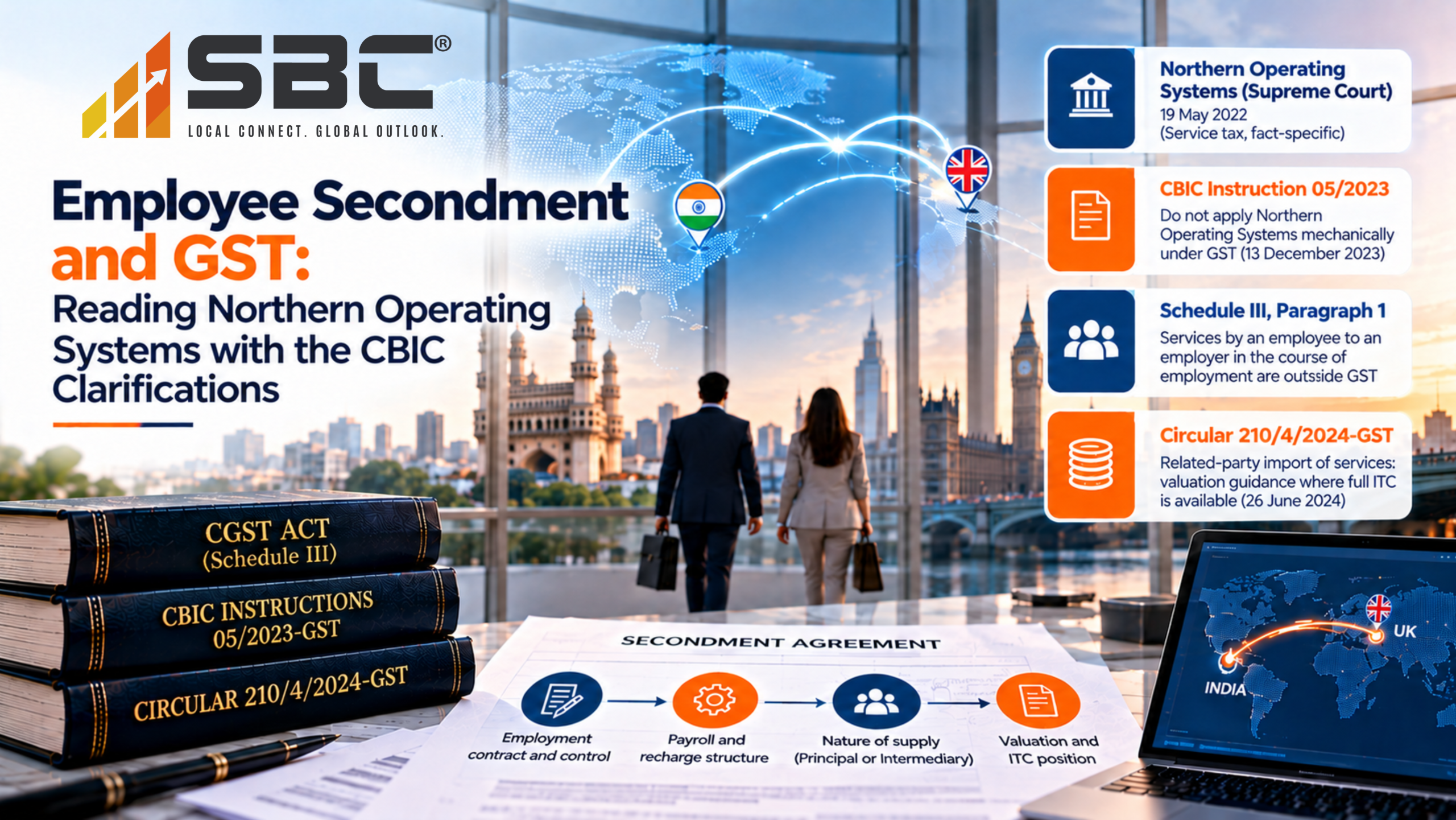
Employee Secondment and GST: Reading Northern Operating Systems with the CBIC Clarifications
By CA Rupesh Reddy and CA Mithilesh Sai Sannareddy, Founder and CEO, Steadfast Business Consulting LLP | Indirect Tax Litigation / Controversy
Quick answer
A cross-border secondment is not automatically a taxable manpower supply merely because the foreign group company processes payroll. Nor is every recharge outside GST. Characterisation follows the contracts, control, employment obligations and actual conduct. Where an import of services between related persons is established, valuation and full-credit treatment require a separate examination under the governing rules and CBIC guidance.
Key takeaways
- The Supreme Court’s decision in Northern Operating Systems (19 May 2022) was rendered under service tax and turned on its own facts, and CBIC Instruction No. 05/2023-GST dated 13 December 2023 tells officers not to apply it mechanically to GST.
- Services by an employee to an employer in the course of employment are outside GST under paragraph 1 of Schedule III to the CGST Act, so the genuineness of the employment relationship is the primary question.
- Circular No. 210/4/2024-GST dated 26 June 2024 deals only with valuation: where a related-party import of services is made to a recipient with full input tax credit, the invoice value is accepted and a nil value is accepted where no invoice is issued.
- High Courts have applied the employment and valuation reasoning in the taxpayer’s favour on the facts before them, including the Delhi High Court in Metal One (2024) and the Karnataka High Court in Alstom Transport India (2025) and Huawei (reported 2026).
- An employee-wise evidence matrix reconciled to payroll, books and bank records is the strongest response to a secondment notice.
Practice illustration: Taxability of employee secondment arrangements
Issue. A GST notice questioned whether employees working for an Indian enterprise were supplied by an overseas group entity.
Approach. The response relied on employment contracts, actual supervision, payroll records, statutory withholding and alternative valuation analysis.
Reported position or outcome. The response contested the secondment allegation and addressed the exposure using employment and payroll evidence. No departmental acceptance, withdrawal of the notice or completed adjudication is claimed.
Practical lesson. Characterisation must be established before discussing valuation.
This illustration is deliberately generalised and must not be used to identify a taxpayer or matter.
Introduction
A secondment dispute often begins with a seemingly simple fact: employees working in India are paid by an overseas group company, and some or all of the cost is recharged to the Indian entity. The department may view the arrangement as a supply of personnel services, while the taxpayer may contend that the individuals are, in substance, its own employees.
The Supreme Court’s decision in Northern Operating Systems became a focal point for such disputes. Yet treating it as a universal declaration that every secondment is taxable is no more accurate than treating salary reimbursement as a universal exemption. The inquiry is highly dependent on the employment structure and the law applicable to the period.
The CBIC issued instructions after that decision and later clarified the valuation of certain related-party imports of services where the Indian recipient is entitled to full input tax credit. Those developments should be read together, but they address different questions and must not be collapsed into one defence.
1. What Northern Operating Systems decided and what it did not
The Supreme Court examined a particular employment arrangement under the service tax law, including the foreign entities’ continued roles, the contracts and the treatment of consideration. Its reasoning requires attention to the full factual structure. The case cannot simply be copied into a GST show-cause notice without testing the charging provisions and facts of the assessee under examination.
The pre-GST statutory setting and the post-2017 GST architecture are not identical. A proper submission identifies the taxable period, the nature of the alleged supply and the statutory mechanism said to create the liability before discussing the Supreme Court decision.
2. The department must identify the alleged supply
A notice should explain who supplied what, to whom, and against which consideration or statutory deeming provision. If a host company genuinely employs workers who operate under its direction and are integrated into its organisation, the contractual and functional evidence may support its position that the services of employees to the employer are outside the charge under Schedule III.
Where the foreign enterprise undertakes to provide skilled personnel or deliver specified services while retaining employer-like obligations and commercial responsibility, the analysis may point in another direction. Payment through foreign payroll is one fact, not the charging provision.
3. Why the employment documents matter
Compare the secondment agreement with appointment letters, visas, local HR policies, appraisal records, leave approval, termination rights, reporting lines, disciplinary authority, insurance and compensation obligations. Identify who controls the employee’s day-to-day work and who bears the consequences if it is not performed.
A secondment letter calling the host “employer” may be contradicted by the real arrangement. Conversely, an overseas payroll slip should not outweigh substantial evidence that the employee works under the host’s exclusive employment control during the period.
4. CBIC Instruction 05/2023: no mechanical invocation of the judgment
The CBIC issued Instruction No. 05/2023-GST on 13 December 2023 on the departmental treatment of the Supreme Court’s decision of 19 May 2022 in Northern Operating Systems in secondment cases. Practitioners should read the complete instruction, including its case-specific caution and directions about investigation.
The instruction is useful to insist on a proper factual inquiry. It is not a statutory declaration that all secondments are exempt. In an audit, the taxpayer should provide enough contemporaneous evidence for the officer to evaluate the arrangement actually implemented.
5. Related-party services and Schedule I
Under Schedule I of the CGST Act, certain imports of services from related persons or other establishments in the course or furtherance of business may be treated as supplies without consideration. That provision should be considered only once the alleged nature and source of the service are properly identified.
It is important to avoid circular reasoning: merely because the companies are related does not establish that a distinct overseas entity supplied manpower services on every occasion when salary costs were borne or reimbursed. The department still needs a coherent account of the supply relied upon.
6. What Circular 210/4/2024 addresses
Circular No. 210/4/2024-GST dated 26 June 2024 addresses valuation of import of services by a related person where the recipient is eligible for full input tax credit; its paragraph 3.7 treats the value declared in the recipient’s invoice as the open market value and accepts a nil value where no invoice is issued. It provides important guidance on the application of the valuation rules, including the significance of invoicing and the circumstances described in the circular.
The circular operates at the valuation stage. It does not eliminate the need to identify the supply or decide the applicability of Schedule III. Nor should full input tax credit be asserted without verifying the recipient’s actual eligibility and any blocked, exempt or mixed-use credit restrictions.
7. Zero valuation, full credit and evidentiary burden
A taxpayer may rely on the CBIC treatment where the conditions of the circular are satisfied. The assessment file should demonstrate eligibility to full input tax credit for the relevant supply and tax period and explain how invoices or absence of invoices were dealt with.
A demand based on a hypothetical payroll figure should be challenged with the correct valuation framework rather than an unsupported assertion that reimbursements never constitute consideration. Keep the primary classification and the alternative valuation arguments distinct.
8. Prepare an employee-wise evidence matrix
The matrix should list employees, home entity, host entity, employment agreements, local reporting manager, salary bearer, recharge basis, contractual termination and control rights, relevant dates, local tax withholding and any intercompany invoicing. Reconcile these data to payroll, general ledger and bank records.
Add a separate tab setting out the department’s factual allegation against the supporting or contradictory document. The strongest defence generally explains concrete inconsistencies in the notice, not simply quotes a court decision or a circular at length.
9. Procedural defence and alternative tax computation
If the show-cause notice is vague about the service or valuation, raise that defect expressly. At the same time, put forward the primary submission that no distinct taxable supply arose where the evidence supports it. Then, without concession, explain the alternative treatment if the authority finds a supply under Schedule I.
Any claimed interest, penalty or extended-period demand requires its own factual test. Do not concede suppression merely because the taxpayer used a different legal characterisation. Full disclosure in audited records and contemporaneous correspondence may be relevant to the limitation and penalty discussion.
What the Supreme Court decided in Northern Operating Systems, and what followed
In the Commissioner of Customs, Central Excise and Service Tax, Bangalore (Adjudication) v. Northern Operating Systems Pvt. Ltd. (Civil Appeal Nos. 2289-2293 of 2021, decided on 19 May 2022), the Supreme Court held, under the service tax law, that the Indian company was the recipient of manpower supply services from overseas group companies and was liable to service tax under reverse charge. The Court looked at the substance of the arrangement over its form, including control over the seconded employees and who gained economically from their work, and said that no single factor is conclusive.
After that decision, field formations began issuing GST notices on secondment arrangements. The CBIC responded with Instruction No. 05/2023-GST of 13 December 2023, which says that secondment is not only a service tax issue, that each arrangement must be examined on its facts, that the judgment should not be applied mechanically, and that the extended period under section 74(1) cannot be invoked merely because GST was not paid. Circular No. 210/4/2024-GST of 26 June 2024 then addressed valuation of related-party imports of services where the recipient has full input tax credit.
How High Courts have applied these clarifications
In Metal One Corporation India Pvt. Ltd. v. Union of India, decided by the Delhi High Court on 22 October 2024, the Court applied the second proviso to Rule 28(1) of the CGST Rules and the Circular, holding that where no invoice is raised and the Indian company has full credit, the value of the related-party service may be treated as nil. In Alstom Transport India Ltd., decided by the Karnataka High Court on 15 July 2025, expatriates on the Indian payroll and under the Indian entity’s control were held to be employees, so the arrangement fell outside supply under Schedule III; the Court added that even if a supply existed, the absence of an invoice meant a nil value under the Circular. In Huawei Technologies India Pvt. Ltd., reported in February 2026, the Karnataka High Court quashed a notice on similar reasoning that the individuals were employed directly.
These are decisions on their own records, and the Revenue can still rely on Northern Operating Systems where the overseas entity retains control, a mark-up is charged, or the employment is in substance with the foreign company. They show, however, that courts examine the employment documents and the payroll flow closely.
A practical evidence checklist and common mistakes
A useful file contains, for each individual: the secondment or assignment agreement; the Indian appointment letter and any foreign contract; visa and work permit sponsor; the reporting line and performance records kept in India; the entity with disciplinary and termination rights; payroll and income-tax withholding records (for example Form 16 and Form 12BA); social security and insurance arrangements; and the intercompany recharge schedule with the basis of computation and any mark-up. These should be reconciled to the general ledger and bank statements, and the department’s allegation should be set against each document in a separate column.
Common mistakes are quoting the judgment without the employee-wise facts, calling every recharge a reimbursement without testing for a mark-up or a management fee, asserting full input tax credit without checking blocked or exempt-use credits, running the primary and alternative arguments together so that one reads as a concession of the other, and conceding suppression because a different legal characterisation was adopted. The evidence should be assembled while the arrangement is running; a reconstruction created after the notice carries less weight.
Conclusion
Secondment disputes are decided by their commercial and employment facts. The Supreme Court decision supplies important guidance, while the CBIC instruction and valuation circular define how officers should approach particular questions in the GST framework.
A credible defence separates the threshold supply question from related-party valuation and builds both positions from documents that existed during the arrangement.
Frequently asked questions
1. Does Northern Operating Systems make every secondment taxable?
No. The facts and statute relevant to the actual secondment must be examined.
2. Is a payroll recharge always consideration for a service?
No universal conclusion follows from recharge alone; contractual and functional substance matter.
3. What is the importance of CBIC Instruction 05/2023?
It directs attention to the proper assessment of the judgment and facts rather than an indiscriminate approach.
4. Does Circular 210/4/2024 resolve secondment characterisation?
No. It addresses related-party import-of-service valuation in the circumstances covered by the circular.
5. Can full input tax credit be assumed merely because the recipient is registered?
No. Actual full-credit eligibility must be established under the governing provisions.
6. Is GST payable on salary reimbursed to a foreign parent for seconded employees?
Not automatically. If the individuals are in substance employees of the Indian entity, their services fall under Schedule III of the CGST Act and are not a supply. If the overseas company supplies manpower, an import of services may arise. Where it does, Circular 210/4/2024-GST may allow a nil value if no invoice is issued and full input tax credit is available.
7. What did the Karnataka High Court hold in Alstom Transport India on secondment?
On 15 July 2025, in W.P. 1779 of 2025, the Karnataka High Court quashed a GST demand on expatriate secondment, holding that employees on the Indian payroll and under the Indian entity’s control were in an employment relationship outside supply, and that even if a supply existed the value was nil under Circular 210/4/2024-GST. The reasoning is specific to its facts.
8. Can the extended limitation period be invoked in secondment cases?
Not merely because GST was not paid. CBIC Instruction No. 05/2023-GST states that section 74(1) of the CGST Act applies only where there is fraud, wilful misstatement or suppression of facts to evade tax, and that the evidence must be set out in the show cause notice. The facts of each case, including disclosure in audited accounts, remain relevant.
9. Does Circular 210/4/2024-GST apply to all secondment arrangements?
No. It deals with the valuation of an import of services between related persons, and does not mention secondment. It applies only after a supply from a foreign related person is established, and only where the Indian recipient is eligible for full input tax credit. Whether the secondment is a supply at all is decided first, on the employment facts.
Talk to SBC’s tax team
If a show cause notice or audit query treats seconded or expatriate staff as a supply of manpower, a review of the employment documents and the payroll flow against the points above is a sensible starting point. Our GST team can discuss the facts of your arrangement. Explore our GST services | Contact SBC
Disclaimer
This article is general professional commentary and not advice on any particular facts. Applicable law, procedural requirements, circulars and statutory amendments must be verified for the relevant tax period. It is not a description of an identifiable client engagement.