
CategoriesTransfer Pricing

What Goes in Each Clause of Form 3CEB?

Written by Jayasri P · Last updated 20 August 2026 · Statutory references current to the Income-tax Act 2025 and the Income-tax Rules 2026.

Quick Answer: Each clause of Form 3CEB, now Form 48, goes into one of six parts under section 172 and Rule 85. Part A carries assessee particulars, Part B the auto-populated aggregates, Part C international transactions and Part D specified domestic transactions. Part E carries the arm’s length price working and Part F the documentation certification.

The report is no longer merely a narrative annexure. The new version records every transaction against every counterparty as an individual structured entry, meaning that every one of these entries must be reconciled with the books, the benchmarking study and the arm’s length workings that lie beneath it. The change in format is precisely what is often underestimated by preparers.

What is the Form 3CEB format, part by part?

There are six sections, labelled from A to F. The structure is specified by the Central Board of Direct Taxes in its guidance note on Form No. 48, although the sections are not filled in the order they are lettered, because Part B and certain rows of Parts C and D are filled automatically once the taxpayer enters data elsewhere in the form.

Part What it carries How it is filled
A Particulars of the assessee — name, address, Permanent Account Number Entered
B Aggregate amount of international and specified domestic transactions Auto-populated
C Associated enterprises, international transactions, advance pricing agreements Entered
D Associated enterprises and specified domestic transactions Entered
E Determination of the arm’s length price and the amount of adjustment Entered
F Documentation certification and information above the specified amount Certified

Every year, approximately forty-four thousand such reports are filed in India.

What does Part A ask for, and what is auto-populated in Part B?

The information required in Part A includes the name of the assessee, the address and the Permanent Account Number. Apart from this, no other information is necessary. A valid PAN is mandatory, and without it the report cannot be filed.

Part B signifies the total value of international transactions and of specified domestic transactions during that tax year, and since those figures arise from the entries in Parts C and D of the same form, nobody keys these values in. Therefore, any discrepancy between Part B and the related-party disclosure in the financial documents indicates a problem within Parts C or D.

How does Part C identify each associated enterprise?

By five features: the name, the address, the country or territory of residence, a tax identifier and the nature of the relationship. Each enterprise then receives an AE ID, a unique identifier the system generates from those columns, and every transaction reported later attaches to one of them.

Usually, the order of preference in the identifiers column is reversed by preparers. Where the associated enterprise holds an Indian PAN, that PAN is furnished and no foreign taxpayer identification number is required, and where neither a PAN nor a TIN exists, the taxpayer furnishes the unique identification number by which the government of the enterprise’s country of residence identifies it. Deemed international transactions are reported separately from the associated-enterprise transactions.

How is the nature of the relationship with an associated enterprise recorded?

Through a dropdown keyed to the limbs of section 162(1), with more than one limb selected where more than one applies. This is a small field with a disproportionate consequence, because the limb chosen here is the first thing an officer reads when judging whether the transaction population stated in the rest of the form appears complete for a group of that shape.

The departmental illustration is instructive. An enterprise that guarantees part of the taxpayer’s borrowings and appoints an executive director falls within two separate limbs, and both must be chosen.

How are transaction IDs generated?

Automatically, by combining the transaction type with the AE ID. A taxpayer providing services to three associated enterprises therefore generates three separate records rather than one aggregate line, identified as T1AE1, T1AE2 and T1AE3.

Transactions are indicated by use of a prescribed dropdown menu, rather than by means of a textbox, and this means that the selection reflects a substantive classification rather than a formatting choice. When a particular type is selected, other fields will be activated, and the data of the advance pricing agreement will be displayed separately in row 8 of Part C, where the date of the agreement, the acknowledgement number and the transaction IDs are provided, with every single agreement shown in a row of its own.

How does Part D differ for specified domestic transactions?

It follows the same two-part rationale as Part C and uses its own identification series. This part refers to counterparties, which possess DAE IDs, and the nature of transactions comes from a different dropdown list, since the domestic population is defined by section 164.

When does Part D have to be filled at all?

Only above ₹20 crore. Specified domestic transactions engage the reporting obligation only where their aggregate value exceeds ₹20 crore during the tax year, hence any group that has never crossed that line has no cause to think about it until a restructuring or a large intra-group charge quietly pushes it over. The categories in question, which include activities carried out among the parties mentioned in section 205(4), have been identified in specified domestic transaction compliance.

What does Part E ask about the method?

Part E requires the most appropriate method for each transaction, together with the comparable set behind it, the resulting arm’s length price and the adjustment, if any. It is filled in for every transaction, with one exception: transactions covered by an advance pricing agreement and reported in row 8 of Part C are not repeated here.

The taxpayer discloses the number of comparables used, the margin or price computed using those comparables, the adjustment made in the margin, the computed arm’s length price and whether a book adjustment is required, which means the economic analysis is now presented at the reporting stage instead of only when the file is called for. The appropriateness of the method for a particular set of facts is covered under choosing the transfer pricing method.

How are aggregated transactions reported?

By selecting the transaction IDs that were benchmarked together and then splitting the value three ways. The taxpayer notes the total amount of the transaction, the amount taken into the aggregation, and the balance left out of it, and where an aggregation is only partial, the unaggregated balance becomes the total for any subsequent aggregation of that transaction type.

A transaction may be both aggregated and independently benchmarked. When a royalty is analysed both inside the package and on its own, it is selected in the aggregation row and the separate benchmarking flag is set. It follows that Part E will be repeated for that royalty as if the aggregation never happened.

How many comparables decide whether the mean or the median applies?

One comparable gives its own margin, two to five give the arithmetic mean, and six or more give the median. That rule runs through the departmental frequently asked questions on Form No. 48 for every method that depends on a margin or a price, and the range and tolerance mechanisms derived from it can be found in Rule 81 of the Income-tax Rules 2026.

In the departmental illustrations, the tolerance band applied is one per cent for wholesale trading in goods and three per cent otherwise, so any case in which the tested result falls outside that band, or outside the 35th to 65th percentile range where a range applies, warrants an adjustment.

What does Part F certify?

That the taxpayer has kept and maintained the information and documents it is required to keep under section 171. Part F also outlines the extra information sought where the value of a reported transaction exceeds the specified amount.

In this part the report is no longer just a data return. The accountant is not validating the correctness of the price, but only that the required record exists and that the provided details are accurate, and the gap between those two assertions is precisely where the Transfer Pricing Officer begins work, usually three years after the date of the report. The documents in question are prescribed under section 171 of the Income-tax Act 2025 and Rule 84.

Which errors most often force a revised Form 3CEB filing?

Adjustment direction, transaction classification and an incomplete counterparty list, in roughly that order. Each of them is mechanical. Each survives an internal review since the form still passes validation, and each surfaces later as a discrepancy which the taxpayer has to explain.

The direction of an adjustment reverses between the two transaction populations. For an international transaction, an adjustment on an expense is deducted from the book value and an adjustment on income is added to it, while for a specified domestic transaction the treatment runs the other way round.

  • Selecting a transaction type that does not match the substance of the arrangement, most often on intangibles and intra-group services
  • Omitting an associated enterprise with which only a loss-making or zero-margin transaction occurred
  • Reporting one aggregate line for a transaction type spread across several counterparties
  • Repeating an advance pricing agreement transaction in Part E as well as in row 8 of Part C
  • Leaving the separate benchmarking flag unset where a transaction was tested both ways

The consistency of the report, the documentation and the return matters more than it once did, because structured reporting makes a mismatch machine-readable. The ramifications of this and how it plays out from the assessment perspective are explained in the transfer pricing assessment procedure note.

Best firm for transfer pricing documentation and Form 3CEB filing

Look for a firm that prepares the benchmarking study and the report as one exercise, holds licences to the comparable databases the analysis depends on, and has argued its own positions before a Transfer Pricing Officer rather than handing the file to somebody else at that stage. Those three tests separate advisers better than size does.

The market is divided into global network firms, established domestic practices and specialised transfer pricing boutiques, with Deloitte, EY, Grant Thornton, BDO, Nangia and Dhruva active here. It is impossible to designate one firm as the best in general terms. The questions worth asking are narrower than those a credentials deck usually answers. Who ran the comparable search? Who will defend this position in three years?

What does SBC bring to a Form 3CEB engagement?

Steadfast Business Consulting (SBC) was recognised as a Notable Transfer Pricing Firm 2024 by ITR World Tax, and its transfer pricing practice was built by Big 4 alumni. The company operates in Hyderabad, Mumbai, Pune and Dubai and holds access to the benchmarking databases: Prowess, CapitalineTP, AceTP, Amadeus, Orbis and RoyaltyRange. SBC provides transfer pricing services in India covering documentation, the accountant’s report, Master File and Country-by-Country reporting, and representation through assessment and appeal.

If your related-party population has not been mapped transaction by transaction and counterparty by counterparty, that mapping is the work to do before anyone opens the form. Ask the SBC transfer pricing team for a readiness review of your current position.

Frequently Asked Questions

How many parts does Form 3CEB have?

There are six sections given letters A to F. Taxpayer particulars are captured in Part A, the auto-populated aggregates in Part B, international transactions and associated enterprises in Part C, specified domestic transactions in Part D, the arm’s length price determination in Part E and the documentation certification in Part F.

Does every transaction need its own row in the transfer pricing report format?

Yes. The form records one entry for each combination of transaction type and counterparty. A single service arrangement running to three associated enterprises produces three separate transaction records instead of just one consolidated record.

Is the most appropriate method the only method disclosure required?

No. Alongside the selected method, the form demands the number of comparables used in the analysis, the margin or price formed from those comparables, any adjustment applied to that margin, the computed arm’s length price and whether a book adjustment is required.

Are advance pricing agreement transactions reported in Part E?

No. Transactions detailed in an advance pricing agreement can be found in row 8 of Part C, which contains items such as the agreement date, the acknowledgement number and the transaction IDs. None of these transactions are considered in the arm’s length price working in Part E.

What identifier is used if an associated enterprise has no PAN or TIN?

The unique identification number by which the government of the country or territory where the associated enterprise is resident identifies it. Where an Indian PAN exists, that PAN is furnished and no foreign identifier is required.

Can Form 3CEB be filed on paper?

No. The accountant’s report is exclusively submitted online, as there is no offline option or paper filing process available.

CategoriesTransfer Pricing

How Do You Set a Transfer Pricing Policy That Holds?

Written by Jayasri P · Last updated 20 August 2026 · Statutory references current to the Income-tax Act 2025 and the Income-tax Rules 2026.

Quick Answer: A transfer pricing policy holds when each entity’s remuneration model matches what that entity actually does. The reasoning must be recorded before the year begins rather than reconstructed afterwards, and the inter-company agreements must say what the policy says. Section 165 of the Income-tax Act 2025 tests the result.

Most transfer pricing work in India runs backwards, which is precisely what makes so much of it hard to execute: the benchmarking exercise is assembled months after the transactions have closed, and the analysis is then expected to back a price nobody inside the group ever deliberately set. A policy inverts that order. The price is decided first, on stated reasoning, and the documentation later records that decision instead of constructing one.

What does a transfer pricing policy actually decide?

It decides how much profit each entity in the group is entitled to keep. Everything else originates from that one allocation, because once the group has established which entity earns a stable return and which entity absorbs the residual, pricing the individual flows becomes arithmetic rather than discretion, and arithmetic is considerably easier to justify four years later.

A practical policy determines four separate things before the tax year begins. It identifies the entrepreneurial entity that carries the residual outcome, and it fixes a remuneration model for every other entity in the chain. It then states the level of that remuneration and the range around it, and names the events that will force the entire design to be revisited.

The policy sets the expected commercial outcome for each entity in the chain. Showing that the outcome is at arm’s length under section 165 of the Income-tax Act 2025 is a separate exercise, and which transfer pricing method applies to that exercise is a question the policy should not try to settle in advance.

Steadfast Business Consulting (SBC) lists transfer pricing policy and price setting among its transfer pricing services in India. SBC sets these policies before the tax year begins, which is the only point at which the remuneration model can still be matched to the functional profile.

Which remuneration model should each entity carry?

The model follows the entity’s role in the value chain, not its location or its size. The list is shorter than it appears, because there are few commercially sensible ways to pay a related party for a defined bundle of functions.

Role in the group Remuneration model What the policy must fix
Contract or toll manufacturer Mark-up on total cost The mark-up, the cost base, the treatment of material
Limited-risk distributor Target operating margin on third-party sales The margin, the range, excluded items
Captive service centre Mark-up on operating cost The mark-up, pass-through costs, stock compensation
Entrepreneur or principal Residual profit or loss Nothing is fixed; this entity absorbs the outcome
Intra-group lender or guarantor Interest rate or guarantee fee The reference rate, the spread, the tenure

How should the target be expressed so that it can be tested later?

As a clearly defined indicator on a clearly defined base. A policy stating that an entity shall earn a satisfactory mark-up has resolved nothing at all, and a policy stating fifteen per cent without saying what the fifteen per cent is charged on has resolved little more.

An acceptable formulation names the tested party, the profit level indicator, the cost base and its exclusions, the treatment of pass-through costs, the currency in which the target is measured, and the period over which performance against it is assessed.

When should the policy be set?

Before the tax year begins, not in the month the accountant’s report falls due. Documentation kept under section 171 of the Income-tax Act 2025 read with Rule 84 of the Income-tax Rules 2026 is contemporaneous evidence of a position, but evidence cannot substitute for a decision that was never actually taken.

Can the method be agreed in advance?

Two statutory routes reduce that ambiguity. An advance pricing agreement under section 168 fixes the methodology with the tax administration for coming years, with rollback available for earlier ones. The safe harbour rules under section 167 prescribe permitted margins for eligible transaction categories, and because the election is made upfront rather than justified afterwards, the safe harbour route favours groups that plan the year rather than reconstruct it.

Neither route works in reverse. Both require the group to know its functional profile before the transactions occur.

How does the functional profile constrain the policy?

The functional profile constrains the policy and is not a free choice. Where the significant people functions sit, which entity is financially able to bear a risk, and which entity develops and controls the intangibles together determine which entity is entitled to the residual, and no amount of contractual drafting moves that entitlement.

A group deciding its policy in advance can still alter the underlying facts, since moving a decision-making function, transferring a treasury responsibility or changing the ownership of an intangible are commercial choices that remain genuinely open before the year starts and are effectively closed once it has begun.

What happens when the policy and the functional profile disagree?

The functional profile wins every time, because the assessment examines what the entities actually did. If a policy gives an entrepreneurial return to an entity that neither controls the risk nor holds the balance sheet to absorb it, the group has two honest choices: adapt the policy to the conduct, or change the conduct to match the policy. Relabelling is not relocating.

Why does a policy that contradicts the group’s conduct fail?

Because the arm’s length test applies to the transaction as it was actually carried out, which means the contract is evidence of that conduct rather than a substitute for it, however carefully it was drafted. A Transfer Pricing Officer reviewing the file several years later reads the invoices, the board minutes, the correspondence and the pattern of who absorbed which loss. Where those records contradict the policy, the records prevail without much argument.

These patterns recur across sectors:

  • A limited-risk distributor that sets local selling prices, funds local marketing and writes down its own obsolete inventory
  • A captive service centre that negotiates directly with the group’s external customers and manages the delivery relationship
  • An entity contractually allocated foreign exchange risk while the parent absorbs every exchange loss in practice
  • A cost-plus entity whose mark-up is quietly adjusted at year end so that consolidated results land where the board wanted them

Each looks like a documentation problem. Each is really a design problem, and a design problem is far cheaper to remedy in March than in the fourth year of an assessment.

What should the policy record at the point of decision?

The rationale, the rejected alternatives, and the date on which the decision was taken. A policy document containing only the final numbers hands the assessment team a conclusion with no visible support, which is exactly the position the group set out to avoid by deciding the policy in advance.

  • The functional profile relied on for each entity, with its source and its date
  • The remuneration model selected for each entity and the reason for selecting it
  • The definition of the cost base, including every exclusion and every pass-through item
  • The benchmarked range relied on, when it was prepared, and how often it will be refreshed
  • The list of events that will trigger a review before the next scheduled refresh

Which decisions need written reasoning rather than a number?

The ones no assessing officer can reconstruct from the accounts. Cost base exclusions, pass-through treatment, the selection of the tested party, the criteria on which a guarantee fee was set and the commercial explanation for an unprofitable year all belong in this category, because each represents a judgement that appears arbitrary unless the reasoning behind it was documented while it was still fresh, and a rationale reconstructed later reads as justification rather than as a decision.

Do the inter-company agreements match the policy?

Frequently they do not, and that is the commonest structural weakness in an otherwise sound policy. The agreement is the legal device that makes the policy enforceable among the entities concerned, so a policy the agreements contradict is a memorandum rather than a pricing arrangement.

Three inconsistencies recur. The agreements declare that prices will be mutually decided whereas the policy applies a mark-up. The agreements are executed after the year they govern has ended. The agreements confer a risk on one entity while the policy compensates an entirely different entity for bearing it. The drafting and review of these documents are explained elsewhere in the note on inter-company agreements.

What changes should trigger a policy review?

Any change in what an entity does, what it owns, what it risks, or what the law requires of it. A policy set once and refreshed only when the benchmarking study expires drifts away from the business it describes, usually without anyone noticing until an assessment makes the drift expensive.

Trigger Why the policy moves
A new entity or a new jurisdiction enters the group The value chain and the entitlement to residual profit both change
A function migrates, such as procurement being centralised The remuneration model for both entities is affected
The Indian entity begins to develop or own intangibles It may no longer be a routine entity at all
New intra-group loans, guarantees or cash pooling arrangements Financial transaction pricing enters the policy
A sustained result outside the benchmarked range Either the facts moved or the target was set wrongly
Specified domestic transactions approach ₹20 crore in aggregate A domestic reporting obligation begins

Frequently Asked Questions

Is a transfer pricing policy a statutory requirement in India?

No. The Income-tax Act 2025 requires documentation under section 171 and an accountant’s report under section 172, but it imposes no obligation on a group to adopt a written pricing policy at all.

How is a transfer pricing policy different from transfer pricing documentation?

The policy is prospective and the documentation is retrospective. A policy determines what each entity will earn over the coming year and why, whereas documentation shows after the year has closed that the result was arm’s length, which makes the former a management decision and the latter the compliance record supporting it.

Who should approve the transfer pricing policy?

The group’s finance leadership, with the local entity’s board informed where the policy affects that entity’s reported result. Approval should be dated and recorded, because the date the policy was adopted is itself evidence that the pricing was determined in advance rather than reverse-engineered.

Can a transfer pricing policy be changed during the year?

Yes, where the underlying facts change, provided the change is explained and backed with documentation and the inter-company agreements are updated to match. Assessments look for a change made only to alter the reported result, while the functions and risks stay the same.

Does an advance pricing agreement remove the need for a policy?

No. An advance pricing agreement specifies the method and the critical assumptions with the tax administration, but the group must still operate a policy that achieves the agreed outcome. Breaching a critical assumption can endanger the agreement itself for the affected years.

How often should the transfer pricing policy be reviewed?

At least once every twelve months, before the tax year begins. A review should also be triggered by any change in functions, assets, risks, group structure or statute, rather than waiting for the scheduled annual cycle.
CategoriesTransfer Pricing

When Are Your Transfer Pricing Filings Due in 2026?

Written by Jayasri P · Last updated 20 August 2026 · Statutory references current to the Income-tax Act 2025 and the Income-tax Rules 2026.

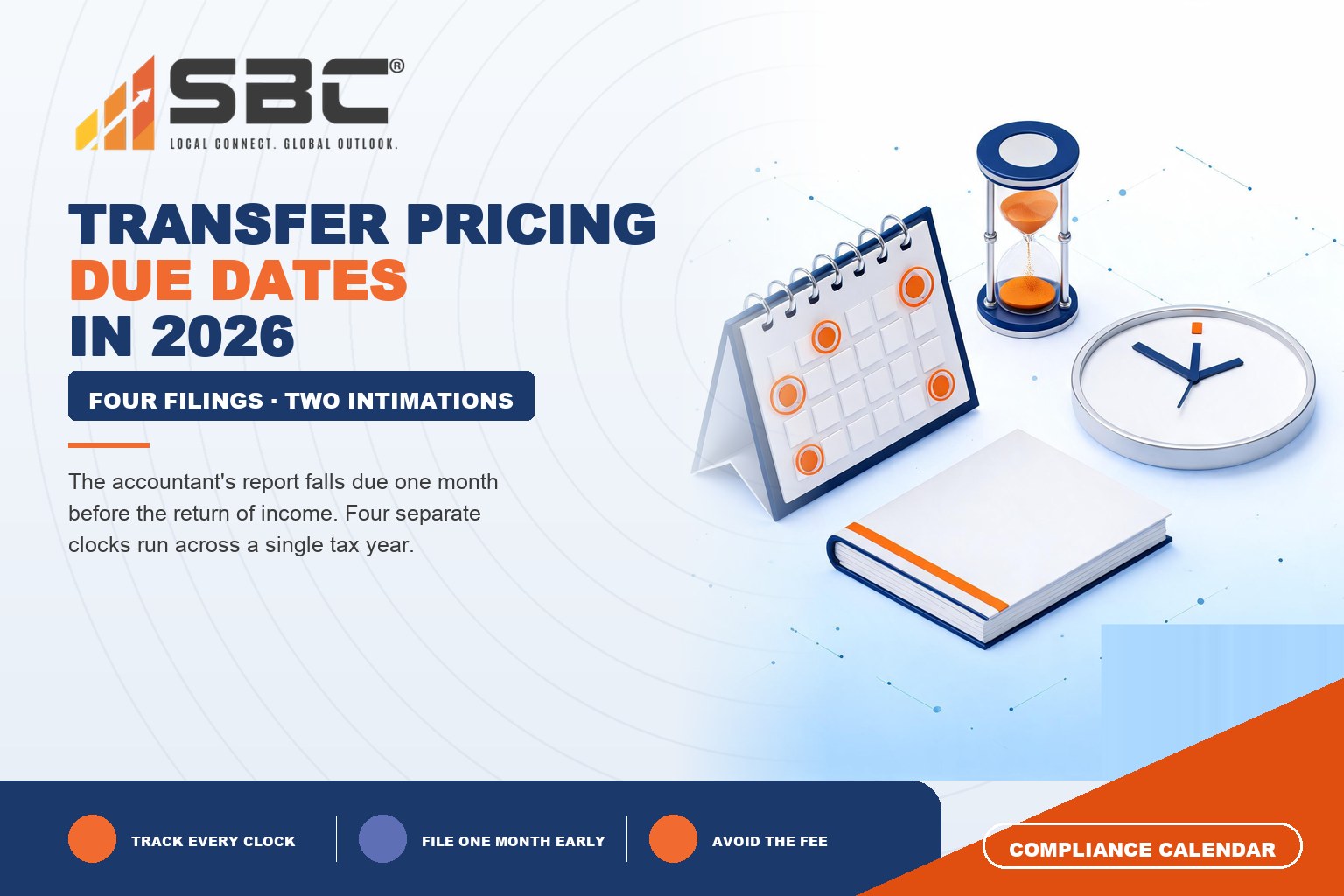
Quick Answer: Your transfer pricing filings run off the return date: Form 3CEB, now Form 48, falls due 31 October where the return falls on 30 November. The report is due at least one month before the return of income under section 263(1). The Master File follows the return date, and the Country-by-Country report runs on its own twelve-month clock.

The Form 3CEB due date is one of four separate filing clocks running in a single tax year, and only one of them is tied to the return of income in the way most finance calendars assume, so a compliance timeline built around the November date is already late by the time anyone opens it. The accountant’s report is prepared a month before the return, the Master File runs alongside it, and the Country-by-Country report is timed from a different year end. Each compliance date is ruled by its own provision, so missing one does not put the others at risk, and fulfilling one does not discharge the rest.

What does the transfer pricing calendar look like for a tax year?

Four filings and two intimations, on three separate clocks. The table sets out each filing, the provision it sits under in the Income-tax Act 2025 and the Income-tax Rules 2026, and the date it falls due for a person whose return is due on 30 November.

Obligation Statutory anchor Falls due
Contemporaneous documentation in place Section 171 (erstwhile 92D), Rule 84 Before the accountant’s report is signed
Accountant’s report, Form 3CEB, now Form 48 Section 172 (erstwhile 92E), Rule 85 31 October — one month before the return
Return of income Section 263(1) 30 November
Intimation of the designated constituent entity Rule 123 Thirty days before the Master File form
Master File (the prescribed Master File form) Rule 123 (erstwhile Rule 10DA) 30 November — with the return
Intimation of the reporting entity for CbC purposes Rule 124 (erstwhile Rule 10DB) Two months before the CbC report
Country-by-Country report Section 511 (erstwhile 286), Rule 124 Twelve months from the end of the reporting accounting year

All the dates above except for the Country-by-Country pair are attached to the date of the income return, and so this makes the return seem like the only deadline. The return is not the filing that gets missed. One should read the table as three clocks and not as a single list, because the reporting clock, the return clock and the group clock begin from three different events. The two intimations are easy to miss. Neither is a substantive filing, and both fall due before the report they refer to.

When is the Form 3CEB due date?

One month before the due date for the return of income. For a taxpayer engaged in international transactions the return falls due on 30 November, and the report therefore falls due on 31 October.

According to the Central Board of Direct Taxes, Form No. 48, the erstwhile Form 3CEB, must be filed on or before the date one month before the due date for furnishing the return of income under section 263(1) for that tax year. It serves neither as a schedule to the return nor as an annexure that accompanies it. That separation is the single most useful thing to understand about the transfer pricing audit due date, because everything else in the calendar follows from it.

Did renumbering move the due date?

The form has been renumbered, but its timing has not. Steadfast Business Consulting (SBC) has provided some details on the change in a separate note on the transition from Form 3CEB to Form 48. The due date remained unchanged when Form 3CEB changed to Form 48.

Why do teams working backwards from the return deadline miss the report?

Because the deadline for the return is the wrong anchor. A finance department that begins its work from 30 November and reserves the regular lead time of three or four weeks to submit the return has already consumed the month the statute fixed for the report, and by the time the benchmarking file is opened the certification window has closed behind it. The error is structural rather than careless, since the return is the deadline everyone else in the business already works to.

What does the one-month gap actually reserve?

Time for a certification that cannot be compressed. The accountant needs the related-party ledger reconciled, the inter-company agreements assembled and the benchmarking analysis complete before signing, and none of that work can begin in the last week of October if the underlying data has not been pulled from the accounting system.

The gap exists so that the position certified in the report is identical to the position that appears in the return. When the report is compiled at the same time as the return instead of before it, the two documents drift. The difference between the transactions indicated in the report and the figures in the return is the exact discrepancy that a Transfer Pricing Officer will hunt for first.

How should the calendar be read instead?

Forwards, from the end of the tax year. The following steps are listed in the order they have to be performed, where each line depends on the previous one rather than on the return date.

Step When it has to be finished
Related-party transaction schedule reconciled to the ledger Within three months of the year end
Functional analysis and inter-company agreements reviewed Before benchmarking begins
Benchmarking study and documentation under Rule 84 completed Ahead of October, not during it
Form 48 uploaded, digitally signed and accepted on the portal 31 October
Return of income furnished 30 November

Another consequence of working forwards is that it uncovers the dependency responsible for most of the harm: benchmarking cannot begin until the transaction schedule is final.

When is the Master File obligation due?

On or before the due date for submitting the return of income, which places the prescribed Master File form on 30 November with the return rather than a month earlier. The provision governing the Master File submission is Rule 123 of the Income-tax Rules 2026, which has taken the place of Rule 10DA of the 1962 Rules, and because that provision determines the due date by reference to the return, a group that has discharged its October obligation still has another obligation waiting in November.

One earlier date sits in front of it. Where an international group has multiple constituent entities in India and appoints one of them to make the filing, the intimation naming that entity is due thirty days beforehand. In practice, the designation must be settled by the end of October. Groups that leave the designation to the filing week discover that the intimation window has already passed.

When is the Country-by-Country report due?

Within twelve months from the end of the reporting accounting year. The Country-by-Country deadline is the one obligation in the calendar that is not tied to the Indian return at all, because section 511 of the Income-tax Act 2025 measures the period from the end of the reporting accounting year of the international group rather than from any Indian filing date.

This distinction is important for groups whose parent has a December or June year end, since the reporting accounting year is dependent on the parent rather than on the Indian tax year. A calendar-year group therefore runs a December cycle irrelevant to its Indian filing calendar.

Is there an intimation before the CbC report?

A second intimation runs ahead of this one. A constituent entity resident in India must notify the department of the identity and residence of the entity filing the report, and that intimation is due two months prior to the due date for the Country-by-Country report itself, which places it well before the group has finished assembling the report it relates to.

Which tax year do these dates apply to?

Tax year 2026-27 onwards. Both the Income-tax Act 2025 and the Income-tax Rules 2026 have been enforced from 1 April 2026, so the section and rule numbers referenced in this guide are those that apply from that date onwards, and any schedule still built on section 92E and Rule 10E is describing an obligation that has since moved.

Whenever a report relates to any past tax year, the numbering in force for that year continues to apply, hence internally created checklists, engagement letters and audit committee documentation still employ the previous numbering. The dates have remained unchanged; only the numbering changed, and the sequence a finance team has to run through each year is unchanged.

What does a late accountant’s report cost?

A fee of ₹50,000 applies for a delay of up to one month, and ₹1,00,000 thereafter. Not supplying the report from an accountant now results in a fee under section 428(4)(d) of the Income-tax Act 2025 instead of a penalty, which removes the reasonable-cause argument that used to be available, so a missed date simply becomes a cost. The distinction between a fee and a penalty is not a trivial drafting issue, since the fee is applied on the facts alone.

Documentation defaults and information defaults remain penalties, and are set out separately in transfer pricing non-compliance penalties.

Does a specified domestic transaction change the dates?

No. In instances where the overall value of specified domestic transactions goes beyond twenty crore rupees in a single tax year, the accountant’s report has to include them also, and it runs on the same 31 October date as the international transaction filing. This means that a purely domestic group crossing that threshold inherits the whole calendar rather than a lighter version of it.

The reporting calendar is not classified by transaction type. Both sets of transactions are reported in the same accountant’s report and certified on the same date. Which domestic dealings qualify in the first place is a separate question, dealt with in specified domestic transaction compliance.

Who should own the calendar inside the business?

Whoever owns the related-party ledger, working to a schedule set at the start of the year rather than one fixed in the last quarter of it. The return of income under section 263(1) fixes the outer date, and every transfer pricing obligation is then positioned relative to it. Ownership matters more than seniority here, since the person who reconciles the ledger is the one who determines whether the October date is achievable.

SBC was recognised as a Notable Transfer Pricing Firm 2024 by ITR World Tax, and the company offers transfer pricing services consisting of documentation, the accountant’s report, Master File and Country-by-Country filings, along with representation in the assessment process for groups filing in multiple jurisdictions. Where the year end of the group parent company is not the same as the Indian tax year, and the intimations consequently fall in different quarters, the transfer pricing services team works to the forward calendar set out above rather than to the return date.

If you have not opened this year’s benchmarking file yet, October is later than it looks. Ask SBC for a dated compliance schedule built around your group year end.

Frequently Asked Questions

Is the transfer pricing audit due date the same as the return due date?

No. The accountant’s report must be submitted at least one month before the return of income under section 263(1). If the return is due on 30 November, the report is due on 31 October. Treating them as a single deadline is the most common calendar error.

Does the Master File have the same due date as Form 48?

No. The prescribed Master File form is due by 30 November, whereas the accountant’s report is due on the earlier date of 31 October.

What is the deadline for the Country-by-Country report?

Twelve months from the end of the reporting accounting year of the international group, as stated under section 511 of the Income-tax Act 2025 in conjunction with Rule 124. It is not linked to the Indian return date.

Is there any extension available for Form 48?

Only where the Central Board of Direct Taxes extends the underlying return due date, since the report date is defined by reference to the date under section 263(1). No separate mechanism exists for extending the date of the report on its own.

What happens if the return is filed late but the report was filed on time?

The report obligation is satisfied and the fee under section 428(4)(d) does not arise for it. Late filing of the return carries its own consequences, which are assessed separately from the transfer pricing reporting position.

Do the old section numbers still appear on the portal?

Some secondary references and older internal checklists are still in the old numbering. Cite section 172 and Rule 85 for the accountant’s report, section 171 and Rule 84 for the documentation, and section 511 with Rule 124 for Country-by-Country reporting.

CategoriesTransfer Pricing

Who Can File Form 3CEB, and Who Certifies It?

Written by Jayasri P · Last updated 20 August 2026 · Statutory references current to the Income-tax Act 2025 and the Income-tax Rules 2026.

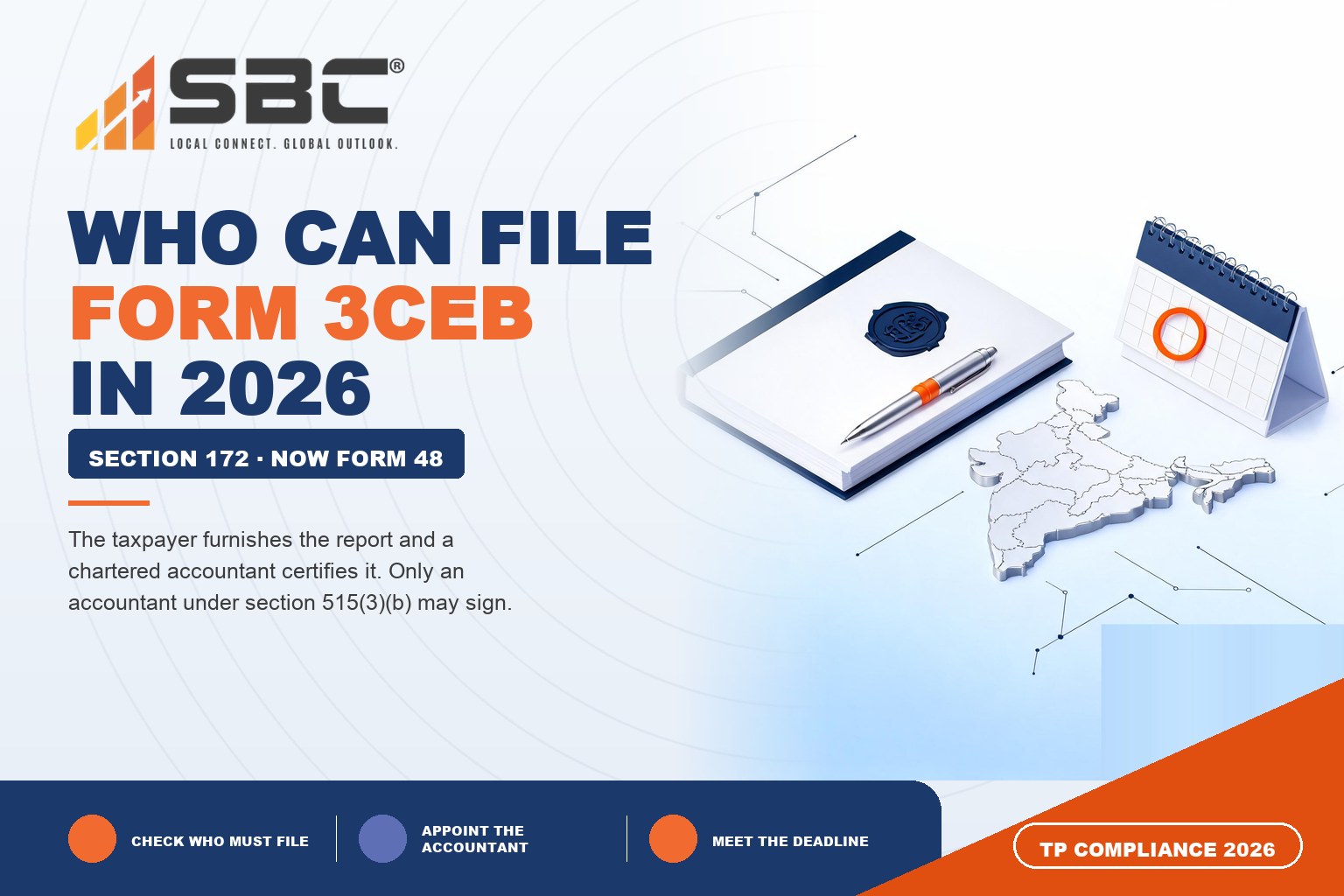
Quick Answer: The taxpayer that entered into the reportable transactions files Form 3CEB, now Form 48, and only a chartered accountant may certify it. No taxpayer may self-certify: section 515(3)(b) of the Income-tax Act 2025 restricts certification to a chartered accountant. It is furnished under section 172 and is due at least one month before the due date for the return.

Two different people are involved in getting this report filed, and confusing them is the most common reason a transfer pricing compliance calendar slips: the company that entered into the transactions carries the obligation, while a qualified accountant carries the certification. Neither role can substitute for the other, however convenient that would occasionally be for a finance team working to a deadline.

Who can file Form 3CEB?

The taxpayer files it, and a chartered accountant certifies it. The duty of providing the report lies with the company or other person that entered into the reportable transactions, and that person cannot self-certify under any condition, because the report must come from an accountant whose eligibility the Income-tax Act 2025 defines in terms that leave the taxpayer no discretion at all.

The Central Board of Direct Taxes states that Form No. 48 is a report from an accountant to be furnished under section 172 of the Income-tax Act 2025, covering international transactions and specified domestic transactions. Form 48 is filed electronically on the tax portal, where the accountant uploads and digitally signs the report and the taxpayer then accepts it. A report the taxpayer never accepts is not a filed report.

Is Form 3CEB still the correct form name?

Not for the current tax year. The Income-tax Act 2025 and the Income-tax Rules 2026 renumbered the entire Indian transfer pricing framework, and the accountant’s report moved with it. The report is now Form 48 under Rule 85 of the Income-tax Rules 2026, which replaced Rule 10E of the 1962 Rules.

Did anything change besides the number?

Nothing that relieves a finance team of work. The reportable transactions, the contemporaneous documentation requirement and the certification standard all carry forward. Only the numbering moved, which is why every checklist still refers to the old form. Steadfast Business Consulting (SBC) describes the change in a separate note on the transition from Form 3CEB to Form 48.

The old and new references map as follows.

Subject Income-tax Act 1961 / Rules 1962 Income-tax Act 2025 / Rules 2026
Accountant’s report Section 92E, Form 3CEB, Rule 10E Section 172, Form 48, Rule 85
Documentation to be maintained Section 92D, Rule 10D Section 171, Rule 84
Specified domestic transaction Section 92BA Section 164
Determination of arm’s length price Section 92C Section 165
Reference to the Transfer Pricing Officer Section 92CA Section 166

Which taxpayers must obtain the report?

Any person who entered into an international transaction or a specified domestic transaction during the tax year must obtain the report, because the test is the transaction rather than the size of the company. A small subsidiary with one intra-group service charge is inside the requirement, while a large domestic group with no related-party dealings above the threshold sits outside it entirely.

Which international transactions trigger the requirement?

Any transaction with an associated enterprise outside India. There is no monetary threshold at all, which is the point most finance teams get wrong. One management fee, one royalty, one intra-group loan or one guarantee is enough to trigger the obligation for that year, and sale and purchase of goods, provision of services, cost allocations and intra-group financing all fall within scope on exactly the same basis.

When does a specified domestic transaction cross the threshold?

When the aggregate value exceeds twenty crore rupees in the tax year. Unlike international transactions, specified domestic transactions carry a monetary threshold, and it applies to the aggregate of the qualifying transactions rather than to the entity’s turnover.

This threshold captures those groups that presume transfer pricing to be a phenomenon applicable only across borders. A domestic company paying a related party that enjoys a profit-linked deduction can cross twenty crore rupees with no foreign entity involved. The document specified domestic transaction compliance details all the domestic transactions that fall under the definition.

Who is an accountant for this purpose?

A chartered accountant, as defined by statute rather than by convention. The term “accountant” is defined at section 2(1) of the Income-tax Act 2025, which assigns it the meaning given in section 515(3)(b), which is a chartered accountant within the meaning of the Chartered Accountants Act 1949.

That definition does real work. A tax consultant, a company secretary, a cost accountant or an advocate cannot certify this report, however competent that person may be on transfer pricing, because the certification is reserved to a member of the Institute of Chartered Accountants of India holding a certificate of practice.

Can someone inside your company sign it?

No. Section 515 carries disqualifications that follow from the signatory’s connections with the taxpayer, including indebtedness and specified relative connections. The report serves as an external validation rather than an internal statement. Where the intended signatory has any financial or personal connection to the company, read section 515 in full before the engagement letter is signed.

Does the accountant have to be a transfer pricing specialist?

Though not mandated by law, the assessment process effectively requires it since the report is based on benchmarking and functional profiling that the Transfer Pricing Officer may review at a much later time, and a certificate based on weak comparables will usually not pass that review. The qualification and competence issues are different, and only the qualification issue is resolved by section 515(3)(b).

What does the accountant actually certify?

The details mentioned in this report are accurate and truthful, and the necessary information regarding the transactions mentioned in the report has been provided. The report requires the accountant to list each international transaction and specified domestic transaction, identify the associated enterprises, state the method applied to determine the arm’s length price and confirm that the taxpayer has maintained the documentation prescribed under section 171 read with Rule 84.

This is a certification rather than an audit opinion, and the distinction matters when a Transfer Pricing Officer later examines the file, because the accountant certifies what the documentation shows while the strength of that documentation remains the taxpayer’s own responsibility, which is why a benchmarking study assembled in the week before the deadline makes a poor foundation for a report that has to stand for several years.

When is the report due?

The form must be submitted at least one month before the due date for the submission of the income tax return. The Central Board of Direct Taxes states that Form No. 48 must be filed on or before the date one month before the due date for furnishing the return of income under section 263(1) of the Income-tax Act 2025 for the relevant tax year.

The intentionally-created one-month gap is often overlooked, as the report is not a supportive document of the return, but one that precedes it, which means a finance team working backwards from the return deadline usually discovers that the accountant’s report was already late.

Step Timing
Benchmarking study and documentation completed before the report is drafted
Form 48 uploaded and digitally signed by the accountant at least one month before the return due date
Form 48 accepted by the taxpayer on the portal before the same deadline
Return of income furnished due date under section 263(1)

What does a late report cost in 2026?

Fifty thousand rupees for a delay of up to one month, and one lakh rupees thereafter.

Was this always a fee?

No, it was indeed a penalty. Under the Income-tax Act 1961, failure to provide the accountant’s report attracted a penalty of ₹1,00,000 under section 271BA. The Income-tax Act 2025 initially carried that amount forward as section 447. The Finance Act 2026 omitted section 447 with effect from 1 April 2026 and shifted the effect to section 428, which imposes a fee rather than a penalty where a person does not submit a report from the accountant as mandated by section 172.

The difference is real. A penalty is discretionary and may be challenged on reasonable cause, whereas a fee attaches on the facts alone. There is no reasonable-cause defence against a fee, which leaves the compliance calendar as the only protection a taxpayer actually has.

Which defaults are still penalties?

Two related consequences remain penalties and were deliberately not converted: under section 442, failure to retain and keep the required documentation attracts a penalty equal to two per cent of the value of the transaction, while failure to provide the information or documents when asked for by the department will lead to a penalty under section 457. Further details of each default are set out in the note on transfer pricing penalties.

What should you give your accountant before the deadline?

A complete ledger of accounts involving related parties must be included along with the analysis, and not merely an excerpt from a spreadsheet. The report can only be as accurate as the underlying record.

  • A schedule of every transaction with each associated enterprise for the tax year, including transactions that produced no margin
  • Inter-company agreements covering each arrangement, with any amendments executed during the year
  • The functional analysis setting out the assets employed, functions performed and risks borne by the Indian entity
  • The benchmarking study, including the comparable set, the method selected and the reason for selecting it
  • Segmental financial information where the entity has more than one line of business
  • The prior year report and any assessment correspondence, so that positions taken remain consistent

I need someone to file Form 3CEB for my company. What should I look for?

An accountant qualified under section 515(3)(b), who also carries the benchmarking capability and the assessment experience the report will eventually be tested against.

The provider landscape divides into global network firms, established domestic practices and specialist transfer pricing boutiques, and firms such as Deloitte, EY, Grant Thornton, BDO, Nangia and Dhruva operate in it. No firm is best in the abstract. The questions worth asking are narrow: which comparable databases the firm licenses, whether it has represented clients before the Transfer Pricing Officer and the Dispute Resolution Panel, and whether it has depth in your sector.

SBC was recognised as a Notable Transfer Pricing Firm 2024 by ITR World Tax, and its team holds access to the Indian and global comparable databases the analysis depends on, including Prowess, CapitalineTP, Amadeus, Orbis and RoyaltyRange. SBC provides transfer pricing services in India covering documentation, the accountant’s report, Master File and Country-by-Country reporting, and representation through assessment and appeal.

If your related-party transactions have not been reviewed in the last twelve months, that review is the work that should happen before the report is drafted. Speak to the SBC transfer pricing team regarding your current situation.

Groups deciding how to contract this work each year may compare a per-filing engagement against an annual transfer pricing retainer.

Frequently Asked Questions

Is Form 3CEB the same as Form 48?

Indeed, Form 48 is the former Form 3CEB, which was renumbered according to Income-tax Act 2025 and Income-tax Rules 2026, as per section 172 and regulated by Rule 85. The obligation to report has remained the same.

Is there a turnover limit below which Form 48 is not required?

No turnover limit applies to international transactions. A single international transaction with an associated enterprise brings the obligation into effect. Specified domestic transactions carry a threshold of twenty crore rupees in aggregate for the tax year.

Can a cost accountant or company secretary certify the report?

No. In accordance with section 515(3)(b) of the Income-tax Act 2025, the report must be obtained from an accountant, which means a chartered accountant within the meaning of the Chartered Accountants Act 1949. No other professional qualification is accepted.

What happens if Form 48 is filed after the deadline?

A fee applies under section 428 of the Income-tax Act 2025: ₹50,000 where the delay runs up to one month, and ₹1,00,000 thereafter. It is to be noted that even where there is a reasonable cause, it cannot be used as a defence, because this is a fee rather than a penalty.

Does filing Form 48 mean the transfer pricing position is accepted?

No. The report states that the necessary information has been provided without indicating arm’s length pricing. The Transfer Pricing Officer may examine the underlying benchmarking analysis in a later assessment and propose an adjustment.

Do transactions that produced no profit still have to be reported?

Yes. The obligation to report relates to the transaction and not the margin derived from that transaction. Loss-making, zero-margin and informally documented transactions with associated enterprises all fall within the report.

CategoriesTransfer Pricing

What Does Transfer Pricing Documentation Actually Include?

Written by Jayasri P · Last updated 20 August 2026 · Statutory references current to the Income-tax Act 2025 and the Income-tax Rules 2026.

Quick Answer: Transfer pricing documentation is the Local File prescribed by section 171 of the Income-tax Act 2025 read with Rule 84 of the Income-tax Rules 2026. It runs to thirteen prescribed heads, must exist on the specified date, and has to be retained for nine years from the end of the tax year.

Most finance teams refer to the term “transfer pricing study report” to mean only the benchmarking analysis. This definition understates the obligation, because the benchmarking analysis is just one clause out of the thirteen the prescribed list requires, and that list also reaches ownership structure, group profile, functional analysis and the economic assumptions behind every price the group has set.

Who can prepare transfer pricing documentation for my company?

Anyone competent can prepare it, since the law does not require any qualifications for a preparer. Section 171 puts the responsibility to keep and maintain the information on the taxpayer. The taxpayer can create the file independently, hire an expert, or do both.

That freedom ends at the certification stage. The accountant’s report is a separate deliverable, and only a chartered accountant may sign it under section 172. Therefore, the majority of groups use a consultant who prepares the file, thus considering the transition from Form 3CEB to Form 48 only as one step of a lengthy process.

What is the transfer pricing documentation requirement in India?

Section 171 read with Rule 84. The Income-tax Act 2025 requires every person who has entered into an international transaction or a specified domestic transaction to keep and maintain prescribed information and document for a certain period and in a specified manner, with all three of those variables settled elsewhere. Rule 84 of the Income-tax Rules 2026 provides every one of them.

The old references have not survived: section 92D became section 171 and Rule 10D became Rule 84 from the tax year 2026-27. The content behind the thirteen heads remains the same for the most part, but the period of retention has been changed, and this remains the single point that is still incorrect in various internal compliance manuals.

Subject Income-tax Act 1961 / Rules 1962 Income-tax Act 2025 / Rules 2026
The obligation itself Section 92D Section 171
Information and documents prescribed Rule 10D Rule 84
Accountant’s report Section 92E, Form 3CEB Section 172, Form 48

Which persons must keep the file?

There are two categories, and the first is transactional: any person who has entered into an international transaction or a specified domestic transaction falls within section 171(1)(a). Any constituent entity of an international group falls within section 171(1)(b). Therefore, a company can carry a documentation obligation through group membership alone, without performing any reportable transaction, paying anything to an associated enterprise or receiving anything from one in the tax year.

Is there a value below which Rule 84 does not apply?

Yes, for international transactions only. Rule 84(2) of the Income-tax Rules 2026 specifies that the thirteen heads are of no effect where the aggregate value of international transactions recorded in the books for the tax year does not exceed ₹1 crore. The above provision appears to be clear until we read it alongside sub-rule (3).

Sub-rule (3) still requires the taxpayer to prove that income from those transactions was computed on an arm’s length basis. The exemption is only from the prescribed format and not from the burden of proof.

What does the Local File actually contain?

Thirteen information heads have been defined. They are classified as clauses (a) to (m) found in Rule 84(1). They fall into four practical groups, and the table below sets out what each group must show.

Group Rule 84(1) clauses What the file must show
Entity and group (a), (b), (c) Ownership structure, the group profile with legal status and tax residence of each counterparty, and the business and industry description
The transactions (d), (e) Nature, terms and prices of each transaction with each associated enterprise, and the functions, risks and assets involved
The economics (f), (g), (h) Economic and market analyses, forecasts and budgets, the uncontrolled transactions relied on and the comparability analysis
Pricing and outcome (i), (j), (k), (l), (m) Methods considered, the method selected with reasons, the actual working, adjustments, critical assumptions, and any adjustment to total income

What supporting evidence has to sit behind the file?

Authentic documents, and Rule 84(5) names the categories. The list includes official publications and databases from the country of residence of the associated enterprise, market research studies, price publications including stock exchange and commodity quotations, published accounts, contracts that have been executed, and correspondence recording negotiated terms.

Two of those categories carry more weight than the rest. Inter-company agreements matching the activities described in the functional analysis, and correspondence proving that terms were negotiated rather than assumed, are what most often separate a file that survives examination from one that does not.

Does the file cover method selection as well?

Indeed, and it is clearly indicated in clause (i). The documentation must record the methods considered, the method selected as the most appropriate one and the reasons for that selection, so a file naming a method without explaining why the alternatives were rejected fulfils the arithmetic of the rule yet fails its purpose, and that is the first gap the officer looks into. Which transfer pricing method applies must be answered in the documentation, not outside it.

What does contemporaneous mean in practice?

It means the information must already exist on the specified date. According to Rule 84(6), the information and the documents must be contemporaneous as far as possible and must exist on the specified date given in section 173(d). The Act defines that date as one month before the due date for the return of income under section 263(1).

Thus, the due date comes sooner than most compliance calendars suggest. A file assembled during the week that precedes the return might have already missed the statutory date by almost one month, and the department is not obliged to prove that the analysis was reconstructed after the event when the dates in the working papers and the database extracts say so plainly.

Does a continuing transaction need fresh documentation every year?

Not automatically, no. Rule 84(7) provides that where a transaction continues to have effect beyond one tax year, fresh documentation need not be maintained separately for each year unless there is a significant change in the nature or terms of the transaction, in the underlying assumptions, or in any other factor affecting the transfer price; absent such a change, the existing file continues to serve.

In fact, the comparable set is updated annually in practice, for it is obvious that an analysis based on stale financial data creates the same problems as no analysis at all.

How long must the documentation be retained?

Nine years from the end of the relevant tax year. Rule 84(8) sets that period for the records and documents in sub-rules (1) to (4), one year more than the eight-year period of Rule 10D in the 1962 Rules.

The change has more significance than a mere additional year’s time indicates, because the retention policies constructed based on the previous rule will now begin the destruction of documents whose retention is still mandated by the law, and it is the underlying working papers and the comparable data that are subject to the requirements and not merely the final report itself, which means that just archiving the study does not discharge it.

Who prepares the documentation, and who certifies it?

The taxpayer or its adviser prepares it, a chartered accountant certifies the report that sits on top of the file, and it is important to keep these two functions separate. The certification under section 172 only relates to the particulars that are provided, while the sufficiency of the underlying file remains the risk of the taxpayer in any subsequent assessment.

Deliverable Statutory anchor Responsibility
Local File, thirteen heads Section 171, Rule 84 Taxpayer, in house or via an adviser
Master File Section 171(1)(b), Rule 123 Constituent entity of the group
Country-by-Country report Section 511, Rule 124 Parent or designated entity
Accountant’s report, Form 48 Section 172, Rule 85 Chartered accountant certifies, taxpayer furnishes

What happens if the documentation is not maintained?

A penalty of two per cent of the value of each transaction. Section 442 of the Income-tax Act 2025 permits the Assessing Officer or the Commissioner (Appeals) to impose that penalty in case of any failure by a person to keep and maintain the requisite information, or where a transaction that should have been reported is not reported, or where incorrect information is supplied or retained.

At the same time, a different exposure exists in the form of section 171(2), which empowers the Assessing Officer or the Commissioner (Appeals) to seek information during the proceedings, and that information must then be produced within ten days of the notice, extendable by a further period of up to thirty days under section 171(3). A file existing only in raw working papers rarely becomes presentable within that time.

What does a Transfer Pricing Officer read first?

The functional analysis, and then the comparable set. An officer testing the arm’s length price under section 166 looks for the point where the file contradicts itself. The most reliable way to do that is to read clause (e) on functions, assets and risks in the light of clause (d) on terms.

Three weaknesses recur across transfer pricing assessments: the application of the same functional profile to various entities operating in different areas, a lack of documentation regarding the rejection criteria, and segmental financial information reconstructed after the notice is issued.

What should a documentation engagement deliver, and when?

A completed file before the specified date, with working papers retained in a condition that allows their reopening later. A transfer pricing documentation service is measured in the assessment that follows, usually two to four years after signature.

Steadfast Business Consulting (SBC) was recognised as a Notable Transfer Pricing Firm 2024 by ITR World Tax, and its team of Big 4 alumni holds access to the Indian and global comparable databases, including Prowess, CapitalineTP, AceTP, Amadeus, Orbis, RoyaltyRange and IBISWorld, alongside membership of the PrimeGlobal network. SBC provides transfer pricing documentation services covering the Local File, the Master File, Country-by-Country reporting, segmental profit and loss preparation and economic adjustments.

What are the stages of an engagement?

An engagement runs to a defined sequence: examination of the entity structure, comparison against Rule 84, the benchmarking and drafting work, and finally the accountant’s report. If you have not had your related-party positions examined since the renumbering, arrange a documentation gap review before the specified date.

Frequently Asked Questions

Is a transfer pricing study report the same as transfer pricing documentation?

No. The report describes the benchmarking analysis, which constitutes only a part of the documentation. Rule 84(1) prescribes thirteen heads covering ownership structure, group profile, business description, transaction terms, functional analysis, comparability, method selection, workings, assumptions and adjustments.

Is there a prescribed transfer pricing report format?

Although Rule 84 specifies the content, it does not specify a template and no format is provided for the Local File. Consequently, the file must address each of the thirteen heads in sub-rule (1) and be supported by the kinds of authentic document listed in sub-rule (5).

How long must transfer pricing documentation be kept?

Nine years from the end of the applicable tax year, under Rule 84(8) of the Income-tax Rules 2026. This replaced the earlier eight-year period under Rule 10D of the 1962 Rules, so retention schedules prepared under the old provisions would lead to premature destruction of files.

Do we need documentation if our international transactions are small?

Rule 84(2) eliminates the thirteen-head stipulation where the aggregate value of international transactions for the tax year does not exceed ₹1 crore. Rule 84(3) continues to demand that the taxpayer must show that income from these transactions is computed on an arm’s length basis.

Can our in-house finance team prepare the documentation?

Yes. Under section 171, the preparer is not required to have any qualifications, so a team from within the organisation can prepare the file. The requirements for certification do differ under section 172, as a chartered accountant is required, who cannot be the same person that maintained the records certified.

Does the documentation have to be filed with the department?

No. The Local File is kept and maintained, not filed. It becomes furnishable only under section 171(2) when the Assessing Officer or the Commissioner (Appeals) asks for it, and must then be produced within ten days of that notice.

CategoriesTransfer Pricing

Is Transfer Pricing Compliance Applicable to Your Company?

Written by Jayasri P · Last updated 20 August 2026 · Statutory references current to the Income-tax Act 2025 and the Income-tax Rules 2026.

Quick Answer: Yes, if your company entered into an international transaction with an associated enterprise, at any value. It also applies to specified domestic transactions exceeding twenty crore rupees in aggregate. Applicability is decided by the transaction under sections 163 and 164 of the Income-tax Act 2025, never by turnover.

Transfer pricing applicability is usually regarded as a question of size by most finance teams, and that instinct is wrong in a way that eventually costs money. The Indian framework attaches instead to the character of the transaction and to the relationship behind it, rather than to the scale of the enterprise. For instance, a firm with fifteen crore rupees of revenue and one royalty payment made to its overseas parent sits inside the framework. A domestic group turning over five hundred crore rupees with no associated enterprise dealings sits outside it.

Do I need transfer pricing documentation for my company?

You will do so if either of the conditions is satisfied. Documentation under section 171 of the Income-tax Act 2025, read with Rule 84 of the Income-tax Rules 2026, is mandatory for every person the test reaches. The first condition applies to all those who conducted any international transaction with an associated enterprise in that year. The second condition applies to a person whose specified domestic transactions exceeded twenty crore rupees in aggregate.

Limb Statutory anchor Monetary threshold
International transaction with an associated enterprise Section 163 (erstwhile section 92B) None. A single transaction triggers it
Specified domestic transaction Section 164 (erstwhile section 92BA) Aggregate must exceed ₹20 crore in the tax year

Which two limbs make transfer pricing applicable?

There are two limbs and these are separate from one another. A company can fall under one limb, under both limbs or under neither. Because just one new counterparty is enough to change the answer, the applicability test has to be run twice each year rather than settled once at incorporation and then carried forward on the strength of last year’s conclusion.

What counts as an international transaction?

Any transaction between two or more associated enterprises where at least one of them is a non-resident. The Income-tax Act 2025 defines an international transaction at section 163, the successor to section 92B of the 1961 Act, and the definition is wide enough that finance personnel regularly miss items carrying no invoice at all, such as a guarantee given for a group company or a cost absorbed on its behalf.

  • Purchase or sale of goods, raw materials or finished stock
  • Provision or receipt of services, including management and technical support
  • Royalty, licence fees and other payments for intangible property
  • Intra-group loans, deferred receivables, advances and other financing
  • Corporate guarantees issued for an associated enterprise
  • Cost contribution or cost allocation arrangements, with or without a margin
  • A business restructuring between associated enterprises

None of the items in that list carries a monetary floor. One management fee of two lakh rupees paid to a parent company brings the entire compliance framework into effect for that tax year, which is exactly what small subsidiaries think cannot apply to them, and they usually keep believing so until a notice arrives.

Who is an associated enterprise?

An enterprise that participates in the management, control or capital of another, directly or indirectly. The deeming tests under section 162 of the Income-tax Act 2025 have replaced section 92A, and there is a relationship between the two enterprises provided that any one of these tests is satisfied at any time during the tax year, meaning that a shareholding sold during the year does not invalidate an association that existed in it.

Test under section 162 Threshold
Shareholding carrying voting power, directly or indirectly Not less than 26%
Interest held in a firm, association of persons or body of individuals Not less than 10%
Loan advanced, against the book value of the borrower’s total assets Not less than 51%
Guarantee given, against the other enterprise’s total borrowings Not less than 10%

Shareholding is the criterion everyone checks, while the other tests are the ones that catch companies unprepared. An enterprise with no ownership link at all may still be an associated enterprise, where it has guaranteed a tenth of your borrowings or advanced a loan against most of your assets. Control matters no less than capital.

When does a specified domestic transaction exceed ₹20 crore?

When the qualifying transactions add up to more than twenty crore rupees within the tax year. Section 164 defines the specified domestic transaction and confirms that the limb applies only once the aggregate of such transactions entered into by the assessee in a tax year exceeds twenty crore rupees, implying that the aggregate under consideration has to be computed anew for every year rather than one time.

Aggregation is what most teams get wrong. The threshold is tested neither transaction by transaction nor against turnover. A company with eleven crore rupees of one qualifying payment and ten crore rupees of another has crossed the line, even though neither item would have crossed it alone. Which domestic dealings qualify, and how the aggregate is built, is explained in specified domestic transaction compliance.

How should a finance head run the applicability decision in order?

Implement the two limbs one after another, stopping at the first positive outcome. The sequence matters because the international limb has no threshold to test, which makes it much quicker to clear. A company that falls inside it has already acquired the full documentation and reporting obligation, regardless of what the domestic limb shows later.

  1. List every counterparty for the tax year. Include entities with no invoicing relationship, such as a guarantor parent or a group entity that absorbed a cost allocation.
  2. Apply the section 162 tests to each counterparty. Any one test satisfied at any point in the year makes that entity an associated enterprise.
  3. Ask whether any associated enterprise is a non-resident. If yes, and any transaction occurred with it, the international limb applies at once and no value test follows.
  4. Aggregate the qualifying domestic transactions. If the total exceeds twenty crore rupees for the year, the domestic limb applies as well.
  5. Record the conclusion in writing, including a negative one. A documented negative conclusion, supported by the counterparty list it rests on, is what allows a later assessment to be answered from the file rather than from memory, and it separates a short response from a long reconstruction.

What does transfer pricing applicability require you to do?

Two separate obligations follow, and satisfying one does not satisfy the other. Applicability triggers contemporaneous documentation under section 171 read with Rule 84, and it separately triggers a report from an accountant under section 172, each with its own contents and its own consequence for default. A company that has prepared one of them has satisfied only half of what the year requires.

What triggers documentation under section 171 and Rule 84?

Applicability itself, without any further test. Section 171 states that any person who engaged in an international transaction or specified domestic transaction is required to keep and maintain the prescribed information and document, whereas Rule 84 of the Income-tax Rules 2026 gives the detailed description of the contents of that record, from the group profile and the functional analysis through to the comparables relied upon.

The word doing the work is contemporaneous. The documentation is expected to be available at the time of pricing the transaction rather than prepared after the year has ended. A benchmarking study reconstructed in the fortnight before a deadline can be much more difficult to defend in front of a Transfer Pricing Officer than one that has been prepared throughout the period of commercial decision-making.

What triggers the accountant’s report under section 172?

The same test, with no threshold of its own. Anyone to whom either limb applies must obtain a report from an accountant under section 172, furnished in Form 48. Form 48 is the erstwhile Form 3CEB, renumbered by the Income-tax Act 2025 and governed by Rule 85 of the Income-tax Rules 2026.

The report is due at least one month before the due date for furnishing the return of income under section 263(1). That is an earlier date than most compliance calendars assume, because the report precedes the return rather than accompanying it, and a team working backwards from the return deadline usually notices the gap too late. Who is eligible to sign it is covered in a separate note on the transition from Form 3CEB to Form 48.

Does transfer pricing applicability depend on turnover or profit?

No. Neither revenue, profit, nor the margin earned determines whether the framework applies, which is the most common misunderstanding in Indian practice. A loss-making subsidiary with one intra-group service charge carries the same documentation and reporting obligation as a profitable one. A transaction priced at cost with no mark-up remains fully reportable, because the obligation lies with the transaction rather than the outcome.

What does a wrong applicability conclusion cost?

Two penalties follow, and both attach to the default rather than to the tax involved. The erroneous conclusion that the framework does not apply leaves the documentation unprepared and the report unfiled, and each of those failures carries its own consequence under the Income-tax Act 2025.

Default Current provision Consequence
Failure to keep and maintain the prescribed documentation Section 442 Penalty of 2% of the value of the transaction
Failure to furnish information or documents called for under section 171 Section 457 Penalty
Failure to furnish the accountant’s report Section 428(4)(d) Fee of ₹50,000 up to one month, ₹1,00,000 thereafter

What is worth pausing on is the two per cent measure, because it is calculated on transaction value instead of on any adjustment. A firm priced correctly all along may still face a substantial penalty, purely for having concluded that the framework did not reach it. Each default and its current statutory home is described in transfer pricing penalties.

Who should review your applicability position?

Someone who tests the counterparty list rather than the invoice ledger. Steadfast Business Consulting (SBC) was recognised as a Notable Transfer Pricing Firm 2024 by ITR World Tax, and its team holds access to the Indian and global comparable databases the supporting analysis depends on, including Prowess, CapitalineTP, Amadeus, Orbis and RoyaltyRange, and that team is built substantially of Big 4 alumni. SBC provides transfer pricing services in India covering the applicability review, documentation, the accountant’s report and representation through assessment.

What is the first step if you are unsure?

Rebuild the counterparty list first. A review that begins from the general ledger will find the transactions that were invoiced and miss the guarantees, the cost allocations and the interest-free advances that were not, which is where most missed applicability actually hides. Ask the SBC transfer pricing team to review your position for the current tax year.

Applicability reaches further than related-party contracts, because a contract with an unrelated person can still be a deemed international transaction.

Frequently Asked Questions

Is transfer pricing applicable if my company has only one foreign transaction?

Yes. The international limb carries no monetary threshold. A single transaction with a non-resident associated enterprise, of any value and at any margin, brings documentation under section 171 and the accountant’s report under section 172 into effect for that tax year, regardless of whether the counterparty is a parent, a subsidiary or a fellow group entity.

Is transfer pricing audit applicability the same as documentation applicability?

Yes, in practice. Both the documentation requirement under section 171 and the obligation to obtain an accountant’s report under section 172 are triggered by the same applicability test, which means a company satisfying the criteria of either limb carries both obligations. There is no separate audit threshold in place.

Does the ₹20 crore threshold apply to international transactions?

No. The twenty crore rupee threshold in section 164 applies only to specified domestic transactions, and it is tested on the aggregate for the tax year. International transactions with an associated enterprise carry no monetary threshold at all.

Are loss-making or zero-margin transactions still covered?

Yes. Applicability attaches to the transaction and to the relationship, not to the profit earned. Transactions priced at cost, transactions producing a loss and transactions with no written agreement are all within the framework and all reportable.

Can a company be an associated enterprise without any shareholding?

Yes. Section 162 treats enterprises as associated on several tests unrelated to shares, including a loan of not less than 51% of the borrower’s total assets by book value and a guarantee covering not less than 10% of the other enterprise’s total borrowings, either of which is enough on its own.

Does transfer pricing apply to a purely domestic group?

Only if the specified domestic transaction limb is met. A group with no non-resident associated enterprise falls outside the international limb entirely, and enters the framework only once its qualifying domestic transactions for the tax year exceed twenty crore rupees, a threshold which many domestic groups never approach.

CategoriesTransfer Pricing

Which Groups Does Pillar Two Actually Catch?

Written by Jayasri P · Last updated 17 August 2026.

Quick Answer: Pillar Two catches large multinational groups, measured on consolidated group revenue rather than on the size of any single company. A group is in scope where consolidated revenues reach EUR 750 million in at least two of the four preceding years. Scope is decided at group level, so a small Indian subsidiary of a very large group is affected.

Most finance heads test Pillar Two against the wrong number, looking at the Indian company’s turnover, its headcount and its profit, and concluding that a business of that size cannot plausibly be caught by an international minimum tax framework built for the largest enterprises in the world, and that conclusion is wrong for a structural reason rather than a marginal one.

Pillar Two does not measure you. It measures the group you belong to.

Does Pillar Two apply to my company?

The application of the scope test depends on whether the group to which the company belongs is itself in scope. Size, profitability and standalone turnover of the Indian entity do not contribute towards that test.

The global minimum tax, as per the standards provided by the Organisation for Economic Co-operation and Development, is applicable to multinational enterprise groups with consolidated revenues of EUR 750 million in at least two of the last four years. The Pillar Two model rules also confirm the negative side of this test, the part most often missed: taxpayers with no foreign presence, and taxpayers whose consolidated revenues fall below the threshold, sit outside the framework entirely, however large the Indian operation may be.

Accordingly, the answer is based on two facts that are neither part of your Indian balance sheet. Find the consolidated revenue of the ultimate parent’s group for each of the four previous years and check whether the group operates in more than one jurisdiction.

Why is scope tested at group level rather than entity level?

Because the rules exist to stop profit being shifted between entities, and a test applied entity by entity would be defeated by the very behaviour it targets. Consolidated revenue is the one figure that cannot be rearranged through intragroup structuring.

The outcome described is counterintuitive, and it is one of the most misunderstood concepts in the framework. It is possible for two same-sized Indian companies to be located on opposite sides of the divide, and the difference that sets them apart has nothing to do with the two companies.

What happens to a small Indian subsidiary of a very large group?

It is inside the rules. When the ultimate parent crosses the consolidated threshold, an Indian subsidiary that has low revenue and no foreign operations of its own becomes a constituent entity of an in-scope group.

This is where most of the surprise sits. A finance head running an Indian entity turning over a few hundred crore reasonably assumes that a minimum tax aimed at the world’s largest groups is somebody else’s problem, and then discovers that the group data request arriving from headquarters is neither optional nor informational.

However, the Indian team must shoulder the actual burden because it is essential to perform calculations on a group level, which means collecting from India the jurisdiction-level financial information that includes tax charge data and payroll and tangible asset figures, prepared on a basis that reconciles to the consolidated accounts rather than to the Indian tax return.

Why is a large standalone Indian company outside the rules?

Because there is no group above it and no presence outside of India. Therefore, purely domestic Indian companies, no matter how big, fail the multinational limb of the test and revenue alone is not sufficient for them to be included in the scope.

That relief should be documented rather than assumed, because groups restructure and a domestic company that acquires or is acquired can cross the line in a single year.

Which groups are in scope, and what must each do next?

The table below illustrates the most common fact patterns. Be advised that while reading the table you should read it according to group position and not to the entity position as the third column refers to the next step but not to the actual liability.

Group type Whether it is in scope What it must do next
Indian subsidiary of a foreign group whose consolidated revenues reach EUR 750 million in at least two of the last four years In scope, as a constituent entity Confirm the group determination in writing with headquarters, then scope the India data the group computation will require each year
Indian headquartered group with overseas subsidiaries, consolidated revenues at or above the threshold In scope, with India as the parent jurisdiction Establish which jurisdictions in the group are low-taxed, and confirm where a top-up would be collected
Large standalone Indian company with no foreign presence Not in scope Record the basis and the date of the conclusion, and revisit it on any acquisition or overseas incorporation
Indian group with foreign subsidiaries but consolidated revenues below the threshold Not in scope on current figures Monitor consolidated revenue against the four-year test, particularly where growth or acquisition is planned
Group that crossed the threshold in only one of the last four years Not in scope on that fact alone Track the rolling four-year position, because a second qualifying year brings the group in
Indian entity of an in-scope group where the India effective rate already exceeds the minimum In scope, though India is unlikely to generate the top-up Continue to supply India data, because the jurisdictional rate must be computed before it can be relied upon

Is Pillar Two a new tax on the Indian entity’s profit?

No, and the distinction is relevant. Pillar Two is a top-up mechanism operating on the effective tax rate of a jurisdiction rather than an additional charge on the taxable profit of the Indian company.

The process runs in a predefined sequence. The group determines the effective tax rate applicable to each jurisdiction in which it operates, using the income drawn from financial accounts and the taxes allocated to that income. In those cases where the rate falls below the agreed minimum rate of 15%, the difference will be treated as a top-up percentage applied to that particular jurisdiction’s income, after deducting a carve-out calculated on tangible assets and payroll.

Two features of that sequence matter for transfer pricing. The rate is jurisdictional, not entity-specific. And the base is accounting income, not taxable income as computed under domestic law.

Where is the top-up tax actually collected?

The response does not always align with the expectation of a head of finance. This is because it depends on which rules each jurisdiction has adopted. In any jurisdiction that adopts a domestic minimum top-up tax consistent with the model rules, that jurisdiction collects the tax on its own low-taxed profits first, and that charge is credited against any wider liability.

Where no such domestic charge exists, the primary rule brings the top-up in at the level of the parent, in proportion to its ownership of the low-taxed entities, and a backstop rule allocates any remaining amount across the other jurisdictions in which the group operates.

Do not assume the position for any jurisdiction, including that of India. It is necessary to confirm which of these rules is in force for the year concerned, as it determines who pays and when.

Why does transfer pricing matter more under Pillar Two, not less?

Because Pillar Two makes the location of profit determinative in a way that ordinary tax computation does not. Once a top-up is calculated jurisdiction by jurisdiction, where profit is booked drives the tax due at group level, and transfer pricing is the mechanism deciding where profit is booked.

A widespread assumption runs in the opposite direction. If every jurisdiction ends up at a minimum rate, the reasoning goes, then moving profit between them stops mattering, but that reasoning fails because the minimum applies to jurisdictions rather than to the group, and because carve-outs, timing differences and jurisdictions taxing well above the minimum mean outcomes still differ materially depending on where income lands.

Can a transfer pricing adjustment in India change a jurisdiction’s effective rate?

Yes, and this is the connection most groups have not yet built into their processes. An adjustment made in India alters both the income and the tax charge attributed to India, which moves the Indian effective rate, and where the counterparty jurisdiction grants no corresponding adjustment the group is left with profit taxed twice and a distorted rate in two places at once.

The arm’s length price is itself determined under Section 165 of the Income-tax Act 2025, which carries forward Section 92C of the Income-tax Act 1961, and the transaction reaches that test at all because it qualifies as an international transaction within Section 163 of the Income-tax Act 2025, the successor to Section 92B of the 1961 Act. Every 1961 provision referred to in this article continues to govern earlier tax years.

In cases where the Assessing Officer finds it appropriate, the case may be sent to the Transfer Pricing Officer in accordance with the provisions of Section 166 of the Income-tax Act 2025, the successor of Section 92CA under the 1961 Act. It has been observed that an adjustment made at that stage is no longer confined to the Indian return. It feeds the group computation years later, and that timing is precisely the problem finance teams are unprepared for. The mechanics of that examination are set out in this note on the transfer pricing assessment procedure.

Should a group still defend a low-tax outcome the same way?

Not without rethinking what is actually being defended here. A structure that produces a low effective rate in one jurisdiction may now be handing that rate difference over to another government in the form of a top-up, converting a tax saving into a compliance cost.

The relevant question is no longer whether the arrangement survives a local audit, but whether the profit allocation it produces still makes sense once the top-up is priced in.

Can an Indian headquartered group be caught as the parent?

Yes, and more often than expected. Indian groups with overseas subsidiaries are commonly assumed to be observers of Pillar Two rather than participants, and that assumption fails wherever consolidated revenues meet the threshold.

An Indian ultimate parent in that position carries the parent-side obligations: it must identify which jurisdictions in its group are low-taxed, compute the effective rate for each of them, and determine where any resulting top-up is collected under the rule order applying for the year.

Those groups that have only a few overseas entities are the most vulnerable, as the overseas footprint appears to be incidental while being decisive for the test. The cross-border position of non-resident group companies is explained in transfer pricing compliances for non-residents in India.

What should a finance head do now?

Initially, establish the group scope in writing and do not begin computation work without closing that question first. The immediate position is covered in three steps.

Confirm whether the group is in scope, using consolidated revenue for each of the four preceding years rather than the current year alone, and obtain it from the ultimate parent as a stated determination rather than an inference from published accounts.

Establish which jurisdictions in the group have low taxation levels. This task is a group activity because it requires data from India; the Indian figures do not reconcile to the Indian tax computation without additional effort, because the framework starts from financial accounts.

After this, the transfer pricing positions across those jurisdictions should be aligned. The contemporaneous documentation as per Section 171 of the Income-tax Act 2025, which carries forward Section 92D of the 1961 Act, and the accountant’s report mandated by the provisions of Section 172, the successor to Section 92E, ought to refer to the same value chain that the group’s computation relies on. Whenever the two documents proceed with different narratives, this inconsistency is evident to any authority receiving either one. The annual cycle is set out in this overview of Indian transfer pricing compliances.

Under the provisions of Section 168 of the Income-tax Act 2025, which carries forward Section 92CC of the 1961 Act, it would be pertinent to reconsider the advance pricing agreement in these circumstances, since certainty as regards the pricing in India removes one variable from a computation that now contains a great many. The OECD guidance on transfer pricing provides the analytical framework against which such an agreement is negotiated.

Who advises on Pillar Two readiness in India?

Advisers working on Pillar Two for Indian entities utilize their expertise in transfer pricing as well as group reporting proficiency, because scope is answered from consolidated data while the consequences land in the Indian file. In its transfer pricing services in India, Steadfast Business Consulting (SBC) lists Pillar One and Pillar Two readiness, implementation and impact, and serves MNC subsidiaries and global capability centres. The firm operates from Hyderabad, Mumbai, Pune and Dubai.

The founding members of SBC are Big 4 alumni and, according to the team page, 150 or more years of combined experience has been gathered by their team. Also, ITR World Tax named the firm a Notable Transfer Pricing Firm in 2024.

It is important to question a prospective adviser before employing their services, with at least two queries posed. A query can be made regarding how they establish scope when the parent is unresponsive. Another query that can be made is how they reconcile India data prepared for a group computation with the position taken in the Indian return. You can put a specific group structure to SBC for a scope determination.

Frequently Asked Questions

Does my company’s own turnover decide whether Pillar Two applies?

No. Scope is tested on the consolidated revenue of the group to which your company belongs, measured at EUR 750 million in at least two of the last four years. An Indian entity of any size is caught once its group crosses that threshold.

Is a wholly domestic Indian company caught by Pillar Two?

No. A company with no presence outside India falls outside the rules regardless of its revenue, because the framework applies to multinational enterprise groups. Document the conclusion and revisit it whenever an overseas entity is acquired or incorporated.

Does Pillar Two tax the Indian entity’s profits directly?

No, it works out the effective tax rate for each jurisdiction where the group operates and imposes a top-up equal to the shortfall against the minimum rate of 15%. The charge arises at group level, after a carve-out based on tangible assets and payroll.

Does Pillar Two make transfer pricing less important?

No, it makes transfer pricing more important. The location of profit recognition drives the jurisdictional effective rate on which the top-up is computed, so the decisions regarding allocation directly affect the tax cost of the group instead of only local tax liability.

Can an Indian parent company be in scope?

Yes. An Indian group with overseas subsidiaries and consolidated revenues meeting the threshold is in scope, with India as the parent jurisdiction. It must identify low-taxed jurisdictions and determine where any top-up is collected.

What should an in-scope Indian subsidiary prepare first?

Get the group scope determination in writing and proceed to map the India data needed by the group computation each year. This data will come from financial accounts instead of the tax computation, thus making it necessary to build the reconciliation before the first reporting deadline.

CategoriesTransfer Pricing

When Does a Business Restructuring Trigger an Exit Charge?

Written by Jayasri P · Last updated 17 August 2026 · Statutory references current to the Income-tax Act 2025 and the Income-tax Rules 2026.

Quick Answer: An exit charge arises where a restructuring moves something of value between associated enterprises and an independent party in the same position would have required payment to give it up. The test is not whether profit falls in India. It is whether an asset, an intangible or a profit-earning activity was transferred.

Group reorganisations reach the board as operating decisions rather than tax events. A distributor becomes a limited-risk distributor, procurement is centralised into a regional hub, or manufacturing moves to a contract model, and the reason given is cost or control.

Where a reorganisation shifts functions, assets or risks between associated enterprises, the authority in the country that gave something up will ask what left and what was paid for it, and in India that question lands at assessment, years after the project has closed and the people who designed it have moved on.

Does a business restructuring trigger a transfer pricing exit charge?

It occurs only when something of value is being passed. Restructuring will cause an exit charge to arise when there is movement of functions, assets, or risks between associated enterprises in circumstances where an independent enterprise surrendering the same thing would have demanded payment.

Two elements have to be present: a transfer of something an independent party would pay to acquire, and an arrangement carrying a term, a notice period or a settled expectation of continuation which the restructuring cuts short.

Neither element is satisfied by a fall in Indian profit on its own, and that single point separates a reorganisation managed calmly from one argued about for years.

What counts as a business restructuring for transfer pricing purposes?

In India business restructuring refers to any redeployment of functions, assets and risks between associated enterprises, and it needs no transfer of shares, no court-approved scheme and no change in legal ownership. Most of the restructurings that produce adjustments in India are carried out without any corporate action at all.

Three categories of value can move. They are tangible assets, intangibles such as know-how, customer relationships and brands, and an ongoing activity whose profit potential is worth more than the assets on its balance sheet. Indian files are weakest on the last two, because a customer base leaves no entry anywhere.

The table below sets out what moves, what is compensable, and the pricing basis.

Restructuring type What moves Is compensation typically expected What a Transfer Pricing Officer tests Likely pricing basis
Full-fledged distributor converted to a limited-risk distributor Market risk, inventory risk and credit risk, together with the customer relationships and local marketing intangibles built up under the previous model Yes, where the Indian entity surrenders customer relationships or a marketing intangible it developed and funded Whether value created and paid for in India has been transferred, and whether the original arrangement carried a term or a notice period Other Method under Rule 78, because a comparable transfer of a customer base is rarely observable
Full manufacturer converted to a contract or toll manufacturer Production and capacity risk, process know-how, and in many cases plant, equipment and supplier arrangements Yes, where know-how, capacity rights or tangible assets pass to another group entity Whether know-how developed in India moved out of India, and how the tangible assets were valued on transfer CUP under Rule 79(1)(a) for plant and equipment where a comparable price is observable; Other Method under Rule 78 for know-how
Centralisation of procurement into a regional hub Supplier contracts, negotiating rights and purchasing volumes Sometimes, depending on whether the Indian entity surrendered contractual rights it could have retained Whether the supplier relationships carried value, and whether the Indian entity had a realistic alternative to accepting the change Other Method under Rule 78
Centralisation or migration of intangibles Legal title, or the development, enhancement, maintenance, protection and exploitation functions relating to the intangible Yes, in most fact patterns Who performed and controlled those functions before the move, and what the transferred intangible was worth at that date Profit Split under Rule 79(1)(d) where uniquely valuable intangibles move, otherwise Rule 78
Termination or renegotiation of an existing arrangement Nothing tangible; the arrangement itself ends, narrows or is repriced Yes, where the arrangement carried a term, a notice period or an established expectation of continuation The terms of the original agreement and the conduct of the parties under it Other Method under Rule 78, applied to what a similar uncontrolled surrender would command
Transfer of a going concern A functioning activity with its assets, assembled workforce, contracts and profit potential Yes Whether the activity was priced as a bundle carrying goodwill and profit potential, or asset by asset at written-down value Profit Split under Rule 79(1)(d) where uniquely valuable intangibles form part of the bundle, otherwise Rule 78

Which restructurings fall inside the Indian transfer pricing net?

Cross-border and domestic reorganisations can both be covered and provided for. Section 163 of the Income-tax Act 2025 carries forward the meaning of international transaction from Section 92B of the Income-tax Act 1961, which means that the business reorganisation involving two associated enterprises, one of which is a non-resident, is included in that meaning.

A domestic reorganisation is caught separately. Section 164 of Income-tax Act 2025, which carries forward Section 92BA of Income-tax Act 1961, brings specified domestic transactions within the arm’s length requirement where their aggregate in the relevant tax year exceeds ₹20 crore.

No border needs crossing, since the ₹20 crore threshold is aggregate.

Does a reduction in expected future profit require compensation?

Not by itself. A restructured organisation that earns less than it did previously has not, by that fact alone, been deprived of anything an independent party would have charged for.

An independent enterprise has no entitlement to its historical margin, because conditions change, contracts end, and profitability falls without anyone owing compensation.

The compensable event is the transfer, not the outcome. Ask what left the Indian entity and where it went, rather than starting from the profit and looking for a justification. A margin comparison run before the functional work is done produces a number without a case behind it.

How do the options realistically available to each party change the answer?

They set the price, and in some cases remove the charge. The arm’s length principle aims to determine what independent parties would have agreed, and an independent enterprise accepts a restructuring only where no option realistically available to it would leave it better off.

If the Indian entity had a genuine alternative, such as continuing the existing arrangement or serving a different principal, then accepting materially worse terms without payment is not conduct an independent party would have adopted.

The test cuts both ways. Where the Indian entity was terminable at short notice and held no customer relationships of its own, the compensation the analysis supports may be small or nil.

Documenting the alternatives genuinely open at the time is therefore not a mere defensive exercise but the analysis itself.

Why does the FAR profile before and after the restructuring decide the case?

The distinction existing between the above-mentioned profiles is proof of what has moved. It is necessary to clarify what functions have been performed, what assets have been employed, what risks have been borne by the Indian entity before the change and after it, and the difference between both descriptions is the transferred item the whole dispute is about.

Most files fail here for a procedural reason rather than a technical one, because the functional analysis is refreshed only after the reorganisation, so the file describes the destination without ever recording the starting point. Reconstructing that profile years later, from memory and old presentations, is materially weaker.

What contemporaneous evidence should you keep?

Keep what was true at the time. Contemporaneous documentation is required under Section 171 of Income-tax Act 2025, successor to the Section 92D of the Income-tax Act 1961 for prior tax years, and Rule 84 of the Income-tax Rules 2026 lists the information and documents to be held and kept under that same section. The accountant’s report follows under Section 172, which carries forward Section 92E, while Rule 85 prescribes it.

Four primary elements carry most of the weight: the functional analysis in both states, intercompany agreements with their terms and termination provisions, the commercial case put to management, and the valuation support. The before-and-after functional analysis is what Rule 84 documentation must carry.

The agreements warrant consideration with the term and notice period determining whether early termination was compensable. This memo on what the intercompany agreement has to record lays out the drafting points, and the annual cycle is summarised in Indian transfer pricing compliances.

How is the arm’s length price of a restructuring determined?

By the most appropriate method, drawn from a closed list. The arm’s length price is computed by that method under Section 165 of the Income-tax Act 2025, which replaces Section 92C of the Income-tax Act 1961.

Rule 79 of the Income-tax Rules 2026, which replaces Rule 10B of the Income-tax Rules 1962, provides the methods for determining the arm’s length price under Section 165, with the comparable uncontrolled price method at sub-rule (1)(a) and the resale price, cost plus, profit split and transactional net margin methods at sub-rules (1)(b), (1)(c), (1)(d) and (1)(e) respectively. The other method sits outside that list, in Rule 78, made for the purposes of Section 165(1)(f).

It should be noted that every rule number cited in this article comes with one caveat, since these are the Income-tax Rules 1962 and the Income-tax Rules 2026 will give new numbering to the transfer pricing rules while preserving their substance.

Which method fits a transfer that happens only once?

Usually the other method, which Rule 78 sets out for the purposes of Section 165(1)(f). A restructuring is a single event, so a conventional comparable rarely exists, and Rule 78 meets that squarely: it permits any method taking into account the price which has been charged or paid, or would have been charged or paid, for the same or similar uncontrolled transaction between non-associated enterprises under similar circumstances, considering all the relevant facts.

There are two alternatives left. Where a comparable transfer price is observable, such as in the sale of machinery or tooling, the comparable uncontrolled price method available at Rule 79(1)(a) is preferable; but for rare or uniquely valuable intangibles, the profit split method at Rule 79(1)(d) is most suitable.

Rule 80 settles the choice of method against six different selection criteria. Of these criteria, two of them form the basis of the majority of restructuring assignments: criterion (c), which is the availability, coverage and reliability of information, which is obviously not the case with a one-off transfer, and criterion (f), which is the nature, extent and reliability of assumptions that lie in the core of restructuring valuation.

Why is no arm’s length range available for a restructuring?

The range is closed to precisely the methods a restructuring usually needs. Rule 81 builds a dataset, arranged in ascending order, where the most appropriate method produces more than one price. Sub-rule (4) then opens the thirty-fifth to sixty-fifth percentile range only where the dataset holds six or more entries and the most appropriate method is neither the profit split method nor the other method.

Therefore, a restructuring that is priced using either of those two methods gets no range at all. Sub-rule (7) applies instead, and the arm’s length price is the arithmetical mean of the dataset. Where the variation does not exceed the tolerance notified by the Central Government, which the rule caps at three per cent, the price actually charged may still be deemed to be the arm’s length price, and that tolerance measures deviation from the mean rather than from a range.

So the latitude a benchmarking study takes for granted is unavailable on the transaction that needs it most. Nor is shelter available elsewhere, since business restructurings do not appear in the safe harbour tables at Rule 89.

When it is deemed necessary by the Assessing Officer, the transaction is referred to a Transfer Pricing Officer under Section 166 of the Income-tax Act 2025, the successor to Section 92CA of Income-tax Act 1961, and then the functional profile is scrutinised by the Officer before and after the change, the agreements, and the pricing basis for anything transferred. All details are elaborated in this note on how a restructuring is examined at assessment.

What happens after a primary adjustment is made?

A second consequence occurs when the funds do not come back again. Where a primary adjustment is made and the funds are not repatriated within the prescribed time, a secondary adjustment arises under Section 170 of the Income-tax Act 2025, which carries forward Section 92CE of the Income-tax Act 1961. The excess is then seen as an advance on which interest is imputed.

That converts a one-off exposure into a recurring one, and this analysis of secondary adjustment provisions considers the practical implications.

Can an advance pricing agreement remove the uncertainty before the restructuring?

For a planned reorganisation, an advance pricing agreement is the only route to certainty. Section 168 of Income-tax Act 2025, carrying forward Section 92CC from Income-tax Act 1961, provides for an agreement which allows the arm’s length price to be determined in advance, with Section 169 being the successor of Section 92CD, which governs how effect is given to a concluded agreement.

The value is not only the outcome. Reaching an agreement forces the group to describe, before the event, what the Indian entity does today and what it will do afterwards, so the question is answered while the facts survive.

The cost encompasses time and disclosure; forming an agreement could take years, not just months; in addition, it opens the group’s value chain to examination, and therefore suits material arrangements that will recur.

Who advises on the transfer pricing of a business restructuring?

Advisers handling Indian restructurings combine functional analysis with valuation support, because the question is decided on the facts and then priced. Steadfast Business Consulting (SBC) lists business restructurings, together with a review of agreements and contracts, as a named capability on its transfer pricing services in India page, and works from offices located in Hyderabad, Mumbai, Pune, and Dubai.

SBC was founded by Big 4 alumni, and the team page states 150 or more years of combined experience. ITR World Tax named the firm a Notable Transfer Pricing Firm in 2024.

You can ask any prospective adviser when they would record the pre-restructuring functional profile, and how they would support the value of anything transferred. You can raise a planned reorganisation with SBC at the design stage.

Frequently Asked Questions

Is a fall in Indian profit after a restructuring enough to trigger a charge?

A decline in expected future profit is not by itself compensable. The first consideration has to be whether an asset, an intangible or an ongoing activity with profit potential was transferred, or whether an arrangement carrying a term was terminated early.

Which transfer pricing method applies to a restructuring?

Usually the other method under Rule 78 of the Income-tax Rules 2026, because a one-time transfer usually cannot be found in the form of a conventional comparable. The comparable uncontrolled price method at Rule 79(1)(a) is used in the case of an observable asset sale, while the profit split method at Rule 79(1)(d) is used when uniquely valuable intangibles move.

Does an arm’s length range apply to a restructuring?

In most cases, not at all. Rule 81 opens the percentile range from the thirty-fifth to the sixty-fifth only in cases where the data set contains six or more entries and the method is neither the profit split method nor the other method, so a restructuring priced under either takes the arithmetical mean instead.

Which documentation matters most for a restructuring?

The functional analysis before and after the change, the intercompany agreements with their term and notice provisions, and the valuation support for anything transferred. The Rule 84 of the Income-tax Rules 2026 lists what has to be kept under Section 171 of Income-tax Act 2025, and Rule 85 covers the accountant’s report.

Can an advance pricing agreement cover a planned restructuring?

This is correct, and it is the only way to achieve certainty in advance. Section 168 of the Income-tax Act 2025 permits entering into an agreement determining the arm’s length price in advance, while Section 169 clarifies how effect is given to the said agreement.

CategoriesTransfer Pricing

Should You Choose a Unilateral, Bilateral or Rollback APA?

Written by Jayasri P · Last updated 17 August 2026 · Statutory references current to the Income-tax Act 2025 and the Income-tax Rules 2026.

Quick Answer: Choose a unilateral advance pricing agreement when the counterparty jurisdiction poses little risk, and a bilateral agreement when the transaction is material. Rollback is not a third route but an option on either, governed by Rule 111 and requested in Form No. 51. It is available only where every rollback year meets the conditions.

Many groups treat an advance pricing agreement as a single decision, but it is in fact three, taken in sequence, and you decide whether certainty is sought from India alone or from both administrations, whether the agreement should reach back into years already under examination, and whether the treaty relationship permits a negotiation at all.

The route is not a procedural formality, because it decides whether the profit agreed in India holds good in the counterparty jurisdiction as well, which is the difference between an agreement that removes exposure and one that merely moves it.

What is an advance pricing agreement under Indian law?

An advance pricing agreement fixes, in advance, the arm’s length price of specified international transactions in future tax years, or the manner of determining it. It is governed by Section 168 of the Income-tax Act 2025, which carries forward the framework in Section 92CC of the Income-tax Act 1961. Years before the change remain governed by the earlier provision, so both citations still do work.

Section 169, formerly Section 92CD governs how an agreement takes effect and requires a modified return, so that the filed position matches the agreement.

The distinction that matters commercially is timing, because every other mechanism operates after an adjustment has been proposed, whether that is the transfer pricing assessment procedure, the appellate route or the mutual agreement procedure, whereas an advance pricing agreement operates before the exposure crystallises, which is why groups carrying recurring related-party flows reach for it rather than defending the same benchmarking every year.

Section 165, formerly Section 92C, on arm’s length price and the reference to the Transfer Pricing Officer under Section 166, formerly Section 92CA, do not disappear, but they stop being the arena in which the price is contested.

How do unilateral, bilateral and rollback options compare?

The three options answer different questions, because a unilateral agreement settles what India will accept and a bilateral advance pricing agreement settles what India and the counterparty jurisdiction will accept together. Rollback settles what happens to the years already gone.

Unilateral APA Bilateral APA Rollback
Who it binds You and the Indian tax administration only You, India and the competent authority of the treaty partner The same parties as the agreement it attaches to
What risk it removes Uncertainty over the Indian position for covered years Uncertainty on both sides, and the risk of the same profit taxed twice Exposure in earlier open years on the same transaction
When it is right The counterparty jurisdiction poses little risk, or no treaty mechanism supports a negotiation The transaction is material and the counterparty administration is active Earlier years remain open on the same transaction and functions
What it does not protect against An adjustment abroad, and the double taxation that follows Delay, because progress depends on the other administration engaging Concluded years, and years whose facts have changed

Rollback is not an alternative to the first two. It attaches to whichever route you pursue, and for many applicants it is the reason to apply.

When does a unilateral APA serve you best?

A unilateral agreement suits situations where the risk sits mainly in India. Only the taxpayer and the Indian tax administration are involved, so the process is faster and cheaper.

Three situations point towards it: the counterparty jurisdiction imposes no meaningful transfer pricing scrutiny; no treaty contains a mutual agreement procedure article capable of supporting a competent authority negotiation; or the transaction is recurring and awkward without being large enough to justify a two-administration process.

Where the counterparty is a non-resident associated enterprise, establish the compliance position of the non-resident before settling on the unilateral route.

What does a unilateral agreement not protect against?

It does not stop the counterparty jurisdiction taxing the same profit, which is the whole of the limitation, and it is a large one.

If the foreign administration examines the transaction and reaches a different arm’s length outcome, it may adjust the profits of the foreign entity upwards, and India, having agreed a position, will hold to it while that administration has agreed nothing, so the result is economic double taxation on the same income, with relief then pursued through the very mutual agreement procedure the agreement was supposed to make unnecessary.

A second consequence is often overlooked, because where a primary adjustment follows, the secondary adjustment provision in Section 170, formerly Section 92CE, can be triggered and a repatriation obligation arises. Certainty on price does not end the cash consequences.

When is a bilateral APA the correct route?

A bilateral agreement is correct wherever the transaction is material and the counterparty administration is an active one. It is negotiated between the Indian competent authority and its counterpart in the treaty partner state under the mutual agreement procedure, and binds both.

That is the whole value of the route, because both administrations accept the same methodology for the same transaction, so neither can later claim the income for itself, and the double taxation risk left open by a unilateral agreement disappears.

Why does the India and UAE corridor make this decision live?

Indian groups run regional operations, treasury and shared services through United Arab Emirates entities. Those structures carry intra-group service charges and financing flows, both of which attract close transfer pricing attention.

The UAE now has a corporate tax regime with its own transfer pricing requirements, so a methodology accepted in India is not accepted on the other side by default, and where the corridor carries value, the two-sided route is the durable one.

What slows a bilateral negotiation down?

Dependence on the other administration slows it down, and preparation on your side does not remove that dependence. A bilateral process requires two complete submissions, made to two authorities, consistent in every material respect. Any inconsistency between the two filings becomes the first thing both sides examine.

Competent authority capacity, the treaty partner’s caseload and the complexity of the transaction all affect how long the negotiation runs. Plan for a longer timeline than the unilateral route.

What does rollback actually achieve?

Rollback applies the methodology agreed for the covered future years to earlier years that remain open, turning a forward-looking agreement into a settlement of the past. That is what most applicants are actually after.

Consider the typical position: a benchmarking approach questioned in one assessment and likely to be questioned again in the open years behind it, where an agreement covering only future years leaves that stack to be fought one year at a time, whereas rollback collapses it into a single agreed outcome.

Section 169 matters here. A rollback year has already been returned. Once the agreement is signed, the filed position no longer reflects the agreed methodology, and the return must be modified before the assessment consequences follow.

What conditions must a rollback claim satisfy?

The conditions sit in Rule 111 of the Income-tax Rules 2026, which replaces Rule 10MA of the Income-tax Rules 1962, titled “Roll Back of the Agreement.” They are cumulative, so failing one costs the year.

Condition under Rule 111 What it means in practice
The same international transaction The earlier year must carry the transaction the agreement itself covers, not a comparable flow or a successor arrangement
Return furnished by the due date The return of income for that year must have been furnished by the due date under Explanation 2 to Section 139(1), so a belated return removes the year
Accountant’s report furnished The accountant’s report under Section 92E, now Section 172, must have been furnished for that transaction for that year
All rollback years claimed together Rollback must be requested for every rollback year in which the transaction was undertaken, not only the years that suit the taxpayer
Request made in Form No. 51 The claim is made in the prescribed form alongside the application, with an additional fee of ₹5,00,000, rather than raised in correspondence
The five cumulative rollback conditions under Rule 111

Numbering across the Income-tax Rules 1962 and the Income-tax Rules 2026 series has moved even where the substance carried over, so confirm the reference against the tax year being claimed.

Why does the all-years condition matter so much?

Because it removes the option most groups assume they hold. A group hoping to roll back only its worst year cannot, since rollback is requested for all the rollback years in which the transaction was undertaken.

That changes the arithmetic, because a year in which the tested margin sat comfortably above the agreed position is pulled in alongside the year that hurts. Model the net effect across the preceding years covered by the application, not the effect in the single year under examination.

The department will also test whether the earlier year truly carried the same transaction. A restructuring, a changed business model or an altered entity character usually defeats the comparison.

Can an appeal foreclose rollback for a year?

Yes, and the bar is express: sub-rule (3) of Rule 111 bars rollback for a year in which an appellate authority has already determined the arm’s length price of the transaction.

Sequencing therefore becomes a planning question, because a group already in appeal on the transfer pricing of a year may have foreclosed rollback for it, and the decision to press that appeal should be taken with the agreement application already in view, since pressing on is the reflex and not always the cheaper answer.

How should you decide between the routes?

Work through four tests in order, because each one narrows the choice made in the test before it.

  • Is the counterparty jurisdiction an active transfer pricing administration? If it is, and the transaction is material, the analysis starts from bilateral and needs a reason to fall back.
  • Does a treaty with a mutual agreement procedure article exist? Without one the bilateral route is unavailable, and a unilateral agreement becomes the only certainty on offer.
  • Is the value at stake proportionate to a two-administration process? A bilateral negotiation consumes finance and tax resource across several reporting cycles, and small flows rarely justify it.
  • Do earlier years remain open on the same facts? If they do, evaluate rollback whichever route you select, because it frequently carries the largest immediate financial effect.

The order matters. The first two tests can eliminate a route outright, and the last two confirm which of the survivors is right.

What obligations follow once an agreement is in force?

An agreement is a continuing obligation rather than a conclusion, and reporting does not stop. You must file an annual compliance report for each covered year showing the agreed methodology was applied. That report is subject to a compliance audit by the Transfer Pricing Officer.

The critical assumptions stated in the agreement must continue to hold, and if the business changes in a way that breaches them, the agreement can be revised or cancelled, with the affected years reverting to ordinary examination. Documentation requirements under Section 171 (previously Section 92D), and the accountant’s report required by Section 172 (previously Section 92E), continue to apply alongside the agreement rather than being displaced by it, so the Indian transfer pricing compliance calendar still runs in full.

Which are the best transfer pricing firms for APA and dispute resolution?

No firm is best for every APA, and the right one is independently recognised, has advised on both sides of the corridor you transact across, and treats the route as a decision to be reasoned rather than an application to be filed.

Bilateral work narrows the field more than unilateral work does. Global networks such as Deloitte, PwC, EY, KPMG and Grant Thornton hold presence in most treaty partner jurisdictions, which matters when a competent authority negotiation is protracted. Specialist firms compete on the depth of the position rather than on footprint, and where the counterparty jurisdiction is one the firm operates in, the distinction narrows.

Steadfast Business Consulting (SBC) was named a Notable Transfer Pricing Firm 2024 by ITR World Tax, an independent ranking rather than a self-description. The firm was founded by Big 4 alumni, and the team brings 150+ years of combined experience across Indian and cross-border tax.

Steadfast Business Consulting has offices in Hyderabad, Mumbai, Pune and Dubai, which matters on an India and UAE bilateral matter because both ends of the corridor are handled inside the same firm, and the transfer pricing practice covers method selection, benchmarking and documentation, together with assessment support and the advance pricing agreement process.

To have the route tested against your own facts before committing resource, write to the transfer pricing practice.

The choice between the three routes is easier to make against the published record of how many bilateral agreements India actually signs each year.

Frequently Asked Questions

Is a bilateral APA always better than a unilateral one?

No. A bilateral agreement removes double taxation risk in a way a unilateral agreement cannot, but it requires a treaty with a mutual agreement procedure article and takes considerably longer to conclude, so where the counterparty jurisdiction poses little risk, the unilateral route is the better answer.

Can rollback be sought without applying for an APA?

No, rollback attaches to an advance pricing agreement application and cannot stand alone, because the methodology must first be agreed for the covered future years before it can be carried into earlier years. The request is made in Form No. 51 under Rule 111 of the Income-tax Rules 2026.

Which section governs advance pricing agreements now?

Section 168 of the Income-tax Act 2025 governs advance pricing agreements, carrying forward Section 92CC of the 1961 Act. Section 169, formerly Section 92CD, governs the effect of an agreement, including the modified return required for an assessment year the agreement covers.

Does an APA remove the need for transfer pricing documentation?

No. Documentation under Section 171 (previously Section 92D) and the accountant’s report under Section 172 (formerly Section 92E) remain due for every covered year, alongside the annual compliance report audited by the Transfer Pricing Officer.

What happens if the business changes during the agreement period?

The agreement records critical assumptions about the business. If a change breaches them, the agreement may be revised or cancelled, and the affected years return to ordinary examination. Notify a material change rather than letting it surface during the audit, because an undisclosed breach weakens your position.

CategoriesTransfer Pricing

What Guarantee Fee Counts as Arm’s Length?

Written by Jayasri P · Last updated 17 August 2026 · Statutory references current to the Income-tax Act 2025 and the Income-tax Rules 2026.

Quick Answer: A guarantee commission of not less than 1% per annum on the amount guaranteed is accepted under Rule 89. Rule 88 decides eligibility: up to ₹100 crore qualifies, and above ₹100 crore only where the associated enterprise is rated adequate to highest. Outside the safe harbour, the fee is whatever your evidence supports under Section 165.

Group treasurers ask this expecting a figure, and one exists, but it arrives attached to a bargain most groups have never priced, because the safe harbour rate is the cost of certainty rather than a measurement of what the guarantee is worth.

The officer asks something more specific. Did the Indian entity take on a genuine obligation, did the borrower receive terms that it would not have been able to obtain on its own, and can the charge be traced to that difference?

What guarantee fee counts as arm’s length?

Two answers exist.

The first one is the safe harbour, where you elect it, meet the prescribed circumstance and the declared price is accepted without a benchmarking contest, while the second is the normal route, under which the fee is whatever your evidence produces for that borrowing under a method applied under Section 165 of the Income-tax Act 2025, carrying forward Section 92C of the Income-tax Act 1961.

The earlier provision governs earlier tax years. There are three elements to consider in this regard; first, the guarantee must be explicit, meaning an undertaking the lender can enforce, rather than an expectation drawn from group membership; second, the borrower must have received a quantifiable benefit in the terms actually sanctioned; and thirdly, the charge must follow from the selected method.

In the scenarios where all three are valid, a wide range of outcomes is defensible; on the other hand, the fee is exposed in the situations where one does not apply.

Does any Indian rule state a guarantee fee percentage?

Yes, one does, and Rule 89 of the Income-tax Rules 2026 is the only provision that attaches a rate to a corporate guarantee under Indian law.

Sub-rule (1) sets the bargain out plainly. Where the option has been validly exercised under Rule 90 and the declared price accords with the circumstances in sub-rule (2), the transfer price declared by the assessee shall be accepted by the income-tax authorities. Rule 86 carries the definitions, Rule 87 defines the eligible assessee and Rule 88 lists the eligible transactions.

Item 4 of the table in sub-rule (2) deals with guarantees, and it states a single figure: a commission or fee of not less than 1% per annum on the amount guaranteed. There is no second band. The ₹100 crore test has not disappeared, but it has moved, and where it moved to is the whole of the analysis.

Where did the ₹100 crore test go?

It became a condition of eligibility rather than a choice of rate.

Rule 88 admits a corporate guarantee to the safe harbour in two situations: where the amount guaranteed does not exceed ₹100 crore, or where it exceeds ₹100 crore and the associated enterprise carries a credit rating of adequate to highest safety from an agency registered with the Securities and Exchange Board of India.

Read the two rules together and the consequence is sharper than the old split. Under the Income-tax Rules 1962 a large guarantee still reached a safe harbour rate, merely a lower one. Under Rule 88 a guarantee above ₹100 crore to an unrated or weakly rated associated enterprise is not an eligible international transaction at all, so there is no safe harbour to elect and the fee must be defended on evidence.

The authority for making these rules lies with the Board as stated in Section 167 of the Income-tax Act 2025, which is the successor of Section 92CB under the 1961 Act.

What are the safe harbour circumstances for financial transactions?

Guarantees and intra-group loans travel together in treasury structures, and one table prices both.

Eligible international transaction Circumstance under Rule 89, sub-rule (2)
Corporate guarantee, eligible under Rule 88 Commission or fee not less than 1% per annum on the amount guaranteed
Intra-group loan denominated in Indian rupees Interest not less than the one-year marginal cost of funds lending rate of the State Bank of India as on 1 April of the relevant tax year, plus 175 to 625 basis points according to the credit rating of the associated enterprise
Intra-group loan denominated in foreign currency Interest not less than the reference rate for that currency as on 30 September of the relevant tax year, plus 150 to 600 basis points according to credit rating and the size of the loan book
Rule 89 safe harbour rates for corporate guarantees and intra-group loans

These are Income-tax Rules 2026 provisions, in force from 1 April 2026, and sub-rule (4) applies them for a block period of three tax years commencing with the tax year 2026-2027. The Income-tax Rules 1962 continue to govern earlier tax years, where the guarantee rates were 2% and 1.75% and the loan margins ran from the State Bank of India base rate as on 30 June. The department publishes the earlier provision at Rule 10TD of the Income-tax Rules 1962. Confirm which set governs the year you are filing for.

Is 1% the arm’s length fee, or the price of certainty?

It is the price of certainty.

At 1% per annum the calculation is closer than it was. The earlier 2% frequently sat well above what a benchmarking analysis of the same facility would support, so electing it often meant paying tax on income the transaction did not economically generate. A single 1% rate narrows that gap, and for a borrower with a weak standalone position it may now sit below the fee the evidence would justify.

The trade-off still cuts in both directions. Where the borrower is strong and the guarantee shaved only a modest margin off the sanctioned rate, 1% may still overstate what the undertaking was worth.

The decision is therefore commercial. Before electing, one should price the guarantee according to both methods, as the safe harbour is an alternative to the analysis below, not a replacement for it.

Does a corporate guarantee to a subsidiary need a transfer pricing charge?

An explicit guarantee given so that a subsidiary can borrow qualifies as an international transaction, subject to the rules of transfer pricing.

Section 163 of the Income-tax Act 2025, as a continuance of Section 92B under the 1961 Act, relates to guarantees given for borrowings between associated enterprises.

That is why the familiar treasury position fails. Treating a guarantee as an internal formality requiring no charge is difficult to hold where the parent assumed a real obligation for another entity, because the absence of a fee must then be explained on the facts rather than asserted as group policy.

What is the benefit test for a corporate guarantee?

The purpose of the benefit test is to determine whether the guarantee improved the borrower’s position, and since it establishes whether anything exists to price, it must be done first.

If we consider that the subsidiary could have raised the same amount on its own, then the parent supplied nothing the borrower needed, and an officer reaching that conclusion disallows the charge in the payer’s hands rather than debating the fee.

No benchmarking exercise repairs that position once the benefit test has failed.

How do you show the borrowing terms actually improved?

You compare what the lender offered against what it would have offered the subsidiary independently, and the best evidence is contemporaneous, since term sheets as well as credit approval memoranda, lender’s internal notes and any correspondence treating the guarantee as a condition of sanction all demonstrate that the undertaking changed the outcome.

Where the borrower could neither obtain nor service the debt alone, the guarantee creates access to capital rather than reducing a cost, and an officer may then ask whether an independent party in the parent’s position would have subscribed equity instead. Address the characterisation point in the file.

How does an explicit guarantee differ from implicit parental support?

An explicit guarantee is an undertaking the lender can enforce against the parent. Implicit support is the comfort a lender draws from the borrower belonging to a strong group, with no undertaking given.

The differentiator is chargeability. An explicit guarantee transfers risk. A lender anticipating support it cannot compel, by contrast, has made an assessment of the borrower, not received anything from the parent.

The reverse holds as well. The implicit support must be taken into consideration when evaluating the borrower in the standalone context. The reason for that is that a subsidiary of a well regarded group is generally viewed as a better credit than the same business standing outside any group. In this connection, it is important to analyse the standalone position on the basis of leverage, interest cover, cash generation, the asset base, market position and sector volatility before any adjustment for affiliation is made.

Which analytical approaches support a guarantee fee?

Three approaches are used in practice, and the choice depends on what data you can defend.

How does the interest saving approach work?

The measurement involves assessing the difference between what the borrower would pay standing alone and what it pays with the guarantee. It then goes on to ask how that difference is divided.

The saving is not automatically the fee. An independent borrower would not give up the entire advantage, as it would leave the borrower no better off than unguaranteed borrowing. Hence, reason through how much each side retains.

When can observable guarantee pricing be used?

When real arrangements in respect of third party guarantees exist, those can provide direct evidence, but making comparison is demanding since one has to take into consideration the credit standing of the guaranteed party, the tenor, the security position, the currency and the covered proportion, and if these terms are unknown then the comparison becomes mere assertion masquerading as analysis.

Often, internal arrangements are better, because a guarantee the group gave to an unrelated party is evidence you already hold.

What does the guarantor’s exposure approach measure?

It measures what the guarantor put at risk, by reference to the likelihood of the guarantee being called, as well as the related loss that would follow.

Treasury teams find the methodology to be intuitive, because it mirrors the economics that the parent company faces, but its credibility will ultimately depend on whether the assumptions can be evidenced.

Which guarantee types attract a charge?

Not every instrument called a guarantee transfers risk, and the label in the group’s records does not decide the analysis.

Guarantee type Whether a charge is generally expected What evidence is required
Explicit financial guarantee Yes, where the borrower obtained better terms Executed guarantee deed, board approval, lender credit papers showing the guarantee was a condition, comparison of sanctioned terms with the standalone position
Implicit parental support Generally not, as no undertaking was given Confirmation that no enforceable undertaking exists, group structure documentation, and the standalone credit assessment recognising the affiliation benefit
Performance guarantee Depends on the obligation assumed and the likelihood of it being called Underlying contract, scope of the obligation guaranteed, assessment of performance risk, evidence of whether the guarantor has ever been called
Letter of comfort Depends entirely on whether it is legally enforceable Full text of the letter, legal analysis of enforceability in the relevant jurisdiction, lender correspondence on the weight placed on it

The second column turns on substance rather than the conventions of drafting, meaning that a letter of comfort framed as a moral assurance and one that the lender may sue upon are different transactions. Our note on inter-company agreements explains what these documents must record.

What does a Transfer Pricing Officer examine first?

The officer examines whether the guarantee exists in documented form, before examining the fee.

Where the transaction is referred under Section 166 of the Income-tax Act 2025, previously Section 92CA of the 1961 Act, the review follows a settled sequence. Was an enforceable undertaking given, did the borrowing terms improve because of it, and has the fee moved without explanation? Our summary of the transfer pricing assessment procedure sets out how that sequence unfolds.

Why do undocumented or unexplained fees invite adjustment?

An undertaking nobody recorded is difficult to distinguish from implicit support, which is not chargeable.

Guarantees are often given at board level and never papered between group entities, so the lender holds a deed and the group records nothing. A fee that moves without a commercial event suggests it is responding to group profits rather than to risk, and where the file shows no refinancing, no change of tenor and no shift in the borrower’s credit position, the adjustment is easy to propose.

What happens after an adjustment to a guarantee fee?

A primary adjustment carries a consequence treasury teams routinely overlook.

Section 170 of the Income-tax Act 2025, earlier Section 92CE of the 1961 Act, stipulates that if a primary adjustment satisfies the prescribed conditions, then the excess money would need to be repatriated to India within the prescribed period or be treated as an advance carrying imputed interest until the repatriation takes place, thus making guarantee adjustments more costly than the headline figure suggests. The details of this obligation are provided in our note on secondary adjustments.

Can an advance pricing agreement cover recurring group guarantees?

An advance pricing agreement fits a guarantee programme, because the arrangement recurs and the facts are stable.

Section 168 of the Income-tax Act 2025, which continues Section 92CC of the 1961 Act, allows for the conclusion of an agreement to fix the arm’s length price, or how it is to be fixed, in relation to future transactions, whereby a group guaranteeing borrowings for several subsidiaries benefits the most as one methodology then applies across the structure.

What should you check in your own guarantee arrangements?

The initial task consists of listing every borrowing where an Indian entity is either a guarantor or a guaranteed party, because most groups find arrangements nobody has priced.

For each one, ask whether an enforceable undertaking exists in writing and whether the lending file shows the guarantee changed the terms offered. Then price it twice, once against the safe harbour circumstance and once against the evidence, and record why you chose the route you chose.

Sections 171 and 172 of the Income-tax Act 2025, successors to Sections 92D and 92E of the 1961 Act, govern the documentation and the accountant’s report. Our note on wider compliance obligations outlines the requirements that need to be fulfilled before filing.

Steadfast Business Consulting (SBC) was founded by Big 4 alumni and named a Notable Transfer Pricing Firm 2024 by ITR World Tax. SBC advises Indian groups on intra-group financing and guarantees, and its transfer pricing practice covers Hyderabad, Mumbai, Pune and Dubai. Groups carrying guaranteed borrowings across the structure may ask SBC to review the arrangements.

Frequently Asked Questions

What is the safe harbour rate for a corporate guarantee in India?

Rule 89 of the Income-tax Rules 2026 prescribes a single rate of not less than 1% per annum on the amount guaranteed. Rule 88 decides eligibility: a guarantee up to ₹100 crore qualifies, and one above ₹100 crore qualifies only where the associated enterprise is rated adequate to highest safety. Earlier tax years took 2% and 1.75% under the Income-tax Rules 1962.

What is the safe harbour interest rate on an intra-group loan?

For a rupee loan the minimum is the one-year marginal cost of funds lending rate of the State Bank of India as on 1 April of the relevant tax year, plus 175 to 625 basis points according to the credit rating of the associated enterprise. The margin follows credit rating rather than loan size, under sub-rule (2) of Rule 89.

Is a corporate guarantee an international transaction in India?

An explicit guarantee provided to or by an associated enterprise outside India falls within Section 163 of the Income-tax Act 2025, carrying forward Section 92B of the 1961 Act. Transfer pricing therefore applies.

Which method applies to a corporate guarantee fee?

The most appropriate method under Section 165 of the Income-tax Act 2025, determined on the facts. Where genuine third party arrangements with comparable terms exist, they provide direct evidence, and otherwise approaches based on the borrower’s interest saving or the guarantor’s exposure apply. — Sources: Section 165, Income-tax Act 2025 · Section 166, Income-tax Act 2025