
Written by Jayasri P · Last updated 20 August 2026 · Statutory references current to the Income-tax Act 2025 and the Income-tax Rules 2026.
Quick Answer: A Country-by-Country report is due where the total consolidated group revenue of an international group exceeds ₹6,400 crore for the reporting accounting year. The obligation sits in section 511 of the Income-tax Act 2025, read with Rule 124 of the Income-tax Rules 2026, and the report is furnished within twelve months of that year end.
Country-by-Country reporting is a transfer pricing requirement an Indian finance team can carry even without a single reportable transaction of its own, because the trigger is the consolidated revenue of the group standing above it rather than anything the Indian entity did during the year. Knowing which entity reports, and which entity only notifies, decides whether the calendar is right.
Which groups must file a Country-by-Country report in India?
International groups whose consolidated revenue exceeds the prescribed threshold, irrespective of what the Indian company itself earns. Section 511 of the Income-tax Act 2025, read together with Rule 124 of the Income-tax Rules 2026 and carrying forward what section 286 of the Income-tax Act 1961 introduced, places the obligation on an international group whose total consolidated group revenue crosses the prescribed figure, and the test is conducted at the level of the group as a whole and never at the level of the Indian company sitting on its own.
An Indian subsidiary with a tiny turnover sits inside the framework wherever its ultimate parent is large enough, while a sizable Indian company that belongs to no multinational group sits outside it entirely. This reporting head is the third tier of the documentation architecture set by BEPS Action 13, above the Master File and the Local File, each of which carries its own separate threshold and is dealt with elsewhere.
What is the CbCR India threshold?
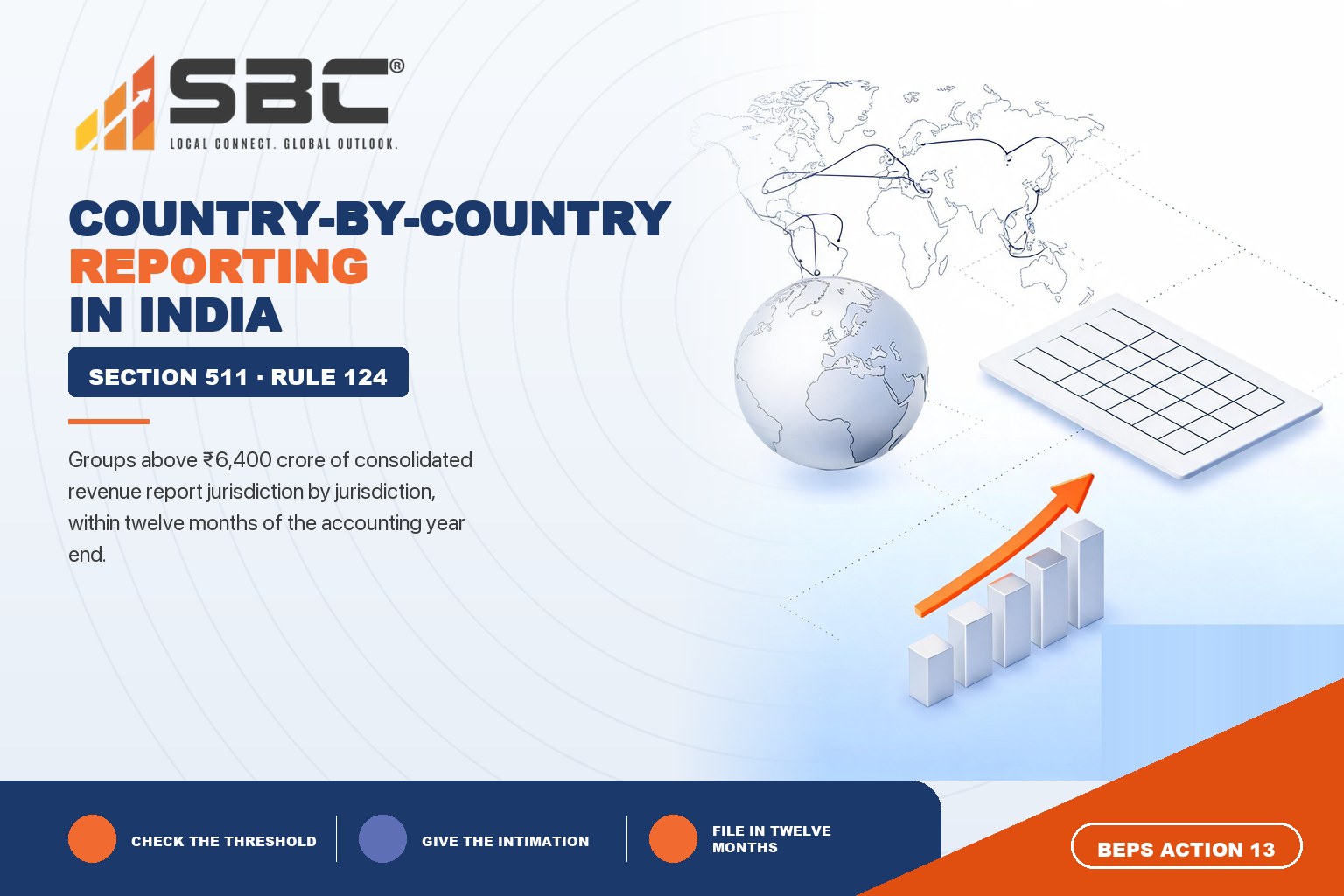
Total consolidated group revenue exceeding ₹6,400 crore. The Central Board of Direct Taxes states that a parent entity resident in India, or an alternate reporting entity resident in India, must furnish the Country-by-Country report where the total consolidated group revenue of the international group exceeds ₹6,400 crore for the relevant accounting period, and no smaller group is drawn in.
How is consolidated group revenue measured?
Revenue is measured at group level, from the consolidated financial statements themselves. The figure taken is the revenue recorded in the accounts the parent company prepares for the accounting year immediately preceding the reporting accounting year. Once the threshold is crossed in any year, such a group reports for the subsequent year and not for the year in which the threshold was crossed. Groups reporting in a foreign currency convert at the prescribed rate.
Does the threshold look at the Indian entity’s turnover?
No. The Indian constituent entity may have revenue of a few crore rupees and still sit inside a group that reports, because the threshold attaches to consolidated group revenue alone. That is why Indian subsidiaries so often become aware of the obligation late, and through an instruction from the group rather than through their own compliance review.
Who is the reporting entity?
The parent entity, unless the group has appointed an alternate. Where the parent entity of the international group is resident in India, that parent furnishes the report to the prescribed authority within twelve months of the end of the reporting accounting year, and every other Indian constituent entity of the same group is relieved of the filing itself while it continues to carry its own separate notification duty.
When does an alternate reporting entity file instead of the parent?
An alternate files whenever the group formally designates it for that purpose. An alternate reporting entity is a constituent entity nominated by the group to submit the report in the jurisdiction of its own residence, in place of the parent, which enables a group based in a jurisdiction with no reporting requirement of its own to fulfil the obligation through one designated filer, instead of making parallel filings in every location in which it operates.
When must an Indian constituent entity file the report locally?
Indian local filing is only required in three specific instances, and in no others. The first arises where the parent entity is not mandated to provide a Country-by-Country report in its own jurisdiction at all. The second occurs where India has no agreement with that jurisdiction providing for the exchange of such a report. The third arises where a systemic failure of that jurisdiction has been intimated to the Indian entity.
Where more than one constituent entity of the same group is resident in India, the group may designate one of them to file on behalf of all. That choice is itself communicated to the prescribed authority under section 511(4). In the absence of such a designation, each Indian entity carries the obligation separately.
Who must give the notification, and when is it due?
Every Indian constituent entity of a foreign-parented group, two months ahead of the report. Section 511(1) requires every constituent entity resident in India, being a constituent of an international group whose parent entity is not resident in India to notify the prescribed authority of the identity and residence of the entity that will furnish the report.
Filing this notification is a standing annual duty that does not depend on whether the Indian entity ever files the report itself. The prescribed notification falls due two months before the due date for furnishing the Country-by-Country report, which places it ten months after the end of the reporting accounting year on an ordinary twelve-month timeline. Missing it is a separate default from missing the report.
| Obligation | Who carries it | Timing |
|---|---|---|
| Notification of the reporting entity | Every Indian constituent entity of a foreign-parented group | Two months before the report is due |
| Country-by-Country report | Indian parent entity, alternate reporting entity, or designated Indian entity | Within twelve months of the end of the reporting accounting year |
| Designation where several Indian entities exist | The group, in favour of one Indian constituent entity | Communicated under section 511(4) |
What does the report disclose for each jurisdiction?
The report contains aggregate financial and economic data, presented jurisdiction by jurisdiction. It is not a transaction-based report, and it names no counterparty. It aims to show a tax administration how the group’s profits, taxes and real economic substance are distributed across the territories in which it operates, and then to let that administration ask why those figures diverge from one another.
| Disclosure field | What the tax administration reads from it |
|---|---|
| Revenue, split between related-party and unrelated-party amounts | Where turnover is booked, and how much of it is intra-group |
| Profit or loss before income tax | Where margin accumulates relative to where revenue arises |
| Income tax paid on a cash basis | Actual cash tax outflow in the jurisdiction for the year |
| Income tax accrued for the current year | Charge recognised in the accounts, against cash actually paid |
| Stated capital and accumulated earnings | Capitalisation of the entities resident there |
| Number of employees | Human substance supporting the profit reported |
| Tangible assets other than cash and cash equivalents | Physical substance supporting the profit reported |
| Constituent entities and their main business activities | Which legal entities sit in the jurisdiction, and what they do |
The most significant risks come from the employee and tangible-asset rows. A jurisdiction that shows high profits, a negligible number of employees and very little in the way of tangible assets is exactly the pattern this template was meant to bring to the surface. An Indian group that cannot explain such a profile from its own functional analysis and inter-company agreements should expect the question to be put during a transfer pricing assessment.
How do tax administrations exchange the report?
Reports are sent automatically under the bilateral and multilateral agreements India has established. A report furnished in one jurisdiction reaches the other jurisdictions in which the group operates without any further filing, provided an exchange relationship is live between the two administrations, and the local filing triggers exist as a fallback for exactly the case where that relationship is absent or has broken down.
As a result, an Indian company may find the Indian tax authority already holding the group’s full jurisdictional profile before any assessment begins. The document the group filed abroad and the position the Indian entity takes in its own documentation are read together. Any inconsistency between them is visible without an enquiry being raised.
What does a CbCR default cost under section 459?
A daily penalty that escalates the longer the failure runs. Section 459 of the Income-tax Act 2025 carries the penalty for failure to furnish the report, or for furnishing an inaccurate report, under section 511. It prescribes ₹5,000 for every day for which the failure continues, rising to ₹15,000 for every day where the default runs on beyond the initial period.
Since the amount accrues daily instead of as a lump sum, the cost of a Country-by-Country default depends on how quickly the group detects it. That is an awkward design for a filing which many Indian subsidiaries simply assume their foreign parent takes care of. A separate exposure attaches where the report is furnished with inaccurate particulars. The wider position on transfer pricing defaults is set out in transfer pricing penalties.
Best transfer pricing firms for Master File and CbCR compliance
Seek a firm that handles the group filing and the Indian benchmarking as one file instead of splitting them into two separate engagements, because the work that matters is reconciling what the group reports jurisdiction by jurisdiction against what the Indian entity claims in its own documentation. Very few disputes arise from the mechanics of the filing itself.
Which firms work in this space, and what should a group ask them?
Global network firms, established domestic practices and specialist transfer pricing boutiques all coexist here side by side, and names such as Deloitte, EY, Grant Thornton, BDO, Nangia and Dhruva appear alongside smaller specialist practices. No firm is best in the abstract. The right questions are narrower than the brochures suggest: whether the firm has reconciled a group report against Indian documentation before, whether it has represented clients before the Transfer Pricing Officer, and which comparable databases it actually licenses.
What does SBC bring to a Master File and CbCR engagement?
Steadfast Business Consulting (SBC) was recognised as a Notable Transfer Pricing Firm 2024 by ITR World Tax, and is a member of PrimeGlobal, which connects it to roughly three hundred firms across more than a hundred countries, working from Hyderabad, Mumbai, Pune and Dubai. SBC provides transfer pricing services in India covering documentation, the accountant’s report described in the note on the move from Form 3CEB to Form 48, Master File and Country-by-Country reporting, and representation through assessment and appeal.
If nobody in your Indian finance team can name the entity responsible for submitting your group report, that is a gap worth closing before the next year end. Ask the SBC transfer pricing team to map your group’s reporting position.
Frequently Asked Questions
Is the Country-by-Country report the same as the Master File?
No. They are separate filings, with separate thresholds and separate content. The Master File contains the group’s business description, its intangible property and its financing arrangements. The Country-by-Country report presents aggregate financial data for every jurisdiction in which the group operates.
Does an Indian subsidiary file the report if its foreign parent already has?
In general, no. Where the parent has filed the report in a jurisdiction that exchanges reports with India, the Indian entity gives only the prescribed notification. Local filing applies where the parent is not obliged to file, where no exchange agreement exists, or where a systemic failure has been intimated.
What is the Country-by-Country reporting threshold in India?
Total consolidated group revenue of the international group exceeding ₹6,400 crore for the accounting year, taken from the group’s consolidated financial statements. The turnover of the Indian entity itself has no relevance to the test.
When is the Country-by-Country report due?
Within twelve months from the end of the reporting accounting year. The notification identifying the reporting entity falls due two months before that date, so both dates have to sit on the Indian compliance calendar rather than only on the group’s.
What is BEPS Action 13, and how does it relate to section 511?
BEPS Action 13 is the OECD standard that introduced three-tiered transfer pricing documentation. India implemented its third tier through section 286 of the Income-tax Act 1961, now section 511 of the Income-tax Act 2025 read with Rule 124 of the Income-tax Rules 2026.
Does filing the report settle the group’s transfer pricing position?
No. The report is a risk assessment tool for tax administrations, and it does not determine an arm’s length price. A Transfer Pricing Officer still has the authority to examine the benchmarking analysis of the Indian entity and propose an adjustment.