
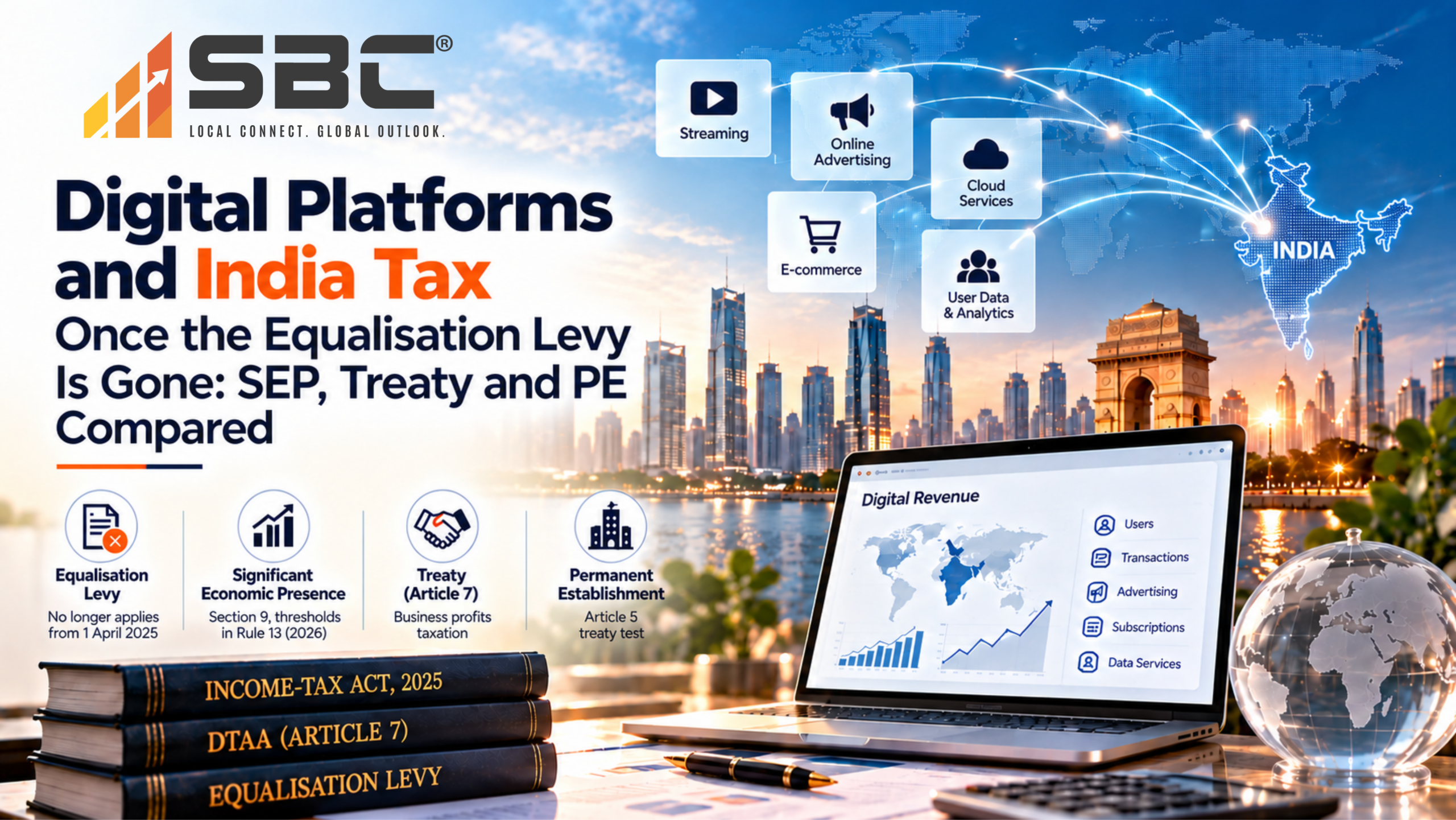
Digital Platforms and India Tax Once the Equalisation Levy Is Gone: SEP, Treaty and PE Compared
By CA Mithilesh Reddy, Founder and CEO, and CA Rajesh Vaishnav, Partner, Steadfast Business Consulting LLP | Direct Tax Advisory
Quick answer
The equalisation levy has not applied to consideration received or receivable on or after 1 April 2025. Significant economic presence (SEP) stays part of business connection under section 9 of the Income-tax Act, 2025, with thresholds in rule 13 of the 2026 Rules. Treaty Article 7 and the PE definition apply separately; domestic SEP does not rewrite treaty PE.
Key takeaways
- The equalisation levy has not applied to consideration received or receivable on or after 1 April 2025 (the 2 per cent e-commerce levy ceased from 1 August 2024), but income-tax rules on business connection, royalty, fees for technical services and permanent establishment continue to apply.
- Under the Income-tax Act, 2025, significant economic presence is part of business connection in section 9, with thresholds of Rs 2 crore of payments or 3 lakh users prescribed in rule 13 of the Income-tax Rules, 2026 (formerly rule 11UD).
- Only income reasonably attributable to the transactions or activities that create the nexus is deemed to accrue in India; worldwide advertising revenue is not the default measure.
- Domestic SEP does not rewrite a treaty: a treaty-eligible enterprise is taxable on business profits only to the extent attributable to a treaty permanent establishment, and treaty entitlement must be documented.
- Each revenue stream (advertising, licences, hosting, data, hardware) should be characterised by the rights granted and services performed, and the direct tax, GST and transfer pricing positions should assert the same facts.
Practice illustration: Cross-border digital revenue and Indian nexus
Issue. A multinational group sought advice on whether income from digital services connected with the Indian market created Indian tax exposure.
Approach. The review separately considered domestic business-connection provisions, significant economic presence, treaty permanent establishment, income characterisation and local transfer pricing.
Outcome. A digital-tax operating and compliance framework was implemented on the documented facts. That advisory conclusion was not a binding ruling of non-taxability.
Practical lesson. A domestic nexus analysis does not dispense with the separate treaty test.
This illustration is deliberately generalised and must not be used to identify a taxpayer or matter.
Introduction
The withdrawal of India’s equalisation levy is not the same as withdrawal of India’s interest in taxing offshore digital business. It removes a separate levy; it does not repeal the income-tax rules that deal with business connection, royalty, fees for technical services or permanent establishment.
This distinction matters for platform operators, connected television businesses, advertising networks and software suppliers. The customer may be in India, the contract signed abroad, the infrastructure hosted elsewhere and the monetisation split among advertising, licensing, data and services. A single description such as “digital revenue” conceals several different tax questions.
The right starting point is to map the payment and the legal capacity in which it is earned. This article explains how significant economic presence should be assessed after the equalisation levy sunset, and why treaty access often changes the resulting answer.
1. Two levies with different legal foundations
The equalisation levy was a specific charge on defined digital transactions under the Finance Act 2016 regime. India first excluded e-commerce supplies from 1 August 2024 and later withdrew the residual online-advertising levy from 1 April 2025. The Income-tax Department overview reflects the withdrawal.
Significant economic presence is part of the Income-tax Act business-connection framework. It can establish a domestic nexus for a non-resident even without a conventional physical office. The policy may be related, but the tests are not interchangeable. Tax practitioners should not continue treating a platform transaction as automatically subject to an abolished levy.
2. Identify the transaction before measuring nexus
A platform may sell advertising inventory, licence software, provide analytics, arrange third-party services or sell hardware. Each receipt should be described by its contractual rights and obligations. The customer agreement, invoicing chain, allocation of advertising revenue and ownership of the content or technology are fundamental.
For example, a contract granting an Indian customer restricted access to a cloud platform may raise a different characterisation from one transferring commercially exploitable copyright rights. Whether a payment is royalty or business profits cannot be decided by the label “subscription” alone.
3. SEP thresholds and attribution are separate steps
Explanation 2A to section 9(1)(i) of the 1961 Act (now section 9(9)(d) of the Income-tax Act, 2025, with the thresholds in rule 13 of the Income-tax Rules, 2026, formerly rule 11UD) established an SEP test using prescribed payment or user-interaction thresholds. That domestic rule also contemplates attribution only of income connected with the relevant transactions or activities. For current periods, check the relevant statutory provision and operative rules rather than borrowing threshold figures from earlier guidance.
A system collecting India-associated users or payments is not sufficient on its own for a tax computation. The enterprise must determine whether the statutory test applies, what income is connected with the nexus, and how the governing rules treat attribution. Global profit or worldwide advertising revenue is not the default attributable amount.
4. A treaty can change the result
Under many treaties, Article 7 permits source-state taxation of business profits only where a qualifying permanent establishment exists and only to the extent attributable to it. The result requires treaty residency, beneficial entitlement where relevant, the operative treaty text and the facts relating to presence, personnel, agents and infrastructure.
Domestic business connection and treaty PE are related but distinct concepts. A platform can have a domestic SEP analysis requiring reporting even where treaty protection ultimately limits Indian taxation. Equally, a treaty claim should never be assumed where the claimant is not entitled to its benefits or a specific anti-abuse rule applies.
5. Do not overlook service and royalty classification
An advertising or streaming ecosystem may involve software licences, database access, campaign management, creative services, hosting and equipment. Those components may fall under different domestic charging provisions or treaty articles. The contract bundle should be analysed by service and right, with careful attention to who owns the intellectual property and what the recipient may do with it.
A royalty claim should identify the particular right or equipment said to be used, not merely cite the use of technology somewhere in the supply chain. A fees-for-technical-services claim similarly requires the treaty-specific definition and any “make available” requirement.
6. Permanent establishment in a digital operating model
Potential PE questions include who habitually concludes contracts, where decisions are made, whether dedicated infrastructure is at the enterprise’s disposal, and whether a local group company acts independently or on behalf of the foreign principal. Legal separation between entities is relevant but not conclusive.
A local advertising sales team that performs routine marketing is not necessarily the same as one authorised to bind the overseas enterprise. Conversely, a group should not dismiss PE exposure because standard customer terms are accepted through an offshore digital interface. Authority and actual conduct matter.
7. Withholding is a transaction-by-transaction decision
An Indian payer should distinguish payments potentially chargeable to tax under domestic law from those entitled to treaty relief. Before applying withholding, verify the payee, residence documentation, agreements, invoices, scope, PE declarations where relevant and applicable statutory procedures.
Where an agreement contains several revenue streams, a single withholding conclusion for all payments can be indefensible. The file should state which component was reviewed, why a specific treaty article applies and what evidence supports the beneficial-owner and PE assumptions.
8. An operating model that survives review
A defensible digital-tax memorandum maps contractual counterparties, customer location, rights granted, service delivery, software architecture, local functions, user or payment data, invoicing and funds flow. Reconcile the map with indirect tax and transfer pricing positions so the group does not advance inconsistent facts in different filings.
Keep separate a statutory conclusion, a modelling assumption and a commercial forecast. If expected payment volumes may cross the prescribed SEP threshold, record the trigger for a fresh review rather than relying indefinitely on an initial conclusion.
What are the SEP thresholds under the Income-tax Act, 2025?
Significant economic presence is now part of the business-connection rule in section 9 of the Income-tax Act, 2025, with the two thresholds prescribed in rule 13 of the Income-tax Rules, 2026, which carries forward former rule 11UD. Rule 13 prescribes aggregate payments of Rs 2 crore in the tax year from transactions in goods, services or property with any person in India, including downloads of data or software, and 3 lakh users with whom the non-resident systematically and continuously solicits business or who interact with it. The official rule page cites section 9(9)(d)(i) and (ii) for the two limbs, and meeting either is enough to create the nexus.
Attribution is a separate step. Only income reasonably attributable to the transactions or activities that create the nexus is deemed to accrue or arise in India, and transactions confined to the purchase of goods in India for export are excluded. The export-purchase exclusion was added to Explanation 2A of the 1961 Act with effect from 1 April 2026.
How did the equalisation levy end, and which periods remain open?
The 2 per cent levy on e-commerce supply or services stopped applying to consideration received or receivable on or after 1 August 2024, under an amendment made by the Finance (No.2) Act 2024. Section 146 of the Finance Act 2025 then amended sections 163 and 165 of the Finance Act 2016 so that the 6 per cent levy on specified services, mainly online advertisement, does not apply to consideration received or receivable on or after 1 April 2025. The Income-tax Department’s equalisation levy page records that the provisions are not applicable with effect from 1 April 2025.
These are prospective cut-offs, not a retrospective repeal, so assessments, appeals and refund claims for earlier consideration continue under the provisions as they stood. For income received on or after 1 April 2025, commentary reports that the section 10(50) exemption, which protected income already subject to the levy, no longer applies from assessment year 2026-27. The ordinary charging provisions and any treaty therefore become the operative analysis for those receipts.
A decision sequence for a foreign platform with Indian users or customers
First, list each revenue stream and the contract under which it arises, such as advertising inventory, software or content licences, hosting, data and hardware. Second, identify who pays: an Indian customer or group company triggers a withholding question under section 393(2) of the 2025 Act, while a non-Indian payer may not. Third, test the domestic charge: business connection including SEP, royalty and fees for technical services.
Fourth, test treaty entitlement: tax residency certificate, Form 41 (formerly Form 10F), beneficial ownership and any limitation of benefits or principal purpose test. Fifth, if the treaty applies, test permanent establishment on the facts: a fixed place, equipment or servers at the enterprise’s disposal, a dependent agent, and the functions of any local group company. Sixth, attribute profit: only profits attributable to a permanent establishment under Article 7 where a treaty applies, or income attributable to the SEP nexus under domestic law where it does not. Seventh, record the conclusion and the trigger for a fresh review, such as payments or user numbers approaching the rule 13 thresholds.
Common mistakes in digital-tax files after the levy
The first is treating the end of the levy as the end of exposure. The second is quoting SEP thresholds from earlier years or from commentary instead of rule 13. The third is assuming that SEP creates a treaty permanent establishment, which it does not unless the treaty itself provides so. The fourth is calling every digital receipt royalty because of the words ‘platform’ or ‘subscription’, when the Supreme Court in Engineering Analysis Centre of Excellence Pvt. Ltd. v. CIT looked at the rights actually granted in the software.
The fifth is treating the Indian subsidiary’s local activity as irrelevant because customer contracts are accepted through an offshore interface. The sixth is preparing the direct tax conclusion, the GST analysis and the transfer pricing file separately, so that each asserts a different set of facts.
Conclusion
The digital tax question after the equalisation levy is not whether India has ceased taxing offshore platforms. It is which statute and treaty article now governs each identifiable revenue stream.
Commercial reality, contract architecture and evidence of local activities will decide more than broad descriptions of online business. The strongest analysis is built around the transaction, not the business label.
Frequently asked questions
1. Does the equalisation levy still apply in October 2026?
No. The Income-tax Department states that its provisions are not applicable from 1 April 2025.
2. Does SEP automatically create a treaty PE?
No. Treaty PE is determined under the treaty, subject to its application and anti-abuse provisions.
3. Must every digital receipt be characterised as royalty?
No. The rights granted and services performed must be reviewed separately.
4. Can an Indian subsidiary create PE risk for a foreign platform?
It can on particular facts, but common ownership alone is not sufficient.
5. Can historic equalisation-levy periods be ignored?
No. Prior periods may remain relevant for compliance or disputes under the law then applicable.
6. What are the significant economic presence thresholds in India for 2026?
Rule 13 of the Income-tax Rules, 2026 prescribes aggregate payments of Rs 2 crore in the tax year from transactions with persons in India, or 3 lakh users with whom business is systematically solicited or who interact with the non-resident. The rule carries forward former rule 11UD and is linked to section 9(9)(d) of the Income-tax Act, 2025.
7. Is the equalisation levy abolished in India?
It no longer applies to new consideration. The 2 per cent e-commerce levy stopped applying from 1 August 2024, and the 6 per cent levy on specified services such as online advertisement from 1 April 2025. Earlier periods remain subject to the provisions as they stood, so assessments and disputes for those periods can continue.
8. Does significant economic presence create a permanent establishment under a tax treaty?
No. Significant economic presence is a domestic-law limb of business connection under section 9. A treaty permanent establishment is determined by the treaty’s own Article 5, and Article 7 limits India’s right to tax business profits to those attributable to a permanent establishment. A treaty-eligible enterprise therefore needs both analyses, and entitlement to treaty benefit must be documented.
Talk to SBC’s tax team
If your platform has Indian users or customers and the direct tax, GST and transfer pricing analyses have not been reconciled, SBC’s team can discuss how the revenue streams and treaty position are mapped. Explore our Income Tax services | Contact SBC
Related reading from SBC
- Smart TVs, Digital Advertising and Cross-Border GST: Separate the Hardware from the Platform
- Defending the Residual Profit Split Method in India When the TPO Proposes TNMM for an Intangible-Owning Entity
- Attributing Profits to an Indian Project Office: Which Head Office Expenses Count?
- Shared Services from Singapore: Applying the ‘Make Available’ Test to Indian Withholding
- More articles on the SBC blog
About the author
CA Mithilesh Reddy, Founder and CEO, Steadfast Business Consulting LLP, led the team that handled this engagement.
CA Rajesh Vaishnav is a Partner at Steadfast Business Consulting LLP. SBC provides direct and indirect tax, international tax and transfer pricing advisory and dispute support.
Disclaimer
This article is general professional commentary and not advice on any particular facts. Treaty eligibility, applicable law, procedural requirements and statutory amendments must be verified for the relevant tax period. It is not a description of an identifiable client engagement.