CategoriesTransfer Pricing

Should an Indian Subsidiary Use the Parent’s Global Transfer Pricing Adviser?

Written by Jayasri P · Last updated 29 August 2026 · Statutory references current to the Income-tax Act 2025 and the Income-tax Rules 2026.

Quick Answer: Only if the Indian subsidiary also appoints a local adviser, because the parent’s global adviser cannot sign the Indian report. The accountant’s report in Form 48 must be signed in India, and local documentation under Section 171 and Rule 84 must be built to Indian requirements. Most groups run both advisers together, using the global firm for group policy.

Looking for a transfer pricing consultant for an overseas parent company?

Appoint the parent’s global adviser for group policy and the Master File, and appoint an Indian firm for the statutory filing, the Local File and any assessment. That split is not a preference: the Indian obligations under the Income-tax Act 2025 attach to the Indian entity and are discharged in India.

The question usually arrives in a settled form. Group tax has a long relationship with a global network firm, that firm already services fifteen or twenty jurisdictions, and the Indian subsidiary is told to use it as well. What the instruction does not do is answer the four questions an Indian finance head has to answer to the Transfer Pricing Officer.

Who signs the accountant’s report for the Indian entity?

An accountant signs Form 48 in India, and the signature is a personal statutory act, not a firm-level output. Section 172 of the Income-tax Act 2025, read with Rule 85 of the Income-tax Rules 2026, requires every person who has entered into an international transaction to obtain a report from an accountant and furnish it by the due date. The Central Board of Direct Taxes has published guidance on Form 48, which replaced Form 3CEB.

A report produced outside India, however thorough, is not the accountant’s report for the purposes of Section 172, and someone in India still has to review the transactions, form an independent view on the method and the arm’s length price, and put a name to that view. We have set out the eligibility position in full in a separate article on who may certify the Indian accountant’s report.

When do groups discover this?

Usually in October.

The global adviser delivers a benchmarking study in September, an Indian firm is engaged three weeks before the due date, and that firm is then asked to certify work it did not perform and cannot fully see. Certification under time pressure on someone else’s analysis is where avoidable exposure enters an Indian file.

What does the Indian statute require that a global report does not cover?

Indian documentation is a defined list, not a general standard of reasonableness. Section 171 read with Rule 84 sets out the entity-level record that has to exist by the filing date, and the official navigator maps each new rule against the 1962 rule it replaces, with Rule 84 replacing Rule 10D.

A group transfer pricing report is usually built to a different specification. It documents the policy, the value chain and the group’s method selection. It does not necessarily contain the ownership structure of the Indian entity, the transaction-by-transaction functional analysis in Indian terms, the comparable set drawn from an Indian database, or the year-specific economic adjustments a Transfer Pricing Officer expects to see evidenced rather than asserted. Our note on what Indian transfer pricing documentation contains sets out the components.

Which Indian filings sit outside the global adviser’s usual scope?

Several of these are assumed to be covered when they are not.

Obligation Provision Who normally prepares it
Local documentation Section 171 with Rule 84 Indian adviser, entity level
Accountant’s report, Form 48 Section 172 with Rule 85 Indian accountant, signed in India
Master File Rule 123 Group adviser, Indian filing by the entity
Country-by-Country report Section 511 with Rule 124 Parent, with Indian notification
Advance pricing agreement Section 168 Joint, Indian filing and negotiation

The Master File and the country-by-country report are genuinely group deliverables, and the parent’s adviser is the right party to build them. The Local File and Form 48 are not.

Where does Indian practice diverge most from group method?

Comparable selection is the sharpest divergence. Indian benchmarking practice draws on Indian databases, applies turnover, related-party and persistent-loss filters that Indian appellate authorities have accepted or rejected over roughly two decades, and must defend the resulting set against a Transfer Pricing Officer running its own search. A global set built on regional data usually satisfies a group audit committee. It usually does not survive a reference under Section 166.

Does the parent’s adviser follow Indian rule changes closely enough?

Assume nothing here, and test it. India moved to the Income-tax Act 2025 and the Income-tax Rules 2026, renumbering the transfer pricing chapter and replacing Form 3CEB with Form 48. An adviser who serves India as one of many jurisdictions may still be working from the Section 92 series and the 1962 rule numbers.

Which mechanics does a group-level review miss?

Three carry consequences a group-level review does not reach. Secondary adjustment under Section 170 bites once a primary adjustment reaches ₹1 crore. It converts the excess into a deemed advance and runs interest until the money is repatriated, transforming the pricing issue into a treasury concern for the parent company. Penalty under Section 442 is computed at 2% of the value of the transaction for documentation and reporting defaults, so the exposure scales with the size of the related-party flow rather than sitting at a fixed sum. A reference under Section 166 then starts a separate process with its own timelines.

A group preparing an uncertain tax position must evaluate the Indian position on Indian facts, which we set out in our article on the FIN 48 exposure of an Indian subsidiary.

Whose interest does the adviser serve when the parent appoints and pays?

The adviser serves the party that engages it, and in a group mandate that party is the parent.

Transfer pricing allocates profit between two related parties. When the Indian entity is a captive service provider and group policy sets its cost-plus mark-up, two additional percentage points raise Indian taxable profit and reduce taxable profit in the parent’s jurisdiction by nearly the same amount, which is why the number is set at group level. An adviser reporting to group tax is asked to optimise the group position, while the Indian directors must be able to defend the Indian position as at arm’s length under Section 165. Those are not the same instruction.

Who carries the consequence if the Indian position fails?

The Indian entity does, and its officers do.

A penalty under Section 442 or Section 457 is levied on the Indian assessee, an adjustment raises Indian tax, Indian interest and an Indian appellate cost, and the parent’s adviser bears none of it under an engagement letter very likely signed in another country.

What does an independent Indian view actually change?

An independent Indian view changes what gets challenged before filing rather than after. An adviser reporting to the Indian board will say plainly when a group mark-up sits below the range Indian comparables support, when a service charge lacks the evidence of benefit an officer will demand, and when a policy that worked in twelve jurisdictions will draw an adjustment in this one.

How should the cost of the parent’s global transfer pricing adviser be recharged?

The recharge is an international transaction itself and must be charged at arm’s length. Where a parent engages a global adviser and recharges part of the fee to the Indian subsidiary, that charge falls under Section 163 as a service transaction between associated enterprises under Section 162, and is subject to the provisions under Section 165.

This creates a circularity worth naming. The fee for transfer pricing advice is itself a related-party charge that must be defended on transfer pricing principles, and a Transfer Pricing Officer who is unconvinced by an intra-group service charge does not make an exception for the professional fees.

What has to be demonstrable for the recharge to hold?

Four things, the same four that apply to any intra-group service charge.

Test What the Indian entity must be able to show
Benefit The Indian entity received an identifiable service, not a shareholder activity, a distinction drawn in the OECD Guidelines rather than a numbered Indian provision
Need The service was required and was not duplicated locally
Allocation The key used is rational and consistently applied across entities
Mark-up Any mark-up on cost is supported, or the charge is at cost with reason stated

Shareholder activity is the trap. Work performed because the parent must satisfy its own group reporting, audit committee or home-country disclosure obligations is a cost of being a shareholder, and is not chargeable to the subsidiary at all, whatever allocation key is applied. A global report prepared principally for consolidated purposes sits close to that line, so the allocation basis has to be documented at the time rather than reconstructed later.

A charge recovering group overhead through the transfer pricing fee is a different transaction from a pass-through of the invoice of an external adviser, and the two must be identified separately in the intercompany agreement, because only the second is straightforwardly supported by a third-party invoice.

What governance model works for a subsidiary with a foreign parent?

A two-tier model works, and most well-run Indian subsidiaries of foreign groups arrive at it. The parent’s adviser owns group policy, the Master File and consistency of method, while an Indian firm owns the Local File, the Form 48 certification, the benchmarking search on Indian data and any proceedings before the Transfer Pricing Officer.

The two-tier model costs more than a single mandate, and less than an adjustment. It also survives a change of adviser at group level, because the Indian record stays in India with the firm that built it.

Steadfast Business Consulting (SBC) works in this position for Indian subsidiaries of overseas groups, alongside the group’s existing adviser rather than in place of it. SBC was named a Notable Transfer Pricing Firm 2024 by ITR World Tax, and the practice covers transfer pricing documentation, benchmarking and representation from Hyderabad, Mumbai, Pune and Dubai, including representation through the dispute stages.

What should the parent’s tax director settle before issuing the engagement letter?

Six points, settled in writing, remove most of the friction that appears later.

  • Who signs Form 48, and whether that person has seen the underlying analysis
  • Whether the Local File will be prepared contemporaneously or reconstructed after year end
  • Which database the Indian comparable search will use
  • Who instructs the adviser if the Indian and group positions differ
  • How the global adviser’s fee is allocated to India, and on what basis
  • Who appears before the Transfer Pricing Officer, and under whose engagement

None is a difficult question, and each becomes difficult once the year has closed.

If you are weighing this decision now, speak to our transfer pricing team about the split of responsibilities before the engagement letters are issued.

Frequently Asked Questions

Can the parent’s global adviser prepare the Indian Local File?

It can prepare the analysis, but the file must meet Section 171 and Rule 84 in Indian terms, including an Indian comparable search. Most groups have the Indian adviser build or review the Local File so the person certifying Form 48 has seen the work.

Who is allowed to sign Form 48 for an Indian subsidiary?

An accountant, signing in India. Certification is a personal statutory act under Section 172 and Rule 85, not a firm-level deliverable issued from another jurisdiction. Our separate article on the accountant’s report sets out eligibility in detail.

Is the fee charged by the parent’s adviser deductible in India?

It is deductible where the charge is a genuine intra-group service at an arm’s length price under Section 165, with benefit, need and a rational allocation key demonstrable. A charge reflecting shareholder activity for the parent’s own reporting is not chargeable at all.

Does using two advisers create inconsistency in the group position?

Not if policy sits with the group adviser and the Indian firm applies it to Indian facts. Inconsistency results from an unexamined single mandate more often than from a two-tier one, since the group method is never compared with Indian comparables until an officer does so.

What happens if the Indian and group transfer pricing views differ?

The Indian entity must file the position it can defend under Section 165, because the penalty under Section 442 and any adjustment fall on the Indian assessee. Escalate and resolve the difference before filing, which is why the instructing party must be agreed in the engagement letter.

Is an advance pricing agreement an alternative to this arrangement?

An advance pricing agreement under Section 168 fixes the method for future years and reduces dispute risk, but it removes neither the annual local documentation nor the Form 48 obligation. Pursue it jointly, with the group adviser on policy and an Indian firm on the negotiation.

CategoriesTransfer Pricing

Per-Filing Engagement or an Annual Transfer Pricing Retainer?

Written by Jayasri P · Last updated 29 August 2026 · Statutory references current to the Income-tax Act 2025 and the Income-tax Rules 2026.

Quick Answer: A per-filing engagement buys the annual compliance file and the accountant’s report in Form 48. A transfer pricing retainer buys continuous access across the whole year, including price setting and monitoring, while a project mandate buys one defined outcome such as an Advance Pricing Agreement. Scope, not price, separates the three.

What do transfer pricing advisory services in India actually cover?

Transfer pricing advisory services in India cover three distinct bodies of work, and most buyers purchase only one of them without realising the other two exist as separate commitments. Annual compliance is bounded by a filing date, a year-round retainer by a period rather than a deliverable, and a project mandate by an outcome.

Which statutory obligations sit underneath every model?

Four obligations sit underneath all three models, and the model you choose changes who performs them rather than whether they arise. Section 171 of the Income-tax Act 2025, read with Rule 84 of the Income-tax Rules 2026, requires the Local File; section 172 read with Rule 85 requires the accountant’s report, now furnished in Form 48 in place of the erstwhile Form 3CEB. Rule 123 governs the Master File, and section 511 read with Rule 124 governs the Country-by-Country report.

The numbering changed with effect from the tax year 2026-27, and the Central Board of Direct Taxes has published a mapping of every rule in the Income-tax Rules 2026 against its predecessor in the 1962 Rules, which is where Rule 10D becomes Rule 84 and Rule 10E becomes Rule 85. A proposal still citing the 1962 numbering is describing an obligation that has moved.

What is in scope under each engagement model?

Scope is the only reliable way to compare two proposals, because the same activity appears under different headings in different documents.

Activity or obligation Per-filing engagement Year-round retainer Project mandate
Local File under section 171 and Rule 84 Included Included Included if the project requires it
Accountant’s report in Form 48 under section 172 Included Included Scoped separately
Master File under Rule 123 and Country-by-Country report under section 511 Included at the threshold Included at the threshold Scoped separately
Benchmarking study for the year Included Included Included if the project requires it
Interim benchmarking refresh during the year Quoted separately Included Included within the project scope
Price setting for a new intercompany transaction Quoted separately Included Included where it is the project
Drafting and review of intercompany agreements Quoted separately Included Included where it is the project
Monitoring of actual margins against the tested margin Quoted separately Included Quoted separately
Response to a reference to the Transfer Pricing Officer under section 166 Quoted separately Ordinarily a separate mandate This is the project
Advance Pricing Agreement under section 168, or a safe harbour election Quoted separately Advisory included, filing separate This is the project

No cell above means a provider cannot perform the activity. The difference is whether the work is already paid for when the need arises, or whether it triggers a fresh scoping conversation at the least opportune moment.

What does a per-filing engagement include?

A per-filing engagement is an annual compliance engagement, and its boundary is the accountant’s report. It ordinarily covers the functional analysis, the benchmarking study for the year, the Local File built to the thirteen prescribed heads, and the certification in Form 48.

The engagement is staffed against a filing calendar rather than against your business. That is a genuine strength where related-party transactions are stable and already priced under an agreed policy, because the work really is the same every year. Continuous availability would buy nothing, and our article on what transfer pricing documentation must include sets out the deliverable itself.

What does a year-round transfer pricing retainer include?

A year-round transfer pricing retainer includes everything in the per-filing engagement plus continuous access during the year. That access covers price setting before a new intercompany arrangement goes live, review of agreements before they are signed, periodic comparison of actual margins against the tested margin, and a view on whether a safe harbour election is worth pursuing.

Timing is the distinguishing feature, because a retainer reaches the analysis while the price is still changeable, whereas a per-filing engagement can only document a price already charged. Where a group restructures, adds an entity or begins financial transactions with an associated enterprise, the difference is measured in adjustment risk rather than in fees.

What does a project mandate include?

A project mandate includes one defined outcome and the work required to reach it. Typical mandates are an Advance Pricing Agreement under section 168, representation in an assessment, a Mutual Agreement Procedure, or a policy design exercise for a newly formed group.

A group on a per-filing engagement that receives an unfavourable order will ordinarily appoint a separate mandate for representation through the stages of a transfer pricing dispute, while the engagement for the annual compliance will still be carried out concurrently.

What falls outside each model?

Exclusions are where unbudgeted work appears, so read every proposal for its boundary.

What sits outside a per-filing engagement?

Everything that happens between filings sits outside it. That includes a transaction entered into after the file was closed, an interim refresh of comparables, a review of a new intercompany agreement, and correspondence with the department once the year is picked up for examination.

The consequences of the file are excluded too. A secondary adjustment under section 170 arises where a primary adjustment of ₹1 crore or more is not repatriated within the prescribed period. Tracking that repatriation runs across months, by which time the filing engagement has closed.

What sits outside a retainer?

Contentious work ordinarily sits outside a retainer, and this is the most common misunderstanding in the model. A retainer covers advice and monitoring, and it does not usually extend to preparing submissions, appearing before the Transfer Pricing Officer or the Dispute Resolution Panel, or running an appeal, because those consume time in volumes no availability fee can absorb.

Applications sit outside as well, and an Advance Pricing Agreement is the clearest instance, since it runs across several years through pre-filing, application, negotiation and annual compliance reporting, so whether to apply is retainer work while the application itself is a mandate.

What sits outside a project mandate?

A project mandate covers only what its scope names, and everything outside that list falls away. A mandate to obtain an Advance Pricing Agreement does not carry the Local File for the current year, and a mandate to defend one assessment year does not carry the next, which is why groups running a dispute alongside ordinary compliance hold two engagements at once.

What happens when an assessment notice arrives mid-year?

A notice arrives without regard to your engagement calendar, and this is where the three models separate in practice. Once the Assessing Officer refers the international transactions to the Transfer Pricing Officer under section 166, the file you already hold becomes the entire basis of your defence, and no model can retrospectively improve it.

How does each model absorb the work?

A per-filing engagement absorbs none of it. The provider holds the file and is usually willing to act, but quotes for the response as fresh work, which means a scoping conversation and a fee approval while a statutory clock is already running, whereas a retainer absorbs the diagnostic stage and then hands the submissions on to a separately scoped mandate. A project mandate is the response itself.

Our guidance on how to respond to a transfer pricing show-cause notice sets out the sequence, which always begins with retrieving a file that is already complete.

How does each model handle the benchmarking refresh?

A per-filing engagement refreshes comparables once, when the Rule 84 file is built, using the most recent data available on that date, whereas a retainer refreshes when the business changes rather than when the calendar turns, which matters where margins have drifted or a comparable set has been disturbed by an acquisition.

When does a refresh become a fresh study?

The trigger is functional, not numerical. Updating financial data for the same accepted comparables is a refresh, whereas a change in the risks borne, the assets employed or the functions performed makes the earlier set inappropriate under section 165 and forces the search to be run again from the screening stage.

Groups on a per-filing engagement often discover this in the eleventh month, because nobody was watching the functional profile. A transfer pricing health check establishes which of the two situations you are in before the filing window opens.

How is intercompany monitoring handled across the year?

Monitoring is the activity most often assumed and least often purchased. It means comparing the entity’s actual operating margin against the margin the policy targets, at intervals short enough that a correction is still possible, and it belongs to a retainer because it has no deliverable of its own.

When does monitoring stop being useful?

A per-filing engagement runs the same comparison once, after the year has closed, when the only remaining option is a year-end adjustment the Transfer Pricing Officer may examine under section 166, so groups filing to a published transfer pricing due date calendar without an interim checkpoint learn the outcome too late.

Which engagement model should you choose?

Choose on the volatility of your related-party transactions, not on the size of your group. Where transactions are stable, documented under an existing policy and unchanged from the prior year, a per-filing engagement is proportionate.

Where the group is restructuring, adding entities or carrying a history of adjustments, a retainer reaches the price while the price can still be set. A project mandate is chosen on top of either, never instead of them.

What actually drives cost across the three models?

Cost is driven by the number of international transactions, the number of distinct functional profiles requiring separate benchmarking, whether the Master File and Country-by-Country obligations are triggered, the databases the analysis requires, and the volume of prior-year positions that must be defended rather than merely documented. None of those variables is a function of the model you select.

Penalty exposure is absent from that list deliberately, because failure to keep and maintain the prescribed documentation attracts a penalty of two per cent of the value of the transaction under section 442, while failure to furnish information called for under section 171 attracts a penalty under section 457. Those consequences fall on the taxpayer in every model.

Where does Steadfast Business Consulting fit?

Steadfast Business Consulting (SBC) publishes its transfer pricing scope in seven blocks, among them compliances, advisory, litigation support and representation, alternate dispute resolution routes covering advance pricing agreements, mutual agreement procedure and safe harbour, and BEPS advisory — and each of the three models above is assembled from those blocks rather than a fixed package. SBC was named a Notable Transfer Pricing Firm 2024 by ITR World Tax. The practice is built by Big 4 alumni working from Hyderabad, Mumbai, Pune and Dubai.

Which model does SBC scope for a first-time filer?

Our transfer pricing practice page sets out the published scope, and a short scoping conversation will establish which shape your related-party profile needs.

Frequently Asked Questions

Is a transfer pricing retainer worth it for a single-entity subsidiary?

Only where the transactions change. A subsidiary charging one cost-plus service fee under a stable agreement is well served by a per-filing engagement. The same subsidiary adding a royalty or an intercompany loan has moved into retainer territory, because those prices need setting before they are charged.

Can I move from a per-filing engagement to a retainer mid-year?

Yes. The typical entry point is a health check that determines your current position before the retainer begins. Moving mid-year is cheaper than moving after a notice because early opportunities to change price are available.

Does a retainer cover representation before the Transfer Pricing Officer?

Ordinarily it does not. Most retainers cover advice, monitoring and the initial assessment of a notice, while submissions and appearances are scoped separately. Confirm this in writing before signing. It is the most common gap between what a buyer assumes and what the letter says.

Which model covers the Master File and Country-by-Country report?

All three can, and all three require thresholds to be checked separately. Rule 123 governs the Master File and section 511 read with Rule 124 governs the Country-by-Country report. Confirm whether your engagement includes them, because one scoped to the Local File alone will not.

Does the engagement model change the penalty position?

No. Sections 442 and 457 place the documentation and information penalties on the taxpayer, whatever engagement shape is agreed. Scope clarity therefore matters more than the label on a proposal.

CategoriesTransfer Pricing

What Drives the Cost of a Transfer Pricing Engagement in India?

Written by Jayasri P · Last updated 29 August 2026 · Statutory references current to the Income-tax Act 2025 and the Income-tax Rules 2026.

Quick Answer: The cost of a transfer pricing engagement follows scope rather than company size. Seven variables move it: entities in scope, tested transactions, benchmarking freshness, jurisdictions, whether a Master File or Country-by-Country report applies, dispute history, and record quality. A single-entity file with rolled-forward benchmarking sits at one end; a multi-jurisdiction group with an open dispute at the other.

Finance heads asking what a transfer pricing engagement costs usually want something narrower: why one quote arrives at several times another for the same compliance obligation. The answer is scope. Two groups with identical turnover can need engagements of very different size, because the statutory work is driven by the number and character of related-party transactions rather than by revenue, and because the seven drivers below multiply the work rather than adding to it.

What actually determines the size of a transfer pricing engagement?

Scope determines it. Section 163 of the Income-tax Act 2025 sets out what counts as an international transaction and Section 162 defines which enterprises are associated for that purpose, and every hour an adviser subsequently spends flows from where those two definitions place your group.

Why is turnover a poor proxy?

Turnover is a poor proxy. A manufacturer with large revenue but a single import from its parent has a narrow file under Section 163, whereas a smaller services company that pays a technology charge, receives a cost-plus reimbursement, holds an intra-group loan and licenses a trademark carries four transaction categories, four method decisions and, in most years, more than one benchmarking search.

Do domestic transactions widen it?

Specified domestic transactions widen the picture further. Under Section 164 they enter the framework only where the aggregate value of such transactions exceeds ₹20 crore in the tax year, and that threshold applies to the transactions rather than to turnover.

How does the number of entities in scope change the engagement fee?

Entity count is close to a direct multiplier on the professional fee, because each Indian entity with international transactions carries its own compliance obligation. The report from an accountant under Section 172 is furnished entity by entity, in Form 48, which replaced the erstwhile Form 3CEB. Documentation under Section 171, read with Rule 84 of the Income-tax Rules 2026, is likewise entity-level.

Groups often find during scoping that fewer entities are in scope than assumed, because a holding company with no associated-enterprise transactions has no accountant’s report to furnish for that year, a dormant subsidiary usually has none either, and settling that list before work begins removes effort never required.

How many tested transactions does the engagement cover?

Transaction count is the driver most often understated at the quoting stage. It is also the one that most reliably moves the final figure, because each distinct category requires its own analysis, and because the most appropriate method under Section 165, read with Rule 80 of the Income-tax Rules 2026, is selected transaction by transaction.

Why does each tested transaction carry its own method decision?

Because the methods measure different things. A cost-plus study on captive services and a comparable uncontrolled price analysis on a royalty draw on different comparables, different financial data and different functional facts, which is why the work does not compound across them and why each has to be built separately.

One terminology point is worth settling here. An intercompany management fee charged by a parent to its Indian subsidiary is a tested transaction inside the file, defended on its own evidence, and that separate subject is covered in defending a management fee in an Indian transfer pricing audit. It is not the adviser fee this article addresses.

Which transactions can be grouped rather than tested separately?

Closely linked transactions may be aggregated where the facts genuinely support it, an approach the OECD Guidelines endorse rather than a numbered Indian provision, and doing so reduces the number of studies without weakening the file. A single service agreement covering several routine support functions on one cost base is usually one transaction.

Aggregation that the facts do not support is a false economy. Where those boundaries usually sit is set out in what transfer pricing documentation actually includes.

When must a benchmarking search be run fresh rather than rolled forward?

A fresh search is required whenever the functional profile changes, a new transaction category appears, or the previous comparable set no longer reflects the tested party. Where functions, assets and risks are unchanged, the search may be rolled forward with updated financial data, which is materially less work than building a comparable set again.

Why does a first year cost more?

This explains much of the gap between a first-year engagement and a steady-state one. Year one carries the functional analysis, the search strategy, the screening criteria and the rejection matrix, while year two in a stable business refreshes financials and revisits the screens.

Database access matters too, since the accepted sources are subscription products rather than public filings, the licence is an annual cost the adviser carries whether or not your search runs, and the search itself takes analyst time that scales with the number of tested transactions. Which of them hold up under examination is set out in the databases a TPO will accept.

How many jurisdictions does the engagement touch?

Every additional country adds a documentation standard, a filing calendar and often a language requirement, none of it absorbed by the Indian file. A group with entities in India and one other country runs two sets of local documentation on two timelines. A group spanning five countries runs five.

The containing move is a single global functional analysis that every Local File draws from, rather than five independent analyses prepared in isolation that later contradict one another on the same facts and create a dispute risk of their own.

Does a Master File or a country-by-country report fall within scope?

Both are group-level obligations sitting on top of entity documentation, and both are triggered by prescribed thresholds rather than by choice. The Master File is governed by Rule 123 of the Income-tax Rules 2026, and the country-by-country report by Section 511 read with Rule 124. Whether your group crosses those thresholds is covered in which groups must file a Master File in India.

Where either applies, the work changes in character rather than in volume. Data has to be collected from every constituent entity across the group, reconciled against consolidated figures and presented in a prescribed structure, and the Indian finance team is frequently the one chasing information from entities it does not control.

How does a dispute history change what the engagement costs?

An open dispute converts a compliance engagement into a litigation engagement, and the two are not priced on the same basis. Where the Assessing Officer has made a reference under Section 166, the Transfer Pricing Officer examines the file directly, and responding to that examination requires written submissions, supporting evidence and appearances.

Do prior-year adjustments carry forward?

Prior-year adjustments carry forward as well. A primary adjustment of ₹1 crore or more brings the secondary adjustment provisions in Section 170 into play, with a repatriation obligation and interest attached, so an unresolved older year keeps generating work inside every current year until it is closed. Penalty exposure under Section 442, set at two per cent of the value of the transaction, and under Section 457, raises the standard of evidence the file has to meet.

The containing moves are structural. Closing older years on settled positions, or moving prospective years into an Advance Pricing Agreement under Section 168, removes recurring uncertainty. Where representation is already needed, who represents you at each stage of a transfer pricing dispute sets out what each stage involves.

How does the state of your own records change the professional fee?

Records are the driver a finance team controls most directly. It is also the one that most often surprises them. An adviser working from executed intercompany agreements, a maintained cost allocation basis and contemporaneous evidence of services received is documenting a position that already exists. An adviser without those is reconstructing one months later, from people who have moved on.

Reconstruction is slow, and it produces a weaker file. Section 171 read with Rule 84 requires information and documents to be kept and maintained, and the statutory design plainly assumes contemporaneous maintenance through the year rather than an assembly exercise carried out once the year has already closed. A group that keeps agreements current presents a narrower scope.

Which drivers move the cost of a transfer pricing engagement most?

All seven move it. The table below sets out what increases each driver against what contains it.

Cost driver What increases the work What contains it
Entities in scope Each entity with international transactions needs its own Section 172 report Confirming early which entities transact with associated enterprises
Tested transactions Each category needs its own most appropriate method under Section 165 Grouping closely linked transactions where the facts support aggregation
Benchmarking searches A fresh search for every new category or changed functional profile Rolling a search forward with updated financials
Jurisdictions Separate documentation standards, filing calendars and language rules One global functional analysis that every Local File draws from
Master File and CbCR Group-wide data collection across every constituent entity Confirming applicability early in the year, not at the deadline
Dispute history Open assessments, appeals and Section 166 references needing representation Closing older years, or an Advance Pricing Agreement under Section 168
State of records Reconstructing agreements, allocation keys and evidence of benefit Contemporaneous documentation under Section 171 and Rule 84

Who is the best transfer pricing service consultant in India?

No consultant is best in the abstract, and any firm answering otherwise has not asked what your file contains. The right adviser is the one whose depth matches your scope, so the seven drivers set out above are also the criteria on which providers should be compared.

Which three checks make two quotes comparable?

Three checks separate a comparable quote from an incomparable one. Ask which entities and transaction categories the quote assumes, since a proposal that omits them is pricing an unknown. Ask whether benchmarking is fresh or rolled forward, because that single assumption can account for most of the difference between two otherwise similar proposals, and ask who appears before the Transfer Pricing Officer if the year is examined.

Independent recognition is worth weighing, because it is a third-party judgement rather than a self-description. Steadfast Business Consulting (SBC) was named a Notable Transfer Pricing Firm 2024 by ITR World Tax, and SBC was founded by Big 4 alumni working across Hyderabad, Mumbai, Pune and Dubai. What SBC handles is set out on the published transfer pricing scope.

How should you brief an adviser so that quotes are comparable?

Give every adviser the same scope facts. List the entities with international transactions and the transaction categories under each, state which years remain open, and say plainly what documentation exists, because quotes built on identical facts become comparable in a single reading.

Where you do not know one of those answers, say so rather than estimating it, because a scoping conversation that surfaces an unrecorded entity or an unbenchmarked transaction category early is far less expensive than the same discovery made three weeks before a filing date. To start one, speak to the transfer pricing team at SBC.

Frequently Asked Questions

Does a larger company always pay more for transfer pricing work?

No. The professional fee follows the number of entities and tested transactions rather than turnover. A large manufacturer with one import transaction can have a narrower file than a smaller services company with four transaction categories, each needing its own method under Section 165.

Is a first-year transfer pricing engagement more expensive than later years?

Usually, yes. Year one carries the functional analysis, the comparable search strategy and the screening work, while later years in a stable business refresh the financial data and revisit the screens rather than rebuilding the search strategy.

What is the difference between a fresh and a rolled-forward benchmarking search?

A fresh search builds a comparable set from the beginning, and is required where functions, assets or risks have changed or a new transaction category has appeared. A rolled-forward search retains the existing set and updates the financial data, which is defensible only where the functional profile is unchanged.

Does an open transfer pricing dispute increase the engagement fee?

Yes. A reference to the Transfer Pricing Officer under Section 166 turns a compliance engagement into a litigation engagement requiring submissions, evidence and appearances. Unresolved prior-year adjustments compound this, since a primary adjustment of ₹1 crore or more engages Section 170.

Does the Master File obligation change what the engagement involves?

Yes. The Master File under Rule 123 of the Income-tax Rules 2026, and the country-by-country report under Section 511 read with Rule 124, need data from every constituent entity. Applicability should be confirmed early in the year.

CategoriesTransfer Pricing

Should Transfer Pricing Be Run In-House or by an External Firm?

Should Transfer Pricing Be Run In-House or by an External Firm?

Written by Jayasri P · Last updated 29 August 2026 · Statutory references current to the Income-tax Act 2025 and the Income-tax Rules 2026.

Quick Answer: Neither alone: transfer pricing divides, with policy and monitoring inside and benchmarking and the accountant’s report outside. Policy setting and intercompany monitoring require daily access to the ledger, so they belong in-house. The benchmarking refresh and the accountant’s report under section 172 belong outside, so decide function by function rather than wholesale.

The question usually arrives as a budget question, once a year, a few weeks before the return falls due. Framed that way it has no good answer, because the thing being priced is not a deliverable but a function running twelve months that produces one filing at the end.

A narrower question works better. Which parts of that twelve-month function need somebody sitting inside the company, and which parts need somebody outside it? Answer that function by function and the decision resolves itself, almost always into a split rather than a straight choice.

What does the transfer pricing function involve across a full year?

Four things run continuously: policy setting, intercompany monitoring, the benchmarking refresh, and audit readiness. Documentation and the accountant’s report are not separate activities but the outputs those four produce, which is why a file assembled in the final fortnight records twelve months of decisions that nobody inside was tracking at the time.

Statute fixes the scope. Section 162 of the Income-tax Act 2025 defines when two enterprises are associated and section 163 defines what counts as an international transaction, and between them the two provisions fix which flows the function has to watch throughout the year.

Why does the calendar decide more than the org chart?

Because three of the four are worthless late. A policy set after the invoices have gone out is a rationalisation, a monitoring exercise run in March cannot correct a margin that drifted the previous July, and audit readiness assembled after a notice arrives is a reconstruction rather than a record of what was actually decided.

Only the benchmarking refresh tolerates being done in one concentrated block. That is also the activity most groups already outsource, which indicates where the real dividing line sits.

Which parts can an in-house team run, and which cannot?

Most of it can. Given ledger access and a defined policy, the year-round work runs perfectly well in-house, while the parts requiring a commercial database, an independent certification or contested representation do not, and the table below sets out the split most groups converge on.

Function across the year In-house team External firm Where the split falls
Policy setting Functional facts, cost base, commercial rationale Most appropriate method under section 165 Joint, method documented externally
Intercompany monitoring Margins against policy, month by month Advice when a drift needs correcting In-house, external call on exceptions
Benchmarking refresh Tested party and functional profile Database search, filters, rejection reasons External, database access decides it
Documentation assembly Entity, industry and transaction descriptions Review against Rule 84 and the method Shared, drafted inside, reviewed outside
Accountant’s report in Form 48 Underlying data and reconciliations Certification under section 172 External by statute, no in-house option
Audit readiness and representation Record retrieval and reconciliation Response to the Transfer Pricing Officer under section 166 External, on in-house retrieval

Two of those rows are settled by statute rather than by preference.

Where does the law decide the split for you?

At two points. The accountant’s report is one, because section 172 read with Rule 85 of the Income-tax Rules 2026 requires a report from an accountant. An employee of the company does not qualify, because section 515(3)(b) read with section 141(3) of the Companies Act 2013 excludes an officer or employee of the assessee, which removes the fully in-house model for every taxpayer within scope. The departmental guidance on the new Form 48 confirms the number that replaced Form 3CEB. The narrower question of who can file it and who is qualified to certify it is settled separately.

The second point runs the other way. Nothing in section 171 or Rule 84 requires the documentation itself to be prepared by an outsider, and a finance team with the records can prepare much of it. What transfer pricing documentation must actually include is prescribed in detail. The drafting is a question of discipline, not specialist judgement.

What does the penalty structure imply about ownership?

The failures the statute punishes are record-keeping rather than analytical, and section 442 penalises failure to keep the prescribed information at two per cent of the transaction value. Section 457 covers failure to furnish documents when called for.

Both are defaults of custody, and custody is the one thing an external firm cannot hold on your behalf.

Who should own transfer pricing policy setting?

The company owns the facts and the external adviser owns the method. Policy setting is the activity most often mislabelled, because it looks like an annual advisory deliverable while behaving like an operating decision that the finance team takes afresh every time it raises an intercompany invoice.

What does policy setting require from inside the company?

The material nobody outside can obtain quickly: the functions performed at each entity, the assets deployed, the risks genuinely borne, the cost base and the reason the arrangement exists in the form it does. An adviser can interview for those facts, but no adviser verifies them against a general ledger at the speed a controller can.

What does policy setting require from outside the company?

A method selection defensible under section 165 of the Income-tax Act 2025, which replaced section 92C of the 1961 Act. Rules 79 to 81 of the Income-tax Rules 2026 carry the detail, and the official Navigator mapping traces them back to Rules 10B, 10C and 10CA of the 1962 Rules. Method selection is where files are lost.

The finance team writes the facts and an external firm writes the method analysis on top, and setting a transfer pricing policy that holds depends on that division being explicit rather than on which side of the arrangement does the typing.

Who should monitor intercompany transactions during the year?

The in-house team, without exception. Monitoring means comparing realised margins against the policy at intervals short enough to correct a drift, and no external firm ever sees a monthly ledger without first being handed a reporting pack that somebody inside the company has already prepared for it.

Outsourcing monitoring therefore outsources the reporting rather than the control, which produces the worst of both arrangements: an external fee for work the company has already done, and a first look at the numbers only after the year has closed.

What should trigger a call to an external adviser mid-year?

Four things, and every one is an event rather than a date: a new transaction type, a changed functional profile at an entity, a margin that has moved outside the range the policy assumed, or a proposal to make a year-end adjustment.

The last of those matters most, because a year-end true-up that reduces Indian income is what invites the department’s own primary adjustment, and a primary adjustment of ₹1 crore or more that increases total income attracts a secondary adjustment under section 170 of the Income-tax Act 2025, with repatriation and interest consequences that are far more expensive than the advice would have been.

How often should the benchmarking study be refreshed, and who should refresh it?

Annually as a working assumption, and by whoever has the database. The comparable set has to reflect the financial data available when the file is prepared, and the search itself has to be reproducible, because the Transfer Pricing Officer will ask how the accepted set was arrived at rather than merely whether it exists.

Database access decides this row of the table, since the databases an officer will accept are licensed on annual terms that rarely make sense for one group to carry alone, and the value sits less in the access itself than in the accumulated judgement about filters and rejection reasons that survives a challenge. The seven steps of a benchmarking study are the same whoever runs them. The rejection reasoning is not.

Does the refresh have to be a full search every year?

Not always, though the working assumption should be that it does, because updating the financial data for an existing accepted set is defensible only where the functional profile is unchanged and the reason for that decision was recorded contemporaneously.

Who carries audit readiness when a notice arrives?

The external firm carries the response and the in-house team carries the retrieval. The second half fails more often, because once a reference is made to the Transfer Pricing Officer under section 166, the requests that follow are for source records, agreements, cost allocations and reconciliations, and every one of them arrives with a short deadline attached.

A group that has run monitoring internally answers those requests from a working file, whereas a group that outsourced everything finds that its adviser holds the analysis while the company holds the evidence, and that nobody has joined the two.

What are the best transfer pricing services in India to buy when you already have a finance team?

Buy the four your team cannot produce: method selection and defence, the benchmarking search, certification of the accountant’s report in Form 48, and representation before the Transfer Pricing Officer. Everything else is cheaper and more accurate inside.

That list is deliberately short. A group with a competent controller need not pay an external firm to describe its own business or draft its intercompany agreements. Paying for those items makes an outsourced arrangement feel poor value. Steadfast Business Consulting (SBC), named a Notable Transfer Pricing Firm 2024 by ITR World Tax, works with in-house teams on that basis. SBC takes the method, the search, the certification and the representation while the company keeps the records and the monitoring.

What should you ask a prospective firm about the split?

Ask which parts of the work the firm expects you to do, and what happens to the engagement if you do them badly, because a firm that has genuinely thought about the division answers both questions immediately and in operational terms. Which transfer pricing firm suits a group of your size is a separate exercise. It should follow the split decision, not precede it.

How should you test the split for your own group?

Run three tests, in order. First, count the transaction types between associated enterprises and ask whether anyone inside reconciles them monthly. If not, monitoring is the gap, and external advisory work does not close it. Second, ask when the benchmarking set was last searched rather than last updated. Third, ask who would produce the source records if a request arrived with a fortnight to respond.

A group that fails the first and third tests has an in-house problem that outsourcing will not fix, while a group failing only the second has an external gap, which is by some distance the cheaper of the two to close.

SBC advises Indian subsidiaries of overseas groups, global capability centres and domestic groups with related-party transactions across all four year-round activities, and is often engaged for two rather than four. To have the split assessed against your own transaction map, start with the transfer pricing practice at SBC.

Frequently Asked Questions

Can a company run transfer pricing entirely in-house?

No. Section 172 of the Income-tax Act 2025 requires the accountant’s report in Form 48 to be furnished by an accountant, and an employee of the company does not qualify under section 515(3)(b) read with section 141(3) of the Companies Act 2013. Every other activity in the function can in principle sit inside, but the certification cannot.

Is it cheaper to keep transfer pricing in-house?

Not reliably. Keeping monitoring and record retrieval inside is usually cheaper and more accurate, because the data already sits there, while keeping method selection and benchmarking inside is rarely cheaper, since a database licence for a single group costs more than the work bought externally.

How much of the documentation can our finance team prepare?

A substantial part. Nothing in section 171 or Rule 84 of the Income-tax Rules 2026 restricts who drafts the file, so entity, industry and transaction descriptions are ordinarily written inside. The method analysis and the comparable set are the portions that usually come from outside.

Does an external firm reduce the risk of a penalty?

Only partly, because section 442 penalises failure to keep and maintain the prescribed information at two per cent of the transaction value, which is a custody failure. Custody stays with the taxpayer regardless of who prepared the analysis, so records discipline remains an internal responsibility.

Should the same firm do the benchmarking and the certification?

It is common and it is permitted, though the two are separable, and some groups prefer one firm for the year-round advisory work and another for certification. The practical consideration is whether the certifying accountant has enough visibility of the underlying analysis to sign without delay.

When does a group need a full in-house transfer pricing role?

Usually when transaction types run into double figures across jurisdictions, or when the group is in a continuing dispute. Below that threshold, a controller with defined monitoring responsibilities and an external firm engaged for the four bought services handles the function adequately.

CategoriesTransfer Pricing

Should an Indian Captive Share Its Location Savings With the Group?

Written by Jayasri P · Last updated 27 August 2026 · Statutory references current to the Income-tax Act 2025 and the Income-tax Rules 2026.

Quick Answer: No, an Indian captive does not usually share location savings as a separate amount. Where the Indian entity is tested against good local comparables, India’s published position accepts that the benefit is already captured in the arm’s length price. The claim survives only where reliable local comparables are missing or the overseas enterprise is the tested party.

The argument arrives in almost every captive assessment, and it arrives in plain commercial language rather than in statutory language. The group operates in India because operating in India costs less than operating at home, and the Indian entity that produces the saving earns a fixed mark-up on its own costs while the residual sits offshore.

Put that way the position sounds unanswerable, but it is not. India has published its position on location savings, and that published position contains the concession which decides most files.

What are location savings in transfer pricing?

Location savings are the net cost savings a group realises by carrying out an operation in a lower-cost jurisdiction instead of a higher-cost one. The concept is a comparability question rather than a separate charge, and it enters an Indian file through the comparability analysis supporting the arm’s length price.

The drivers are ordinary operating costs. The UN Practical Manual on Transfer Pricing for Developing Countries identifies labour, raw material and transportation costs, rent, training, subsidies, tax incentives and infrastructure as the items whose differential produces the saving.

Why do dis-savings reduce the figure?

The reason is that only net savings can generate additional profit. A saving advantage in terms of labour may be counterbalanced by dis-savings arising from unreliable power supply, higher transportation cost or quality control problems, and the manual specifies that what matters is the saving less dis-saving amount.

That disposes of a good number of departmental computations, since a working sheet comparing gross wage rates in two countries has measured a gross differential and not a saving.

How do location-specific advantages differ from location savings?

Location savings are cost savings. Location-specific advantages, usually shortened to LSAs, are the wider set of benefits attaching to a geography, of which cost savings are only one part. A market can be cheap without being advantageous otherwise, and advantageous for reasons unconnected to cost.

The distinction matters because the two are argued differently. A cost saving can be computed from accounts, whereas an advantage such as proximity to a growing market resists computation, so LSA disputes turn on characterisation rather than arithmetic.

What is a location rent?

A location rent is the incremental profit, if any, actually derived from exploiting location-specific advantages. Location savings represent the cost side and location rent the profit side, and the manual states that the value of a location rent is at most equal to, and often less than, the value of the advantages themselves.

That qualifier carries the weight, because advantages can exist in full while the rent attributable to them is nil. Nothing guarantees that a saving converts into a profit somebody is entitled to claim.

What is India’s published position on location savings?

India’s position is set out in the country practices part of the UN Practical Manual, in a dedicated section on location savings. It treats them as one of the aspects taken into account during a comparability analysis in a transfer pricing audit, and the expression is read broadly, extending beyond relocation from a high-cost to a low-cost site to any cost advantage a jurisdiction can provide.

India is not an incidental participant in that manual. The country profile India supplied to the OECD records that the Indian tax administration largely follows the comparability guidance in the OECD Transfer Pricing Guidelines and the relevant guidance under the UN Manual in practice, which is why the country practices section carries weight in an Indian assessment rather than sitting as international commentary.

Which advantages does India list as location-specific?

India lists seven of them, and the published list begins with a highly skilled, specialised and knowledgeable workforce, then names access and proximity to large and growing local or regional markets, followed by a large customer base with increased spending capacity. It continues with superior information networks, superior distribution networks, various policy incentives and market premium.

India separately records the operational cost advantages it considers the country to offer, which include the availability of low-cost labour or skilled employees, lower raw material cost, lower transaction cost, lower training costs, reasonably priced rental space, infrastructure available at a lower cost, and various direct and indirect tax incentives.

Does India say the saving must be split?

India requires the allocation to be made by reference to what independent entities would have agreed upon under similar conditions, which states the arm’s length principle rather than an entitlement. Where comparable uncontrolled transactions are unavailable, the profit split method is identified as a possible route, and both functional analysis and bargaining power are considered appropriate factors.

Bargaining power is itself defined commercially, tied to the competitiveness of the market, the availability of substitutes and the cost structure, none of which favours the Indian entity.

Why is a bare cost-plus mark-up said to miss the saving?

The argument is that a mark-up on the Indian cost base rewards effort rather than value, and that the base has already been reduced by the saving in dispute. On that reading the Indian entity is paid a percentage of a deliberately low number, while the benefit accrues offshore. It is coherent and deserves an answer. What it does not establish is that the arm’s length price has been understated, because that price is measured against comparables rather than against the group’s counterfactual cost elsewhere.

How does the department’s case compare with the taxpayer’s answer?

The two positions meet at six points, and a file that has addressed all six is materially harder to adjust than one answering only the headline proposition.

Point in issue The department’s argument The taxpayer’s counter-argument
Where the benefit arises The group operates in India because India costs less, so the saving is generated in India The saving follows from the relocation decision and the capital the parent committed; the Indian entity performed no function that created it
Whether comparables capture it Indian comparables are themselves low-cost operators, so their margins reflect the local cost base rather than the saving against the overseas alternative India’s published position accepts that where good local comparables are available, the benefit is captured in the price so determined
Exclusivity of access Skilled workforce, policy incentives and infrastructure are advantages the group could not obtain elsewhere on the same terms Access is open to competitors on identical terms, so no exclusive advantage exists to be rented
Where the profit ends up Residual profit sits with the overseas principal while the Indian entity earns a fixed return on cost In a competitive end market the benefit largely passes to customers as lower prices, leaving little or no rent to allocate
Choice of method Where comparable uncontrolled transactions are unavailable, a profit split can allocate the saving by reference to bargaining power Rule 80 of the Income-tax Rules 2026 requires the most appropriate method on the facts, and a benchmarked net margin beats a split resting on assumptions
Quantum The cost differential between the Indian operation and the overseas alternative measures the saving Only net location savings count, because dis-savings such as unreliable infrastructure offset part of the gross figure

Does the arm’s length principle require the saving to be shared?

Not by itself. Determination of the arm’s length price is governed by Section 165 of the Income-tax Act 2025, which replaced Section 92C of the Income-tax Act 1961, and it requires a price computed by the most appropriate method rather than an allocation of group-level benefit.

Location savings therefore enter as a comparability factor and do not create a standalone entitlement. No provision of the Act or of the Income-tax Rules 2026 directs that a share of a group saving be attributed to the Indian party independently of the method.

What happens when the end market is competitive?

There may be no rent whatsoever. If the market for the final product is a competitive one and all rivals can benefit in the same way, the manual acknowledges that almost all the benefit will go to customers in the form of lower prices and very little location rent can be allocated, although it also records that such circumstances vary and may be permanent or temporary.

This is the strongest analytical answer available to an Indian captive, and also the least documented. Groups assert competitive pricing pressure constantly in board material and almost never in the transfer pricing file, where it would actually matter.

When does bargaining power change the answer?

When access is not open. Attribution of location rents depends on competitive factors relating to access to the advantages, and on the realistic alternatives available to each party, so an entity that could readily be replaced by another provider in the same market has weak bargaining power by definition.

The converse is the exposure. Where the Indian operation is genuinely hard to replicate, or was the first mover in a market with no comparable low-cost producers, the reasoning supports a share of the rent moving to India.

When do local comparables settle the question?

When they are good, and when the Indian entity is the tested party. India’s published position states that if good local comparables are available, the benefits of location savings can be said to have been captured in the arm’s length price so determined, and that is a concession rather than an argument.

There are still two exceptions. The position preserves the issue only where good local comparables cannot be found or where the tested party is the overseas associated enterprise. Consequently, the selection of the tested party is the point on which the argument turns.

What evidence decides a location savings dispute?

It is the file that makes the decision, and useful evidence turns out to be narrower than most groups believe, because a position taken for the first time in the reply to the Transfer Pricing Officer, and absent from the contemporaneous documentation prepared before the return was filed, is worth very little at the point it is needed.

  • The comparable set, with the search process recorded, showing that accepted companies are Indian operators facing the same cost environment as the tested party
  • The reasons the Indian entity was selected as the tested party, drawn from the functional analysis rather than from convenience
  • Evidence that competitors obtain the same workforce, incentives and infrastructure, which is what defeats an exclusivity argument
  • Pricing evidence on the end product showing whether the group holds a price premium or competes on price
  • A net computation identifying dis-savings, wherever the group has quantified any saving internally
  • Consistency between the intercompany agreement, the conduct of the parties and the characterisation claimed

Underneath all of this sits the functional analysis separating a routine entity from an entrepreneurial one, because an entity described as routine cannot also claim the bargaining power a rent allocation requires. Where the comparable set is contested, the choice of benchmarking database and its screens becomes the battleground, and where the margin is disputed on grounds unconnected to the comparable set the point usually moves on to the economic adjustments a Transfer Pricing Officer will accept.

Which are the top transfer pricing firms in India for a location savings position?

No firm is the correct answer in the abstract, because the right adviser depends on what the group actually needs. A location savings position is decided by comparability evidence and by the quality of the functional analysis, so the criteria that matter are narrower than a general reputation for tax work.

Four of them separate advisers on this issue, the first being whether the adviser has run comparable searches that survived scrutiny rather than drafted around searches performed elsewhere. The second is whether the team writing the study also handles the assessment, since a position written by one adviser and defended by another tends to lose the reasoning in between, and the reasoning is what a Transfer Pricing Officer actually tests. The third is whether international guidance is used as published rather than as summarised, and the fourth is whether the adviser will record an unhelpful fact in the file rather than leave it to surface later.

The Indian market offers three broad categories of provider. Global network firms carry the widest cross-border footprint, which fits a position that must be coordinated across many jurisdictions at once. Established domestic practices offer depth in Indian assessment and appellate procedure, while specialist transfer pricing boutiques concentrate on this discipline alone, which suits groups whose exposure sits in a few positions.

Steadfast Business Consulting (SBC) sits in the third category. The firm was founded by Big 4 alumni and works with global capability centres and multinational subsidiaries from offices in Hyderabad, Mumbai, Pune and Dubai. ITR World Tax recognised SBC as a Notable Transfer Pricing Firm 2024, which is a third-party assessment rather than a self-description. SBC provides transfer pricing benchmarking, documentation and assessment representation, and the captive characterisation questions beneath this argument are set out in our note on transfer pricing for a GCC or captive unit.

If a Transfer Pricing Officer has raised location savings in your assessment, or you would like the position tested before it is raised, speak to our transfer pricing specialists.

Location savings arguments arise frequently in the southern capability centre corridor, which is covered in transfer pricing services in Hyderabad, Telangana and Andhra Pradesh.

Frequently Asked Questions

Is location savings a separate charge under Indian transfer pricing law?

No. Neither the Income-tax Act 2025 nor the Income-tax Rules 2026 creates a standalone location savings charge. It is a comparability factor considered while determining the arm’s length price under Section 165, and it affects the price only through the method and the comparable set applied.

Does a cost-plus captive automatically owe a share of location savings?

No, because characterisation matters more than the pricing model. A routine service provider tested against reliable Indian comparables holds a strong position, since India’s published position accepts that good local comparables capture the benefit in the price so determined.

What is the difference between location savings and a location rent?

Location savings are net cost savings, whereas a location rent is the incremental profit actually derived from location-specific advantages. Advantages may exist while the rent is nil, and the value of a rent is at most equal to the value of the advantages themselves.

Can competitive market pressure defeat a location savings adjustment?

It can, where evidenced. Where the end market is competitive and competitors have the same access, much of the benefit passes to customers as lower prices, leaving little or no rent. The point must be documented rather than asserted at assessment.

Does the choice of tested party affect a location savings argument?

Yes, significantly, because India’s published position preserves the location savings issue where the overseas associated enterprise is chosen as the tested party. Selecting the Indian entity as the tested party, and supporting that choice from the functional analysis, closes one of the two open routes.

Which method applies where no comparable transactions exist?

The profit split method is identified as a possible route, allocating savings and rents by reference to functional analysis and bargaining power. Rule 80 of the Income-tax Rules 2026 still requires the most appropriate method on the facts, so a split must be justified rather than assumed.

CategoriesTransfer Pricing

Does an ESOP Cross-Charge Belong in Your Captive’s Cost Base?

Written by Jayasri P · Last updated 27 August 2026 · Statutory references current to the Income-tax Act 2025 and the Income-tax Rules 2026.

Quick Answer: Yes, an ESOP cross-charge belongs in the cost base where the Indian entity actually bore the expenditure. That requires a recharge arrangement covering its own employees. It stays outside where the charge is notional, never recovered, or disallowed in the return, and whichever position is taken must be applied to every comparable company.

Two questions decide most captive transfer pricing adjustments in India: what the entity actually does, and what sits in the cost base on which its mark-up is calculated. The second question is where an ESOP cross-charge does its damage.

The facts are ordinary. A parent outside India grants restricted stock or options to employees of its Indian capability centre, carries the cost in its own accounts, and recovers it by debit note. Nothing looks contentious until a Transfer Pricing Officer opens the file and asks whether the recovery should have carried a mark-up.

What is an ESOP cross-charge, and how does the debit note work?

A foreign parent recovers its cost of equity granted to the Indian subsidiary’s employees as an ESOP cross-charge. The parent issues its own shares, bears the cost of doing so, and charges that cost onward to the entity whose employees received the benefit.

The mechanism is important in that it indicates that no money changes hands at the time of the granting of the stock, since one company gives the equity and another company receives the services, so a contractual bridge has to carry the cost across the border.

What exactly does the parent recover?

Usually the difference between the market value of the shares on the date of exercise or vesting and the price the employee paid, measured employee by employee; that difference is the economic cost of the grant, and it is what most recharge agreements define as recoverable.

Some groups recover something else entirely: a parent applying an option-pricing model may recharge the accounting charge it recognised over the vesting period, a fair-value estimate resting on assumptions about volatility, attrition and expected life rather than on any realised outflow. The two figures rarely match, and that gap is the first thing a Transfer Pricing Officer looks for.

Why does the debit note matter more than the accounting entry?

Because the debit note is what turns a parent-level accounting charge into an expenditure the Indian entity has borne, whereas an entry in the profit and loss account made under a group accounting policy proves only that a cost was recognised somewhere. It does not prove that the Indian company incurred it.

A debit note raised under an agreement that predates the grant, supported by an employee-wise computation and settled by remittance, proves something quite different, and the department reads that trail as evidence of a real cost. Where it is missing, the same charge reads as a book entry.

Why does including the cost change the margin at all?

Because the cost base is the denominator. When an Indian captive receives payment based on costs incurred and is evaluated using the transactional net margin method, the profit level indicator is operating profit divided by operating expense. Therefore, the addition of even one rupee to the operating expense leads to a decrease in profit margin declared by the captive without changes in the service price.

That is the whole of the department’s interest, and deductibility is beside the point: what matters is the base. Section 165 governs the computation of the arm’s length price, while Rule 79 of the Income-tax Rules 2026 prescribes the methods and Rule 80 settles which is most appropriate.

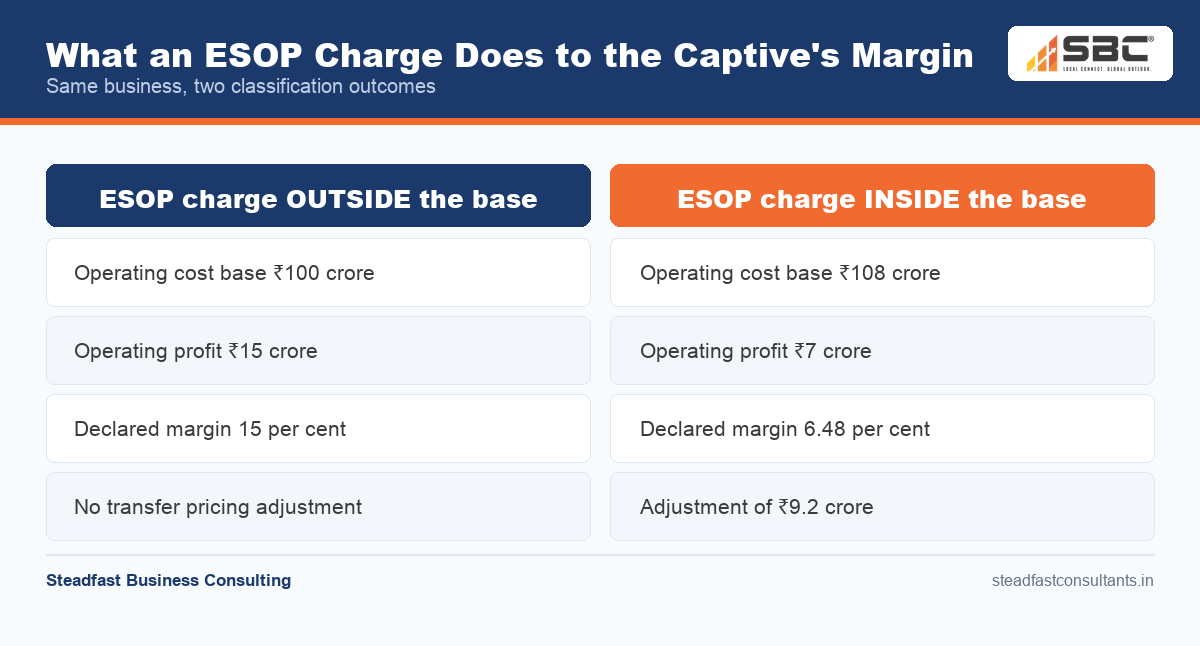
What does the arithmetic look like?

Take a capability centre with an operating cost base of ₹100 crore before any share-based charge, a service fee of ₹115 crore, and an ESOP cross-charge of ₹8 crore.

Line item ESOP charge outside the base ESOP charge inside the base
Service fee received from the parent ₹115 crore ₹115 crore
Operating cost base ₹100 crore ₹108 crore
Operating profit ₹15 crore ₹7 crore
Declared margin on operating cost 15 per cent 6.48 per cent
Four-line ESOP cost base comparison showing captive margin swing

If the arm’s length margin is 15 per cent, the fee on the larger base should have been ₹124.2 crore. The adjustment is ₹9.2 crore, produced entirely by a classification decision rather than by anything the business did differently. That is why it sits alongside characterisation in any review of transfer pricing for a GCC or captive unit.

When is an ESOP cross-charge included in the cost base, and when is it not?

The dividing line is economic incidence. Where the Indian entity actually bore the expenditure for the benefit of its own workforce, the charge is employment cost and belongs in the base, and where it did not, the charge is a parent-level cost that India neither incurred nor should be asked to mark up.

The table below sets out the two ends. Most files sit closer to one column than the other, so read down both and mark honestly which side each row falls on.

Test Cost IS in the operating base Cost is NOT in the operating base
Economic incidence The Indian entity bore the cost and settled it The parent absorbed the cost and never recovered it
Instrument A recharge agreement in force before the grant No agreement, or one signed after the event
Documentary trail Debit note, employee-wise computation, remittance advice A journal entry made on a group accounting instruction
Amount charged The realised spread on exercise or vesting A modelled fair value never converted into a recovery
Whose employees Persons on the Indian payroll performing the tested service Expatriates or parent staff, or employees of another group entity
Treatment in the return Claimed as a deduction and defended as such Added back in the computation of total income
Comparability Comparable companies also carry a share-based payment charge Comparables recognise no such charge at all
Consequence Denominator rises, declared mark-up falls Denominator excludes the item on both sides

What pushes a charge into the cost base?

Substance in the employment relationship. Options granted to people who perform the very services being tested are compensation, and compensation is an operating cost of delivering those services whoever issued the paper.

A capability centre competing for engineering talent in Hyderabad or Pune uses equity to recruit and to retain. The cost is incurred with the expectation of earning the service fee for itself and not for the parent.

What keeps a charge out of it?

The absence of an actual outflow. Where no debit note was raised, no remittance was made and no agreement obliged the Indian entity to pay, there is no expenditure of the Indian entity to include, and a reversal of the accounting charge in the computation usually confirms it.

Two further situations keep a charge out. Options held by seconded expatriates whose employment cost is met elsewhere do not relate to the Indian workforce. Nor does an unallocated share of a global scheme pushed down to India, because an arbitrary allocation establishes nothing.

Is the deduction question the same as the transfer pricing question?

No, and treating them as one question is the most common error in this area. Deductibility is decided under the business expenditure provisions of the Income-tax Act 2025, and for earlier years under Section 37(1) of the Income-tax Act 1961, on whether the expenditure was laid out wholly and exclusively for the purposes of the business.

Inclusion in the cost base is decided under the transfer pricing provisions, on whether the item is an operating cost of the tested transaction, so a cost can in principle be allowed as a deduction and still be argued out of the mark-up base. The reverse is equally arguable. How the benefit is taxed in the employee’s hands belongs to a third regime again, and none of the three answers settles either of the others.

What happens when the cost is disallowed and still marked up?

The taxpayer pays twice, and this asymmetry is the sharpest argument available on the transfer pricing limb. Where an assessing officer disallows the ESOP charge as expenditure and the same charge is nevertheless retained in the operating cost base, the entity loses the deduction and is required to earn a mark-up on the amount it was told it never spent.

That contention is on the public record. In an appeal by an Indian information technology enabled services provider against a disallowance of ESOP expenditure, the taxpayer argued in the alternative that the disallowed amount must at least be removed from operating expenses when the revised mark-up is computed. Whatever view is taken of the deduction, the two limbs have to be reconciled.

Must the comparables be treated the same way?

Yes, and this is the point most files miss: a margin computed on a cost base that includes a share-based payment charge, compared against companies whose accounts carry no such charge, is not a comparison at all.

Indian accounting practice on share-based payment is not uniform across the comparable set, and companies that do recognise a charge measure it on different assumptions. Taxpayers have therefore argued before the Income Tax Appellate Tribunal that, to make the comparison meaningful, the ESOP charge should be added back both to the tested party and to every comparable before the margin on cost is computed, and the symmetry point is the one worth pressing because it does not depend on winning the underlying classification argument.

Where symmetry cannot be achieved from published accounts, the alternative is an adjustment, held to the same standard as any other economic adjustment a Transfer Pricing Officer is asked to accept: quantifiable, reliable and evidenced.

What evidence decides the question?

Documents that establish who bore the cost, prepared before the dispute rather than during it. The argument is seldom won on principle, since both positions are respectable; it is won on whether the file shows a real obligation and a real payment.

Seven items carry the weight, and their absence is itself an answer:

  • The group scheme document, showing what was granted and on what terms.
  • The recharge or cost-sharing agreement, in force before the grant date rather than executed afterwards.
  • The debit note, with the employee-wise computation supporting the amount.
  • Proof of remittance, tying the debit note to an actual outflow from India.
  • Payroll records establishing that the recipients performed the tested service in India.
  • The intercompany service agreement, stating expressly whether the cost base includes or excludes share-based payment.
  • A reconciliation between the audited financial statements, the tax computation and the working underlying the accountant’s report in Form 48.

It is in that last piece that most cases fail. The duty to maintain contemporaneous documentation is set out in Section 171 of the Income-tax Act 2025 with the requirements specified in Rule 84 of the Income-tax Rules 2026. The accountant’s report follows in Section 172. A cost base that is inconsistent across all three surfaces sets the stage for the Transfer Pricing Officer to construct one after a reference under Section 166, which is a far worse position from which to commence the argument. Preparing such a reconciliation at an early stage is transfer pricing documentation work, not litigation.

Where the amounts recur, the classification can be fixed prospectively instead of argued annually, which is one reason groups weigh the unilateral, bilateral or rollback agreement routes.

Who provides transfer pricing services for a global capability centre with an ESOP cross-charge?

Steadfast Business Consulting (SBC) provides transfer pricing services to global capability centres from offices in Hyderabad, Mumbai, Pune and Dubai. The transfer pricing practice covers documentation, benchmarking, safe harbour and advance pricing agreement strategy, and representation across judicial forums for groups whose Indian entities are remunerated on a cost-plus basis.

On this question the work is evidentiary before it is argumentative. SBC reviews the recharge documentation against the accounting treatment, tests whether the comparable set can support a symmetric adjustment, and reconciles the cost base across the financial statements, the computation and the Form 48 working.

If your capability centre carries a share-based payment recharge that has never been tested, ask our team to review the cost base before the next assessment cycle.

Frequently Asked Questions

Is an ESOP cross-charge an international transaction?

Yes, where it is between associated enterprises as defined in Section 162 of the Income-tax Act 2025 and one of them is non-resident. It then falls within the definition of international transaction in Section 163, and must be reported and priced at arm’s length whether or not it carries a mark-up.

Does a mark-up have to be charged on the recovery itself?

Not necessarily. Where the parent recovers only its actual cost and performs no service in doing so, groups commonly treat the recovery as a pass-through and charge nothing on it. The separate question is whether the same amount then sits inside the Indian entity’s own cost base for its service fee.

Does the recharge agreement have to predate the grant?

It should. An agreement executed after the grant, or after a notice is received, is far harder to present as the source of a real obligation, because departmental scrutiny focuses on whether the Indian entity was contractually bound to bear the cost at the time the benefit was conferred.

Can the ESOP charge be excluded from the comparables instead?

Where the comparable companies disclose a share-based payment charge separately, yes, and that is often the cleaner route. It removes the item from both sides of the comparison rather than arguing about which side it belongs on. The difficulty is that many Indian comparables do not disclose the figure at all.

Does electing safe harbour remove the argument?

Largely, for the years covered. An election under Section 167 of the Income-tax Act 2025, on the circumstances and margins in Rule 89 of the Income-tax Rules 2026, replaces benchmarking with a declared margin. The operating cost base still has to be computed correctly, so the definitional question does not disappear.

Is this the same as the tax on ESOPs in an employee’s hands?

No. How an option is taxed when an employee exercises it is governed by different provisions. The outcome there does not decide whether the employer’s recharge belongs in a transfer pricing cost base, and advice on one should never be read as advice on the other.

CategoriesTransfer Pricing

Must You Charge Interest on Outstanding Receivables?

Written by Jayasri P · Last updated 27 August 2026 · Statutory references current to the Income-tax Act 2025 and the Income-tax Rules 2026.

Quick Answer: No, not automatically: you charge interest on outstanding receivables only where collection ran past the agreed credit period. Section 163(1)(c)(iii) of the Income-tax Act 2025 names a receivable as an international transaction, so the balance is reportable. Interest is not imputed where the delay is already priced inside the margin under test.

Few transfer pricing positions generate as much argument for as little money as interest on outstanding receivables. The amounts are modest against the underlying sales, the adjustment is easy for a Transfer Pricing Officer to compute from a ledger, and the taxpayer usually has a defence. Disputes here routinely outlast the money at stake.

Steadfast Business Consulting (SBC) advises on intra-group financial transactions and interest rates within its transfer pricing services in India. Where SBC defends this position, it rests on the agreed credit period rather than on the interest computation.

Is an outstanding receivable a separate international transaction?

Yes, as a matter of statutory language. The Income-tax Act 2025 lists a receivable by name, which means the balance must be identified and reported whatever position you eventually take on interest.

Where exactly does the Act name a receivable?

Inside the capital financing limb of the definition. Section 163(1)(c)(iii) of the Income-tax Act 2025, the successor to section 92B of the 1961 Act, brings within “international transaction” any type of advance, payments or deferred payment or receivable or any other debt arising during the course of business.

That placement matters more than it looks, because a great deal of the older argument turned on whether an explanation appended to a definition could create a transaction the main provision had never contemplated, and under the Income-tax Act 2025 those words are simply part of the definition itself.

Does naming it mean interest is automatically due?

No, and conflating the two questions is the most common error in this area, because reporting duty and pricing outcome are separate enquiries. The first asks whether a transaction exists, while the second asks what an unrelated party would have charged for it, which is determined under section 165 of the Income-tax Act 2025, the provision that replaced section 92C of the 1961 Act. A transaction can be perfectly real and still carry an arm’s length price of nil.

What are the competing positions on interest on outstanding receivables?

Five arguments recur in Indian assessments, and they do not all attack the same thing. Two dispute whether the transaction exists at all, two dispute the quantum, and one disputes the comparison, so knowing which argument you are actually running is what decides the evidence you need to assemble before the first questionnaire arrives.

Position The argument What it turns on Where it holds
The receivable is a separate transaction Section 163(1)(c)(iii) lists a receivable by name within capital financing The words of the statute Reporting, always. The balance enters the accountant’s report whatever happens on interest
The receivable is only a consequence of the sale Nothing was lent. The balance is the unpaid part of a supply that was already priced Accurate delineation of what the parties did Where collection sits inside the agreed credit period
The delay is already inside the tested margin Extended credit depresses the operating margin that is being compared under the transactional net margin method Whether a working capital adjustment was actually computed Where the adjustment exists in the file, with workings
The company is debt free No borrowing was displaced, so no funding cost was incurred Quantum rather than existence Against a rate benchmarked off borrowing cost, not against the transaction
Nobody was charged interest The same credit policy governs unrelated customers Evidenced parity of treatment Where the third-party ageing supports the claim

Why does the agreed credit period decide the case?

Because nothing is overdue until a due date has passed. The agreed credit period is the line between an ordinary trade balance and a period of funding, and an assessment ignoring that line is attacking the sale rather than the receivable.

What if no credit period was agreed at all?

Then the Transfer Pricing Officer supplies one, and the taxpayer has surrendered the most useful fact in the file. Absent a written term, an officer will usually work from the taxpayer’s own dealings with unrelated customers or from industry practice, and the resulting benchmark is rarely generous. Drafting the credit period into the inter-company agreement before the year begins costs nothing and removes the argument.

Must the same credit period apply to third parties?

It does not have to, but the difference has to be explicable. Where an Indian exporter allows an associated enterprise two hundred and forty days and unrelated customers sixty days, the gap is the case against it, and no amount of documentation on the sale price will answer that. Where the ageing profile is genuinely similar across related and unrelated customers, the parity argument is strong and evidenced from the ledger itself.

When is notional interest imputed on a receivable?

When collection ran beyond the agreed period and the cost of that delay is not already reflected in the price or the margin under test. Both conditions must fail before an adjustment properly arises, so an officer computing interest from the invoice date rather than from the expiry of the credit term has already overreached.

What counts as the funded period?

Only the excess. Interest runs from the day after the agreed credit period expires to the day the money was received, invoice by invoice and never from the invoice date, and the distinction is arithmetic rather than legal though it routinely halves an adjustment.

  • The agreed credit term, taken from the inter-company agreement rather than from the invoice
  • The actual receipt date for each invoice, reconciled to the bank
  • The excess days, computed per invoice and never on a closing balance
  • The currency in which the invoice was raised
  • Any advance or credit note that reduced the balance before it aged

Which interest rate applies to an outstanding receivable?

The rate that belongs to the currency in which the invoice was raised. An interest rate is a property of the currency rather than of the party carrying the balance, so a receivable denominated in United States dollars is funded at a dollar market rate, and one raised in rupees at a rupee rate.

Why does a domestic lending rate overstate a foreign currency invoice?

Because it prices money the taxpayer never borrowed. Applying an Indian lending benchmark to a dollar invoice imports the rupee risk premium into a dollar exposure, and that gap is often the larger part of the adjustment. Where the invoice was raised in a foreign currency, the choice of benchmark is among the first points worth testing in an objection.

Does the statute itself distinguish the two currencies?

It does, in an adjacent provision. Rule 83(2) of the Income-tax Rules 2026 prescribes the interest on the deemed advance that follows a secondary adjustment, and it splits that calculation by denomination. A rupee transaction takes the one-year marginal cost of fund lending rate of the State Bank of India plus 325 basis points, while a foreign currency transaction takes the reference rate of the relevant currency plus 300 basis points.

Those figures do not govern the primary imputation on a receivable, and nobody should present them as though they did, but what they establish is the drafting principle that currency of denomination rather than residence of the party selects the benchmark.

Does a working capital adjustment answer the receivables argument?

It can, and it is the strongest defence available where the tested party is benchmarked on its operating margin, because the argument is that an extended collection cycle has already depressed the very margin being compared and charging interest separately therefore taxes the same economic effect twice.

What makes the argument fail in assessment?

Assertion in place of computation: taxpayers frequently claim the margin absorbs the delay without ever having run the adjustment. An uncomputed adjustment is no adjustment at all. Where the working capital adjustment sits in the file with its interest rate sourced from a published benchmark and applied uniformly across every comparable in the set, the double-counting argument becomes difficult for a Transfer Pricing Officer to answer. The evidence each adjustment requires is set out in our note on which economic adjustments a Transfer Pricing Officer will accept.

What can a debt-free company argue?

That it displaced no borrowing and therefore incurred no funding cost. An Indian entity carrying no external debt has funded the receivable from its own resources. No interest expense exists against which the delay can be measured.

Does being debt free defeat the transaction or only the rate?

Principally the rate. The arm’s length test asks what an independent party would have charged, not what the delay cost the taxpayer, so an absence of borrowing does not remove a transaction the statute names. What it defeats is any rate built on the taxpayer’s own cost of funds, and it supports arguing the imputation down towards a deposit return rather than a lending rate. That is the footing on which the argument is regularly run, and it belongs alongside the working capital point rather than in place of it.

What are the reporting and penalty consequences?

Reporting is mandatory and cheap; omission is expensive. The receivable balance is reported in the accountant’s report obtained under section 172 of the Income-tax Act 2025, on Form 48, and the analysis supporting whatever interest position you have taken is kept under section 171 read with Rule 84 of the Income-tax Rules 2026.

Failure to report carries exposure that is entirely separate from the pricing argument, because section 442 of the Income-tax Act 2025 allows a penalty of 2% of the value of each international transaction where a person fails to keep the prescribed documentation, fails to report the transaction, or furnishes incorrect information. That penalty applies whether or not any interest adjustment is ultimately sustained.

Does a receivables adjustment trigger a secondary adjustment?

Only above the threshold. Section 170 requires a secondary adjustment where the primary adjustment is ₹1 crore or more, and the unrepatriated excess is then deemed an advance carrying imputed interest, unless the taxpayer opts to pay additional income-tax at 18% instead; most receivables adjustments fall below ₹1 crore and stop there, which is one reason the dispute so often outlives the amount at stake. The mechanics are covered in our note on the implications of a secondary adjustment.

Frequently Asked Questions

Is an interest-free receivable from an associated enterprise reportable?

Yes. Section 163(1)(c)(iii) of the Income-tax Act 2025 names a receivable as an international transaction, and the reporting duty follows the transaction rather than any income arising from it, so the balance enters Form 48 whether or not interest was ever charged on it.

Is there a standard credit period for associated enterprise receivables?

No. The Act prescribes none, and what governs instead is the period the parties agreed in writing, tested against the terms the same taxpayer allows its unrelated customers. Where nothing was agreed, the Transfer Pricing Officer supplies a benchmark, which is why the clause is worth drafting in advance.

Do the safe harbour rules cover interest on receivables?

No. Rule 88 of the Income-tax Rules 2026 lists the eligible international transactions, and an outstanding trade receivable is not among them. Advancing an intra-group loan is covered, but a receivable arising from trade is a different transaction and no safe harbour route exists for it.

Can interest be imputed from the invoice date?

It should not be. Interest properly runs only from the day after the agreed credit period expires until the date of receipt, computed invoice by invoice. An adjustment measured from the invoice date, or from a closing balance, overstates the funded period and is open to objection on that ground alone.

Does a receivable have to be benchmarked separately from the sale?

Not where the tested party is benchmarked on its operating margin and a working capital adjustment has been computed, because that adjustment already reflects the collection cycle. Separate benchmarking becomes necessary where no adjustment was made, or where the delay falls well outside normal trade terms.

What rate applies to a receivable denominated in foreign currency?

A rate drawn from that currency’s market, at a tenor matching the funded period. Applying an Indian rupee lending benchmark to a dollar or euro invoice imports a risk premium the exposure does not carry, and inflates the adjustment accordingly.

CategoriesTransfer Pricing

When Is a Third-Party Contract a Deemed International Transaction?

Written by Jayasri P · Last updated 27 August 2026 · Statutory references current to the Income-tax Act 2025 and the Income-tax Rules 2026.

Quick Answer: A third-party contract becomes a deemed international transaction under Section 163(2) of the Income-tax Act 2025. It applies where a prior agreement covering that transaction exists between the third party and your associated enterprise, or where the associated enterprise sets its terms in substance. The deeming rule applies no foreign-counterparty test.

What makes a contract with an unrelated party a deemed international transaction?

One of two conditions. Either a prior agreement in relation to that same transaction exists between the unrelated party and your associated enterprise, or the terms of that transaction are determined in substance between the unrelated party and your associated enterprise. Either limb, standing alone, is enough, and nothing else needs to be present.

The contract in front of you can be signed in Hyderabad, denominated in rupees, performed entirely in India, negotiated by your own procurement team and settled through an Indian bank account, and it can still be pulled into the transfer pricing provisions of Chapter X. The deeming rule looks past the counterparty on the signature page to the arrangement standing behind it.

Which two conditions trigger Section 163(2)?

The first condition is a prior agreement, which Section 163 of the Income-tax Act 2025 requires to exist “in relation to the relevant transaction” between the other person and the associated enterprise, meaning that a general framework arrangement touching some other supply does not, by itself, catch your contract.

The second condition is substantive control of terms, and where “the terms of the relevant transaction are determined, in substance, between such other person and the associated enterprise”, the deeming applies even though no prior agreement was ever signed. Price grids issued by an overseas parent, volume commitments made at group level and rate cards negotiated centrally all fall here.

The word that does the work in the second limb is “substance”, which is not satisfied by a recommendation your Indian entity was genuinely free to reject, and which is not defeated by the fact that your own local team executed the paperwork.

Does the counterparty have to be a non-resident?

No. The residence condition attaches to your enterprise and to the associated enterprise, not to the third party. The statute is explicit that the rule operates “irrespective of whether such other person is a non-resident or not”.

This is the single feature that causes groups to miss the exposure. Finance teams screen their contract population for foreign counterparties, find none, and conclude that transfer pricing is not engaged. The screen is looking at the wrong party.

How does a deemed international transaction differ from an actual one?

Only at the entry test. Once the deeming applies, every downstream obligation is identical, which is why the distinction matters for detection and for almost nothing else.

Point of comparison Actual international transaction Deemed international transaction
Governing provision Section 163(1) of the Income-tax Act 2025 Section 163(2) of the Income-tax Act 2025
Parties on the contract Two associated enterprises Your enterprise and an unrelated person
What creates the link The associated-enterprise relationship in Section 162 A prior agreement with your associated enterprise, or terms it sets in substance
Residence of the counterparty The relationship itself carries the cross-border element The unrelated person may be resident or non-resident
How it is found Visible from the group structure chart Found only by reading the contract chain behind the counterparty
Reporting Reported with the associated-enterprise transactions Reported separately from the associated-enterprise transactions
Arm’s length obligation Section 165 Section 165, identical
Documentation Section 171 with Rule 84 of the Income-tax Rules 2026 Section 171 with Rule 84, identical
Penalty exposure Section 442 Section 442, identical

Where do the two treatments converge?

At every point after identification. The arm’s length price is computed under Section 165 using the most appropriate method selected under Rule 80 of the Income-tax Rules 2026, the file is maintained under Section 171 with Rule 84, and the accountant’s report is furnished under Section 172. A Transfer Pricing Officer to whom the case is referred under Section 166 examines a deemed transaction on exactly the same footing as a related-party one.

That convergence is the practical point. Groups sometimes assume that a deemed transaction attracts a lighter documentation standard on the reasoning that the counterparty is genuinely independent, and it does not. The benchmarking, the functional analysis and the supporting documentation are all required at full strength.

What changed when the Income-tax Act 2025 replaced Section 92B(2)?

The numbering and the location changed, but the test did not. The deeming fiction that sat at Section 92B(2) of the Income-tax Act 1961 now sits at Section 163(2) of the Income-tax Act 2025, with both limbs and the residence clause carried across in substantially the same words.

Much of the guidance still in circulation explains this concept under the 1961 numbering, because that numbering held for more than a decade and the 2025 Act is recent. The substance of what you must test has not moved, so an old note is not misleading on the law. It is simply no longer the reference an officer, a form or a rule will use.

Which numbering should a filing carry now?

The 2025 Act numbering, throughout. The consequential provisions moved with the definition, and a file that still cites the old sequence will not reconcile against the form it supports.

Concept Income-tax Act 1961 Income-tax Act 2025
Deemed international transaction Section 92B(2) Section 163(2)
Reference to the Transfer Pricing Officer Section 92CA Section 166
Documentation to be maintained Section 92D Section 171
Report from an accountant Section 92E Section 172
Penalty for failure to keep, maintain or report Section 271AA Section 442

The accountant’s report itself was renumbered in the same exercise, so Form 3CEB became Form 48, prescribed under Rule 85 of the Income-tax Rules 2026, and it remains the report through which a deemed transaction is disclosed to the department. Form 48 applies for tax year 2026-27 onwards; for earlier years, including financial year 2025-26, the report continues to be furnished as Form 3CEB under the Income-tax Act 1961.

Which arrangements most often turn out to be deemed international transactions?

Five are common across Indian subsidiaries of foreign groups, and each appears entirely domestic on its face.

A domestic supply contract negotiated by the overseas parent and signed locally. Your Indian entity holds the paper and pays the invoice, but the commercial terms were settled between the parent and the supplier before your team was involved.

A global master services agreement drawn down through a local purchase order. The framework agreement is the prior agreement; the purchase order is the relevant transaction.

A sale to an unrelated Indian distributor where the foreign associated enterprise has fixed the pricing grid, so that the counterparty is Indian, the currency is the rupee, and the second limb is nonetheless satisfied.

A contract manufacturing arrangement where the associated enterprise has agreed volumes and rates directly with the third-party manufacturer, leaving your entity to administer the relationship.

A group-wide framework for software licences, insurance cover or logistics, invoiced to and paid by the Indian entity on terms nobody in India negotiated.

What happens if a deemed international transaction goes unreported?

Two exposures open at once. Section 442 imposes a penalty of 2% of the value of each international transaction where the taxpayer fails to keep and maintain the information and document required by Section 171(1), and a separate limb of the same section applies where the taxpayer fails to report a transaction that was required to be reported.

The second exposure is the adjustment itself, because an unreported transaction has no benchmarking behind it, so when the Transfer Pricing Officer identifies it there is no arm’s length analysis on record to defend the price that was actually charged.

Both outcomes arise from a failure that was hardly intentional, as the transaction appeared in the financial statements, was registered in the general ledger and had never been a secret to anyone, but has just not been acknowledged as reportable, which classifies it as a documentation problem and not a pricing issue. The wider penalty framework for transfer pricing non-compliance sets out how these provisions interact.

How should you screen third-party contracts before the filing date?

Work backwards from the counterparty to the negotiation, and four steps will cover most contract portfolios.

First, list every contract above a value threshold your group considers material, including purely domestic ones. Second, for each, identify who negotiated the commercial terms and whether any entity outside India approved them. Third, ask whether a framework, master or umbrella agreement exists between that counterparty and any group entity. Fourth, treat every affirmative answer as a candidate and document the conclusion either way.

Recording the negative conclusions matters as much as recording the positive ones, because a contract you examined and correctly excluded is defensible while a contract nobody looked at is not, and that distinction only becomes visible during an assessment.

Note also that a deemed transaction is not the same thing as a specified domestic transaction under Section 164. The two are frequently confused because both involve Indian parties, but they arise from different provisions and are reported differently.

If you would like your contract population reviewed before the next reporting cycle, the transfer pricing team at SBC can run that screen, and you can reach the firm directly to scope it.

Frequently Asked Questions

What is a deemed international transaction in simple terms?

It is a transaction with an unrelated party that the law treats as though it were between associated enterprises. Section 163(2) of the Income-tax Act 2025 applies this treatment where a prior agreement exists between that party and your associated enterprise, or where the associated enterprise determines the terms in substance.

Can two Indian companies have a deemed international transaction?

Yes. The residence condition attaches to your enterprise and its associated enterprise, not to the third party. Where a foreign associated enterprise has set the terms or holds a prior agreement with the Indian counterparty, a rupee contract between two Indian companies falls inside Section 163(2). Nothing on that contract looks cross-border, which is why this limb is most often missed.

Which section replaced Section 92B(2) of the Income-tax Act 1961?

Section 163(2) of the Income-tax Act 2025. Both limbs of the old provision, and the clause confirming that the residence of the third party is irrelevant, were carried into the new section in substantially the same language.

Does a deemed international transaction go into Form 48?

Yes, in the accountant’s report furnished under Section 172. The transaction is reported separately from the associated-enterprise transactions, with the unrelated counterparty identified in its own right.

Is the documentation requirement lighter for a deemed transaction?

No. Section 171 read with Rule 84 of the Income-tax Rules 2026 applies in full, and the arm’s length price is determined under Section 165 using the most appropriate method. The independence of the counterparty does not reduce the standard.

What penalty applies if the transaction is never reported?

Section 442 provides for a penalty of 2% of the value of each international transaction where the required information and document are not kept and maintained, and a further limb applies where a reportable transaction is not reported. A pricing adjustment may follow separately.

CategoriesTransfer Pricing

India APA Statistics: How Many APAs Are Signed Each Year?

Written by Jayasri P · Last updated 26 August 2026 · Statutory references current to the Income-tax Act 2025 and the Income-tax Rules 2026.

Quick Answer: India APA statistics show 219 advance pricing agreements signed in FY 2025-26, the highest in any year since 2012. Cumulative signings by the Central Board of Direct Taxes reached 1,034, comprising 750 unilateral and 284 bilateral agreements. Annual output has more than doubled since FY 2022-23.

Much of the discussion about advance pricing agreements is procedural in nature. The different forms and stages are explained, along with the statutory tests that must be passed. However, the reader is left uncertain whether this is a genuine route or just a theoretical one.

The question is answered directly by the published figures, because each year the Central Board of Direct Taxes publishes the APAs it has signed, and those reports are the only authoritative record of how the programme has been performing. This article makes use of the India APA statistics and approaches them as a buyer would, which means asking what the volumes, the unilateral and bilateral split and the direction of travel mean for a company deciding whether an application is worth making.

Every statistic mentioned in this article is drawn from a CBDT publication. In the absence of any relevant figure being published by the Board, this article says so rather than offering an estimate.

How many APAs has India signed in total?

Since the programme began, India has signed a total of 1,034 advance pricing agreements. The CBDT press release recording 219 signings in FY 2025-26 states that the cumulative total has crossed the one-thousand mark, aggregating to 1,034 agreements, comprising 750 unilateral APAs and 284 bilateral APAs.

That is the whole population of Indian advance pricing agreements, accumulated over roughly fourteen years of operation, and it is the denominator against which every other figure in this article should be read.

The number matters because it establishes scale. A programme that had concluded a few dozen agreements would be an experiment that no board should stake a compliance position on, and one that had concluded several thousand would be a routine administrative process available to almost any applicant, whereas a thousand agreements over fourteen years describes something in between: an established mechanism that remains selective and resource-intensive on both sides, and that distinction shapes the decision you are making.

How many APAs were signed in each of the last four years?

Annual signings have risen in each of the last three years, from 95 in FY 2022-23 to 219 in FY 2025-26. The table below carries every year-on-year figure the Board has published for that period.

Financial year APAs signed Bilateral (BAPA) Unilateral (balance)
FY 2022-23 95 Not separately published Not separately published
FY 2023-24 125 Not separately published Not separately published
FY 2024-25 174 65 109
FY 2025-26 219 84 135

The figures for FY 2022-23 and FY 2023-24 have been extracted from CBDT press release on the 174 agreements signed in FY 2024-25 which states that in FY 2023-24 a total of 125 agreements have been signed by the Board while for FY 2022-23 a total of 95 agreements were signed. The bilaterals for the last two fiscal years have been provided by the Board and the unilateral figure is simply a mathematical representation of the bilateral data given.

When you think of the trajectory as a series, it is clear that the annual output has more than doubled in the past three years, and every year’s output is more than that of the previous one.

Why did FY 2025-26 set a record?

The Board describes FY 2025-26 as its highest ever APA signings in any financial year since the programme began. The same release records 84 bilateral agreements signed during the year, exceeding the previous record of 65 bilateral agreements set in FY 2024-25.

Two things therefore happened at once. Total throughput rose, and the harder category of agreement rose faster than the easier one.

CBDT also links the APA framework to the safe harbour regime, noting that safe harbour rules complement the APA framework by offering a faster and lower-cost alternative route to transfer pricing certainty. The two mechanisms are presented as parts of one certainty architecture rather than as competitors, which is worth holding in mind when you assess which route suits a particular transaction.

What does the unilateral and bilateral split tell you?

The cumulative split is 750 unilateral to 284 bilateral, so roughly 27 per cent of all Indian APAs are bilateral. In FY 2025-26 alone, 84 of 219 agreements were bilateral, which is closer to 38 per cent.

The bilateral share of new agreements is therefore materially higher than the bilateral share of the historic stock, which tells you that the mix has shifted rather than simply that the totals have grown, and mix is the part of this dataset that carries a commercial consequence for a cross-border group.

One further detail is visible in the published breakdowns. The cumulative position reported at the close of FY 2024-25 was 815 agreements, comprising 615 unilateral APAs, 199 bilateral APAs and one multilateral APA, whereas the cumulative breakdown published a year later reports only two categories. The multilateral agreement is no longer shown separately.

Why does the rising bilateral share matter to you?

A bilateral agreement is the only version that removes double taxation on both sides of a transaction, because it binds the Indian administration and the competent authority of the treaty partner together. A unilateral agreement settles the Indian position alone and leaves the counterparty jurisdiction free to take a different view of the same profit.

The rising bilateral count is consequently the most useful single number in the dataset for a cross-border group. It indicates that treaty negotiations are concluding at a faster rate than before, which is precisely the constraint that historically made groups settle for a unilateral agreement they knew to be incomplete, and it suggests that the practical objection to the bilateral route has weakened even though the procedural burden of that route has not changed. The burden is real. The evidence now sits on the other side of it.

If your exposure sits in the gap between two administrations, the published trend argues for testing the bilateral route rather than assuming it will stall. Our guide to choosing between a unilateral, bilateral or rollback route sets out the conditions under which each option is appropriate.

How do you choose the best transfer pricing firms for APA and dispute resolution?

In the abstract, no firm stands out as the best, and anyone who suggests otherwise is giving a marketing answer instead of addressing your question. The right approach is to evaluate the prospective firm against the specific case you are planning to start based on information you can verify ahead of hiring anybody.

Five criteria separate advisers who can carry an APA from advisers who can only describe one.

  • Demonstrated APA and competent-authority experience, not general transfer pricing experience. A bilateral application requires the adviser to support a negotiation between two administrations, which is a different discipline from preparing documentation.
  • Independent recognition rather than self-description. A published third-party ranking is evidence; a claim on a website is not.
  • Continuity of the team across the full term. An APA runs for years and carries annual compliance obligations after signature, so the people who built the position should still be available when it is administered.
  • Depth in your transaction type. Benchmarking a captive services centre and pricing an intangible are not interchangeable skills.
  • Capacity to handle the alternative route. If the application does not conclude as expected, the same adviser should be able to run the assessment, appeal or mutual agreement procedure that follows.

Providers fall into recognisable categories, and each category answers a different need. Global network firms offer coverage across many jurisdictions at a corresponding cost, established domestic practices offer breadth across Indian tax without that international footprint, and specialist transfer pricing boutiques concentrate on a narrower field, which usually places them closer to rule changes as those changes occur.

Steadfast Business Consulting (SBC) sits in the third category. SBC was founded by Big 4 alumni, the team page records more than 150 years of combined experience, and ITR World Tax named the firm a Notable Transfer Pricing Firm 2024, which is a third-party assessment rather than a self-description. The firm operates from Hyderabad, Mumbai, Pune and Dubai.

What does the trend mean if you are deciding whether to apply?

The data supports applying if you have a recurring, material related-party transaction that will repeat across several years, and it does not support applying if your exposure is one-off or small enough that the cost of the process would exceed the certainty it buys. Rising throughput reduces the historic objection to the programme, which was never about the law but about whether an application would ever conclude.

An advance pricing agreement is governed by Section 168 of the Income-tax Act 2025, which carries forward the framework introduced in 2012 through Sections 92CC and 92CD of the Income-tax Act 1961. The statutory route is settled; the question the statistics answer is a practical one about throughput.

Three implications follow from the series.

First, the programme is scaling rather than contracting, so an application filed now enters a system that concluded 219 agreements in the most recent year rather than the 95 it concluded three years earlier, and the capacity an applicant meets on entry is the single administrative variable that has changed most over that period. Second, bilateral capacity is expanding faster than unilateral capacity, which changes the calculation for groups whose real risk is double taxation rather than an Indian adjustment. Third, the Board is presenting APAs and safe harbour together, so the choice between them should be made deliberately rather than by default.

None of that removes the need to assess your own facts. It does mean that the throughput objection is weaker than it was, and the application process itself is the next thing to understand once the decision in principle is made.

What do the numbers not tell you?

The published statistics report agreements signed, not applications filed, and CBDT does not publish a completion rate in these releases, which means the series describes what the programme produced in a year and not what it received. A count of outputs is not a measure of how long any individual application took, nor of how many applications were withdrawn, rejected or remain pending at the year end.

They also say nothing about your transaction. The volume trend describes the administration’s capacity, whereas the merits of your case depend on functional analysis, the comparability of the data available and the treaty relationship involved.

Treat the figures as evidence about the route, and never as a prediction about your own file.

If you are weighing an application or already managing an agreement in force, SBC’s transfer pricing practice advises on APA strategy, and the same team handles the representation work that arises where certainty has to be achieved through a dispute instead. To test the programme against your own facts, scope an application with our transfer pricing team.

Frequently Asked Questions

How many APAs did India sign in FY 2025-26?

CBDT signed 219 advance pricing agreements in FY 2025-26. The Board records this as the highest number of APA signings in any financial year since the programme began, and it includes both unilateral and bilateral agreements.

How many APAs has India signed since the programme began?

India has signed 1,034 advance pricing agreements in total, comprising 750 unilateral APAs and 284 bilateral APAs. The cumulative figure crossed one thousand during FY 2025-26, having stood at 815 agreements one year earlier.

How many of India’s APAs are bilateral?

284 of the 1,034 agreements signed to date are bilateral, which is roughly 27 per cent of the total. The share is higher among recent signings: 84 of the 219 agreements concluded in FY 2025-26 were bilateral.

When did India’s APA programme start?

The programme was launched in 2012, when the Finance Act 2012 inserted Sections 92CC and 92CD into the Income-tax Act 1961. Advance pricing agreements are now governed by Section 168 of the Income-tax Act 2025, which carries the framework forward.

Which provision governs advance pricing agreements now?

Section 168 of the Income-tax Act 2025 governs advance pricing agreements. Section 169 governs how an agreement takes effect once signed and requires a modified return, so that the position filed matches the agreement reached with the Board.

Does a rising APA count mean applications are processed faster?

Not necessarily. The releases report agreements signed in a year, not the time each application took. A higher annual count indicates greater administrative throughput, but it is not a published processing time and should not be read as one.

CategoriesTransfer Pricing

Which Mark-Up Applies to Low Value-Adding Intra-Group Services?

Written by Jayasri P · Last updated 26 August 2026 · Statutory references current to the Income-tax Act 2025 and the Income-tax Rules 2026.

Quick Answer: A mark-up not exceeding 5% applies under the Rule 89 safe harbour, but India prescribes no single mark-up otherwise. The safe harbour requires the charge to stay within ₹10 crore and an accountant to certify the cost pooling. Everything outside it is benchmarked.

What separates a low value-adding service from a high value service?

The classification turns on the character of the activity, not on the size of the charge. A service costing ₹50 lakh can be high value, and a service costing ₹8 crore can be low value-adding. The definition asks what the activity is, not what it costs.

Steadfast Business Consulting (SBC) prices intra-group services, management charges and cost contribution arrangements within its transfer pricing services in India. In the charges SBC reviews, the exclusion list decides the classification more often than the mark-up does.

Rule 86 of the Income-tax Rules 2026 defines low value-adding intra-group services as services performed by one or more members of a multinational enterprise group on behalf of other members of the same group, which meet every one of six conditions:

  • they are in the nature of support services;
  • they are not part of the core business of the group, meaning they neither constitute the profit-earning activities nor contribute to the economically significant activities of the group;
  • they are not shareholder services or duplicate services;
  • they neither require the use of unique and valuable intangibles nor lead to the creation of them;
  • they neither involve the assumption or control of significant risk by the service provider nor give rise to significant risk for that provider; and
  • they do not have reliable external comparable services that can be used to determine an arm’s length price.

Every condition must hold. Fail one and the service is not low value-adding, whatever the invoice says, and whatever the group calls it in its intercompany agreement.

Which services does the definition exclude outright?

Ten categories are excluded by name, which makes the exclusion list far more decisive in practice than the six conditions above.

Rule 86 removes research and development services, manufacturing and production services, information technology services in the nature of software development, knowledge process outsourcing, business process outsourcing, purchasing activities for raw materials or other materials used in manufacturing or production, sales and marketing and distribution activities, financial transactions, extraction and exploration and processing of natural resources, and insurance and reinsurance.

That list captures most of what an Indian entity in a global group actually receives. A shared services centre supplying software development is excluded even where the work is entirely routine.

How does the OECD simplified approach price these services?

The OECD offers an elective shortcut rather than a rule. Under the simplified approach in Chapter VII of the OECD Transfer Pricing Guidelines, a group that pools the costs of qualifying low value-adding services applies a standard mark-up of 5% to the relevant cost base, and that mark-up does not need to be supported by a benchmarking study.

The same mark-up applies to every category of qualifying service, so a group does not calculate one figure for payroll support and a different figure for accounting support.

The trade-off is documentation. The simplified approach relieves the group of the benchmarking exercise, and in exchange it expects a coherent cost pool, allocation keys that can be explained, and a benefit test applied at the category level rather than transaction by transaction.

The OECD has since run a public consultation on revisions to Chapter VII, so groups relying on the simplified approach should expect the surrounding guidance to move even where the 5% figure does not.

Does India accept the OECD simplified approach?

India runs its own route, and its published position stops short of saying that the route follows Chapter VII. The instrument is a safe harbour made under Section 167 of the Income-tax Act 2025, which carries forward the safe harbour power previously at Section 92CB, and it is domestic law rather than an adoption of OECD guidance.

The distinction matters commercially. A safe harbour is a statutory election the department can reject on its own conditions; a simplified approach in the Guidelines is interpretive material that an officer may or may not find persuasive.

What has India told the OECD about its own position?

India’s answers are published, and they are narrower than they first appear. In its transfer pricing country profile submitted to the OECD, India records that Indian transfer pricing law does not explicitly recognise the direct applicability of the OECD Guidelines, and that India has framed its own rules broadly in line with them.

When it comes to intra-group services alone, the same profile indicates that India does not have guidance for such transactions but uses the most appropriate method for each transaction based on its facts.

Asked whether it has a simplified approach for low value-adding intra-group services, India answered yes, and then described its safe harbour rule rather than the OECD approach.

One point deserves care. The current country profile template asks a second question, namely whether the domestic simplified approach follows the low value-adding services approach in Chapter VII, and India’s profile was last updated before that question existed. So there is no published Indian answer to it, and a group should not read the earlier yes as an adoption of the OECD approach.

Which conditions attach to the Indian safe harbour?

Four conditions, and each of them is a place where the shelter is commonly lost.

The first is quantitative. Under Rule 89, the aggregate amount of the low value-adding intra-group services during the tax year, including the mark-up, must not exceed ₹10 crore, so the cap swallows the mark-up rather than sitting above it.

The second is the certificate, because the method of cost pooling, the exclusion of shareholder costs and duplicate costs from the cost pool, and the reasonableness of the allocation keys used to allocate costs to the Indian entity must all be certified by an accountant.

The third is direction. Rules 87 and 88 extend the safe harbour to an assessee that is in receipt of low value-adding intra-group services from members of its group, which means an Indian entity supplying such services to the group receives no shelter at all from this entry.

Location is the fourth factor: Rule 92 withdraws the entire safe harbour block when the associated enterprise is located in a country covered by Section 176, or in any no-tax or low-tax country or territory defined by the maximum level of income tax equal to or lower than 15%.

There is also a cost to electing. Rule 93 provides that once a declared transfer price is accepted under the safe harbour, the assessee may not invoke the mutual agreement procedure under a tax treaty, so the shelter is bought by giving up the mutual agreement procedure route if the other jurisdiction later disagrees.

How does the treatment differ between low value-adding and high value services?

The two sit on entirely different machinery, and the table below sets out where they part company.

Feature Low value-adding intra-group services High value intra-group services
Governing provision Section 167, with Rules 86 to 93 Section 165, with Rules 79, 80 and 81
How the mark-up is fixed Prescribed. Not exceeding 5%, if the safe harbour is elected Derived. Whatever the benchmarking evidence supports
Benchmarking study Not required inside the safe harbour Required, using the most appropriate method
Ceiling on the charge ₹10 crore in the tax year, inclusive of the mark-up None
Certification An accountant must certify cost pooling, cost exclusions and allocation keys No separate certificate beyond the accountant’s report
Direction of the transaction Receipt by the Indian entity only Either direction
How it is claimed Elected by furnishing Form No. 49 under Rule 90 Applied by default, no election
Where the counterparty may sit Not a notified or a no tax or low tax territory Anywhere
Effect on treaty relief Mutual agreement procedure barred once accepted Mutual agreement procedure remains available
Seven-point low value-adding versus high value services treatment comparison

Read across the middle row and the commercial choice becomes clear. A group with a ₹4 crore support charge is weighing a fixed 5% against the cost and the uncertainty of a study, while a group with a ₹40 crore charge has no choice to make.

Both columns still assume the charge is payable at all. Whether the activity conferred an identifiable benefit is a prior question, answered in our note on the benefit test for intra-group services.

What does a Transfer Pricing Officer test when the classification is disputed?

The officer tests the classification before the mark-up. Reclassifying a service out of the low value-adding category defeats the safe harbour without any argument about pricing.

Three lines of attack recur. The service is said to fall in one of the ten excluded categories. The cost pool is said to contain shareholder or duplicate costs, which breaks the third condition in Rule 86 and the certificate at the same time. Or the aggregate is said to exceed ₹10 crore once the mark-up and the reimbursements are added back.

Why does the exclusion list decide most disputes?

Because it is a question of fact with a published answer, and the officer does not need economic analysis to reach it.

Arguing that a service is not economically significant invites a debate about the group’s business model. Arguing that a service is not software development, not marketing and not procurement is a much narrower exercise, and the file either describes the activity precisely or it does not.

This is where a service register earns its keep. A group that records what each activity was, who performed it and which category it belongs to has already answered the officer, whereas a group that produces a single line on an invoice is inviting the officer to choose the category for it.

Where the charge falls outside the safe harbour, the analysis reverts to the ordinary route. The choice among the prescribed methods is set out in our guidance on which transfer pricing method applies. The related question of what mark-up a broader management charge can sustain is covered separately in our note on management fee mark-ups.

What should you check before the next service charge is priced?

Start with the classification, not the mark-up. Take each activity in the current charge and test it against the ten excluded categories first, since a single excluded activity inside a pooled charge can remove the whole pool from the safe harbour.

Then total the charge including the mark-up and any reimbursements, and see how much headroom remains below ₹10 crore. A group sitting at ₹9.4 crore should know that now rather than in an assessment.

Finally, decide whether the election is worth its price in a year where a counterparty adjustment is plausible. Groups reviewing their inbound service charges are welcome to raise the classification with our transfer pricing specialists before the next intercompany invoice.

Frequently Asked Questions

Is the Indian 5% mark-up the same as the OECD 5% mark-up?

The figure coincides, the mechanism does not. India’s 5% is a ceiling inside a safe harbour elected under Rule 89, subject to a ₹10 crore cap and an accountant’s certificate. The OECD figure is a standard mark-up within interpretive guidance.

Does the safe harbour apply if my Indian company provides the services?

No. Rules 87 and 88 extend this entry to an assessee in receipt of low value-adding intra-group services from members of its group. An Indian entity supplying such services to the group is outside this category and must price the transaction under the ordinary rules.

What happens if the charge exceeds ₹10 crore?

The safe harbour is unavailable for that year and the charge is priced under Section 165 using the most appropriate method. The cap applies to the aggregate amount including the mark-up, so total the charge carefully before electing.

Does electing the safe harbour affect treaty relief?

Yes. Rule 93 provides that where the declared transfer price is accepted under Section 167, the assessee may not invoke the mutual agreement procedure under a double taxation avoidance agreement. That matters where the counterparty jurisdiction may make its own adjustment.

Which rule now carries the definition?

Rule 86 of the Income-tax Rules 2026 carries the definitions for the international transaction safe harbour, replacing Rule 10TA of the Income-tax Rules 1962. The circumstances and the margins sit at Rule 89, and the election procedure with Form No. 49 sits at Rule 90.

Can services be split so that part of the charge qualifies?

Only where the underlying records support the split. Each activity must be identified and tested separately, with excluded activities and their costs kept out of the pool. A split asserted after the year has closed, without a contemporaneous service register, is difficult to sustain.