
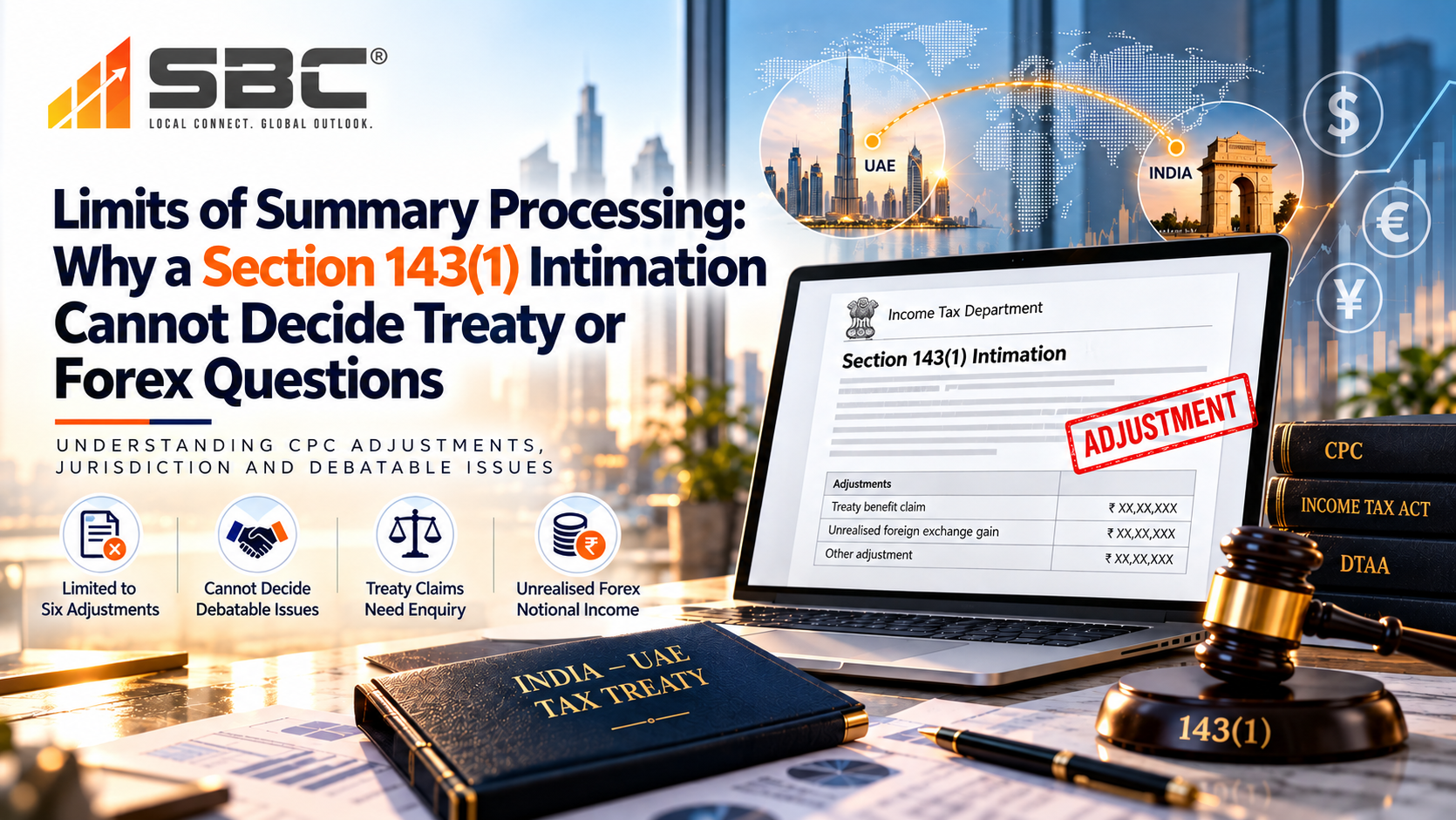
Limits of Summary Processing: Why a Section 143(1) Intimation Cannot Decide Treaty or Forex Questions
By CA Mithilesh Reddy, Founder and CEO, and CA Rajesh Vaishnav, Partner, Steadfast Business Consulting LLP | Direct Tax Litigation / Controversy
Quick answer
Section 143(1) processing is limited to six listed adjustments, such as arithmetical errors and incorrect claims apparent from the return. It cannot decide debatable questions of treaty interpretation or notional income. An intimation that does so can be challenged first on jurisdiction, with the merits argued in the alternative.
Key takeaways
- Section 143(1)(a) of the 1961 Act (section 270(1)(a) of the Income-tax Act, 2025) allows only six categories of adjustment, each tied to what is ascertainable from the return, audit report or a prescribed source.
- The Bombay High Court in Khatau Junkar v. K.S. Pathania (1992) held that debatable questions or claims needing enquiry cannot be decided in processing; the officer must issue a scrutiny notice instead.
- A treaty claim denied by the CPC, and unrealised forex gains taxed because they were disclosed in the tax audit report, are both vulnerable on jurisdiction before they are argued on the merits.
- The power to adjust for inconsistency with the preceding year’s return was inserted in the 1961 Act by the Finance Act 2025 (clause (iia), from 1 April 2025) and is carried into section 270(1)(a)(iii) of the 2025 Act, so consistency across years now has a processing consequence.
- File the appeal within time and argue the merits in the alternative; a rectification application does not extend the limitation period and a debatable question is not a mistake apparent from the record.
Practice illustration: CPC adjustment of a non-resident treaty claim
Issue. An intimation treated receipts claimed as exempt under a tax treaty as taxable under the domestic income-tax provisions.
Approach. The response separated the statutory limits on adjustments during summary processing from the merits of the treaty and permanent-establishment position.
Outcome. The appellate authority granted relief on the jurisdictional issue and directed recomputation. A separate foreign-exchange appeal covered elsewhere in this article resulted in relief subject to verification of the relevant ICDS reporting.
Practical lesson. Do not merge a treaty-related appellate direction with the different conditions attached to an ICDS appeal.
This illustration is deliberately generalised and must not be used to identify a taxpayer or matter.
Introduction
Processing a return is a mechanical step. The return is received, checked against what it contains and against prescribed sources, and an intimation issues. It is not an assessment, no one examines the taxpayer’s position, and nothing in the process is designed to resolve a question on which two views are possible. The statute recognises that by placing the enquiry route in the same provision, immediately after the processing route, for use when a question needs one.
Two fact patterns now generate a large share of these appeals. The first is the denial of a treaty claim during processing, where the return was filed on the footing that business profits are not taxable in India absent a permanent establishment and the system has instead applied the domestic special rate. The second is the taxation of notional foreign exchange gains which the taxpayer disclosed, correctly, as an income computation standard adjustment in the tax audit report. Although the two appear unrelated, they raise the same argument, and it is an argument about jurisdiction rather than about the merits.
This note deals with what follows when an intimation has decided something it had no power to decide. It sets out the categories of adjustment the provision actually permits, the authority confining them, and two fact patterns that now generate a large share of these appeals: treaty claims disallowed during processing, and notional foreign exchange gains taxed because they were disclosed in the tax audit report. It also covers how the submission should be structured and why the rectification route is usually the wrong one. For the underlying treaty question in the first of those fact patterns, see our note on treaties with no fees for technical services article.
1. What the provision actually permits
Section 270(1) of the Income-tax Act, 2025 (section 143(1) of the 1961 Act, summary processing of a return) permits the total income or loss to be computed after specified adjustments. Those adjustments are confined to the six categories listed in section 270(1)(a):
- any arithmetical error in the return;
- an incorrect claim, if such incorrect claim is apparent from any information in the return;
- any such inconsistency in the return with respect to the information in the return of any preceding tax year, as may be prescribed;
- disallowance of a loss claimed by way of set off, where the return for the year in which the loss arose was furnished beyond the due date under section 263(1);
- disallowance of expenditure, or increase in income, indicated in the audit report but not taken into account in computing the total income; and
- disallowance of a deduction under section 144 or under Chapter VIII-C where the return was furnished late.
The third category deserves particular attention, because it is recent. An equivalent power was inserted into the 1961 Act as section 143(1)(a)(iia) by the Finance Act 2025 with effect from 1 April 2025, and the 2025 Act carries it forward, and the scope of what is prescribed under it will determine how far it reaches. It also bears directly on the point made later in this note about taking consistent positions across years, because an inconsistency that would once only have invited a scrutiny notice may now support an adjustment in processing.
It is worth noting what is no longer there. Section 143(1)(a)(vi) of the 1961 Act permitted an adjustment for income appearing in a statement or form but not included in the return, but a proviso bars any such adjustment for returns for assessment year 2018-19 onwards, and the 2025 Act has no equivalent. Neither Act now permits that adjustment, and a submission that proceeds on the footing that it does is answering a case the Revenue is not making.
Two features of that list decide most appeals. First, every category is tied to something ascertainable from the return, the accompanying documents or a prescribed source. None invites an enquiry. Second, an incorrect claim must be apparent from any information in the return. A claim that requires the reader to construe a statute, read a treaty or evaluate a legal doctrine before deciding whether it is correct is not apparent from anything.
The 2025 Act consolidated the processing provision with scrutiny. Sections 143(1), 143(2) and 143(3) of the 1961 Act are now one section: processing and intimation are section 270(1) to (5), and the notice for scrutiny and the assessment order are section 270(8) to (10). The structural point this makes is useful in argument. The statute itself places the enquiry route in the same section, immediately after the processing route. Where a question needs enquiry, the statute supplies the mechanism, and the officer is required to use it.
2. The authority
The leading case remains Khatau Junkar Ltd. v. K.S. Pathania, Bombay High Court, 1992, decided by Sujata Manohar and S.H. Kapadia JJ. The Court held that adjustments in summary processing are confined to arithmetical errors and to deductions prima facie admissible or inadmissible on the face of the return and the accompanying documents alone. Where a disallowance requires enquiry, or turns on a debatable point, the officer must issue a notice for scrutiny; he cannot decide it in processing.
The principle has been applied consistently since. Its practical force is that it converts a substantive dispute into a jurisdictional one. The appellate authority does not have to agree with the taxpayer on the treaty question or the accounting question. It has only to agree that the question was debatable, which is a much lower bar, and that finding disposes of the appeal.
3. First application: treaty claims disallowed in processing
A non resident files a return claiming nil taxability on service income under the business profits article of the applicable treaty, supported by a tax residency certificate, Form 10F and a declaration that it has no permanent establishment in India. The system disregards the treaty position and applies the domestic rate under section 207 of the 2025 Act (section 115A, the special rate on royalty and fees for technical services in the hands of non-residents), generating a demand.
Consider what the system had to decide in order to reach that result. It had to determine that the income was fees for technical services rather than business profits. It had to determine that no permanent establishment existed, or that the existence of one was irrelevant. It had to determine that section 159(4) (section 90(2), treaty relief where more beneficial) did not displace the domestic charge. Each of those is a question of characterisation and treaty construction. The Supreme Court in Union of India v. Azadi Bachao Andolan, (2003) 263 ITR 706 (SC), held that a treaty overrides the Act where it is more beneficial. Whether it does so on particular facts is not a matter capable of determination on the face of a return.
The submission follows from that. The adjustment is not within any category in section 270(1)(a). It is not an arithmetical error. It is not an incorrect claim apparent from the information in the return, because the information in the return supports the claim and the certificate and declaration were filed. Determining otherwise required an exercise in treaty interpretation for which the provision supplies no power.
It is worth adding the alternative. Even if jurisdiction existed, the claim is correct on the merits, and the appellate authority should say so to avoid a second round. A ground that wins only on jurisdiction protects the year but leaves the same adjustment available in the next.
4. Second application: notional foreign exchange gains
A company with foreign currency trade receivables restates them at the closing rate on the balance sheet date, as the accounting standards require, and the restatement produces a gain. The restatement produces an unrealised gain. The company discloses the gain in its tax audit report as an income computation standard adjustment, identifying it as unrealised. The system reads the disclosure as a declaration of income and taxes the full amount.
The adjustment is unsustainable on two grounds, and both should be run.
Jurisdiction. Deciding whether an unrealised restatement is taxable requires reading section 43 of the 2025 Act (section 43AA, the treatment of gain or loss arising from change in foreign exchange rates), the relevant income computation and disclosure standard, and the judicial doctrine on what constitutes real income. That is interpretation, not correction. An audit report disclosure is a reconciliation item. It exists so that the difference between the accounting treatment and the tax treatment is visible. Treating the disclosure as an admission of taxable income inverts its purpose and penalises the transparency the disclosure requirement was designed to produce.
Substance. The real income doctrine is long settled. In CIT v. Shoorji Vallabhdas & Co., (1962) 46 ITR 144 (SC), the Supreme Court held that if income does not result at all, there cannot be a tax. The Court restated the principle in CIT v. Excel Industries Ltd., Civil Appeal No. 125 of 2013, judgment of 8 October 2013, adding that income tax cannot be levied on hypothetical income. In Godhra Electricity Co. Ltd. v. CIT, (1997) 225 ITR 746 (SC), the Court held that although the company followed the mercantile system and had made the book entries, no real income had accrued, and that accrual must be judged by the probability or improbability of realisation in a realistic manner.
One authority needs careful handling. CIT v. Woodward Governor India (P.) Ltd., (2009) 312 ITR 254 (SC), is frequently cited in this context. What it actually decided is that an unrealised exchange loss on restatement of liabilities at the closing rate is allowable expenditure, that expenditure is not confined to cash outgo, and that a consistently followed method of accounting is presumed correct unless the officer gives reasons for rejecting it. It is not a direct holding on the taxability of notional exchange gains. What it does supply is the symmetry principle: among the factors the Court set out is that losses and gains must receive the same treatment. That is a sound argument, but it should be presented as what it is rather than as a holding the case does not contain.
5. The shape of the submission
A submission on either fact pattern should run in this order.
- State the adjustment made, with the amount, the intimation date and the precise clause of section 270(1)(a) (section 143(1)(a)) under which it purports to fall. Often the intimation does not identify one, which is itself worth saying.
- Set out what the processing authority had to determine in order to make the adjustment, as a list of discrete questions.
- Show that each question is debatable, by reference to the statutory provisions that have to be construed and, where available, to decisions going both ways.
- Conclude on jurisdiction, relying on Khatau Junkar and the structure of section 270.
- Argue the merits in the alternative, fully, so that a favourable finding disposes of the issue for later years.
- Annex the documents: the return, the audit report with the relevant clause, the certificate and declaration where treaty benefit is claimed, the reconciliation schedule, the ledger extracts and the accounting entries.
6. A worked example
A manufacturer records unrealised exchange gains on year end restatement of foreign currency trade receivables. The gain is shown in the tax audit report as a disclosure item, described as unrealised. Processing adds the full amount and raises a demand at the applicable rate of tax.
What the file should contain. The tax audit report with the relevant clause; the reconciliation schedule showing how the accounting profit was adjusted to arrive at returned income; the accounting entries recording the restatement; ledger extracts for each foreign currency receivable; the invoice level listing with the transaction rate and the closing rate; and evidence of subsequent realisation, which is often the most persuasive document in the file because it shows what the receivable was actually worth.
What the submission argues. That the adjustment required a determination under section 43 (section 43AA) and the relevant income computation standard, read with the real income doctrine, and that such a determination is outside the processing power. That, in substance, a restatement entry is not a receipt or an accrual, and the charge attaches to income, not to an accounting measurement. That the disclosure was a reconciliation item, not a declaration of income. And that, on the symmetry principle, a position that taxes unrealised gains while disallowing unrealised losses cannot be right.
What usually resolves it. The appellate authority accepting that the question was not capable of summary determination, and directing deletion subject to verification of the disclosure. The verification direction is routine and should not be resisted; it is the mechanism by which the authority disposes of the appeal without conducting an enquiry itself.
7. Where these appeals go wrong
First, the appeal is argued only on the merits. A submission that spends its length on treaty characterisation and never mentions jurisdiction has given away the easier ground.
Second, the jurisdictional ground is stated but not developed. Asserting that the officer exceeded his powers is not an argument. The argument is the list of questions he had to answer, each shown to be debatable.
Third, the rectification route is used first and the limitation period for appeal is allowed to run. A rectification application does not extend the time for appeal, and a debatable question is by definition not a mistake apparent from the record, so the application is likely to fail on the very ground that makes the appeal strong. File the appeal; pursue rectification alongside if it is worth pursuing at all.
Fourth, the documents that make the claim apparent were not filed with the return. Where a certificate or declaration was obtained late, the taxpayer is arguing that the claim was apparent from information that was not before the processing system. That is a harder case, and it should be met directly rather than left for the Revenue to point out.
Fifth, the position across years is inconsistent. Where the same restatement was offered to tax in an earlier year, or the same treaty claim was not made, the inconsistency has to be explained.
Sixth, no stay application is filed. An intimation is a demand, and recovery can follow while the appeal is pending. The jurisdictional ground is usually a strong basis for a stay, and it is wasted if it is not deployed for that purpose.
8. Preventing the adjustment in the first place
Several of these adjustments are avoidable at filing. Where a treaty claim is made, the residency certificate and Form 10F should be in place and filed before the return, and the return should be completed in a way that makes the basis of the claim visible rather than leaving it to inference. Where an income computation standard adjustment is disclosed, the disclosure should state in terms that the amount is unrealised and has not been offered to tax, and the reconciliation should be capable of being read on its own. Where a position is novel, a note in the computation costs nothing and converts a silent claim into a stated one.
None of this guarantees that the system will not make the adjustment. It does mean that when the appeal is filed, the file supports the argument that the claim was apparent on the face of the return, which is precisely the question the appeal turns on.
Practitioner’s perspective
The common thread in these appeals is that an automated process is making determinations the statute reserves for an assessing officer exercising judgment. That is a structural feature of a digitised administration rather than an error in any individual case, and it will continue to produce demands of this kind.
For taxpayers the practical consequence is that the jurisdictional ground should be the first ground in every such appeal, not an afterthought, and the merits should be argued in full alongside it. For non residents in particular, the risk is systemic: a treaty position that is correct, documented and accepted in scrutiny can still generate a demand in processing, and the cost of resolving it falls entirely on the taxpayer.
Two practical habits reduce the exposure materially. Make the basis of every claim visible on the face of the return rather than leaving it to be inferred. And treat the tax audit report as a document that will be read literally by a system that does not distinguish between a disclosure and an admission.
Conclusion
Summary processing cannot adjudicate contested treaty and income-characterisation questions. A procedural ground should be supported by the statutory adjustment limits and a complete alternative argument on the merits.
Frequently asked questions
1. What adjustments are permitted in summary processing?
Section 270(1)(a) of the 2025 Act (section 143(1)(a)) permits six: an arithmetical error; an incorrect claim apparent from any information in the return; a prescribed inconsistency with the information in a preceding year’s return; disallowance of a set off loss where the loss year return was late; an audit report disallowance or increase in income not taken into account; and disallowance of a deduction under section 144 or Chapter VIII-C where the return was late. The third was inserted in the 1961 Act by the Finance Act 2025 (from 1 April 2025) and is carried into the 2025 Act. The power to adjust for income appearing in a statement but not in the return is barred by a proviso for returns for assessment year 2018-19 onwards and has no successor in the 2025 Act.
2. Can a treaty claim be denied during processing?
Denying a treaty claim requires characterising the income, considering whether a permanent establishment exists and applying the treaty override. Those are interpretational questions and are outside the processing power. The denial should be challenged first on jurisdiction and then on the merits.
3. What does it mean for a question to be debatable?
That two views are reasonably possible on it. The taxpayer does not have to show that its view is correct in order to succeed on the jurisdictional ground, only that the question was not capable of determination on the face of the return.
4. Are foreign exchange gains disclosed in the tax audit report automatically taxable?
No. The disclosure is a reconciliation item identifying a difference between the accounting treatment and the tax treatment. It is not a declaration that the amount is taxable income, and treating it as one reverses the purpose of the disclosure requirement.
5. Does Woodward Governor decide that unrealised exchange gains are not taxable?
No. It decided that an unrealised exchange loss on restatement of liabilities is allowable expenditure, and that a consistently followed method of accounting is presumed correct. It supports a symmetry argument, because the Court said losses and gains must receive the same treatment, but it is not a holding on the taxability of unrealised gains and should not be cited as one.
6. Should a rectification application be filed instead of an appeal?
Rectification is confined to a mistake apparent from the record. A debatable question is by definition not such a mistake, so the application is likely to fail on the same ground that makes the appeal strong. Filing rectification also does not extend the limitation period for appeal. File the appeal.
7. Can recovery be enforced while the appeal is pending?
An intimation that raises a demand is enforceable, so a stay application should be filed. A well developed jurisdictional ground is usually a strong basis for a stay, because it goes to the validity of the demand rather than only to its quantum.
8. What if the residency certificate was obtained after the return was filed?
The argument becomes harder, because the taxpayer is contending that the claim was apparent from information that was not before the processing system. The substantive entitlement survives, but the point should be addressed directly in the submission rather than left to be raised against you.
9. Does winning on jurisdiction settle the issue for later years?
No. A finding that the question could not be decided in processing says nothing about the correct answer. That is why the merits should be argued in full in the alternative, so that a favourable finding on substance is available for subsequent years.
10. Which Act applies to an intimation for an earlier year?
Section 536 of the 2025 Act, the repeal and savings provision, preserves the 1961 Act for proceedings pending on 31 March 2026 and for proceedings relating to tax years beginning before 1 April 2026. Most current appeals are therefore argued on 1961 Act numbering, with the 2025 provisions relevant going forward.
11. Is there a time limit for issuing a section 143(1) intimation?
Yes. Under the 1961 Act the intimation must be issued within nine months from the end of the financial year in which the return is furnished (as amended by the Finance Act 2021). Section 270(4) of the Income-tax Act, 2025 carries the same nine-month outer limit. An intimation issued beyond that period is open to challenge.
12. Does the Income-tax Act, 2025 allow an adjustment for inconsistency with the previous year’s return?
Yes. Section 270(1)(a)(iii) allows an adjustment for an inconsistency, as prescribed, with the information in the return of a preceding tax year. The 1961 Act received the same power as section 143(1)(a)(iia) through the Finance Act 2025, effective 1 April 2025. Positions taken across years should therefore be consistent.
Talk to SBC’s tax team
If a CPC intimation has denied a treaty claim or taxed a disclosure item, SBC’s direct tax litigation team can review the intimation, the filing record and the appeal timeline with you. Explore our Income Tax services | Contact SBC
Related reading from SBC
- No FTS Article in the India-UAE Treaty: How Offshore Engineering Income Is Taxed in India
- Faceless Reassessment After Section 147A: Which Officer Can Issue the Section 148 Notice?
- Attributing Profits to an Indian Project Office: Which Head Office Expenses Count?
- More articles on the SBC blog
About the authors
CA Mithilesh Reddy, Founder and CEO, Steadfast Business Consulting LLP, led the team that handled this case.
CA Rajesh Vaishnav is a Partner at Steadfast Business Consulting LLP. SBC provides direct and indirect tax, international tax and transfer pricing advisory and dispute support.
Disclaimer
This article is for general information and does not constitute professional advice. It reflects the law as understood at the date of publication and does not take account of later developments. The Income-tax Act, 2025 came into force on 1 April 2026, and section 536 preserves the Income-tax Act, 1961 for proceedings pending on 31 March 2026 and for earlier tax years, so the applicable numbering depends on the year and the stage of the proceeding. Outcomes turn on the specific facts and documentation. No reader should act on the basis of this article without taking advice on their own circumstances.