
Written by Jayasri P · Last updated 20 August 2026 · Statutory references current to the Income-tax Act 2025 and the Income-tax Rules 2026.
Quick Answer: A Master File is required where the international group’s consolidated revenue exceeds ₹500 crore. The Indian entity’s international transactions must also exceed ₹50 crore, or ₹10 crore where intangible property is involved. It is furnished under section 171(4) of the Income-tax Act 2025 read with Rule 123 of the Income-tax Rules 2026.
Most finance teams meet this obligation late. Neither Indian turnover nor the size of the Indian balance sheet is the trigger. A subsidiary with modest local revenue can carry a filing duty arising out of income earned by entities it has never dealt with.
What is the Master File, and where does it sit under BEPS Action 13?
The group-level tier of the three-part documentation framework that BEPS Action 13 introduced. Action 13 of the OECD Base Erosion and Profit Shifting project replaced a patchwork of national documentation habits with a standardised set of three documents. A Master File describes the group as a whole, a Local File documents the Indian entity’s dealings, and a Country-by-Country report allocates revenue and tax across jurisdictions.
India legislated all three tiers. The Master File now sits in section 171(4) of the Income-tax Act 2025 read with Rule 123 of the Income-tax Rules 2026, which replaced section 92D(4) and Rule 10DA. Both expressions, constituent entity and international group, carry the meanings given in section 511 of the Income-tax Act 2025. That section also governs Country-by-Country reporting, and SBC’s transfer pricing services in India cover both filings.
Which constituent entities must file?
Every resident constituent entity files something, and what differs between them is how much of the Master File each one has to complete. An entity below the thresholds files only the identifying particulars, whereas an entity above them files the entire group narrative.
What does Part A require from every constituent entity?
Identifying particulars, irrespective of value. Rule 123(3) requires a constituent entity to furnish Part A of the prescribed Master File form even where the value conditions in Rule 123(1) are not satisfied, which catches a large population of Indian subsidiaries.
Part A asks for the name, permanent account number and address of the constituent entity, and the accounting year adopted. It is a short filing, and it is also the one most often missed. A team that has correctly concluded it falls below the value thresholds frequently concludes that nothing at all is due.
Which entities must complete the full Master File?
Those that clear both tests together: the consolidated revenue test must be met first, and then either of the two transaction tests will do. The Central Board of Direct Taxes guidance on the Master File sets the consolidated group revenue test at more than ₹500 crore for the accounting year, read alongside a second test measured at the level of the Indian entity.
| Test | Threshold | Measured at |
|---|---|---|
| Consolidated group revenue, per the consolidated accounts | exceeds ₹500 crore | the international group |
| International transactions, per the books of account | exceeds ₹50 crore | the Indian entity |
| International transactions involving intangible property | exceeds ₹10 crore | the Indian entity |
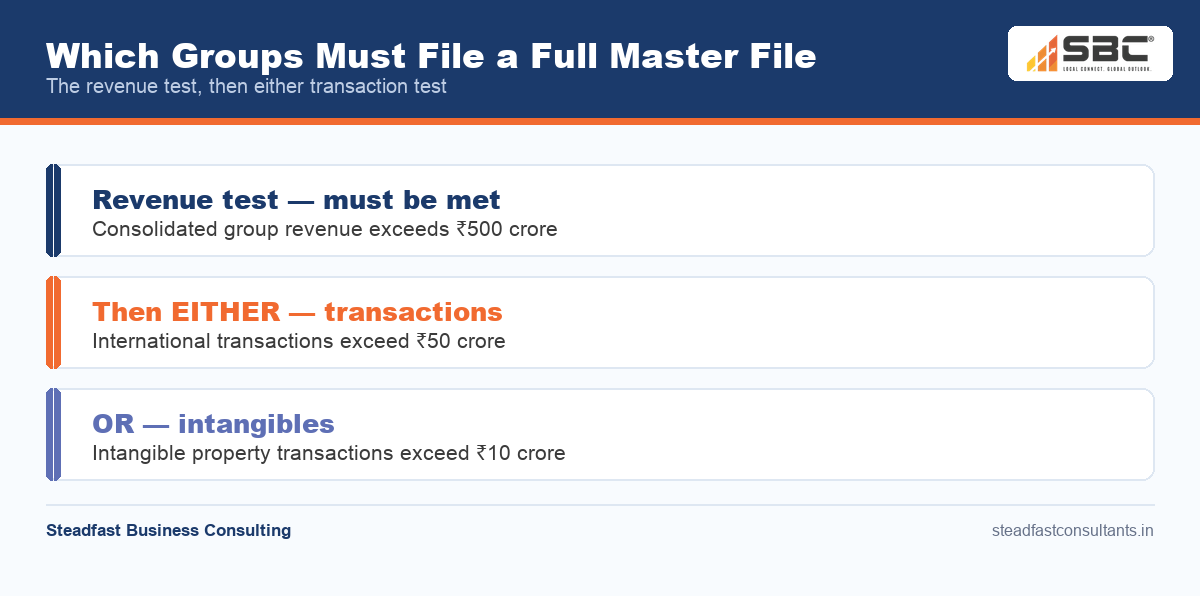
There is a revenue test, and one of the two transaction tests must also be satisfied, so a group with ₹4,000 crore of revenue whose Indian subsidiary pays ₹12 crore in royalties meets the intangibles limb even though its international transactions fall well below ₹50 crore, and that combination is the single most common misunderstanding among finance teams.
What information must the Master File contain?
Five heads, all of them group-level, none of them answered entity by entity the way a Local File would be, because the filing describes how an international group creates and locates value, and an entity-level analysis of the Indian company’s margins does not answer that question.
| Information head | What has to be furnished |
|---|---|
| Group structure | Legal and ownership structure, with the location of every constituent entity |
| Business description | Profit drivers, service arrangements, principal markets, restructurings in the year |
| Intangibles | Intangibles strategy, material intangibles and their legal owners, research and development arrangements |
| Intra-group financing | How the group is financed, the central financing entities, the policy on loans |
| Financial and tax positions | Consolidated financial statements, unilateral advance pricing agreements, and rulings on income allocation |
What must the group structure section show?
Ownership and geography, in a form that reconciles to the accounts. A chart illustrating the legal ownership of the international group and the geographical location of its operating entities is expected, and where the group has restructured during the year the position both before and after the restructuring has to be visible.
How much detail is required on intangibles?
More than most groups expect, because the filing reaches well beyond the summary a parent ordinarily prepares for its own board. Expect the filing to ask for the group’s overall strategy for the development, ownership and exploitation of intangibles, together with a list of the material intangibles, their legal owners, and the important agreements relating to intangible property.
This is the head that most often exposes a gap, because legal ownership of a trademark or a patent frequently sits in one jurisdiction while the development functions that created it sit in another, and a filing that records the first without ever explaining the second invites precisely the enquiry that a group would most prefer to avoid.
What has to be disclosed about intra-group financing?
Financing architecture, rather than the terms of any single loan. What the filing asks is how the international group is financed, including arrangements with unrelated lenders, and it requires the entities performing a central financing function to be named.
Groups that operate a treasury company find this head straightforward, and groups that do not usually find it revealing, since the general policy on intra-group financing has to be stated in terms consistent with the inter-company agreements already executed, and a contradiction between the two is not a small problem.
Which financial and tax positions must be reported?
The consolidated accounts and the rulings the group holds. Consolidated financial statements for the year are required, with a description of existing unilateral advance pricing agreements. Those rulings record positions already taken on the allocation of income, and the narrative is expected to match them.
When is the Master File due?
On the due date for furnishing the return of income. The departmental guidance on the forms notified under the Income-tax Rules 2026 places the Master File filing on the same date as the return of income specified under section 263(1)(c) for the relevant tax year.
That distinction matters, because the accountant’s report falls due at least one month before the return of income, whereas the Master File itself is submitted with the return, as Steadfast Business Consulting (SBC) sets out in a separate note on the move from Form 3CEB to Form 48.
| Filing | Timing |
|---|---|
| Intimation designating one constituent entity | at least thirty days before the Master File due date |
| Part A, where the entity is below the thresholds | due date for the return under section 263(1)(c) |
| Part A and Part B, where the entity is above them | due date for the return under section 263(1)(c) |
How does a group designate one entity to file?
By intimation, filed first, so that the department knows which entity carries the obligation before the Master File itself arrives. Where an international group has more than one constituent entity resident in India, Rule 123(4) permits the group to designate a single entity to furnish the filing for all of them, and that designation is communicated through a separate intimation.
That intimation has to be furnished at least thirty days before the Master File due date, which means the decision cannot wait until the return is finalised. Groups with several Indian entities routinely lose that window.
Why does a copy-paste Master File fail scrutiny?
Because it is read against everything else the group has already said. The Master File is not assessed in isolation, and a narrative lifted unchanged from a foreign parent’s pack will describe functions and risks in terms drafted for another jurisdiction.
What does an assessing officer compare it against?
Every other document describing the same arrangement. The accountant’s report, the Local File documentation maintained under section 171 read with Rule 84, the inter-company agreements and the Country-by-Country report each describe the same arrangements from a different angle. An officer reading them together will notice where the group’s account of itself changes between documents.
By itself, each of the repeated failures is unremarkable, but their combination creates damage. An entity described as a limited-risk distributor in the Local File, while the Master File credits that same entity with market development, is the recurring example. So is a material intangible attributed to one owner in the group narrative and to another in the contract.
What does a default cost?
Enough to make the filing worth doing properly. Failure to keep and maintain the prescribed information and documents attracts a penalty of two per cent of the value of the transaction under section 442 of the Income-tax Act 2025, and failure to furnish information or documents called for under section 171 attracts a further penalty under section 457.
A filing inconsistent with the underlying record leaves the same exposure open, and the position on each default is set out in transfer pricing penalties.
Best transfer pricing firms for Master File and CbCR compliance
One that can draft the group narrative and defend it afterwards. Global network firms, established domestic practices and specialist boutiques divide the market, and firms such as Deloitte, EY, Grant Thornton, BDO, Nangia and Dhruva work in this space.
No firm is best in the abstract, and the useful questions are a good deal narrower than the marketing: whether the team has drafted a Master File from a foreign parent’s source material rather than merely translated one, whether it has defended that narrative before a Transfer Pricing Officer, and whether it reads the group’s agreements before it writes. A short guide to choosing a transfer pricing consultant in India sets out what to ask.
SBC was recognised as a Notable Transfer Pricing Firm 2024 by ITR World Tax, and its team works from Hyderabad, Mumbai, Pune and Dubai.
What should a group do before the filing window opens?
Reconcile before drafting, comparing what the group has already filed elsewhere against what the Master File will say. Most of the Master File is a synthesis of material the group holds elsewhere, and the work that decides whether it survives scrutiny happens before it is drafted.
- Confirm consolidated group revenue against the consolidated accounts, not management accounts
- Total the Indian entity’s international transactions and, separately, its intangible-related transactions
- Identify every constituent entity resident in India, including entities acquired during the year
- Decide which entity is designated, and diarise the intimation thirty days before the return due date
If the group narrative in your file was last written by a parent-company team for a different regulator, it is worth a review this year. Ask the SBC transfer pricing team for a Master File readiness review.
Frequently Asked Questions
Is the Master File the same as the Local File?
No. The Master File describes the international group as a whole, including its structure, intangibles and financing. Local File documentation covers the Indian entity’s own international transactions and the benchmarking supporting them, under section 171 read with Rule 84.
Does a group below ₹500 crore in revenue file anything?
Yes. Rule 123(3) requires every resident constituent entity in India to file Part A, whether or not the value thresholds in Rule 123(1) are met. Only the full group narrative in Part B depends on those value thresholds.
Which rule replaced Rule 10DA?
Rule 123 of the Income-tax Rules 2026 replaced Rule 10DA of the Income-tax Rules 1962, and the enabling provision moved from section 92D(4) of the Income-tax Act 1961 to section 171(4) of the Income-tax Act 2025. In substance the obligation carried forward into the new framework without change.
Can two Indian entities of the same group file separately?
Yes, and by default they must. A single filing on behalf of both is permitted only where the group designates one constituent entity under Rule 123(4) and furnishes the prescribed intimation at least thirty days before the due date.
Is the Master File filed in English?
Yes. Filing is electronic, on the income tax portal in the prescribed form, and material drawn from foreign group documentation should be presented in English.
Does filing a Master File reduce transfer pricing scrutiny?
Not by itself. A complete and internally consistent filing removes an easy line of enquiry, but the Transfer Pricing Officer may still examine the arm’s length price of individual transactions under section 165.