
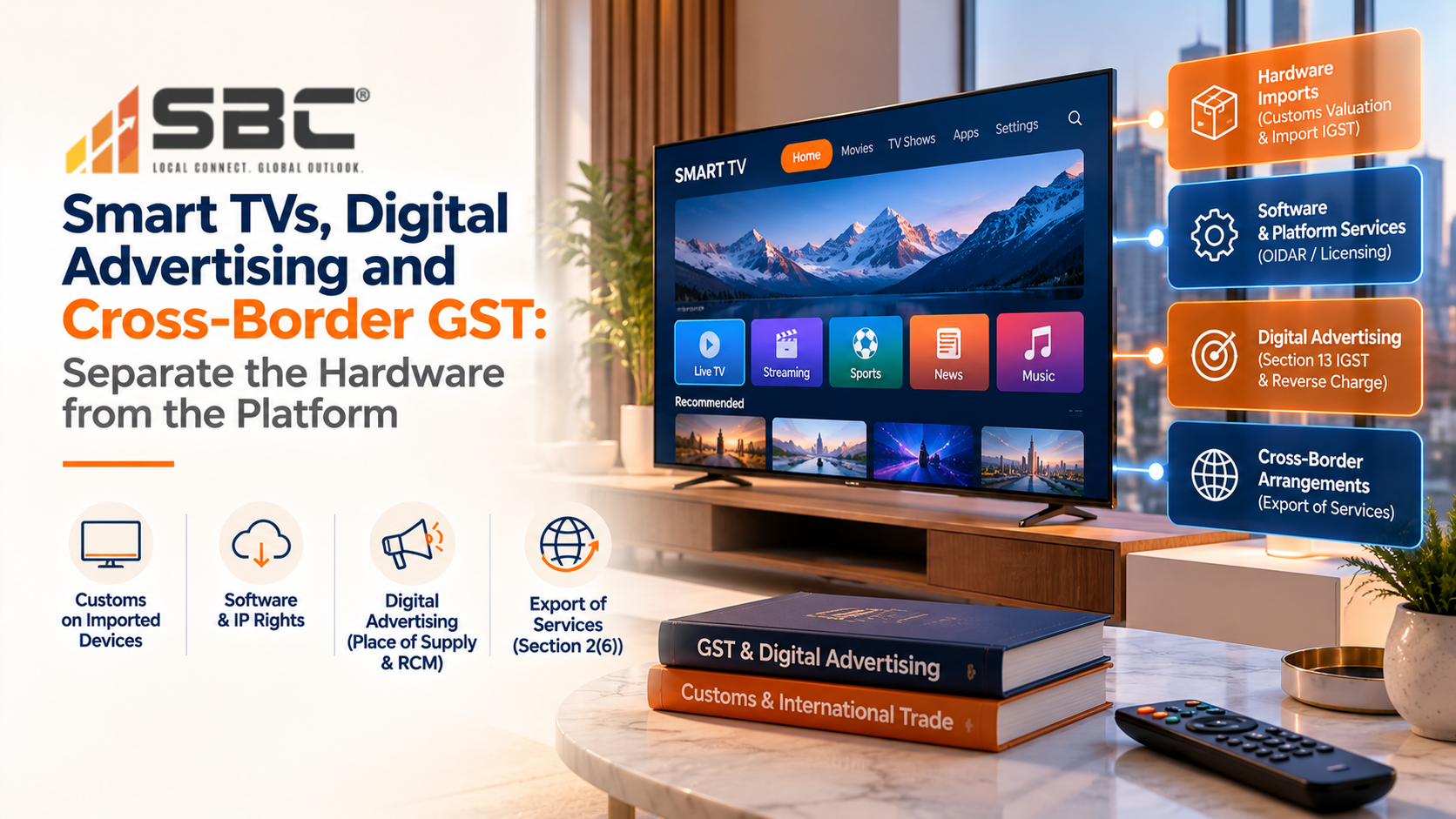
Smart TVs, Digital Advertising and Cross-Border GST: Separate the Hardware from the Platform
By CA Mithilesh Reddy, Founder and CEO, and CA Rupesh Reddy, Steadfast Business Consulting LLP | Indirect Tax Advisory
Quick answer
Draw the goods flow, rights flow, services flow and payment flow separately. Hardware imports are examined under customs and applicable import IGST provisions; cross-border software and advertising arrangements require independent classification, place-of-supply and recipient-location analysis. Do not assume that every payment connected to a smart television has the same tax treatment.
Key takeaways
- A connected TV business has several distinct flows (device import, software and IP rights, advertising inventory, campaign services and settlements), and each has its own supplier, recipient, place of supply and tax consequence.
- Customs value of imported devices is the transaction value under section 14 of the Customs Act, 1962; royalties and licence fees are added under Rule 10(1)(c) of the Customs Valuation Rules, 2007 only if they relate to the imported goods and are paid as a condition of their sale.
- Advertising services supplied across the border follow the recipient-location rule in section 13(2) of the IGST Act, and an Indian business buying from a foreign platform generally pays IGST under reverse charge under Notification 10/2017-Integrated Tax (Rate).
- Since 1 October 2023 the definition of online information and database access or retrieval services no longer requires the service to be essentially automated with minimal human intervention, so bespoke digital services need a fresh look.
- From 30 March 2026, omission of section 13(8)(b) of the IGST Act means intermediary status no longer moves the place of supply of cross-border services, though it still affects valuation and earlier periods.
Practice illustration: Separate tax treatment of imported devices and digital-platform revenue
Issue. A cross-border technology arrangement combined imported goods, software rights and digital advertising services.
Approach. The advisory mapped ownership, contracts, goods movements and cash flows separately for customs, GST and income-tax purposes.
Outcome. A tax and compliance architecture was implemented. It was advisory work, not a final customs valuation determination or GST assessment approval.
Practical lesson. Mapping the separate flows precedes classifying them.
This illustration is deliberately generalised and must not be used to identify a taxpayer or matter.
Introduction
A connected television is sold as hardware, but it also sits within a continuing commercial ecosystem. Manufacturers, importers, operating-system owners, advertising platforms, content licensors, measurement providers and distributors may all earn revenue after the device is sold. Tax analysis built solely around the sale of the television misses most of that structure.
The practical problem is that connected-TV businesses do not supply one composite service merely because all revenues depend on the same screen. Import of devices, licensing of software, grant of advertising rights, campaign-management services, data analytics and settlement of revenue shares are capable of having different suppliers, recipients, places of supply and GST consequences.
This article sets out a transaction-first framework for mapping that ecosystem. It concentrates on the drafting and evidence choices required before agreements are executed, when the group can still separate the commercial rights clearly.
1. Begin with four maps, not an organisation chart
An ownership diagram shows which group company holds an entity, but not who supplies hardware, licensed rights or advertising inventory. Prepare four maps: physical movement of devices; ownership and use of operating-system or content IP; performance of advertising and analytics services; and payment and settlement routes.
The maps should identify each legal counterparty, contract, invoice, source of income and responsibility for performance. Tax positions that are correct under one flow can fail if the invoices and agreements implement a different flow.
2. Importation of television hardware
Customs value, applicable classification, import duties and import IGST depend on the goods actually imported and the relevant customs rules. Whether embedded software, licences or associated consideration must be examined for customs valuation is a fact- and instrument-specific question.
Do not add all subsequent platform revenue to imported-goods value, nor presume that no rights payment can ever be relevant. The contractual condition of sale, commercial relationship and valuation rules must be analysed using the import documentation and rights agreements.
3. Who supplies the advertising inventory?
An advertising group may sell ad slots on a connected-TV home screen, provide campaign placement services, supply analytics or merely arrange transactions between a brand and an overseas platform owner. Each structure affects the supplier and recipient determination under GST.
If an Indian company buys and resells advertising inventory on its own account, that differs from arranging an advertisement supplied by a foreign principal. The intermediary versus principal distinction should be established from contract rights, price-setting power and obligation to deliver the advertising. For supplies on or after 30 March 2026 the distinction no longer changes the place of supply of a cross-border service, because section 13(8)(b) of the IGST Act has been omitted by the Finance Act 2026, but it still matters for earlier periods and for the value on which tax is charged.
4. Digital services and OIDAR are not universal labels
Online information and database access or retrieval services are subject to specific definitions and rules. The fact that a service is delivered over the internet does not automatically bring every advertising, development, management or creative service into that category.
Identify whether the service is delivered over the internet or an electronic network and could not be supplied without information technology, who receives it, and whether a specific location or registration provision applies. Since 1 October 2023 the definition no longer requires the service to be essentially automated with minimal human intervention, and any unregistered recipient in India is a non-taxable online recipient. Digital advertising campaigns that include material bespoke work may require a more nuanced classification than standard platform access.
5. Place of supply should follow the actual contract
For cross-border services, section 13 of the IGST Act applies where the supplier or the recipient is outside India: the general rule in section 13(2) places the supply at the recipient’s location, and the exceptions (performance-based services, immovable property, events, online information and database access) sit in the other sub-sections. Where both parties are in India, section 12 applies instead. Depending on the nature of the supply, location of the recipient, physical performance or another statutory factor may be relevant. A foreign invoice address does not, by itself, prove a service is exported.
When a foreign platform charges an Indian entity, determine whether import-of-service conditions and reverse charge obligations are met. Where an Indian supplier bills overseas group companies, independently test all export-of-services conditions, including the recipient’s location and permitted receipt of payment.
6. Software rights and income-tax characterisation should align
GST classification and direct-tax treaty characterisation serve different legal purposes, but the underlying rights must be described consistently. Distinguish access to software or data from transfer of reproduction, adaptation or commercial exploitation rights.
Contracts should define licensed territory, access controls, sublicensing rights, permitted modifications and ownership of user data or advertising analytics. A generic “technology fee” invoice makes it harder to defend the substance in both withholding and indirect-tax reviews.
7. Advertising revenue shares and foreign exchange settlement
Revenue-sharing agreements should identify the original customer transaction, gross consideration, commissions, refunds, taxes, settlement currency and entity entitled to each amount. A revenue share is not necessarily the same as an agency commission or purchase of services.
Where balances are netted among group entities, analyse foreign exchange rules and maintain a reconciliation of settlement. Transfer pricing should also reflect which party controls monetisation, owns valuable platform rights and assumes advertising fill-rate or customer risk.
8. Input tax credit and allocation of common costs
An importer or domestic seller of devices may have credit on import IGST, logistics and other business inputs, subject to GST conditions. Platform-related services may support taxable, zero-rated, exempt or mixed activities. Eligibility and apportionment cannot be decided without examining the actual output supplies.
Maintain cost centres separating hardware, platform licences, domestic advertising, overseas supplies and shared overheads. An ERP mapped exclusively to hardware turnover can distort the input credit allocation for an increasingly service-driven business.
9. Build a contract pack that is tax-complete
Before commercial launch, review the purchase and distribution agreements, OS or IP licences, advertising inventory terms, revenue-share schedules, campaign-management agreements, data-processing clauses and settlement mechanisms as one package.
A practical sign-off matrix should record the supplier, recipient, description, location, GST treatment, import treatment if relevant, direct-tax withholding, TP policy, invoice owner and evidence needed. Changes to rights and funds flows should trigger an update to the matrix instead of a unilateral invoicing workaround.
Customs valuation of imported televisions and embedded software: the tests to run
For imported goods the value for customs duty is the transaction value under section 14(1) of the Customs Act, 1962, determined under the Customs Valuation (Determination of Value of Imported Goods) Rules, 2007. Where buyer and seller are related, Rule 3(3) allows the declared price to be accepted if the relationship did not influence it, or if the price closely approximates a test value, so a group importer should keep its transfer pricing evidence and its customs evidence side by side and make sure they tell the same story.
Payments outside the invoice price are added only on the tests in Rule 10(1). A royalty or licence fee is added under Rule 10(1)(c) if it relates to the goods being valued and the buyer must pay it, directly or indirectly, as a condition of the sale of those goods. Rule 10(1)(e) similarly reaches other payments made as a condition of sale. A fee for the operating system loaded on the device at import may therefore be addable if the importer cannot buy the television without taking the licence. A fee for platform rights used only after import, such as hosting an advertising marketplace in India, is not automatically addable. The Supreme Court’s decision in Commissioner of Customs v Ferodo India, decided under the corresponding 1988 Rules, illustrates the approach: royalties tied to manufacture in India rather than to the imported goods were not added to assessable value.
Where televisions arrive as unassembled or semi-assembled kits, classification follows the General Rules for the Interpretation of the Customs Tariff, under which a heading extends to an incomplete or unassembled article that has the essential character of the complete article. The valuation file should show what software is loaded at import, what is downloaded later, and which agreement governs each.
Advertising services: supplier, recipient and place of supply
Three fact patterns recur. In the first, an overseas platform owner sells advertising inventory to an Indian brand or agency. Under section 13(2) of the IGST Act the place of supply is the recipient’s location in India. A registered Indian recipient pays IGST under reverse charge under Notification 10/2017-Integrated Tax (Rate) and may claim credit subject to section 16 of the CGST Act. If the service is online information and database access or retrieval and the Indian buyer is unregistered, the overseas supplier itself must register and pay tax under section 14.
In the second, an Indian company sells campaign management or advertising space to an overseas group company. The place of supply is the recipient’s location outside India, but zero rating needs every condition in section 2(6): supplier in India, recipient outside India, place of supply outside India, payment in convertible foreign exchange (or in rupees where the Reserve Bank permits), and supplier and recipient not merely establishments of a distinct person. Settlement through netting or a third group entity is where this most often fails.
In the third, an Indian entity arranges transactions between an advertiser and a foreign platform for a commission. For periods before 30 March 2026 the section 2(13) intermediary test, read with Circular 159/15/2021-GST, decided whether the place of supply was the supplier’s location. Section 13(8)(b) has since been omitted by the Finance Act 2026, so the recipient-location rule applies either way, but the characterisation still decides whether the taxable value is the gross price of the advertising or the commission earned.
A launch checklist for a connected-TV group
Before launch, assemble one file that follows each flow from contract to invoice to payment. For the goods flow, keep the supply and distribution agreements, the commercial invoices, the licence agreements for any embedded software and a short note on classification and valuation. For the rights flow, keep the operating system and content licences with the territory, sublicensing and data ownership terms. For the services flow, keep insertion orders, rate cards and campaign reports showing who contracted with the advertiser and who delivered the advertising. For the payment flow, keep the settlement statements, bank advices and any netting reconciliation.
Then add a sign-off matrix recording, for each contract, the supplier, recipient and their locations, the GST and customs treatment, the withholding position and the evidence held. Re-run the matrix whenever rights or funds flows change, and when the law changes, as it did for intermediary services in March 2026 and for online information and database access services in October 2023.
Conclusion
The complexity of a connected-TV business lies less in the technology than in the number of distinct rights and services monetised through the same device. It is a mistake to tax the whole ecosystem as though it were a single television transaction.
A clear transaction map allows customs, GST, income-tax withholding and transfer pricing analyses to follow the same commercial facts, even where their legal consequences differ. That is a more durable foundation than attempting to repair the tax position after the platform is operational.
Frequently asked questions
1. Are all revenue streams from a smart television sales of goods?
No. Rights and services supplied after device sale may be separate transactions.
2. Is all digital advertising automatically OIDAR?
No. The statutory definition and actual service model must be applied.
3. Does an overseas invoicing entity automatically make the supply an export?
No. The statutory export-of-services conditions must all be examined.
4. Can software licence payments affect customs valuation?
They may in particular circumstances. The rights, condition-of-sale terms and valuation law require review.
5. Why should GST and transfer pricing teams coordinate?
They should describe the same functions, rights and risks even though the valuation and tax rules differ.
6. Is GST payable on advertising services bought by an Indian company from an overseas platform?
Yes, usually. The place of supply is the Indian recipient’s location under section 13(2) of the IGST Act, and a registered Indian recipient pays IGST under reverse charge under Notification 10/2017-Integrated Tax (Rate). Credit can be claimed if the advertising is used for business and section 16 of the CGST Act is satisfied.
7. What is the place of supply for advertising services an Indian company provides to an overseas group company?
The IGST Act has no separate rule for advertising, so section 13(2) places the supply at the recipient’s location. If that is outside India, the supply is an export of services only if all conditions in section 2(6) are met, including payment in convertible foreign exchange and the parties not being merely establishments of a distinct person.
8. Is a software licence fee added to the customs value of imported televisions?
Only if it meets Rule 10(1)(c) of the Customs Valuation Rules, 2007: the royalty or licence fee must relate to the imported goods and be payable by the buyer, directly or indirectly, as a condition of their sale. Payments for rights used after import, unconnected with the sale of the goods, are not automatically added.
9. Does the omission of section 13(8)(b) matter for advertising agencies acting as intermediaries?
Yes. Section 157 of the Finance Act 2026 omitted section 13(8)(b) of the IGST Act, so cross-border intermediary services follow the recipient-location rule in section 13(2). Commentary reads this as effective from 30 March 2026. Intermediary status still affects valuation, and earlier periods remain governed by the old rule.
Talk to SBC’s tax team
If you are planning a connected-TV launch or reviewing an existing platform structure, our indirect tax team can help map each flow to its customs, GST and withholding treatment before contracts are finalised. Explore our GST services | Contact SBC
Related reading from SBC
- Intermediary or Principal? How Section 2(13) IGST Decides Zero Rating of Service Exports
- Digital Platforms and India Tax Once the Equalisation Levy Is Gone: SEP, Treaty and PE Compared
- Defending the Residual Profit Split Method in India When the TPO Proposes TNMM for an Intangible-Owning Entity
- More articles on the SBC blog
About the author
CA Mithilesh Reddy, Founder and CEO, Steadfast Business Consulting LLP, led the team that handled this engagement.
CA Rupesh Reddy, Steadfast Business Consulting LLP. SBC provides direct and indirect tax, international tax and transfer pricing advisory and dispute support.
Disclaimer
This article is general professional commentary and not advice on any particular facts. Treaty eligibility, applicable law, procedural requirements and statutory amendments must be verified for the relevant tax period. It is not a description of an identifiable client engagement.