
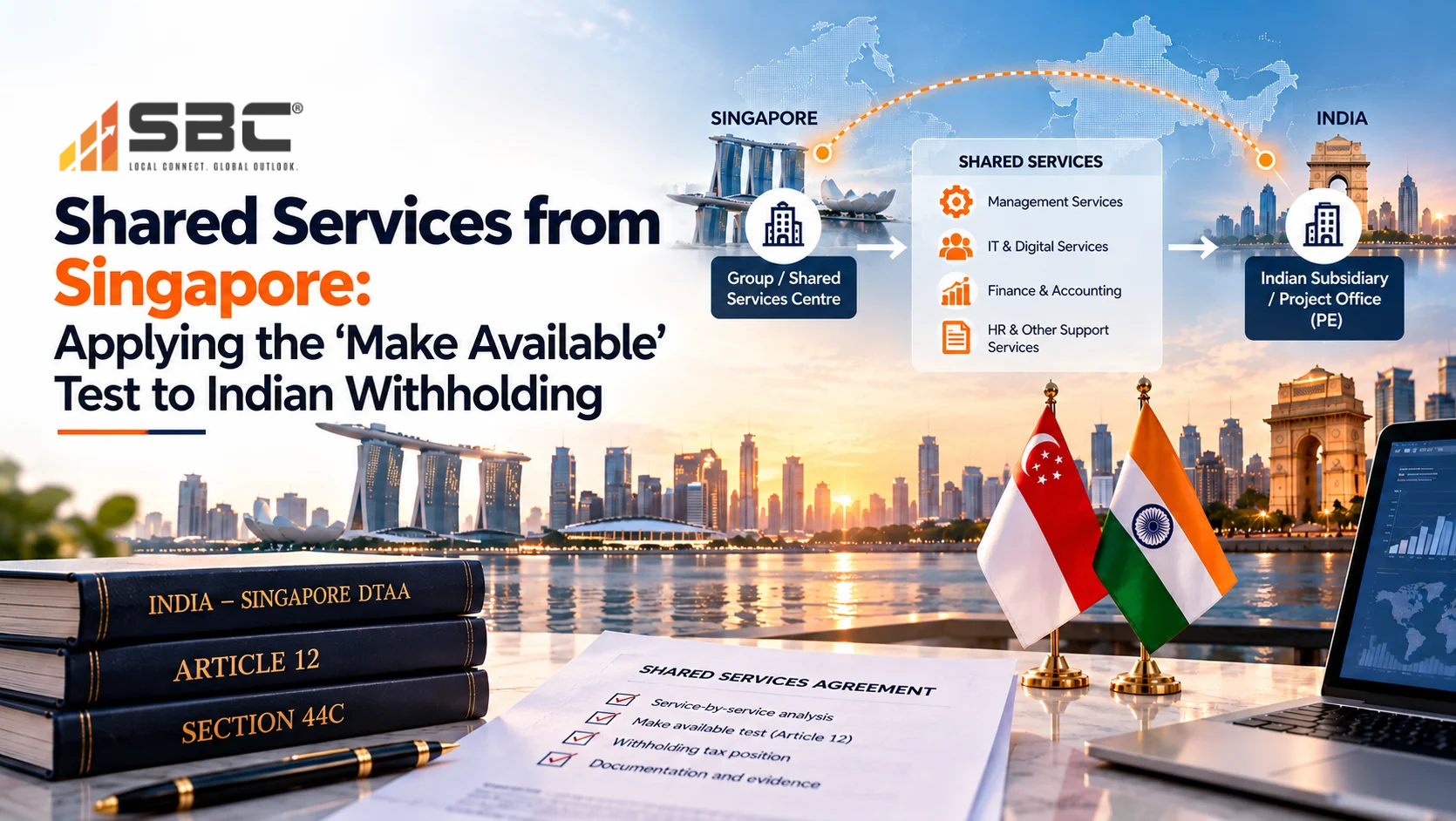
Shared Services from Singapore: Applying the ‘Make Available’ Test to Indian Withholding
By CA Mithilesh Reddy, Founder and CEO, and CA Rajesh Vaishnav, Partner, Steadfast Business Consulting LLP | Direct Tax Advisory
Quick answer
Under Article 12(4) of the India–Singapore treaty, a shared service is taxable in India as a fee for technical services only if it meets one of three limbs. Under limb (b), it must make technical knowledge or processes available so the Indian recipient can apply them independently. Each category is tested separately before any fee is treated as business profits.
Key takeaways
- Article 12(4) of the India-Singapore treaty defines fees for technical services through three alternative limbs; the ‘make available’ enabling condition governs limbs (b) and (c) but not limb (a).
- The test is applied service by service, so one shared services agreement can contain both business profits and fees for technical services.
- A deliverable such as a report or recommendation is the output of the provider’s expertise and does not by itself make knowledge available; retained manuals and process frameworks that the recipient can run unaided are the clearest case that does.
- Where Article 12 applies, the source-State tax is capped at 10 per cent of the gross amount for a beneficial owner (Article 12(2), as substituted by the 2005 Protocol); treaty entitlement also needs a tax residency certificate and Form 10F, which Form 41 succeeds under the Income-tax Act, 2025.
- A segregated withholding position is defensible only if the record exists: a service schedule, category-wise invoices, retained deliverables and a characterisation note that matches the Form 3CEB description.
Practice illustration: Treaty characterisation of bundled group services
Issue. An Indian company was charged for several kinds of group support under an aggregate service arrangement.
Approach. The review identified the actual deliverables of each service and distinguished the applicable limbs of Article 12(4) of the India–Singapore treaty, taking into account withholding and documentation.
Outcome. The assignment produced a documented advisory framework and withholding options. No assessment order, tax ruling or judicial approval of the suggested allocation is claimed.
Practical lesson. Where several services are billed together, the records must support any service-by-service distinction.
This illustration is deliberately generalised and must not be used to identify a taxpayer or matter.
Introduction
Most tax treaties India has entered into since the 1990s qualify the definition of fees for technical services with a condition borrowed from the United States model: the service must make something available to the recipient. The condition exists because the drafters distinguished between buying expertise and acquiring it. A payment for the first is a payment for a service and belongs to the provider’s business profits. A payment for the second is closer to a payment for knowledge, and the source State is given a limited right to tax it.
Where that condition applies, it governs the withholding treatment of most regional shared services arrangements into India. It is also routinely applied as though it were a question about the whole agreement, when it is a question about each service. A regional headquarters supplying several categories of support will frequently find that six fall outside the definition and one falls inside, and the correct answer is not a single rate applied to the whole invoice.
This note deals with how that condition applies to an intra group shared services arrangement, where a regional headquarters supplies several distinct categories of support to an Indian subsidiary under a single agreement and a single fee. It covers the treaty text and its three limbs, the exclusions that are frequently overlooked, a service by service framework, the two withholding approaches available and what each requires by way of evidence, the gross up problem, and the transfer pricing analysis that has to agree with whatever conclusion is reached. Where the treaty contains no technical services article at all, a different analysis applies, and that is dealt with in our note on treaties with no fees for technical services article.
1. The treaty text
Article 12(4) of the India Singapore agreement defines fees for technical services as payments of any kind to any person in consideration for services of a managerial, technical or consultancy nature, including the provision of such services through technical or other personnel, if such services:
(a) are ancillary and subsidiary to the application or enjoyment of the right, property or information for which a payment described in paragraph 3 is received; or
(b) make available technical knowledge, experience, skill, know-how or processes, which enables the person acquiring the services to apply the technology contained therein; or
(c) consist of the development and transfer of a technical plan or technical design, but excludes any service that does not enable the person acquiring the service to apply the technology contained therein.
Two drafting features carry most of the weight, and the second is frequently misread.
The limbs are disjunctive, so a service caught by any one of them is within the definition. It follows that the enabling condition is not a gateway through which every payment must pass. It governs limbs (b) and (c), where it appears expressly and, in limb (c), again as an exclusion. Limb (a) contains no enabling requirement at all. A service that is ancillary and subsidiary to the application or enjoyment of a right, property or information for which a royalty under paragraph 3 is paid is within the definition whether or not anything is made available. Where a group licenses technology and also supplies support in relation to it, limb (a) has to be tested first, and a conclusion that nothing was made available does not answer it.
Article 12(2), as substituted by the 2005 Protocol, caps the source state rate at ten per cent of the gross amount where the recipient is the beneficial owner.
2. The exclusions in Article 12(5), which are frequently overlooked
Article 12(5) removes a list of payments from the definition notwithstanding Article 12(4). The exclusions cover payments for services ancillary and subsidiary, and inextricably and essentially linked, to a sale of property; services ancillary and subsidiary to the rental of ships, aircraft, containers or other equipment used in international traffic; teaching in or by educational institutions; services for the personal use of the individual making the payment; payments to an employee of the payer, or to an individual or firm of individuals other than a company for professional services as defined in Article 14; services connected with an installation or structure used for exploration or exploitation of natural resources; and services referred to in paragraphs 4 and 5 of Article 5.
The exclusion for payments to an individual or a firm of individuals for professional services is worth noting in any arrangement where part of the support is delivered by a professional firm rather than by the group entity. So is the sale related exclusion, where support services accompany a supply of goods.
3. What “make available” actually requires
The test is not whether the service is technical. It is not whether the recipient benefits. It is not whether the recipient’s staff learn something incidentally. The question is whether, after the engagement, the recipient is equipped to apply the technology or process itself, without recourse to the provider.
Three propositions follow, and each is contested often enough to be worth stating.
Recurrence is evidence but it is not proof. Where the same service is bought year after year, that is consistent with nothing having been transferred, and it is a useful fact to put forward. It is not conclusive, because a recipient may acquire a capability and still choose to outsource its exercise for commercial reasons.
A deliverable is not itself a transfer of capability. A report, a recommendation, a signed off control assessment or a market analysis is the product of the provider’s expertise, and handing it over transfers the output rather than the method that produced it.
Training is the difficult category. A structured programme that teaches a methodology, supported by manuals, templates and process documentation which the recipient retains and uses afterwards, is the clearest case of a service that does make available. An induction briefing, or an update session on a change of policy, is not. Between those two the answer turns on whether the recipient keeps and uses the materials and can run the process unaided afterwards.
4. A service by service framework
The analysis has to be conducted category by category. The following reflects how a typical regional support arrangement resolves, and the reasoning is more important than the conclusion, because the conclusion depends on how the particular service is actually delivered.
| Service category | Typical analysis | Indicative characterisation |
|---|---|---|
| Strategic management oversight | Board level direction and review. The provider exercises judgment on behalf of the group; no methodology passes to the Indian entity. | Business profits |
| Treasury and liquidity advisory | The provider runs the analysis and recommends a position. The Indian entity acts on the recommendation but cannot replicate the modelling. | Business profits |
| Human resources strategy and leadership development | Coaching and advisory delivered to individuals. Capability accrues to the person, not to the entity as a transferable process. | Business profits |
| Legal and compliance advisory | Advice on specific questions. The answer is supplied; the ability to answer the next question is not. | Business profits |
| Internal audit and risk assurance | An assurance opinion on the recipient’s processes. The output is the assurance, and the audit methodology stays with the provider. | Business profits |
| Sustainability and corporate responsibility reporting support | Assistance in preparing a report to a framework the recipient does not own. | Business profits |
| Internal control and compliance training programmes | Where structured training is delivered with retained manuals, control matrices and documented process frameworks the recipient then operates itself, the enabling condition is met. | Fees for technical services, in whole or part |
The point of the table is not the labels. It is that a single arrangement can straddle the line, and that the characterisation of each category follows from how the service is delivered and what the recipient is left holding.
5. Two withholding approaches, and how to choose
Once the analysis is done, the group has a decision to make, and it is a decision about risk appetite and documentation capability rather than about law.
The conservative approach applies the treaty rate to the whole of the service fee. It is simple, it is certain, and it costs money on the services that are not fees for technical services. Where the recipient is entitled to credit in its own jurisdiction the cost may be partly recovered, but where the contract requires the Indian entity to bear the tax, the cost is real and falls on India.
The segregated approach applies withholding only to the categories that satisfy the enabling condition. It reflects the correct legal position and it is defensible, but only if the supporting record exists. That record is specific.
- A service schedule in the agreement that describes each category separately, with its own scope and its own deliverables.
- Invoices that bill each category separately rather than as a single monthly support fee.
- Time records or an allocation basis that ties cost to category.
- Deliverables retained and filed, so that the nature of what was supplied can be shown rather than asserted.
- For any category treated as fees for technical services, the materials that evidence the transfer, since that category must also be capable of being proved.
- A contemporaneous analysis note recording the characterisation of each category and the reasons for it.
A group that bills a single consolidated support fee and then argues for segregation at assessment stage is in a weak position, because the only evidence of what was supplied is the invoice, and the invoice says “support services”.
6. The gross up problem
Many intra group service agreements require the Indian recipient to bear any withholding tax arising in India. The commercial intention is that the provider receives the agreed fee net. The tax consequence is that the Indian entity funds the tax from its own resources, and the grossed up amount, not the invoice amount, becomes the base.
Two points follow. First, the clause should be read before the first invoice is raised, not after. Where the characterisation analysis shows that most categories are business profits, the gross up exposure is confined to the minority that is not, and the clause can be scoped accordingly. Second, a gross up clause interacts with the transfer pricing position. If the Indian entity bears a cost that an independent party in its position would not bear, the arm’s length character of the arrangement is in question, and the two analyses need to be consistent.
7. The transfer pricing dimension
A shared services arrangement between associated enterprises is an international transaction under section 163 of the Income-tax Act, 2025 (section 92B of the 1961 Act, the meaning of international transaction). It requires arm’s length pricing under section 165 (section 92C, determination of arm’s length price), documentation under section 171 (section 92D, maintenance of information and documents) and the accountant’s report under section 172 (section 92E, the Form 3CEB report).
Three questions arise in sequence and they are often answered out of order. Were the services actually rendered? Did the recipient derive a benefit? Is the charge arm’s length? The first two are evidential and are where most intra group service adjustments are made. A benefit test is not satisfied by a management assertion; it is satisfied by evidence of what was delivered and what the recipient would otherwise have had to do.
Shareholder activity should be identified and excluded at the outset. Costs incurred by the parent in its capacity as shareholder, such as the cost of group consolidation for the parent’s own reporting or investor relations, are not chargeable to the subsidiary at all. A charge that includes them invites an adjustment on a basis that has nothing to do with the mark up.
8. Treaty documentation
Treaty entitlement requires a valid tax residency certificate for the relevant period, Form 10F filed electronically (for tax years under the Income-tax Act, 2025, its successor Form 41, furnished under rule 75 of the Income-tax Rules, 2026 for section 159(8)) with particulars matching the certificate, and a declaration of beneficial ownership and absence of a permanent establishment in India. The permanent establishment question deserves more attention than it usually receives in a shared services context. Where provider personnel spend time in India delivering the services, the service permanent establishment threshold in Article 5 becomes live, and a day count should be maintained for the same reason it is maintained in any cross border service arrangement.
The limitation of benefits provisions of the India Singapore treaty should also be considered, because entitlement under that agreement has historically carried conditions that do not appear in other treaties.
9. A worked example
A Singapore regional headquarters provides seven categories of support to its Indian subsidiary under an agreement effective from the start of a financial year, on a cost plus basis billed monthly. The agreement requires the Indian entity to bear Indian withholding tax. The annual fee is material relative to the Indian entity’s profit.
Step one. Break the fee into the seven categories and establish, for each, what was delivered and what the Indian entity retained. This is done by reading the deliverables, not the agreement.
Step two. Apply the enabling condition to each category. On the facts described above, six categories produce outputs and decisions; one, the structured internal control training with retained manuals and control matrices, transfers a process the Indian entity then operates itself.
Step three. Quantify the two approaches. Under the conservative approach the treaty rate applies to the whole fee and the Indian entity funds it grossed up. Under the segregated approach it applies only to the training category. The difference is the decision the group is actually making.
Step four. Build the record that the segregated approach requires: restructure the invoicing to bill by category, put a service schedule into the agreement, retain deliverables, and prepare a characterisation note before the first payment rather than after the first notice.
Step five. Align the transfer pricing file, excluding shareholder costs, evidencing rendition and benefit, and ensuring the Form 3CEB description of the transaction matches the characterisation adopted for withholding.
10. Where these arrangements are usually weak
First, the agreement describes the services in a single clause. A schedule that lists seven categories with their own scopes is the foundation of the whole position, and it is cheap to draft before execution and impossible to create afterwards.
Second, invoicing is consolidated. A single line for regional support fees makes segregation unprovable whatever the underlying facts.
Third, deliverables are not retained. The reports, control matrices and advice notes that prove what was actually supplied are held by the provider, or by individuals, and cannot be produced three years later.
Fourth, the withholding position and the transfer pricing position are prepared by different teams and do not agree. A transaction described one way in Form 3CEB and another way in the withholding analysis is an invitation.
Fifth, shareholder costs are embedded in the cost pool. This is the most common cause of adjustment in intra group service cases and it is entirely avoidable.
Sixth, no day count is kept for provider personnel visiting India. A service permanent establishment finding would displace the entire analysis, because the income would then be attributable to a permanent establishment and taxable on a net basis under Article 7 regardless of characterisation.
11. A review checklist
- Read the current text of the applicable treaty, including protocols and the synthesised text, and confirm the wording of the technical services article.
- List every service category actually supplied, from the deliverables rather than from the agreement.
- For each, record what the recipient was left holding and whether it can now perform the activity unaided.
- Check each category against the exclusions in Article 12(5) before concluding.
- Decide between the conservative and segregated approaches, and record the reasons.
- If segregating, restructure the agreement schedule and the invoicing before the next payment cycle.
- Identify and remove shareholder activity costs from the pool.
- Evidence rendition and benefit for the transfer pricing file.
- Reconcile the withholding characterisation with the Form 3CEB description.
- Maintain a day count for provider personnel present in India and monitor it against the treaty threshold.
- Confirm the residency certificate, Form 10F and beneficial ownership declaration for each year.
- Model the gross up exposure under each approach and confirm the commercial terms reflect the intended allocation.
Practitioner’s perspective
The enabling condition is one of the more taxpayer favourable provisions in India’s treaty network, and it is frequently under used because groups apply a single rate to the whole arrangement for administrative convenience. The convenience is real, and for a small arrangement it may be the right answer. For a material arrangement it is an avoidable cost.
What determines whether the better answer is available is almost entirely a documentation question, and it is decided at contracting stage. A service schedule, category level invoicing and retained deliverables cost very little to put in place at the start of an arrangement and cannot be created once a notice has issued. In our experience the groups that defend a segregated position successfully are not the ones with the better legal argument. They are the ones whose invoices show what was supplied.
One further point. The analysis should be revisited when the arrangement changes. A category that was advisory when the arrangement began may evolve into something that transfers a methodology, and a characterisation note prepared three years ago and never revisited is a liability rather than a protection.
Treaty status check: protocols, the MLI and anti-abuse rules
The wording of Article 12(4) that this article relies on has not been changed by the Multilateral Instrument. The MLI does not rewrite the definition of fees for technical services. What it adds to the India-Singapore treaty, as a covered tax agreement, is the principal purpose test: treaty benefit can be denied where obtaining it was one of the principal purposes of an arrangement. CBDT Circular No. 1/2025 dated 21 January 2025 explains that the test operates prospectively from the date it takes effect in each treaty, and notes that the Singapore treaty’s own limitation of benefits clause (Article 24A) continues to apply.
The 10 per cent cap in Article 12(2) comes from the Protocol that entered into force on 1 August 2005 and was notified by Notification No. 185/2005 dated 18 July 2005. Before relying on any characterisation, read the current consolidated treaty text on incometaxindia.gov.in, including all protocols, and confirm that no later instrument has altered Article 12 or Article 5.
For a Singapore provider that is a genuine regional headquarters, the entitlement documents (tax residency certificate, Form 10F or Form 41, and a beneficial ownership declaration) are best accompanied by evidence of substance in Singapore: personnel, premises and expenditure. That evidence answers both the limitation of benefits clause and the principal purpose test.
Service permanent establishment: when provider staff visit India
A characterisation of fees as business profits holds only while the provider has no permanent establishment in India. On the published treaty text, Article 5 contains a service PE rule for services furnished through employees or other personnel, with a threshold of more than 90 days in a fiscal year and a shorter threshold of more than 30 days where the services are performed for a related enterprise. Because shared services are by definition supplied to a group company, the shorter threshold is the one to test first.
Keep a day count by individual and by assignment for every provider employee who works in India, including workshops, training sessions and audit visits. If a permanent establishment exists, the income attributable to it is taxed on a net basis under Article 7 and the fees for technical services analysis under Article 12 gives way, because Article 12(6) disapplies Articles 12(1) and 12(2) where the right or contract is effectively connected with the permanent establishment.
Frequently asked questions
1. What does “make available” mean in the India Singapore treaty?
Article 12(4)(b) requires that the service make available technical knowledge, experience, skill, know-how or processes which enables the person acquiring the services to apply the technology contained therein. The recipient must be left able to apply the technology itself, not merely to benefit from the provider having applied it. The condition governs limbs (b) and (c); limb (a) has no such requirement.
2. Is a technical service automatically fees for technical services?
No. The service must be managerial, technical or consultancy in nature and must satisfy one of the three limbs of Article 12(4). A highly technical service that leaves the recipient no more capable than before does not satisfy limb (b). It may still fall within limb (a) if it is ancillary and subsidiary to the enjoyment of a right or information for which a royalty is paid, so limb (a) must be tested separately.
3. Does repeated purchase of the same service prove nothing was made available?
It is good evidence but not conclusive. A recipient may have acquired a capability and still choose to outsource its exercise for commercial reasons. Recurrence should be presented alongside evidence of what was actually delivered.
4. Can one agreement contain both categories?
Yes, and that is the normal case in a regional support arrangement. The analysis is conducted service by service, and it is entirely consistent for most categories to be business profits and one to be fees for technical services.
5. What rate applies where the condition is satisfied?
Article 12(2), as substituted by the 2005 Protocol, caps the source state rate at ten per cent of the gross amount where the recipient is the beneficial owner. Where treaty benefit is not available, the domestic rate applies under section 207 of the 2025 Act (section 115A, the special rate on royalty and fees for technical services in the hands of non-residents).
6. What documentation does a segregated withholding approach require?
A service schedule describing each category separately, invoices raised by category, time or allocation records tying cost to category, retained deliverables, and a contemporaneous note recording the characterisation of each category and the reasons for it.
7. Who bears the tax where the agreement contains a gross up clause?
The Indian entity, from its own resources, and the grossed up amount becomes the base. The clause should be reviewed before the first invoice, and its effect should be consistent with the transfer pricing position.
8. What exclusions apply under Article 12(5)?
Among others, payments for services inextricably linked to a sale of property, for teaching by educational institutions, to an individual or firm of individuals other than a company for professional services as defined in Article 14, and for services connected with an installation used for exploration or exploitation of natural resources.
9. Does the arrangement create a permanent establishment risk?
It can. Where provider personnel are present in India delivering the services, the service permanent establishment threshold in Article 5 becomes relevant. A finding of a permanent establishment would displace the characterisation analysis entirely, because the income would be taxable on a net basis under Article 7.
10. How does the withholding analysis interact with transfer pricing?
The arrangement is an international transaction under section 163 (section 92B) requiring arm’s length pricing, documentation and Form 3CEB reporting. The description of the transaction in the transfer pricing file should match the characterisation adopted for withholding, and shareholder activity costs should be excluded from the charge altogether.
11. Does the MLI change the make available condition in the India-Singapore tax treaty?
No. The Multilateral Instrument does not change the definition of fees for technical services in Article 12(4). It adds the principal purpose test to the India-Singapore treaty, which can deny treaty benefit for arrangements whose principal purposes include obtaining it. The treaty’s own limitation of benefits clause continues to apply alongside it, as CBDT Circular No. 1/2025 notes.
12. Are management fees paid to a Singapore parent taxable in India as fees for technical services?
Not automatically. They are taxable as fees for technical services only if the services fall within a limb of Article 12(4), and for managerial services that usually means the make available test. In Tagit Pte. Ltd. v. Dy. CIT, the Delhi Tribunal held management fees were not fees for technical services where make available was not shown. Each case turns on its facts.
13. What documents are needed to claim India-Singapore treaty relief on service fees paid from India?
The Singapore recipient needs a tax residency certificate for the relevant period and Form 10F, which Form 41 replaces for tax years under the Income-tax Act, 2025 (rule 75 of the Income-tax Rules, 2026). A beneficial ownership declaration and a no-permanent-establishment confirmation are usual practice, and the limitation of benefits clause should be checked.
Talk to SBC’s tax team
If your group is reviewing how regional shared services fees are characterised, invoiced and documented for Indian withholding and transfer pricing, SBC’s team can walk through the analysis and the records it requires. Explore our Income Tax services | Contact SBC
Related reading from SBC
- No FTS Article in the India-UAE Treaty: How Offshore Engineering Income Is Taxed in India
- Parent Guarantee of an Indian Subsidiary: How Transfer Pricing, Withholding and GST Fit Together
- Seconding Staff Between India and the UK: Employer, Permanent Establishment and Payroll Tax Are Different Questions
- Digital Platforms and India Tax Once the Equalisation Levy Is Gone: SEP, Treaty and PE Compared
- More articles on the SBC blog
About the author
CA Mithilesh Reddy, Founder and CEO, Steadfast Business Consulting LLP, led the team that handled this engagement.
CA Rajesh Vaishnav is a Partner at Steadfast Business Consulting LLP. SBC provides direct and indirect tax, international tax and transfer pricing advisory and dispute support.
Disclaimer
This article is for general information and does not constitute professional advice. It reflects the law as understood at the date of publication and does not take account of later developments. Statutory references give the Income-tax Act, 2025 section with the Income-tax Act, 1961 section in brackets; section 536 preserves the 1961 Act for proceedings pending on 31 March 2026 and for earlier tax years. Treaty positions turn on the specific facts, the contractual documentation and the current text of the applicable agreement. No reader should act on the basis of this article without taking advice on their own circumstances.